1920 Quarter Error List with Pictures

One 1920 quarter was made from copper-nickel intended for Peru’s twenty-centavo coin. The unusual piece sold for $16,100 in March 2011.
Other 1920 quarter errors leave smaller clues: a straight edge, an extra letter near Liberty’s knee, or a lump touching the date. Estimated whole-coin values in this guide range from $30–$30,000.
Follow the individual checks below to learn which features matter and how to distinguish them from damage.
1. 1920 Standing Liberty Quarter Reverse Lamination
Peeling metal on the eagle side is reported on a Philadelphia 1920 quarter. The rough area comes from a weakness within the blank, the metal disc used to make a coin.
A thin layer can lift or break away, leaving an uneven surface. Collectors call this lamination.
It is different from losing an outer layer on a modern clad coin. A normal 1920 quarter is a solid alloy of ninety percent silver and ten percent copper.
The position of this reported reverse flaw is not established. Examine the whole eagle side rather than expecting a particular feather to be missing.
Estimated Value
For a genuine reverse lamination, estimate $40–$400. A small, unobtrusive flake on a worn quarter belongs near the lower part of the range.
A larger separation with clear original edges can interest error collectors more. Strong remaining design helps show that the defect belongs to the coin rather than later scraping.
The estimate covers the entire quarter, including its normal collectible value. Heavy corrosion or deliberate surface removal should not be priced as an original metal flaw.
How to Identify
Turn to the eagle side and inspect the rough area under light from two directions. A raised flap will cast a changing shadow along its free edge.
Follow that edge with a magnifier without touching or lifting it. Thin separation within the metal is more consistent with lamination than a groove bordered by pushed-up metal.
Examine the surrounding feathers and letters for their relationship to the break. Scrapes that cut across finished detail can point to later damage.
Then check for similar corrosion pits elsewhere on the coin. A localized layered split should be distinguished from widespread pitting before calling the patch a lamination.
2. 1920 Standing Liberty Quarter Straight-Clipped Blank
One part of the outline is straight where a normal quarter should remain round. A blanking punch cutting across the edge of a metal strip can create this incomplete disc.
The disc then receives the coin design, leaving a straight clip along its outline. This differs from an arc-shaped clip made by overlapping an earlier punched hole.
GreatCollections listed a 1920 example weighing 6.17 grams, graded ANACS VF25 Details. It has moderate wear and a noted problem that prevented a normal numerical grade.
The visible cutout and nearby design matter more than the small weight difference alone.
Estimated Value
Use an estimated $50–$600 for genuine 1920 clips. Small missing sections on worn or problem coins generally fit below larger, attractive examples with readable dates.
The documented 6.17-gram coin provides a concrete comparison for a straight clip. Its Details designation should be considered alongside its remaining design and the clarity of the missing edge.
A lower weight does not prove an error: later cutting removes metal too. Original edge texture and the coin’s overall condition guide the estimated value.
How to Identify
The straight section needs to belong to the original blank, not a finished quarter cut down later. Check both endpoints under a magnifier for letters sliced off by a sharp tool.
Compare the adjoining rim with a normal quarter. Metal flow near an incomplete blank may soften detail, and the rim opposite the clip may also be weak.
Neither kind of weakness has to be equally obvious on every example.
A digital scale should show whether a loose candidate weighs less than the normal 6.25 grams. The documented coin’s 6.17 grams is its own measured weight.
Inspect the flat edge for parallel saw marks, file strokes, or fresh burrs before accepting its shape as a clip.
3. 1920 Standing Liberty Quarter Raised Die Chips and a Cud at the Date
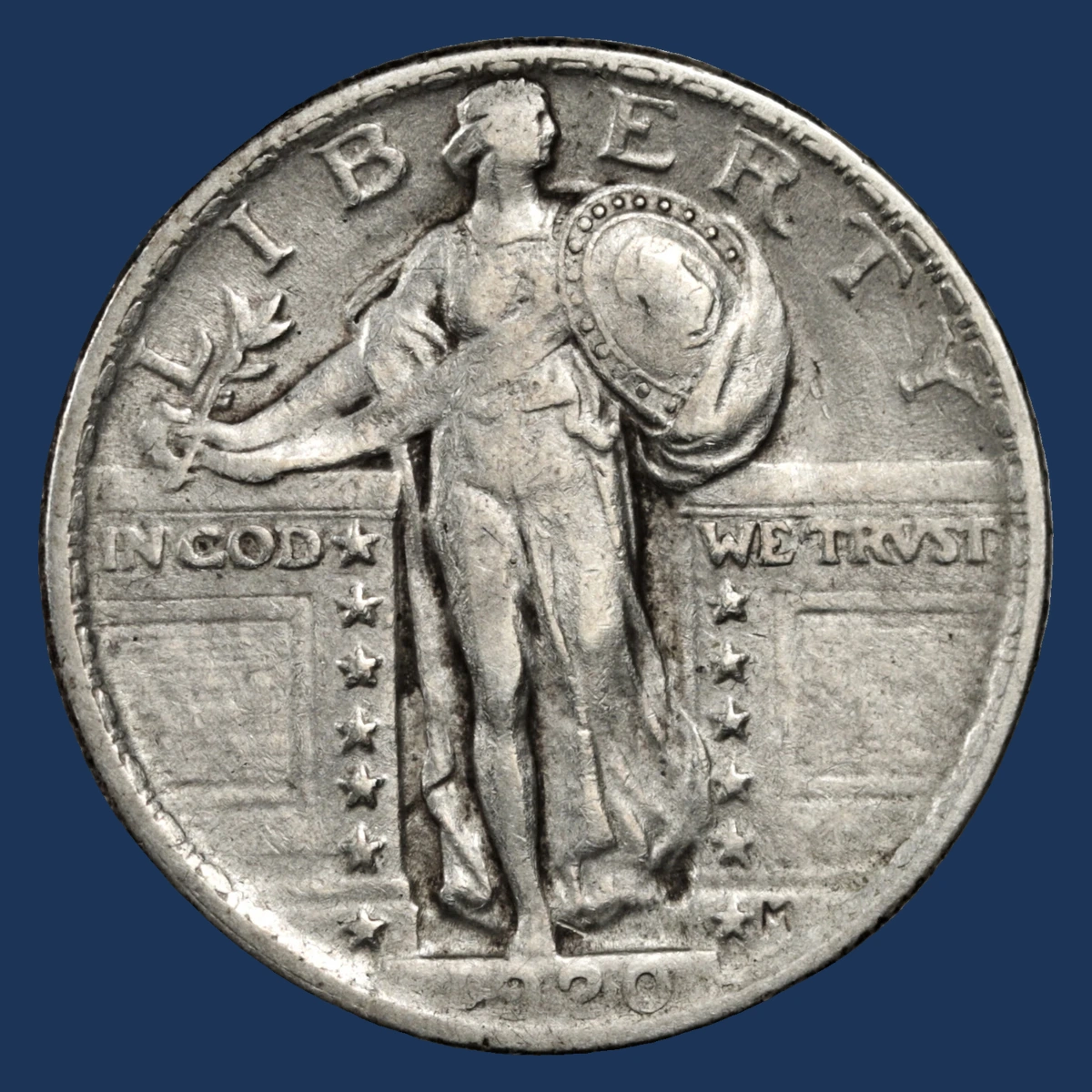
A lump near Liberty’s leg is reported on Philadelphia quarters. A small piece breaking out of the die, the stamping tool, can leave space for this raised metal to form.
A larger break reaching the coin’s rim is called a cud. A cataloged PCGS MS64 example has one at six o’clock, including the bottom of the date’s 0.
MS64 describes a coin without circulation wear but with some noticeable marks. This rim break and the reported leg-area chip are separate examples.
A crack in the tool can also leave a raised line. None of these should resemble a cut groove.
Estimated Value
Estimate $30–$150 for minor raised chips or cracks and $200–$1,200 for a clear, larger rim-connected break. The combined range is $30–$1,200.
The MS64 cud example shows why the shape matters: it replaces part of the normal date and reaches the border. A tiny isolated bump does not have the same visual impact.
These are whole-coin estimates. A sharper date, natural surfaces, and a more obvious break can make a piece more desirable.
How to Identify
For the cataloged cud, start with the 0 in 1920 and follow its lower edge toward the rim. The raised break should connect those areas, rather than sit alone inside the design.
Compare a normal date under the same magnification. The 1920 numerals stand on a raised area and often wear down, so missing detail does not itself prove a cud.
For the separate leg-area chip, check whether a bump is part of the coin’s metal. Attached dirt or a dent with pushed-up edges needs a different explanation.
Low side lighting helps establish height. Trace the extra metal to see whether it remains internal or actually reaches the border.
4. 1920 Standing Liberty Quarter Clashed E and Transferred Reverse Detail
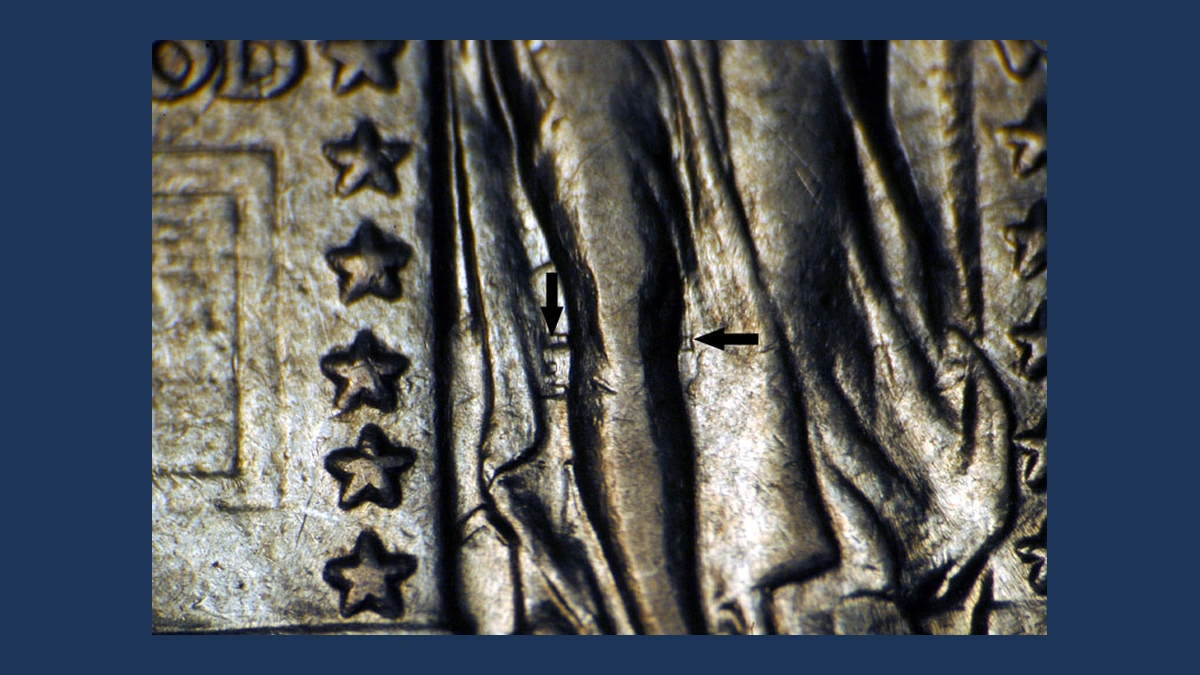
A letter from the back of the coin can appear beside Liberty’s knee on the front. Philadelphia and San Francisco examples are reported with this clash feature.
The two dies struck each other when no blank was between them. Each tool could pick up a trace of the opposing design.
The next coins struck by an affected tool could carry those stray outlines. This explains an E-shaped mark where the normal front design has no letter.
The marks are part of the striking process, not another object later pressed onto the quarter. Different mints require their own matching examples.
Estimated Value
Estimated whole-coin prices are $40–$1,500 for clear 1920 clash examples. Wear can hide the small traces, while good preservation makes them easier to recognize.
A different-year comparison is the 1929-S FS-401 clash quarter that sold for $2,520 in January 2022. Its PCGS MS66+ grade reflects exceptionally well-preserved, unworn surfaces.
That price includes the quality of the entire 1929-S coin. A faint E on a worn 1920 quarter should be compared with much more modest pieces.
How to Identify
Find the mark beside Liberty’s knee and compare its strokes with the E on the eagle side. A clash should connect the stray shape to a real part of the opposing design.
Before choosing a comparison image, identify the mint on the front. An S belongs to San Francisco; Philadelphia quarters normally have no letter there.
Use a magnifier to separate original robe folds from the added trace. Do not treat every irregular line in the fabric as part of an E.
Photograph the entire front and a close view under side lighting. Follow the recognizable letter shape near the knee, checking that scratches or attached material do not explain its outline.
5. 1920 Standing Liberty Quarter Possible Off-Center Strike
A quarter struck off center has part of its design missing beyond the edge. The opposite side retains a crescent of blank metal that the tools did not reach.
This happens when the metal disc is misplaced in the press. Both faces should reflect that misplaced disc.
A clearly identified 1920 example has not been established by the sources used here. This section describes a possible candidate and the evidence it would need.
The raised date wore away easily on these quarters. A coin without readable numerals cannot be called 1920 merely because its general design looks right.
Estimated Value
For an authenticated 1920 off-center quarter with a readable date, use an estimated $300–$8,000. The extent of displacement and the remaining surface quality would drive the price.
A slight shift on a worn coin differs from a large missing portion on a well-preserved piece. The date is especially useful for confirming that the coin belongs to this year.
This is a conditional estimate, not a reported 1920 auction result. Ordinary wear or a trimmed edge does not qualify.
How to Identify
Check for untouched blank metal before measuring how far the picture shifted. Under a magnifier, look for grinding lines or faint letter remnants that would suggest a removed design.
Trace the opposite edge to find where the intended picture runs out of metal. If all the design remains present, an uneven broadstrike may be a better explanation.
Turn to the eagle side and compare its displacement. A shift confined to one face can result from a misplaced tool rather than a misplaced blank.
Use straight-on photographs to keep the outline from appearing distorted. The year must remain readable on the same coin as the blank crescent and missing design.
6. 1920 Standing Liberty Quarter Peruvian and Dime Blanks
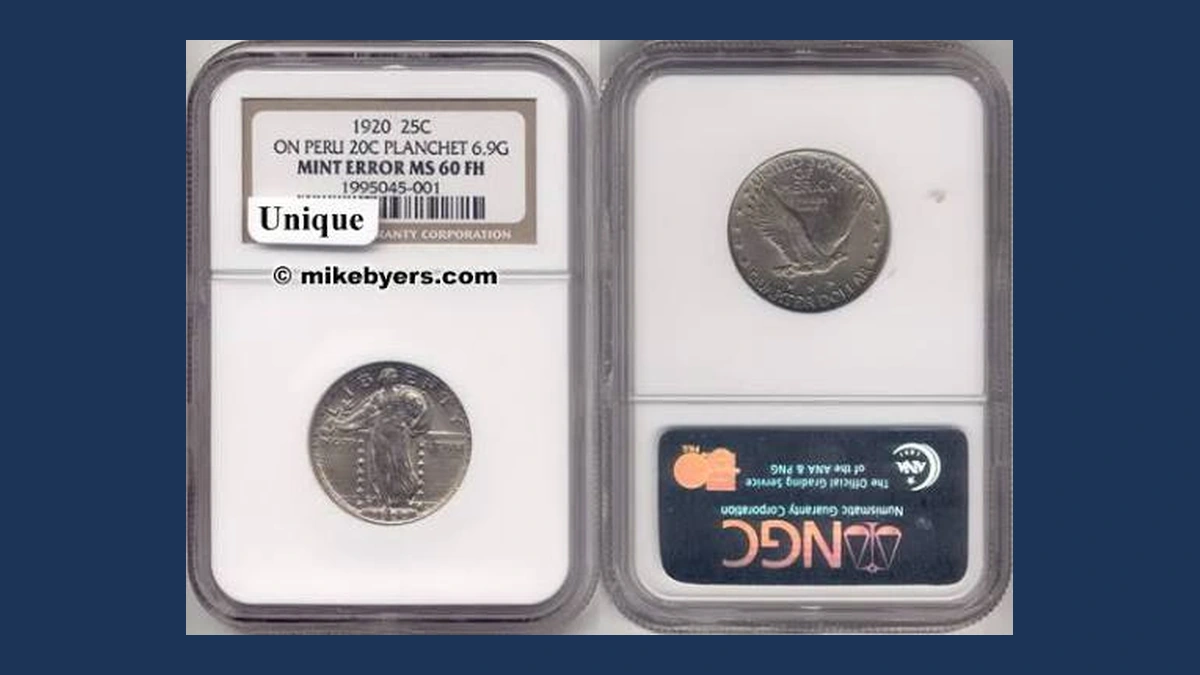
The wrong blank need not make a coin smaller. A documented 1920 quarter on a Peru twenty-centavo blank is nearly full size, but thicker and heavier than normal.
Its recorded weight is 6.9 grams and its metal is seventy-five percent copper, twenty-five percent nickel. NGC graded it MS60 Full Head, meaning unworn with sharply formed head detail.
Philadelphia was making the Peruvian coins at the time. One of their blanks entered the quarter production line.
A specialist list separately reports two 1920 quarters struck on silver dime blanks. Those involve a much smaller disc, not the thick Peruvian blank.
Estimated Value
The Peruvian-blank quarter sold for $16,100 in March 2011. For a comparable authenticated example, an estimated $12,000–$30,000 reflects its unusual metal and rarity.
For the separately reported silver-dime-blank coins, use an estimated $5,000–$20,000. That second range is an estimate, not a quoted sale for either listed coin.
Together the group spans $5,000–$30,000. Correct identification of the blank and preservation of the date matter more than color alone.
How to Identify
A digital scale and calipers separate two very different possibilities here. Normal 1920 quarters start at 6.25 grams and about 24.3 millimeters across.
The recorded Peruvian-blank coin weighs 6.9 grams and measures 24 millimeters. Its thick edge contrasts with an ordinary silver quarter.
A silver dime blank normally weighs 2.50 grams and measures about 17.9 millimeters before striking. Those are blank standards, not measured weights assigned to the two listed errors.
On a loose suspect, inspect the edge for trimming, plating, or added metal. For a sealed certified coin, use its recorded measurements rather than opening the holder.
A specialist’s metal analysis can distinguish the copper-nickel Peruvian blank from the normal silver alloy.
Conclusion
The estimated $30–$30,000 range runs from minor raised tool defects to a quarter struck on the wrong metal. A straight clip and a peeling surface require different edge checks.
For the most unusual pieces, record weight, width, and the readable date before comparing prices. The Peruvian blank is heavier and thicker, while a dime blank is much smaller; their appearances and values should stay separate.