1900 Quarter Error List with Pictures

The date survived on a 1900 quarter struck 15% off-center, even though the design shifted toward the bottom. That moderately worn coin brought $920 in September 2002.
Other 1900 quarter errors require a closer look: a repeated S, extra date strokes, or details hidden by material during striking. Estimated values below span $25 to $8,000, from minor features to major confirmed striking errors.
Read the signs carefully to distinguish missing metal from missing design.
1. 1900 Barber Quarter Struck Through Grease or Debris
A patch of hair or a few letters can be weak while nearby detail remains clear. Grease or other material can block part of the die, the steel tool that stamps the coin.
The blocked area then fails to leave its full design. This is called a struck-through error.
Year guides report weak hair, date, and motto areas on 1900 quarters. Those descriptions do not mean every affected coin has all three areas missing.
Ordinary wear also removes detail, but usually follows the coin’s raised points. Material blocking the tool can instead interrupt a small, uneven part of the design.
Estimated Value
For circulated 1900 quarters with a clearly identified blocked-design error, estimate $25 to $300. A faint missing stroke may add little, especially on an already worn coin.
A distinct affected area beside sharp detail is more appealing because the error can be seen easily. A readable date also helps collectors identify the coin.
The mint and overall preservation still matter. This range concerns ordinary circulated examples, rather than exceptionally high-grade coins whose condition adds substantial separate value.
How to Identify
Compare the weak area with nearby features of similar height. If the surrounding letters and hair are equally worn, the missing detail may simply reflect circulation.
Look for a local change from clear design to weak or absent detail. Photograph that transition without cleaning the surface or trying to remove anything from a depression.
Next examine the corresponding area on the other face and the higher points of Liberty and the eagle. General softness or widespread wear should not be mistaken for a small blocked section.
Grease itself usually does not remain as an identifiable object. Describe the visible loss of design and let an error specialist distinguish blockage from a weak strike or later rubbing.
2. 1900 Barber Quarter Die Cracks and Cuds
Thin raised lines can cross the portrait, open surface, or eagle on a coin made with a cracked die. Silver enters the damaged opening during striking and leaves a raised trace.
The same line can appear on many coins from that tool. It is not necessarily unique to one piece.
A larger missing section of the die can create a raised area joined to the rim, called a cud. Reports for 1900 include both cracks and this broader rim-break type.
A cut into the silver is different. So is a peeling layer that separates from the coin’s own metal.
Estimated Value
Allow an estimated $25 to $600 for circulated 1900 quarters with identified die cracks or rim-connected breaks. The smallest cracks often add only a modest premium.
Larger cuds can be more striking when their border is clear and the date remains readable. Surface damage, heavy wear, or an indistinct lump reduces that advantage.
Compare Philadelphia, New Orleans, and San Francisco coins within their own normal price levels. A scarcer mint’s underlying value should not all be credited to the break.
How to Identify
Use light from the side to decide whether the line is raised or cut into the coin. Do not run a fingernail across it.
Then trace its course across nearby design elements. A line from a broken die belongs to the struck surface, whereas a later scratch can cut through finished detail and leave displaced metal.
For a broad raised patch, include the rim in your photograph so its connection is visible. An internal bump does not become a cud simply because it is large.
Inspect the opposite face for weakness related to the damaged area, but do not require an identical mark there. Ask for comparison photographs showing the whole break, not just its most dramatic close-up.
3. 1900 Barber Quarter Clipped Planchet
A curved bite out of the coin can begin before any design is struck. The blank-cutting punch can overlap an earlier hole in the metal strip, producing an incomplete disk.
The resulting coin is called a clipped-planchet error. Planchet is another word for the metal blank.
Curved clips are reported for 1900 Barber quarters, without a fixed percentage or clock position. The amount and shape of missing metal must be judged on each coin.
Clipping differs from an off-center strike. A clip lacks metal itself, while an off-center coin keeps a blank area beside its incomplete design.
Estimated Value
Estimate $50 to $750 for circulated to modestly unworn 1900 quarters with genuine curved clips. A larger, clearly original gap can attract more interest than a tiny missing sliver.
The date should remain identifiable, and the rest of the coin’s condition still affects its value. Heavy scratches or cleaning can outweigh a small clip premium.
Treat the range as a whole-coin estimate. An ordinary crescent cut into a finished quarter is damage and does not qualify for it.
How to Identify
Compare the two ends of the gap before studying its deepest point. The rim and nearby lettering may weaken as they approach a gap that existed during striking.
Inspect the rim across the coin from the missing section. Weakness there can support an original clip, although that sign is not always obvious.
For a loose coin, a scale reading below the normal 6.25 grams supports missing metal but cannot prove when it was removed. Do not remove a certified coin from its holder for weighing.
Look along the curved edge for saw marks, fresh filing, or sharply cut finished details. A convincing identification combines the gap’s shape with the way the original strike meets both ends.
4. 1900 Barber Quarter Repunched Date
The first digit can carry an extra stroke from an earlier punch impression. Other reported Philadelphia patterns involve more of the date, including earlier strokes below or to the right.
These marks began on the die, where the date was added by hand. A repeated punch placed slightly away from the first could leave parts of both impressions.
The earlier strokes were then stamped onto later coins. They are not extra digits added to each finished quarter.
The 1-only report does not establish a particular direction. Its actual shape should be compared separately from patterns involving the whole date.
Estimated Value
For identified Philadelphia repunched-date examples, estimate $40 to $1,000 from worn through attractive unworn grades. Clear extra digit strokes and original surfaces support stronger prices.
A related 1908 Philadelphia misplaced-date quarter sold for $432 in March 2024 at Heritage. Its ANACS MS63 grade means unworn with noticeable marks.
That coin has digits placed too low, a different date-punch mistake. Use it as a same-series comparison, while judging the 1900 pattern and condition on their own merits.
How to Identify
Enlarge the complete date rather than cropping to one small bump. Compare each suspect stroke with the shape of the digit beside it.
For the 1-only report, match the visible remnant without assuming it must lie below or beside the main stroke. Other listed patterns include earlier date impressions to the south or east, meaning below or to the right.
Check that the extra metal is raised and fits a repeated number. A shallow scratch or a rough lump does not establish another punch impression.
Photograph the whole front and the mint-letter area on the back. These descriptions concern Philadelphia coins, so an O or S needs its own comparison rather than the same identification.
5. 1900 Barber Quarter Repunched S Mint Mark
The small S beneath the eagle can have traces of another S to its left. The Barber Coin Collectors’ Society survey lists this as a westward repunch.
West describes the position of the earlier impression when the back is upright. It does not mean the whole coin was struck toward the left.
A worker punched the S into the die more than once, leaving part of the first letter beside the final one. Later coins could repeat that extra outline.
This report belongs to San Francisco. It does not establish an O-over-O variety for New Orleans.
Estimated Value
An estimated $100 to $1,500 covers identified repunched-S examples in circulated through modestly unworn grades. San Francisco coin value can form a substantial part of that total.
The extra S should be visible enough to distinguish it from a damaged letter. Stronger separation and cleaner surfaces make the variety easier to appreciate.
A worn coin with only a doubtful shadow should be priced primarily for its normal date and mint. Exceptional preservation requires its own comparison beyond this ordinary-grade range.
How to Identify
Place a photograph of the back upright and locate the S beneath the eagle. Magnify the left side of that letter, where the earlier impression is reported.
Look for curved or straight portions that belong to another S. Compare their shape and height with the main letter rather than treating every nearby bump as doubling.
Keep the camera angle fixed while changing the light. A shadow can move or disappear, while a genuine extra raised stroke remains in the same position.
Also inspect the main S for dents that pushed metal outward and created a misleading second edge. A clear image of the letter and its surroundings is more useful for identification than an extreme crop of one tiny curve.
6. 1900 Barber Quarter Off-Center Strike
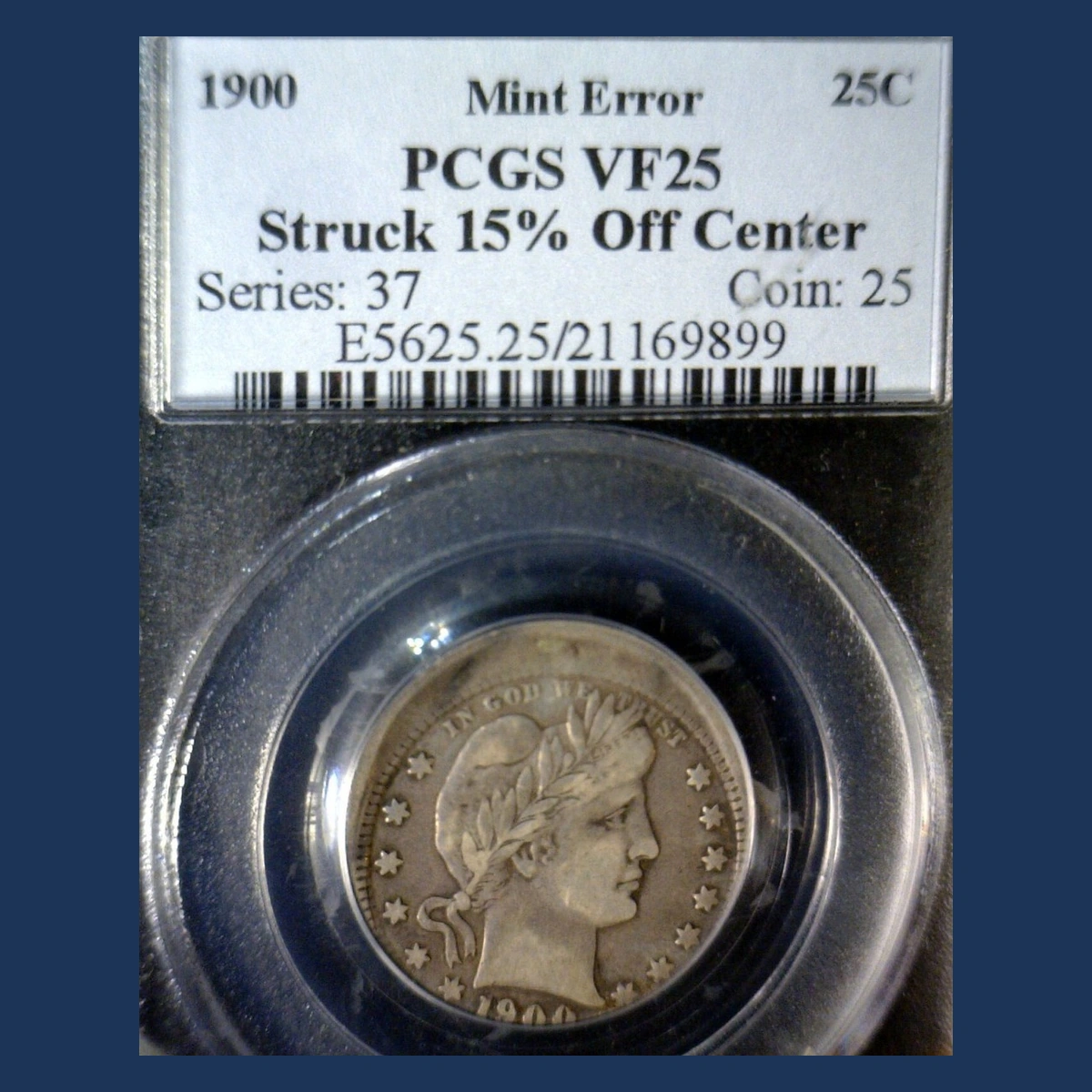
The design moves toward the bottom on a documented 1900 quarter struck 15% off-center. Its date remains readable despite the shift.
PCGS graded that coin VF25, indicating moderate wear. A different dealer-listed example is 10% off-center and has NGC AU Details, with light wear and improper cleaning noted.
An older catalog also records a 20% shift toward about five o’clock. These descriptions concern separate coins.
The error begins when the blank sits partly outside the striking area. It leaves a blank crescent beside a design cut short, rather than removing metal from an already finished quarter.
Estimated Value
The 15% off-center PCGS VF25 coin sold for $920 on September 28, 2002 at Heritage. That is an actual sale of a dated, moderately worn example.
Estimate $300 to $5,000 across genuine 1900 off-center quarters with readable dates, depending on displacement and condition. A larger attractive example can command more than a small shift on a cleaned coin.
The separate 10% NGC coin was listed with its price available on request. That wording does not supply another sale amount.
How to Identify
Follow the date toward the lower edge on the documented 15% example. Its survival is important because a missing date can prevent a secure year identification.
Compare both faces and locate the blank crescent beside the struck area. A raised rim of uneven width on only one face may come from a misaligned tool instead.
Do not transfer the 15% coin’s downward direction to the separate 10% dealer example. The older 20% description has its own five-o’clock direction.
Check the blank surface for scraping and examine where the struck image stops. A filed coin can lose design, but its cut edge and altered surface should not be confused with metal left outside the striking tools.
7. 1900 Barber Quarter Double Strike
Two overlapping portraits can result when a coin receives another strike after moving. The second blow may shift or turn the design relative to the first.
The year guide reports double strikes among 1900 Barber-quarter errors. It does not establish a specific mint, grade, or displacement for a certified example.
The feature is broader than a small extra outline on one date digit. Separate strikes can repeat several parts of the portrait and surrounding lettering together.
A second image pressed into a finished coin outside the Mint can be deceptive. Its direction and effect on the metal need careful examination.
Estimated Value
For a genuine 1900 Barber quarter with two distinct strikes, estimate $1,500 to $8,000. This is a conditional estimate for the reported type, not a documented 1900 double-strike auction result.
A recognizable second portrait, a readable date, and original surfaces support stronger interest. Closely overlapping images or severe damage can reduce the appeal.
The $920 off-center sale involves one displaced strike, so it is only a lower-level comparison for a major minting error in this same date.
How to Identify
Try to connect the extra portrait with repeated lettering or border elements. Several features should make sense as parts of a second impression with the same shift or turn.
Inspect which image crosses over the other where they overlap. That relationship helps an expert reconstruct the two strikes instead of relying on a single doubled profile.
A pressed-in mirror image can come from another coin and does not by itself establish two ordinary strikes. Photograph the opposite face and the edge to show how the metal responded.
Keep small date-punch remnants separate from this test. Before paying for a major double strike, obtain professional examination of the whole coin and both sets of design.
Conclusion
A blank crescent, a missing bite, and a weak patch describe three different things on a 1900 Barber quarter. Their causes matter as much as their appearance.
Estimated values run from $25 to $8,000 for the stated examples and conditions. The documented $920 off-center sale provides a real comparison, while the double-strike range remains conditional on identifying a genuine coin.
Preserve the surfaces and photograph both faces before deciding which explanation fits.