1904 Quarter Error List with Pictures

An extra stroke under the 1 and an extra curve beside the O come from different punches. Knowing which part repeats is the first step in sorting a 1904 quarter error.
Estimated values here range from $25 to $3,000 for the stated conditions. A related date-punch variety from 1908 sold for $432 in March 2024, offering a comparison rather than a 1904 sale.
Use the six sections below to connect each visible feature with its cause.
1. 1904 Barber Quarter Die Cracks, Chips, and Cuds
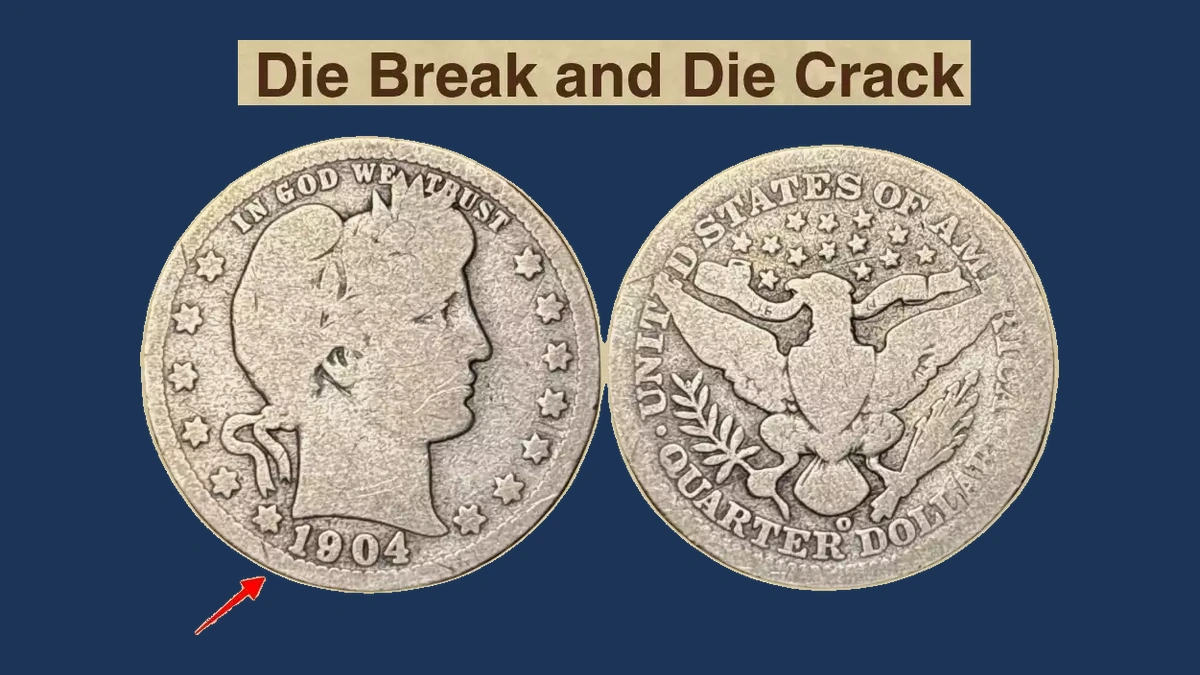
A narrow raised line and a larger raised lump can share the same cause: damage to the die. The die is the steel tool that stamps the design.
A crack in that tool makes a line on the coin. A missing piece of steel allows a larger area of metal to rise.
Reports for 1904 include cracks on the front and around the eagle, plus a chip near the New Orleans coin’s date. A rim-connected break is called a cud.
An internal date-area chip is not automatically a cud. The raised area must reach the rim.
Estimated Value
For worn 1904 quarters with these features, estimate $25 to $600. Small cracks usually contribute little beyond the ordinary coin value.
A large, clear break connected to the rim can attract greater interest than a tiny internal chip. Its size and the survival of the date affect the price.
New Orleans coins can already cost more at the same wear level. Compare their normal value before treating the entire difference as an error premium.
How to Identify
Look at whether the feature rises above the surrounding silver. Side lighting helps distinguish a raised line from a scratch cut into the surface.
Follow the feature to its end without touching it. A small lump near the date stays an internal chip unless a missing-die area connects it to the rim.
The reported front cracks and eagle-area cracks need their own photographs. Do not assume every line belongs to one continuous break across the coin.
For a suspected cud, compare the smooth raised area with nearby struck detail and examine the opposite face for related weakness. A dent with pushed-up metal can mimic a lump, so include the edge in the photographs you send for examination.
2. 1904 Barber Quarter Rotated Dies
The front may stand upright while the back appears tilted after a careful top-to-bottom turn. This happens when the two striking tools are not aligned normally.
A year guide reports a 1904-O example graded PCGS VF30, meaning a moderately worn coin. It does not give that piece’s measured angle.
A separate collector discussion concerns about 15 degrees of rotation. Such a small shift should not be presented as a dramatic error.
The two reports need not describe the same coin. A photograph taken at an angle can also make normal alignment appear wrong.
Estimated Value
Estimate $50 to $750 for circulated 1904-O quarters with measurable rotation, depending on wear and how far the back turns. A small shift near 15 degrees may bring little beyond ordinary coin value.
Large, clearly demonstrated turns are more appealing to error collectors. The angle should be measured before paying a large premium.
The reported VF30 grade does not establish a particular angle or sale price. Price comparisons must match both condition and the degree of rotation.
How to Identify
Keep the coin in the same position throughout the test. Start with Liberty upright, then turn it from top to bottom around a horizontal line through its center.
The eagle should now be upright. Turning left to right instead would normally leave it upside down and give a misleading result.
Repeat the movement without allowing the coin to roll between your fingers. A holder can help keep the turning axis steady; do not remove a certified coin for this test.
Photograph the front, the turning position, and the back against the same straight guide. Measure the back’s tilt from upright rather than estimating it from a casually rotated photograph.
A small repeatable tilt is a small rotation, not evidence of a quarter-turn error.
3. 1904 Barber Quarter Repunched O Mint Mark
The O below the eagle identifies New Orleans. A second curved outline beside that letter is the feature to examine for a repunched mint mark.
Workers added mint letters to dies with a hand punch. A second impression in a slightly different place could leave parts of both O shapes.
The 1904-O feature is reported in year guides, but no fixed direction is established here. An extra curve must fit another O rather than simply form a random bump.
Repeated numbers in the date are a separate matter. They do not establish a repeated mint letter on the back.
Estimated Value
A confirmed repunched O is estimated at $75 to $800 in ordinary circulated grades. The range includes the value of the New Orleans quarter itself.
A clear second oval with enough surrounding detail should be more appealing than an indistinct trace on a heavily worn coin. Scratches or cleaning can offset that appeal.
Treat a large variety premium as payment for a recognizable extra impression. Simply having an O mint letter does not place a coin near the upper end.
How to Identify
Find the O between the eagle’s tail and QUARTER DOLLAR. Compare it with an ordinary 1904-O photographed at the same size and angle.
Trace the suspected extra arc around the main letter. It should make sense as part of another oval, rather than changing into an unrelated rough patch under different light.
Examine the center of the O as well as its outside edge. Wear, a small die chip, or a contact mark can alter only one part of the letter.
Keep the whole back visible in one photograph and take a separate close-up of the O. Ask a specialist to identify the repeated punch from those shapes; a doubled date on the front cannot answer that question.
4. 1904 Barber Quarter Repunched Date
Look just below the base of the 1 on the Philadelphia issue. A small extra raised stroke there is reported as part of an earlier date impression.
The Barber Coin Collectors’ Society survey also lists repeated 04 digits below and a whole date shifted left. These are different patterns, not one required set of marks.
The date punch was applied more than once to the die. Parts of the earlier numbers survived beside the final date.
This is repunching of the same year. It does not imply that 1904 was stamped over another year.
Estimated Value
An estimated $40 to $1,000 covers identified Philadelphia repunched-date quarters from worn to attractive unworn condition. Strong original detail and a plainly visible earlier digit support higher prices.
A different date-punch variety, a 1908 Philadelphia misplaced date graded ANACS MS63, sold for $432 in March 2024. MS63 means unworn with noticeable marks.
That same-series comparison involves digits placed too low, not the exact 1904 repunch. It helps frame the estimate without creating a nonexistent 1904 auction result.
How to Identify
Begin with the shape of an ordinary 1, including its base. Then examine the narrow area below that base for a separate raised remnant that fits another impression.
If the extra marks occur under 04 or to the left of the full date, compare that particular pattern instead. Do not combine unrelated positions from different coins to build an identification.
Use a 10× magnifier and photograph the numbers with light from two directions. A shallow cut beside a digit can cast a convincing shadow but will not become raised metal when the light changes.
Check the back for a mint letter before applying these Philadelphia descriptions. Keep any New Orleans candidate separate for its own examination.
5. 1904 Barber Quarter Doubled Die Obverse
A doubled die obverse means the front design was repeated while the striking tool was being made. The coin can show extra raised outlines in lettering or parts of the portrait.
Year guides report this type for Philadelphia, with New Orleans mentioned separately. They do not establish one precise set of marks shared by both mints.
The date needs special care. Because its numbers were punched separately, doubling only in 1904 may belong to a repunched date instead.
A convincing doubled-die identification should therefore examine the rest of the front. It should not depend on a thick-looking number alone.
Estimated Value
Use an estimated $75 to $1,200 for identified examples in circulated through modestly unworn condition. The strongest candidates would show clear repeated design beyond the date.
Faint effects buried in wear are less attractive than distinct, rounded extra outlines. A New Orleans coin’s normal scarcity also affects its whole-coin price.
These figures assume that the feature is a genuine doubled die. Date repunching and flat striking shelves need their own price comparisons rather than the same premium.
How to Identify
Cover the date in your photograph temporarily and inspect the remaining front design. This helps avoid letting a repeated digit decide the entire identification.
Compare the lettering and portrait with a normal coin of the same mint and wear level. Look for several matching raised extra outlines, not one isolated thick edge.
Flat shelves alongside letters can come from movement during striking. Their height and shape differ from a rounded secondary design copied into the tool.
Now uncover the date and record whether its doubling forms a separate punch pattern. A date-only effect should go to the repunched-date comparison before it receives a doubled-die label.
Keep photographs of both the wider design and the close detail for expert assessment.
6. 1904 Barber Quarter Off-Center Strike
Part of Liberty or the surrounding lettering can end abruptly beside an untouched crescent of metal. An off-center strike forms when the blank is not fully beneath the striking tools.
The missing design lies beyond the blank, rather than having been rubbed away afterward. Both faces can help show the misplaced strike.
Year guides report this type for Philadelphia and New Orleans quarters of 1904. A particular direction or percentage should be measured from the actual coin, not borrowed from another year.
A broad border by itself is not enough. A genuine off-center strike loses part of the intended design.
Estimated Value
Estimate $150 to $3,000 for genuine 1904 off-center quarters with identifiable dates, from small shifts to more dramatic examples. Better condition and a clear date favor the upper portion.
The amount of blank metal matters, but it is not the only factor. A larger shift that removes the year may be less appealing than a smaller, fully dated error.
New Orleans identity must also remain supportable. A missing mint-letter area cannot automatically be read as a Philadelphia coin.
How to Identify
Find the boundary where the struck design meets the blank crescent. Check whether the border lettering is cut off there or merely surrounded by an unusually wide rim.
Examine the opposite face while keeping track of the same area of metal. A shifted design on only one face can indicate a misaligned tool rather than an off-center blank.
Inspect the crescent and its edge for filing, grinding, or a freshly cut surface. Removing part of a finished coin can create missing detail without reproducing the original metal flow of a displaced strike.
Photograph the date and the mint-letter area separately before estimating the percentage. When either has fallen beyond the blank, describe what is visible instead of assigning an unsupported year or mint.
Conclusion
The date, mint letter, and alignment of the two faces answer different questions on a 1904 Barber quarter. Estimated values in the stated conditions range from $25 to $3,000.
A small raised date remnant should not be priced as a dramatic off-center strike. Nor does a slight turn of the back deserve the same premium as a large rotation.
Use clear photographs to establish the actual feature before comparing prices.