1838 Capped Bust Quarter Error List with Pictures

Liberty’s eye and the eagle’s eye nearly meet on one remarkable 1838 quarter. The coin flipped over between strikes, placing parts of both faces together.
Other 1838 Capped Bust Quarter errors leave a blank crescent, faint transferred outlines, or a crack between leaves. An unworn cracked example reached $4,400 before fees in July 2025.
Estimated whole-coin values span $50–$15,000. Read on for four groups belonging to the capped portrait design, which differs from the seated figure also used in 1838.
1. 1838 Capped Bust Quarter Faint Outlines from Colliding Tools
Faint extra outlines near Liberty’s chin and throat can come from the back design. They appear where those shapes do not belong on the front.
The two steel stamping tools, called dies, sometimes struck each other without a metal disc between them. The collision marked the tools, which then passed those extra shapes onto later coins.
Steve Tompkins describes clash traces near the chin, throat, and above the bust on an 1838 example. More than one tool collision can leave repeated traces.
This does not mean the coin itself received two strikes.
Estimated Value
Estimate $75–$2,000 for circulated examples with clearly recognizable clash marks. The price includes the normal collector value of the 1838 quarter.
Faint outlines may add only modest interest, especially when wear makes them hard to separate from the design. Bold, well-positioned traces are easier to demonstrate.
An attractive lightly worn coin can cost more than a heavily worn one with stronger marks. Cleaning, corrosion, and scratches remain important when judging the complete piece.
How to Identify
Use a normal Capped Bust quarter image to separate Liberty’s own neckline from an extra shape. A regular fold or hair edge should not be counted as transferred detail.
Then compare the chin, throat, and area above the bust with Tompkins’s illustrated discovery. Several matching traces provide more evidence than one unexplained line.
Move the light and use a magnifier where the marks cross smooth background areas. Scratches often cut sharply into the surface and need not follow a recognizable design.
A complete overlapping portrait points toward another striking problem, while a clash usually leaves selected outlines. Match the faint shapes to the opposite face in the correct positions before calling them clash marks.
2. 1838 Capped Bust Quarter Crack Joining the Olive Leaves
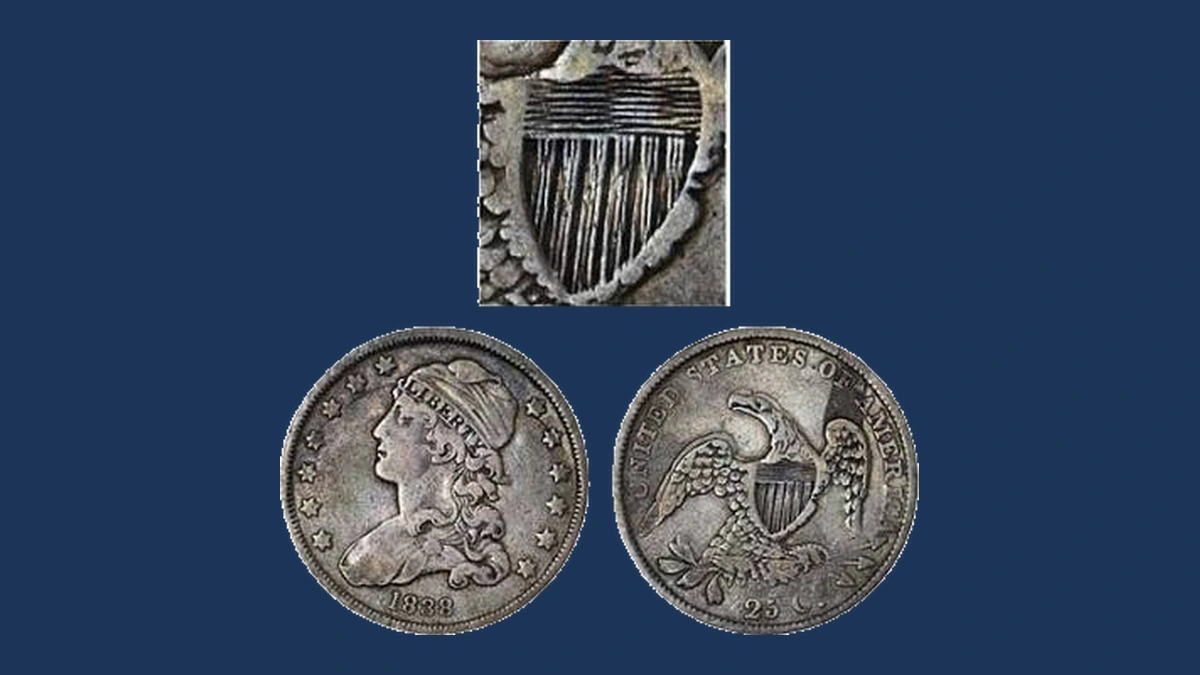
A narrow raised line joins the outer olive leaves on the back. It records a crack that opened in the steel stamping tool.
During the strike, silver entered that narrow gap and formed a ridge on the coin. The line is extra metal above the surface, unlike a scratch cut into it.
A PCGS MS64 example in a 2025 Heritage auction showed a crack connecting three outer pairs of leaves. The catalog also noted weak detail in the lower leaves.
That ordinary weakness is not a second error, and the normal branch must be distinguished from the crack.
Estimated Value
The PCGS MS64 example reached $4,400 before fees in July 2025, as listed in the auction record. Its attractive unworn surfaces account for much of that amount.
Estimate $50–$7,000 across worn through well-preserved unworn coins. The crack may help identify the stamping tool without adding a large premium.
A long visible line is interesting, but it does not cancel heavy wear or cleaning elsewhere on the quarter.
How to Identify
Follow the olive branch on the eagle’s back design and identify its ordinary stems first. The extra line should connect the three outer leaf pairs rather than simply follow an existing branch.
A magnified view with light from the side helps show whether the line rises above the metal. Turn the light across it to avoid mistaking a dark scratch for a ridge.
Compare the path through all three pairs with the cataloged coin. Weak lower leaves alone do not establish a cracked tool.
Keep the full eagle and date in the comparison photographs. The 1838 seated-figure quarter has a different design and cannot provide the matching pattern.
Trace the same raised connection between the outer leaves from end to end.
3. 1838 Capped Bust Quarter Strike Shifted toward the Top
Liberty’s design moves toward the top while a curved area below the date remains unstruck. The metal disc was not centered between the stamping tools.
The documented 1838 example was struck about 20% off center toward twelve o’clock on the front. PCGS graded it VF25, indicating moderate circulation wear.
The auction description mentions a nick below the date in the blank area. That nick is later damage, separate from the original off-center strike.
A shifted design with a natural blank crescent is different from a normal coin that someone trimmed or cut.
Estimated Value
This PCGS VF25 sold for $4,140 on January 15, 2005 at Heritage. The price belongs to the complete off-center coin despite its minor scratches and surface problems.
An estimated $1,000–$10,000 covers a range of circulated examples with a visible date. The amount of displaced design, preservation, and clear year all matter.
An especially attractive strike may outperform a comparable worn piece. A cut edge or unreadable date can sharply reduce interest.
How to Identify
The date and blank area below it provide the clearest starting point on this example. Check that the empty crescent is part of the original disc, with no filed or freshly cut edge.
Look across to the top for design carried beyond the coin’s border. Both faces should show the effects of the off-center position; a shifted face alone may indicate a misaligned tool.
For a loose coin, weighing can help reveal missing metal from cutting. A normal unworn example weighs about 6.74 g, though circulation wear reduces weight.
Do not treat the recorded nick below the date as part of the Mint error. The upward-shifted design and unstruck lower crescent should remain recognizable independently of that damage.
4. 1838 Capped Bust Quarter Two Strikes with the Coin Flipped Over
Part of Liberty’s head appears on the side with the eagle. The coin turned over between two strikes, so the next blow placed a front design over the earlier back design.
Stack’s Bowers described an 1838 example whose clearest overlap is near the eyes. Liberty and the eagle almost share the same eye position.
The 2012 catalog called the coin VF20 and cleaned, meaning it had moderate wear and altered surfaces. It was offered without third-party certification.
The visible overlap is the striking error; cleaning is a separate condition problem.
Estimated Value
For a genuine circulated flipover double strike, estimate $1,500–$15,000. Recognizable parts of both designs on one face can attract strong specialist interest.
The cataloged 1838 coin was cleaned, which should be considered when comparing it with an original-surface example. Strong remaining portrait and eagle details make the unusual sequence easier to see.
This is a whole-coin estimate. An overlapping design does not overcome serious damage, and a claimed second strike should be established before that range is applied.
How to Identify
Turn to the eagle side and look for recognizable parts of Liberty’s portrait. The cataloged example has the clearest overlap around the eyes.
Try to follow enough of the extra portrait to establish its orientation. A lone curve near the eye could be a scratch or a normal part of the eagle.
Now inspect the other face for evidence consistent with the same turnover. The surviving designs should make sense together, even though the second strike can flatten earlier details.
Later squeezing between coins tends to create sunken, reversed impressions. Faint tool-clash traces are different again.
Compare several portrait and eagle details together; a coherent second design is more convincing than one shared-looking eye.
Conclusion
For 1838 Capped Bust quarters, leaf cracks and faint clash traces require close inspection, while off-center and flipover strikes change the design more dramatically. Keep the same-year seated-figure quarters separate.
The estimated whole-coin range is $50–$15,000. A cracked MS64 reached $4,400 before fees, and the 20% off-center VF25 sold for $4,140; their different condition and error type explain why neither price fits every unusual coin.