1856 Flying Eagle Cent Error List with Pictures

A repeated 5 identifies the Snow-3 variety of the 1856 Flying Eagle cent. One exceptionally preserved MS65 example sold for $94,000 at Heritage in January 2016.
The 1856 Flying Eagle cent error list below covers estimated whole-coin values of $8,000–$100,000. These small cents were produced as an experimental issue, with later pieces also made for collectors.
Explore the three features below, keeping the coin’s grade and actual label beside each price comparison.
1. 1856 Flying Eagle Cent Foreign Material Impressed into a Face
A hollow can interrupt the design when material lies between the blank and a stamping tool. The press forces that material into the coin instead of forming the normal detail beneath it.
APMEX lists an 1856 example with a back strike-through, graded NGC PF40. PF denotes Proof, a specially made collector coin; the number reflects substantial wear on this example.
The dealer suggests the blocking object may have been metal, without identifying it conclusively. A separate year guide reports a front strike-through in PF61.
Those descriptions concern different examples. Neither establishes a specific material still attached to the finished coin.
Estimated Value
For 1856 strike-through examples with wear or lower Proof grades, estimate $8,000–$35,000 as a whole-coin range. The rare date and overall preservation account for much of that value.
The PF40 back example and reported PF61 front example require different grade comparisons. No completed sale is assigned to either description here.
A distinct original impression may interest error collectors, while additional damage can reduce appeal. The range is not an extra amount to add to an ordinary 1856 cent’s price.
How to Identify
Compare the stated face on the label with the actual coin before examining the hollow. The APMEX example places its error on the wreath side, not the eagle side.
Use a 10× magnifier and side light to follow how the design stops at the impression. Fresh cuts or metal forced over surrounding detail can instead indicate later damage.
For a loose example, a scale and calipers compare approximately 4.67 g and 19.05 mm; leave a certified coin sealed. These are small-cent specifications, not those of the much larger Braided Hair cent.
Trace the boundary of the missing design without assuming that a dark patch identifies the material that blocked the strike.
2. 1856 Flying Eagle Cent A Surface Layer Still Attached
A faint gray patch near one o’clock appears on an 1856 cent from the Jules Reiver Collection. Heritage described a lamination that remained attached.
A weakness within the original metal allowed the surface layer to separate without falling away. The result may be subtle because the missing-layer hollow has not formed.
The coin was graded NGC PR65, a well-preserved Proof with no circulation wear. Its date also has the repeated 5 associated with the Snow-3 variety.
The auction wording does not specify which face carries the patch. A change in color alone is not enough to identify a separated layer.
Estimated Value
The Reiver PR65 coin sold for $27,600 at Heritage in July 2009. That was the full price of a rare, highly preserved cent with a repunched date and subtle lamination.
For comparable 1856 cents retaining a clear surface layer, estimate $15,000–$50,000 across suitable grades and conditions. This is a whole-coin estimate, not a separate lamination premium.
The degree of separation and surface quality matter. A stained area without a layer boundary should not receive the same description.
How to Identify
Keep the layer in place and view the gray patch from several lighting angles under a 10× magnifier. A fine boundary or slight separation should be distinguishable from color alone.
The catalog gives a one-o’clock position without naming the face. Photograph both upright faces and compare the actual Reiver images before assigning that position to the eagle or wreath.
If the coin is loose, use a scale against 4.67 g and calipers against approximately 19.05 mm, recognizing that an attached layer can leave both readings normal. Follow the physical boundary of the separated surface, rather than treating an ordinary toned patch as missing metal.
3. 1856 Flying Eagle Cent Repunched 5 in the Date
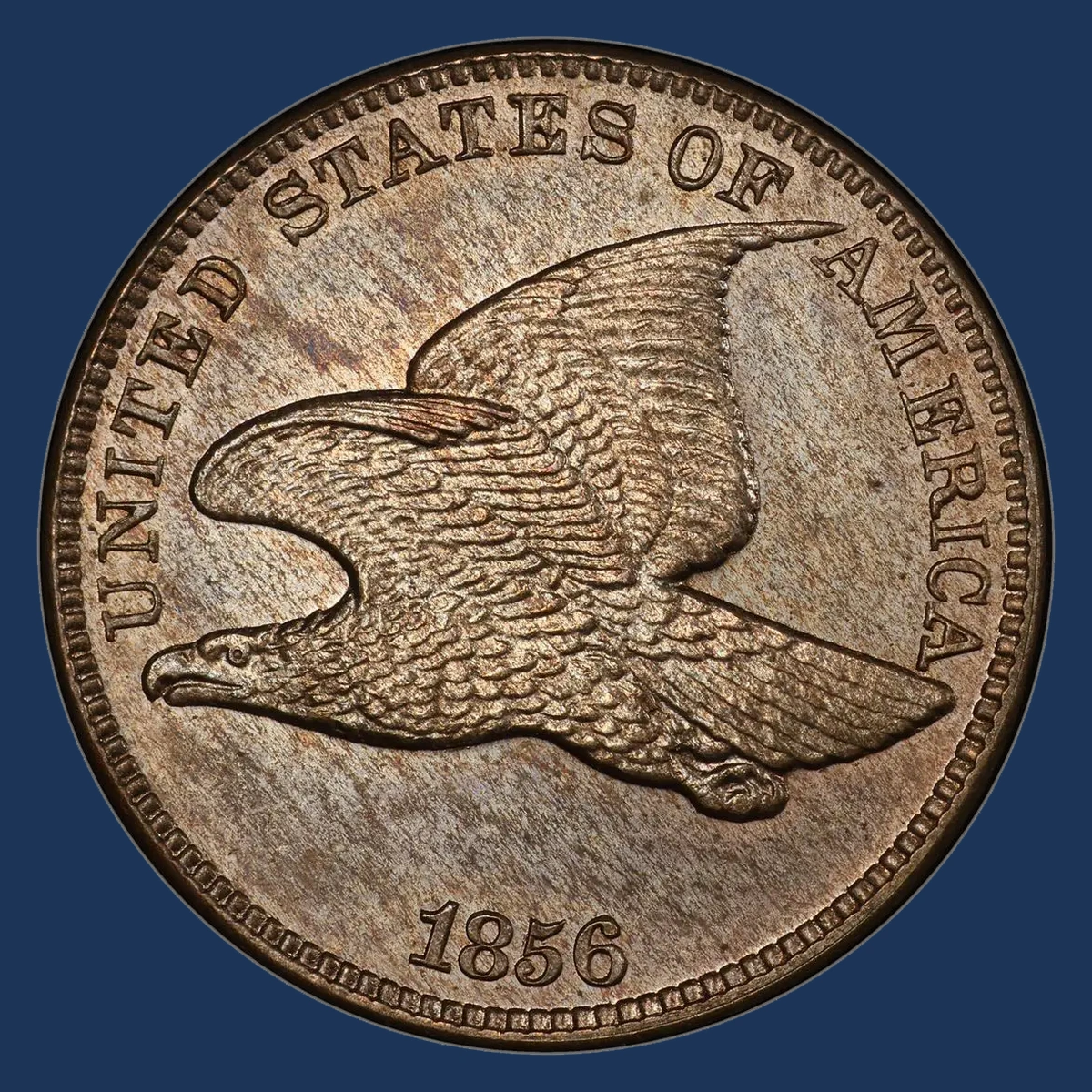
The 5 can show part of an earlier impression beside its final outline. The date punch contacted the stamping tool again, leaving a repeated numeral shape.
PCGS uses this repunched 5 to help identify the Snow-3 variety. The same small feature was copied onto coins made with that front tool.
Grading labels for 1856 examples require care. PCGS lists Snow-3 under regular strikes, while Heritage’s Reiver example carries an NGC PR65 Proof label.
The repeated digit does not settle that distinction by itself. Flattened shelves caused by movement during striking must also be separated from the genuine earlier date impression.
Estimated Value
PCGS records an MS65 Snow-3 at $94,000 in January 2016 and an MS62 example at $20,872.50 in August 2006. Both were unworn, with markedly different preservation.
Estimate $8,000–$100,000 for identified 1856 repunched-5 examples across worn and exceptional grades. The quality and production classification of each coin matter greatly.
The Reiver PR65 with retained lamination brought $27,600. Its two features share that one sale price, and the repeated 5 alone does not account for the full value.
How to Identify
Place the full date under a 10× magnifier, then inspect the extra outline around the 5. Compare its shape with the Snow-3 photographs without confusing it with the digit’s normal thick edge.
Look for engraving grooves or disturbed metal around an altered date. A genuine repeated impression should be raised, not a newly cut extension.
If the coin is loose, a scale and calipers compare approximately 4.67 g and 19.05 mm.
Keep the holder’s MS or Proof classification with the photographs instead of changing it because the 5 is repeated.
Match the earlier 5 outline itself; surface shine or a flat doubled shelf cannot establish the same variety.
Conclusion
The repeated 5 belongs to the stamping tool, while the other two features involve material blocking a blow or separating within the coin. A dent, a stain, and a raised date stroke therefore need different checks.
Estimated whole-coin values range from $8,000 to $100,000. Preserve each example’s grading label and compare its quality alongside the visible feature.
The repunched date and retained lamination can appear together without creating two separately priced coins.