1843 Cent Error List with Pictures

Two 1843 cents can have different portraits and back lettering without either being an error. Those normal design differences matter when matching the 1843 Braided Hair cent errors below.
A dated 15% off-center example brought $2,160 in May 2021. A separate, undated Braided Hair cent on a half-cent blank sold for $3,220 in July 2008; it is a comparison, not an 1843 specimen.
Estimated whole-coin ranges span $15–$10,000. Start with the correct design, then follow the surface, edge, and weight checks for each feature.
1. 1843 Braided Hair Cent Rim Clip — Estimated Value $40–$1,000
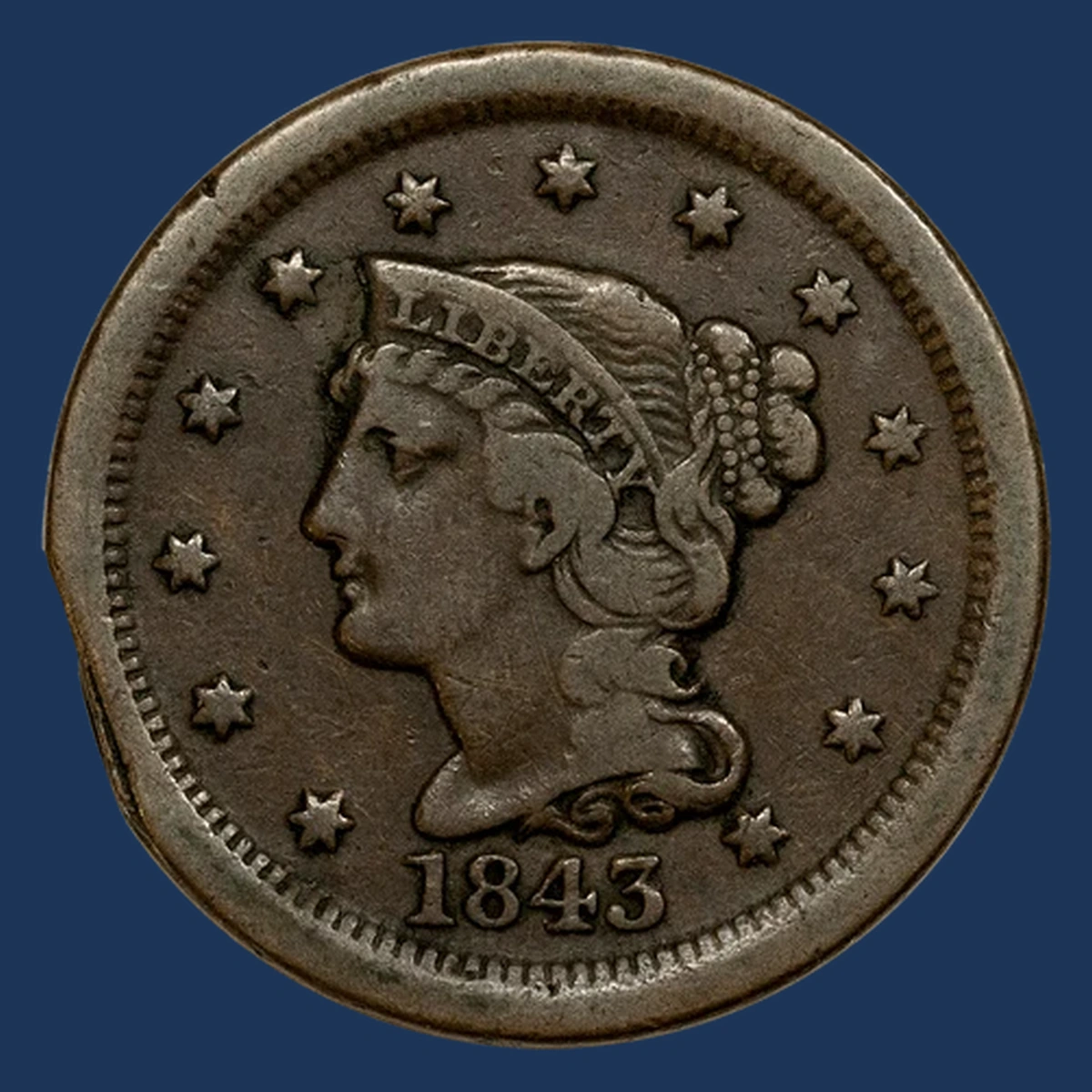
A rim clip begins with metal missing from the blank before it receives a design. The press strikes the remaining disc, leaving an incomplete outline on the finished coin.
A dealer inventory reports an 1843 rim clip in Very Fine condition, meaning circulated with clear major detail. It does not identify the portrait version or give the gap’s direction and size.
Those details need to be matched on the coin. A small piece cut away later can resemble a mint-made clip from a distance.
The difference lies in how the struck rim and design meet the missing area.
Estimated Value
For a genuine 1843 clip, estimate $40–$1,000 according to the opening’s size, surface quality, and remaining design. The dealer’s Very Fine description does not establish a sale within that range.
A same-series 1852 clip graded NGC MS63 Brown sold for $384 in June 2024. It was unworn, unlike the circulated 1843 report.
Use that as a broad comparison rather than a price transfer. A damaged edge and a clean original clip of similar size can attract different levels of interest.
How to Identify
Identify the head and lettering before selecting a comparison photograph. The dealer’s brief rim-clip listing does not settle which normal 1843 design combination the coin carries.
Keep the whole date visible, then enlarge the opening with a 10× magnifier. Look for smooth, original rim formation approaching the gap rather than saw marks crossing finished detail.
For a loose example, use calipers across intact portions against 27.5 mm and compare the weight with 10.89 g on a scale. A shortened span across the gap is not its original diameter.
Inspect the remaining plain edge as well. Weakness opposite a curved clip may help, but the opening itself must carry the evidence of when the metal was lost.
2. 1843 Braided Hair Cent Lamination — Estimated Value $20–$1,500
A layer of copper can lift or peel when the blank contains a weak internal boundary. The resulting rough patch belongs to the metal itself, not to an extra design engraved in a stamping tool.
One seller reports lower-right back lamination on a cleaned, ungraded 1843 cent with Fine-level detail. A separate ANACS VF35 Mature Head, Large Letters example has a front lamination extending from above star five toward star six.
These are different coins. Their defect positions and condition should stay separate.
Neither description establishes that the entire cent split into two complete halves.
Estimated Value
Estimate $20–$1,500 for identifiable 1843 laminations, with cleaning and lost design lowering the useful comparison. The ANACS VF35 front example should not inherit the cleaned back example’s condition.
For perspective, an 1855 cent with a lamination and a rim cud sold for $460 before the buyer’s fee in January 2011. The catalog described that different-year coin as MS62.
That whole-coin price is not a fee per peeling patch. A flake can be interesting while still reducing the coin’s overall appeal.
How to Identify
Choose which face carries the defect before making a condition comparison. The lower-right back report concerns a cleaned coin; the front star-five-to-six example is a separate Mature Head cent.
Under a 10× magnifier, follow the layered edge without lifting it. Cleaning scratches can cross a surface but do not by themselves establish a layer separating from the copper.
If a loose flake remains, leave it in place.
For a loose coin, record scale weight beside the original 10.89 g and caliper diameter beside 27.5 mm. Check the plain edge, but remember that a thin surface loss may barely affect weight.
A local peeling boundary is enough to describe lamination. It does not demonstrate a whole coin split in half.
3. 1843 Braided Hair Cent Struck Through Thread — Estimated Value $75–$2,000
A piece of thread caught between the blank and stamping tool can leave a narrow impression. It interrupted the design while the coin was being struck, rather than scratching the surface afterward.
A dealer lists an 1843 Petite Head, Small Letters cent with this error and an MS64 Brown grade description. MS64 means unworn with some marks; the inventory does not name a grading service.
Its text does not locate the thread mark on a particular face or beside a letter. The actual impression must provide that information.
The normal small portrait and lettering are design features, not additional errors.
Estimated Value
The inventory displayed an asking price of $890 for the MS64 Brown example. It is a dealer quote, not a recorded auction result or an independently assigned grade here.
Estimate $75–$2,000 for a genuine 1843 thread impression, allowing for different condition and clarity. Much of an attractive unworn cent’s price can come from its preservation.
A fine scratch does not receive that estimate merely because it follows a curved line. The impression must fit an obstruction present during striking.
How to Identify
A narrow line needs more than its shape to identify the cause. Under a 10× magnifier, inspect where the line crosses raised design and whether the nearby metal formed around an obstruction.
A later scratch may cut across already finished detail and push metal along its sides. A thread impression should fit interruption of the strike instead.
The dealer’s text does not provide a location, so compare the actual listed coin rather than adding a line beside a guessed letter. Keep the Petite Head, Small Letters identity visible in full-face photographs.
For a loose copper cent, use a scale and calipers to compare 10.89 g and 27.5 mm. Inspect the plain edge for unrelated damage; the thread itself need not alter either measurement.
4. 1843 Braided Hair Cent Die Cracks and Cuds — Estimated Up to $3,000
A crack in a die, the steel stamping tool, can leave a raised line on the cent. When an edge piece breaks away, copper fills the opening and forms a rim-connected patch called a cud.
Reported Petite Head, Small Letters examples have cuds near stars six and seven or above UN on the back. A Petite Head, Large Letters example has a break below the date’s 1.
On the Mature Head, Large Letters variety, another cud sits outside star thirteen. These positions identify different examples, not one coin with all four breaks.
Thin cracks should be checked as raised lines.
Estimated Value
A Mature Head N-6 with a star-thirteen cud and repunched 18 sold for $1,920 in February 2020. NGC graded the whole coin MS64 Brown; the auctioneer’s own assessment was MS63.
Estimate $15–$500 for modest cracks and $75–$3,000 for stronger cuds across different conditions. The cited price includes the coin’s preservation and date variety.
A small worn crack should not inherit that unworn combined-feature result. Keep each head and lettering combination with its own break location.
How to Identify
Start with a full-face comparison that establishes Petite or Mature Head and the back lettering size. Otherwise, a genuine cud may appear misplaced because the wrong normal design is being used.
For a loose cent, weigh it against 10.89 g and measure against 27.5 mm with calipers. Inspect its plain edge where the suspected break meets the rim.
Use side lighting to distinguish solid raised copper from an edge folded inward by an impact. A thin crack likewise needs to rise above the surface, rather than cut into it.
The Mature Head example’s star-thirteen cud can appear with weak repunching under 18. Do not require the Petite Head’s UN, star-six-to-seven, or under-1 breaks on that same coin.
5. 1843 Braided Hair Cent Repunched Date — Estimated Value $30–$4,000
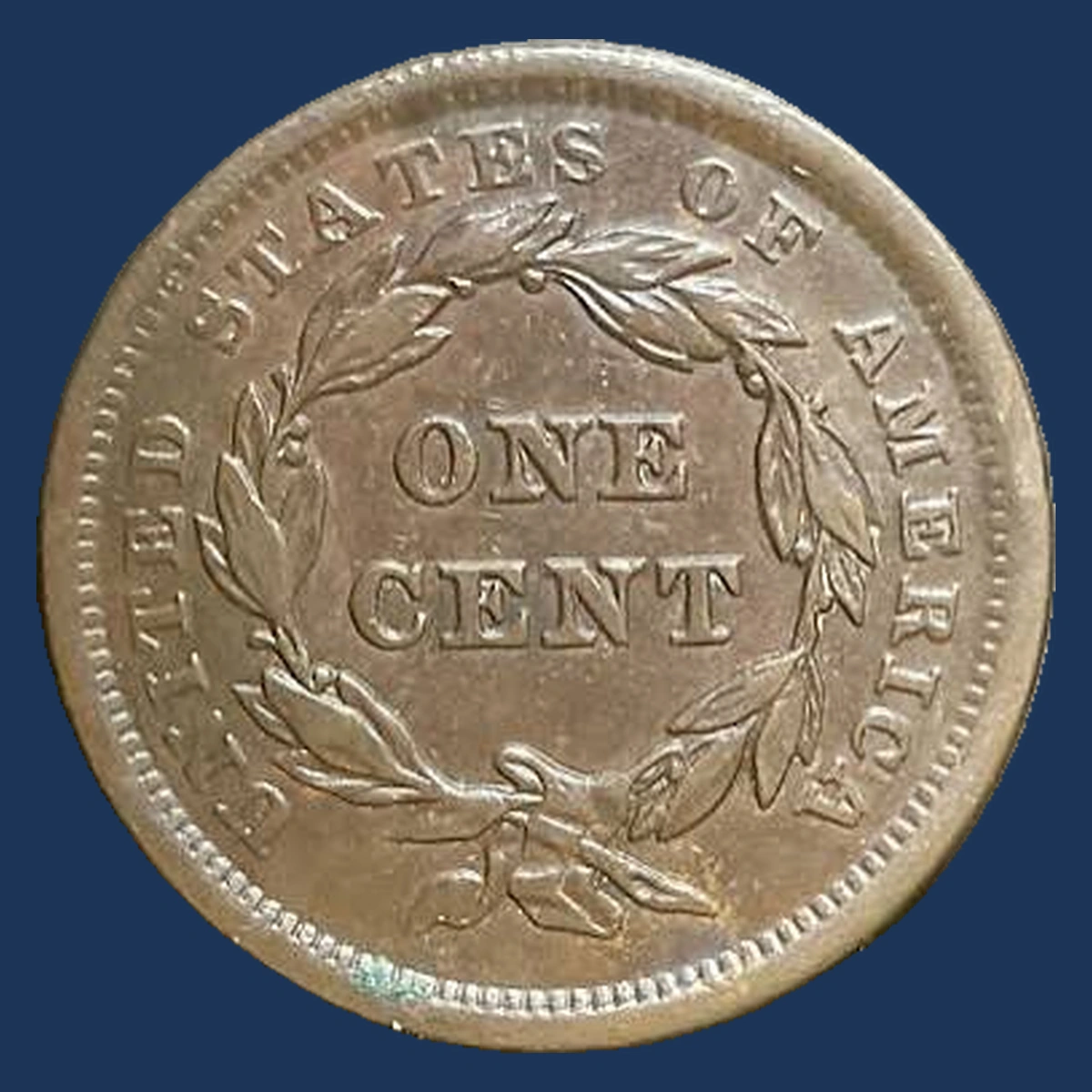
Extra date strokes can survive when a punch enters the stamping tool twice in slightly different positions. Later coins carry the overlapping portions of that repeated date.
A Petite Head, Small Letters example is described as having repunched 843. On a separate Mature Head, Large Letters variety, remnants sit at the bases of 18.
Continued use of the tool can make those small earlier strokes harder to see. They should not be drawn as strong doubling when the coin only preserves faint traces.
The normal differences in portrait and lettering size do not result from the repeated date punch.
Estimated Value
The Mature Head N-6 example with repunched 18 brought $1,920 in February 2020, according to PCGS’s auction record. It also has the star-thirteen cud discussed above.
Estimate $30–$4,000 for identified 1843 repunched dates, from worn examples through attractive unworn varieties. The $1,920 is one whole-coin sale, not an amount to add separately for the date and cud.
Match the actual remnants and condition. A faint ordinary pattern does not automatically share the value of that NGC MS64 Brown specimen.
How to Identify
The auctioned Mature Head coin has weak date remnants, so strong lighting alone can hide what you need to see. Tilt the lamp while leaving the coin still and examine the bases of 18 with a 10× magnifier.
For a loose cent, record its scale weight beside 10.89 g and its caliper diameter beside 27.5 mm. Check the plain edge for alteration.
The Petite Head, Small Letters example instead calls for comparison of 843. Mark the actual raised remnants on a photograph, keeping flat shelves or fresh cuts separate from them.
On the Mature Head example, the star-thirteen cud helps complete the tool comparison. It does not move the weak repunched 18 onto the Petite Head variety.
6. 1843 Braided Hair Cent Off-Center Strike — Estimated Value $300–$5,000
A shifted blank leaves part of the intended design beyond its edge. The opposite area stays bare, producing the crescent that makes many off-center coins easy to notice.
The documented 1843 example is a Petite Head, Large Letters cent struck 15% off center and graded PCGS VF30. It retains a readable date and substantial detail despite circulation wear.
That identity is more specific than a dateless large cent assigned only to a range of years. The reported text does not state its direction of movement.
A slightly uneven rim around a complete design is not the same evidence.
Estimated Value
This PCGS VF30 example brought $2,160 in May 2021, reported in Mint Error News. The sale belongs to the dated Petite Head, Large Letters coin.
An estimated $300–$5,000 covers genuine dated 1843 off-center examples across different offsets and conditions. A readable date makes a stronger comparison than an otherwise similar undated piece.
The size of the bare crescent is only one factor. Surface damage and weak remaining design can reduce appeal, while clear original detail helps explain a stronger price.
How to Identify
The complete date is a useful first check on this reported example. Keep 1843 visible beside the shifted portrait before enlarging the blank crescent.
Compare both faces at the same scale. Look for the part of the design that ran beyond the disc opposite the unused metal, rather than assuming a broad rim proves an offset.
Measure a loose coin’s weight against 10.89 g on a scale; the strike itself need not remove copper. Calipers record its altered outline beside the normal 27.5 mm diameter.
Inspect the plain edge for grinding that could erase finished lettering. The 15% figure does not provide a direction by itself, so use the specific specimen’s photographs to place the shift.
7. 1843 Braided Hair Cent Wrong-Blank Candidate — Estimated Value $1,000–$10,000 if Confirmed
An 1843 cent weighing about 5.4 g has been reported as a possible wrong-blank error. That is roughly half the normal 10.89 g copper weight, but a low reading alone does not identify the blank.
A coin can become lighter through thinning, edge removal, or separation of a metal layer. Those possibilities leave different surface and edge clues.
A true wrong-blank strike happens when a disc intended for another coin enters the cent press. Its size can leave parts of the large-cent design outside the available metal.
The reported weight is a clue to investigate, not proof of the denomination.
Estimated Value
If specialist examination confirms an 1843 wrong-blank strike, estimate $1,000–$10,000 according to the blank, condition, and visible design. This conditional range does not certify the reported 5.4 g candidate.
An undated Braided Hair cent struck on a half-cent blank sold for $3,220 on July 31, 2008 at Heritage. It had scratches, NCS Fine Details, and a recorded 4.69 g weight.
That is a different specimen. Its blank identification should not be transferred to the 1843 claim from weight alone.
How to Identify
Reweigh a loose candidate on a checked digital scale before making any metal or denomination claim. Record its diameter and thickness with calipers alongside the normal 10.89 g and 27.5 mm large-cent standards.
Examine the plain edge under magnification for grinding, cutting, or a layered separation. Those processes can reduce mass without the Mint using another denomination’s blank.
Next, compare the design boundaries on both faces. A genuinely smaller blank should explain the missing outer design through striking, rather than through later trimming.
Keep a certified coin sealed and consult its recorded measurements. A specialist should judge the material, dimensions, and original surface together; the reported 5.4 g by itself cannot name the blank.
Conclusion
Normal portrait and lettering changes make the correct comparison especially important for an 1843 large cent. Keep the Petite Head and Mature Head examples separate, and count combined features on the same coin within one whole-coin value.
Estimated ranges span $15–$10,000. The higher wrong-blank range requires confirmation of that cause, while the dated 15% off-center coin already supplies a $2,160 auction comparison.