1814 Cent Error List with Pictures

Not every unusual 1814 cent has lost part of its design. One worn coin helped stamp a mirror image into another piece of copper, while keeping its own back design raised.
Even a slightly off-center example brought $1,800 including the buyer’s fee in January 2026. This 1814 Classic Head cent error list covers estimated whole-coin values from $100 to $15,000.
Read on to separate missing copper, misplaced designs, and the two sides of a brockage accident.
1. 1814 Classic Head Cent Die Cracks and Rim Cuds — Estimated Up to $2,500
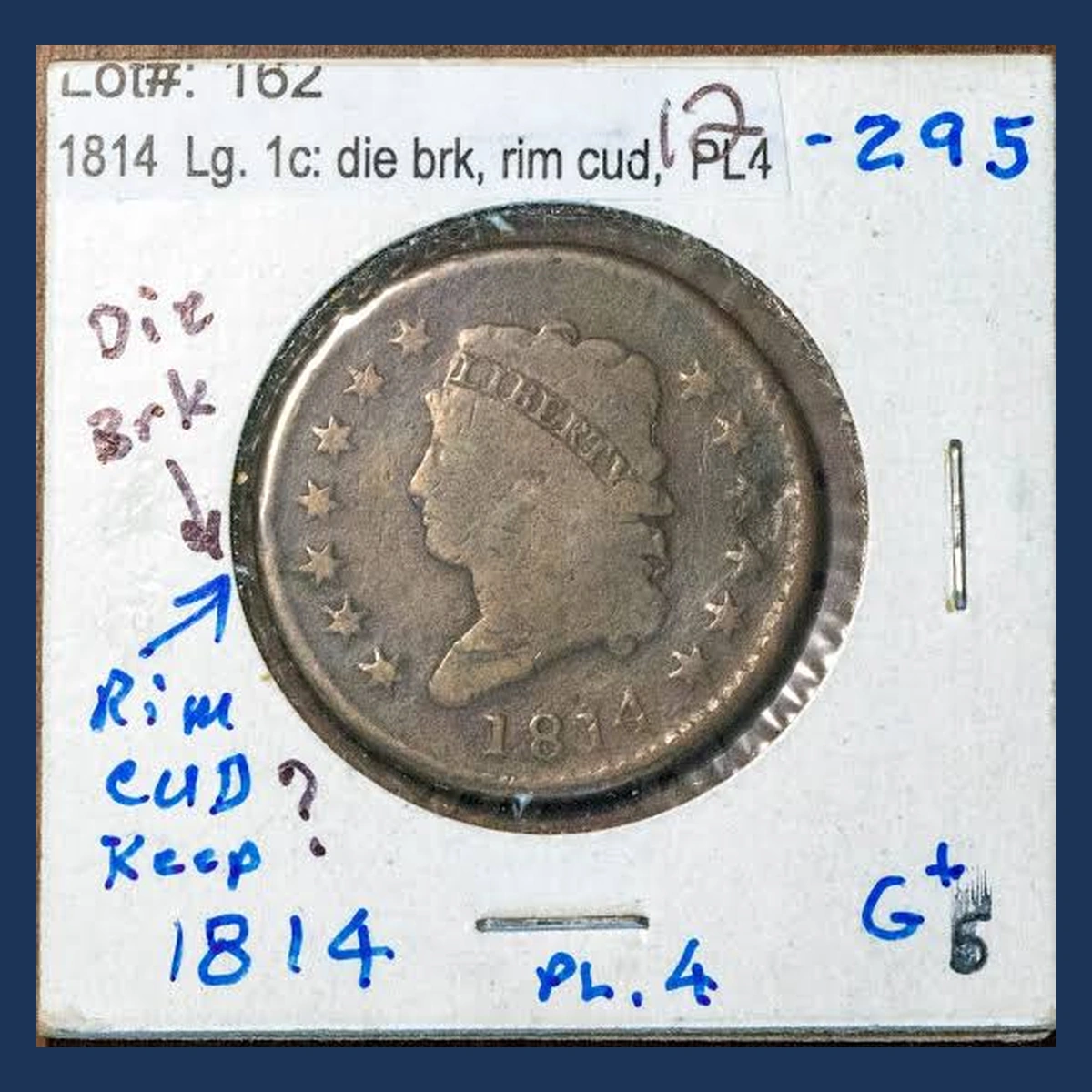
A raised line can mark a crack in the steel tool that stamped the coin. That tool is called a die, and copper pushed into its opening during the strike.
A larger missing piece at the tool’s edge leaves a raised patch joined to the coin’s rim. Collectors call this a cud.
Both features are reported for 1814 cents, without one fixed location that applies to every example. A small lump inside the portrait is not a rim cud, and a line cut into the surface is not a raised die crack.
Estimated Value
A modest crack may add little to the value of an already collectible 1814 cent. Estimate $100–$800 for worn examples with clear cracks, or $250–$2,500 for a substantial authenticated rim break.
For comparison, an 1827 cent with a retained rim break brought $264 including fees in May 2025. That later coin supports a broad comparison, rather than an exact price for a particular 1814 crack or cud.
How to Identify
Tilt the coin under a lamp before selecting a name for the mark. A 10× magnifier should reveal whether it rises above the surrounding copper or cuts down into it.
For a loose coin, use a scale against the normal 10.89 grams and calipers against about 29 mm. Check the plain edge without scraping it.
Now follow the mark: a narrow ridge suggests a cracked tool, while a broad patch needs an original connection to the rim. Pushed metal beside a scratch can also rise above the surface, so inspect both sides of the suspected ridge.
Trace a claimed cud all the way into the rim; an isolated lump inside the portrait does not qualify.
2. 1814 Classic Head Cent Lamination — Estimated Up to $2,500
A thin flap or a shallow area of missing copper can reveal lamination. The metal split within the coin instead of breaking away as one thick piece from the rim.
Trapped impurities or weak bonds in the copper can allow a surface layer to loosen. Some flakes stay attached, while others fall away.
The 1814 reports do not identify a single shared position for this defect. Examine the actual boundary on each coin: corrosion can also remove copper, but a rough or pitted patch alone does not establish that a layer separated.
Estimated Value
Original surfaces matter greatly on early copper coins, even when part of a layer is missing. For an authenticated 1814 lamination, a practical whole-coin estimate is $100–$2,500.
A small layer flaw on an unworn 1842 large cent sold for $750 in September 2021. That different series offers a useful comparison for the defect, but the 1814 coin’s wear and surface quality must be judged separately before choosing a price within the range.
How to Identify
Do not lift a flap to check beneath it. Under a 10× magnifier, follow its thin edge into the surrounding copper and look for a natural separation.
A detached layer may leave a shallow step where the original surface ends. Deep round pits, fresh tool cuts, or a bright scrape call for a different explanation.
The amount of lost copper controls how useful weighing will be.
Compare a loose coin with 10.89 grams on a scale; a small retained flap may leave the weight almost unchanged. Calipers should show about 29 mm across intact areas, and the edge should be plain.
Find a thin attached layer or a natural shallow separation, rather than relying on roughness or low weight alone.
3. 1814 Classic Head Cent Clipped Planchet — Estimated Up to $3,000
A clipped planchet has a missing segment at the edge of the metal disc prepared for striking. The gap existed before the design was pressed into the copper.
Nearby letters or border details may weaken as metal flows toward that open space. The coin can also show a weak rim opposite the gap.
A reported 1814 clip needs those mint-made features, rather than just a bite-shaped outline. A thin or uneven rim can have other causes, and the separate misaligned-back example does not by itself prove that a piece of its blank was missing.
Estimated Value
Allow roughly $150–$3,000 for genuine clipped 1814 cents, with a larger clear gap and better copper surfaces generally attracting more interest. This is an estimate, not a reported sale of the year’s clip.
Ordinary 1814 Plain 4 cents sold for $264 in VG10 and $780 in VF20 in October 2025. Those non-error sales help establish the underlying coin value; the clip’s size and authenticity determine any additional demand.
How to Identify
Begin with the gap’s surface under a 10× magnifier, looking for later file marks, fresh cutting lines, or bent metal. Natural weakening of the struck border beside the gap offers better evidence than a bite-shaped outline alone.
A scale can show a loss from the normal 10.89 grams, but a damaged coin also weighs less. Use calipers across an intact portion against about 29 mm, then inspect the remaining plain edge for cutting marks.
A weak rim opposite the gap can support the identification, though it should not replace examination of the missing segment. Match the gap’s untouched surface and nearby flowing design before treating the absent copper as a mint-made clip.
4. 1814 Classic Head Cent Misaligned Back Die — Estimated Up to $4,000
The back design sits about ten percent toward one o’clock on the recorded 1814 example. Its position differs from the front rather than showing the same shift on both sides.
The back stamping tool was out of line with the opposing tool. This can make the border uneven and push part of one design toward the edge.
Compare it with a coin struck off center, where the disc itself missed the correct position. The shifted back is the documented feature here; an uneven rim should not automatically be described as a separate missing piece of copper.
Estimated Value
For a clearly misaligned back on an authentic 1814 cent, estimate $150–$4,000. The amount of visible displacement matters, but the early copper coin’s preservation can account for much of the price.
An 1814 cent struck slightly off center brought $1,800 including fees in January 2026. That is a different striking error, used only as a same-year comparison; it does not establish a sale price for the reported ten-percent back misalignment.
How to Identify
Keep the coin fixed between the two photographs, or turn it without letting it slide in your fingers. Compare the distance from the front design to its border with the back’s uneven spacing.
On the recorded example, concentrate on the back toward one o’clock. A 10× magnifier helps separate design lost at the edge from lettering simply worn smooth.
If loose, check the copper coin with a scale against 10.89 grams and calipers against roughly 29 mm. Inspect the plain edge for trimming; material removed later can create misleading border gaps.
Then compare both design centers again. A back displaced toward one o’clock while the front lacks the same shift is the key distinction from an off-center strike.
5. 1814 Classic Head Cent Off-Center Strike — Estimated Up to $8,000
About half the design misses the copper disc on the dramatic 1814 example. The strike is displaced toward two o’clock, leaving a large area without normal design.
The coin received the blow while sitting outside the correct position between the tools. Both faces must be considered, because a single shifted tool produces a different pattern.
The recorded worn example also has graffiti on the back’s blank area. Those later scratches are damage, not part of the mint error; other 1814 cents show only a small displacement and should not be expected to match this severe example.
Estimated Value
A slight off-center Crosslet 4 cent assessed as VF30 sold for $1,800 including a 20% buyer’s fee in January 2026. The auction listed a $1,500 winning bid.
An estimated $300–$8,000 covers worn through attractive examples with identifiable dates and differing displacement. The fifty-percent example’s graffiti lowers its appeal, while the January result reflects a better-preserved whole coin rather than a large premium for a tiny shift alone.
How to Identify
A normal copper example weighs 10.89 grams and measures about 29 mm; use a scale and calipers on a loose coin. Allow for an outline distorted by the off-center strike before assuming the metal is wrong.
Locate the date, then separate the original unstruck area from later graffiti across it. Under a 10× magnifier, inspect the plain edge and the boundary beside the design for cuts or signs of an added piece.
The recorded half-off example shifts toward two o’clock, but smaller displacements also occur on other 1814 cents. Look for a matching off-center strike on both faces beside the original unstruck copper.
6. 1814 Classic Head Cent Double Strikes, Indents, and a Brockage Maker — Estimated Up to $12,000
The Plain 4 example has two front impressions, turned only slightly between blows. Its back keeps a single raised design and bulges outward: it pressed that design into another metal disc.
That makes it a brockage maker. The other disc received the sunken mirror image; the maker did not receive that image itself.
A separate 1814 double strike has an indent, a shallow impression left by an overlapping disc during one blow. These are different coins with related striking accidents, rather than three errors that must appear together on every double-struck cent.
Estimated Value
An NGC Good 4 Crosslet 4 double strike sold for $432 in January 2023. The Plain 4 brockage maker drew a $400 winning bid at Goldberg in January 2015; that figure excludes the buyer’s fee.
Estimate $300–$12,000 across worn double strikes and stronger compound examples. For wider context, an 1811 cent with a second strike fifty percent off center brought $16,200 in September 2025, showing the importance of visible separation and condition.
How to Identify
The maker’s back offers the clearest starting point: its design remains raised instead of becoming a sunken mirror copy. In Goldberg’s example, that back also bulges slightly outward.
A loose coin can be checked against 10.89 grams with a scale and about 29 mm with calipers. Inspect its plain edge for later squeezing or a join before studying the two front impressions under a 10× magnifier.
For the separate indented coin, examine the smooth overlapping-disc boundary as well as its repeated design.
On the Plain 4 maker, look instead for two front impressions about five degrees apart and a raised, outward-bulging back.
7. 1814 Classic Head Cent Full Brockage — Estimated Up to $15,000
A full brockage replaces one normal face with a sunken, backward copy of the other design. Letters run in reverse, and the main shapes lie below the surrounding copper.
An already-struck coin became trapped against the next disc and stamped its own raised design into it. The new coin therefore received the wrong image on that side.
Early-cent references record both front-type and back-type 1814 brockages. Their full mirror impressions differ from a partial transfer, and they also differ from the raised back of the double-struck coin that created a brockage on another disc.
Estimated Value
A genuine full 1814 brockage can be estimated at $1,500–$15,000, depending on wear, surface quality, and the clarity of the transferred design. This range is an estimate rather than a claimed sale of a particular 1814 example.
An 1819 cent with a partial back brockage and a twenty-percent off-center strike sold for $5,175 in November 2010. That later compound error provides context, but its partial transfer is not the same as a full 1814 brockage.
How to Identify
Use a mirror beside the unusual face: reversed letters should become readable.
Under a 10× magnifier, check that those letters and the main design are sunken rather than raised. The opposite face should carry a normal raised design.
A digitally reversed photograph changes direction only; it cannot prove that the actual copper contains a sunken impression.
Check a loose coin against 10.89 grams on a scale, and measure roughly 29 mm with calipers. Inspect the plain edge for a seam or heavy squeezing that suggests an altered coin.
The full transfer should cover the face instead of appearing as a small patch. Compare the normal raised face directly with its sunken mirror copy on the other side.
Conclusion
The Plain 4 and Crosslet 4 dates are normal varieties, not errors by themselves. Look instead for separated copper, a shifted strike, repeated design, or a genuinely sunken mirror image.
Estimated whole-coin values span $100–$15,000. Keep later graffiti apart from the mint accident, and remember that a brockage maker has a different appearance from the coin receiving its image.