2005 Nickel Error List with Pictures

A bison stamped over a Lincoln cent brought $26,400 at Heritage in September 2025. Both designs belong to 2005, but they should never have shared one coin.
That unusual piece leads a much wider field of 2005 nickel errors, with estimated values from $5–$30,000. Smaller finds include a missing leg connection, extra horn, and raised spear.
Check whether your nickel has the Bison or Ocean in View back, then use the matching checks below.
1. 2005 Jefferson Nickel Detached Leg and Belly
The bison can appear to have a leg that stops before reaching its body. Part of the belly outline may also disappear.
A known Philadelphia example comes from an overpolished die, the steel tool that stamps the design. Polishing removed shallow details from that tool, leaving gaps on the coins it struck.
This is different from cutting a leg off an existing coin. Similar-looking Denver pieces have also been advertised, but the same appearance alone does not prove the same cause.
Estimated Value
About $10–$50 is a practical estimate for a clear, unworn Detached Leg and Belly example. Fred Weinberg’s price list offered a Philadelphia coin for $20.
That was an asking price, not a recorded sale. Strong gaps with clean surrounding surfaces make a better comparison than a worn animal with several missing details.
Pay for the visible feature rather than the most dramatic nickname on a listing.
How to Identify
Place a normal Philadelphia Bison beside the suspect nickel. A 10× magnifier should show where its front leg normally joins the body and where the belly outline continues.
Compare the two coins in the same light. A polished-away connection can leave a smooth gap while nearby details remain sharp.
Wear tends to soften those neighboring details too. A later cut may leave a trench, fresh scratches, or metal pushed along the edge.
Weigh a loose coin on a digital scale against 5.00 grams and measure it with calipers against 21.21 millimeters. A normal reading cannot prove polishing, but it can reveal substantial metal loss.
Photographs of another known example should show the same missing connections, not merely another weak-looking leg.
2. 2005 Jefferson Nickel Doubled Die
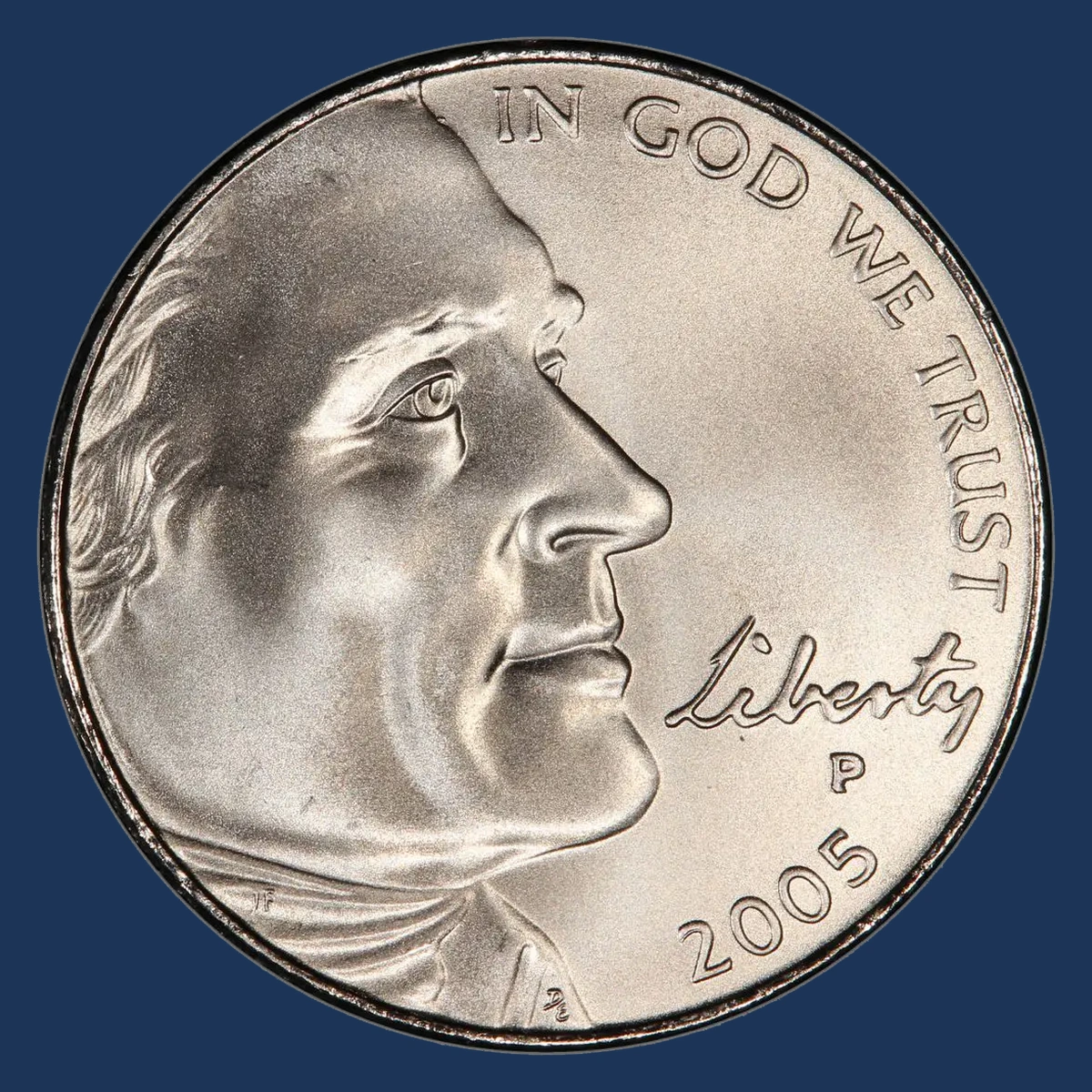
A small second outline can appear beside a letter or design detail. When that extra outline belongs to the stamping tool itself, collectors call the result a doubled die.
One recorded example is a Philadelphia Ocean in View coin with Satin Finish, the softly textured finish used in collector sets. Its auction title identifies doubling on the front.
Other reports describe doubling on the back, including bison details and lettering. Those reports do not make every thick letter or overlapping grass blade an error.
Estimated Value
Allow an estimated $8–$150 for identified minor doubled designs, depending on visibility and condition. PCGS records an $8 GreatCollections result in May 2011 for the Philadelphia Ocean Satin example.
It was graded ANACS 68, indicating an unworn coin with very few marks. That modest result shows why a high numerical grade alone does not guarantee an expensive doubled die.
Back-design reports need their own clear photographs before using the upper estimate.
How to Identify
A Satin Finish Ocean coin needs a Satin comparison, not a shiny circulation coin or a Bison nickel. Photograph the date and mint letter before taking close-ups.
Under a 10× magnifier, examine the reported extra outlines from more than one lighting angle. A flat shelf beside a normal letter often comes from movement during striking rather than a doubled tool.
The auction title for the Ocean example does not name the exact doubled spot. A seller should supply a matching close-up instead of pointing vaguely at LIBERTY.
Normal loose nickels measure about 21.21 millimeters with calipers and weigh 5.00 grams on a digital scale. On Bison backs, compare each apparent second grass blade with an ordinary coin before treating it as extra design.
3. 2005 Jefferson Nickel Feeder Mechanism Marks
Parallel marks across a nickel may be described as feeder finger marks. The feeder is part of the machinery that moves blanks into position for striking.
A year guide reports a Philadelphia example and also lists Denver pieces. However, parallel lines by themselves do not show exactly what touched the coin or its stamping tool.
Scrapes left on a tool can repeat on later coins. Direct contact with material during a strike produces a different mark, so the depth and surrounding design matter more than the label.
Estimated Value
For genuine Mint-made feeder-related marks, use a working estimate of $20–$150. Clear, repeated raised marks usually offer a more useful starting point than an unexplained damaged surface.
The year guide’s much higher reported figure lacks enough detail for a like-for-like comparison here. The range assumes that the marks have been identified, not simply that several lines run in parallel.
An ordinary scratched nickel belongs outside this error estimate.
How to Identify
Choose one line and follow it across the coin with a 10× magnifier. Note what happens when it reaches a raised letter: a fresh groove crossing everything may simply be a scratch.
Now compare the pattern with another reported example rather than judging parallel lines alone. Several raised marks repeated in the same positions can point to a scratched stamping tool, while a direct strike-through needs different supporting evidence.
Check the edge for crushing or filing, using calipers against the normal 21.21 millimeters. A digital scale should show about 5.00 grams; after those checks, the line’s depth and its meeting point with the design matter most.
4. 2005 Jefferson Nickel Die Cracks and Chips
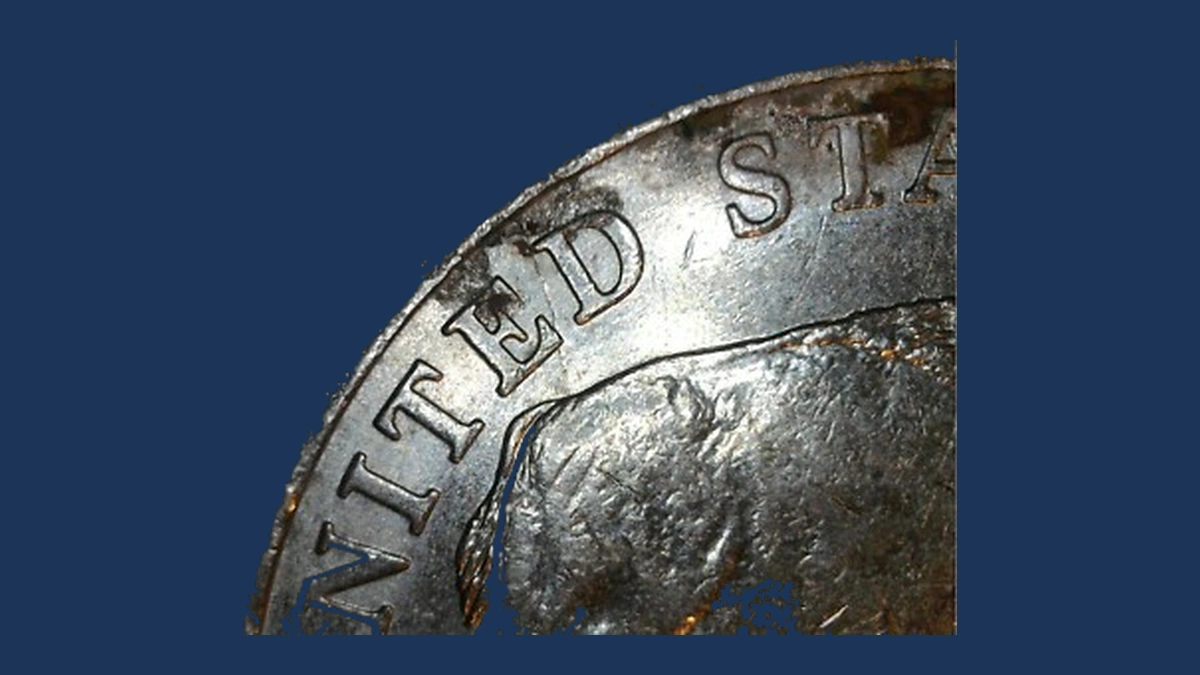
A cracked stamping tool leaves a raised line, while a small missing piece of that tool can leave a blob. Both features add metal above the normal design.
Bison examples include an irregular back crack and the “Two Horned Bison,” with an extra raised patch near the horn.
These differ from the straight Speared Bison line.
A separate San Francisco Ocean example is a Proof, a specially made collector coin. Its front crack runs from the right rim through LIBERTY, showing that the two back designs have distinct examples.
Estimated Value
The useful estimated range is $5–$200, with small chips toward the bottom and larger, clearer breaks higher. A Philadelphia Bison graded NGC MS66 sold for $45 at Heritage in April 2022.
The Ocean Proof crack appeared in an eleven-coin Proof set offered for $135. That figure priced the entire set, not the nickel alone.
Compare the size of the raised feature before paying extra for a colorful name.
How to Identify
The Ocean Proof gives a specific place to start: the right-hand rim, slightly below the horizontal center. Follow the raised line inward through LIBERTY with a 10× magnifier.
For the Bison chip, compare the horn with an ordinary coin. Added metal beside it should be part of the surface, not dirt sitting on top.
Irregular back cracks need a different comparison from the straight Speared Bison gouge. Photograph the entire path rather than one small bright section.
Check a loose piece with a digital scale and calipers against 5.00 grams and 21.21 millimeters. A genuine raised break does not add a separate lump of material to the coin; a sunken cut with torn edges points to damage.
5. 2005 Jefferson Nickel Rotated Dies
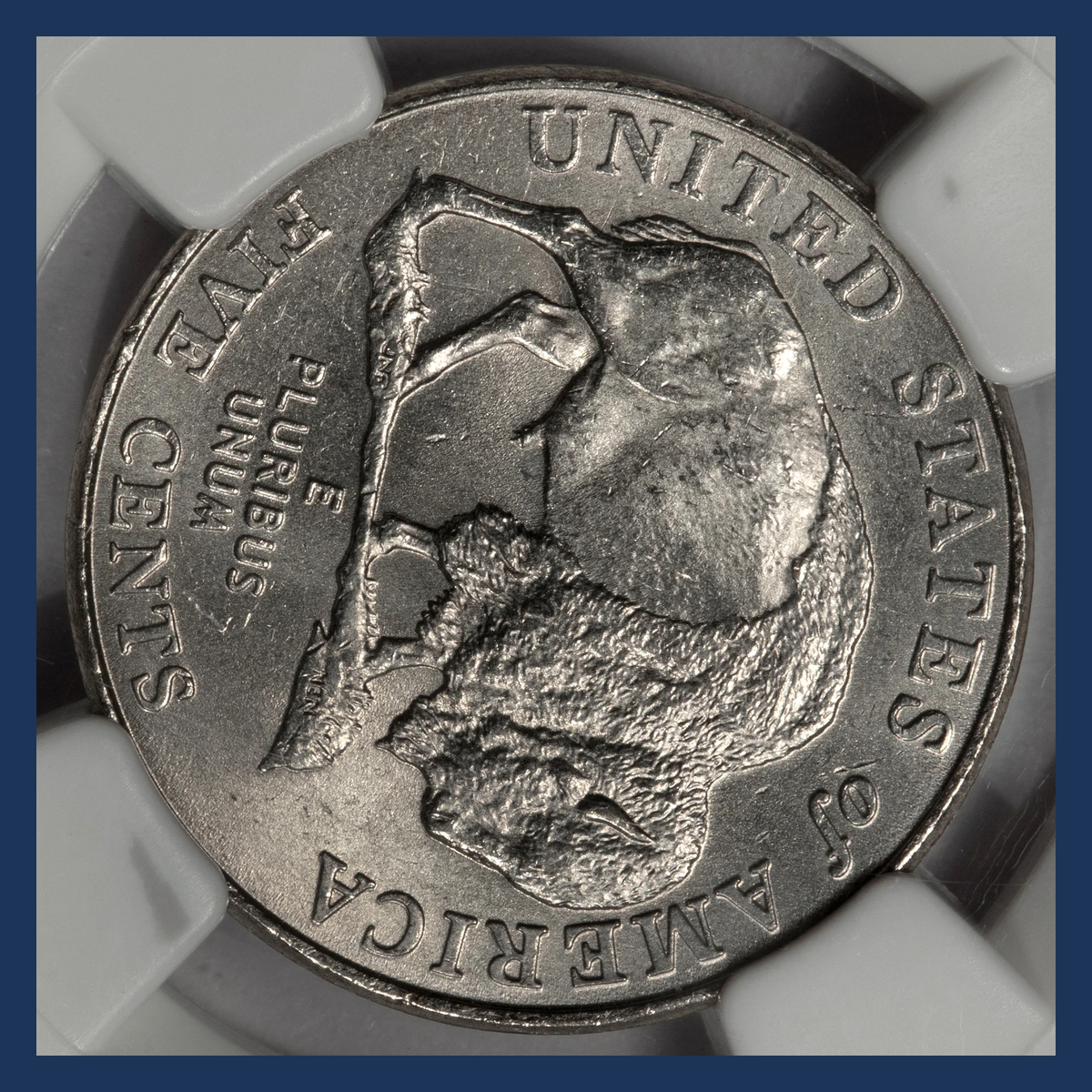
Jefferson may look upright while the bison sits at an unexpected angle after you turn the coin over. This can happen when one stamping tool turns away from its normal position.
Collector CTF reports a Philadelphia Bison example graded NGC MS65, meaning an unworn coin with relatively few marks. The published account does not give its rotation angle.
The important feature is the relationship between the two faces. A crooked photograph of one side cannot establish an error, even if the coin itself is genuine.
Estimated Value
A genuine, readily visible rotation can be estimated at $20–$200. Larger turns generally attract more attention than a slight lean that is difficult to notice.
The reported Philadelphia MS65 example supplies an identity, but no matching sale price or measured angle. This is therefore an estimate for the type, not a valuation of that particular coin.
A buyer should see both faces turned together before comparing the upper end.
How to Identify
Hold Jefferson upright and flip the nickel from top to bottom. Keep your fingers from turning it sideways during the movement.
The bison should stand upright after that flip. Repeat the movement on a normal nickel if the expected direction seems confusing.
Record the suspect coin in one continuous video, then measure the bison’s lean with a printed angle guide. Two separately rotated phone photographs cannot establish the same relationship.
For a loose piece, a digital scale and calipers can check the normal 5.00 grams and approximately 21.21 millimeters. Inspect its plain edge for a seam or evidence of joining two faces.
Leave a certified coin in its holder. Turning the whole holder preserves the relationship between Jefferson and the bison.
6. 2005 Jefferson Nickel Improper Annealing
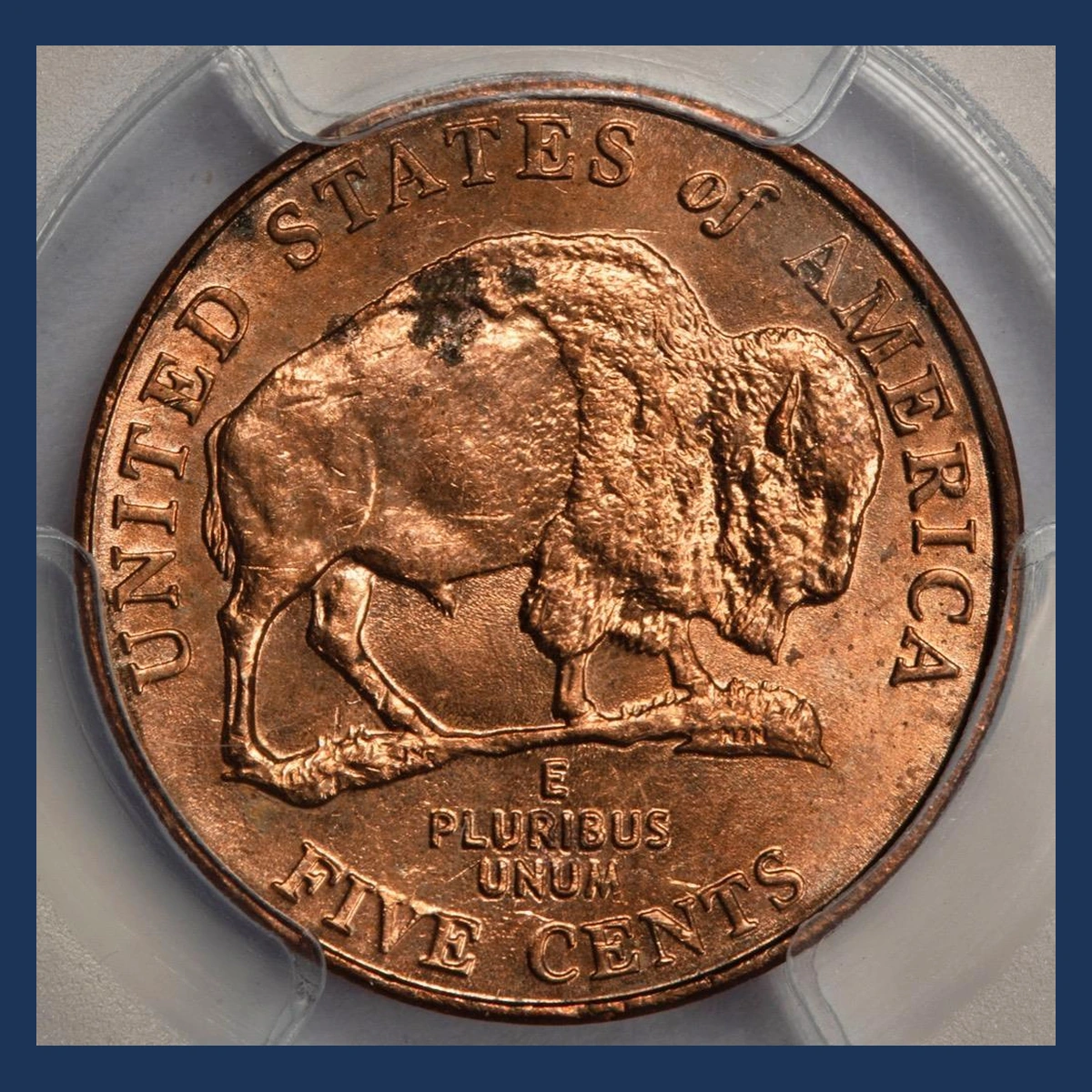
A coppery nickel can look like it was made from the wrong metal. In some Bison examples, the unusual color instead developed during heating of the blank before striking.
That heating step is called annealing. Trouble during the process can leave dark or copper-colored surfaces on a nickel made from its normal copper-nickel alloy.
Recorded Philadelphia examples have been graded by NGC and PCGS. Color alone is not enough, though: a coin exposed to chemicals or heat after leaving the Mint can look similar.
Estimated Value
An estimated $25–$250 covers a useful span of identified examples. Heritage recorded $28 for a PCGS MS64 coin in August 2009 and $126.50 for an NGC MS65 in September 2010.
Both were unworn, but their appearance and grades differed. A separate dealer listing asked $185 for a coppery Bison coin.
These older amounts are comparisons, not current bids, and a brown pocket nickel does not automatically qualify.
How to Identify
A coppery color first raises a question about the metal itself. Weigh the loose coin on a digital scale: its normal copper-nickel alloy weighs about 5.00 grams, while a cent-based error is much lighter.
Check the diameter with calipers against approximately 21.21 millimeters, then inspect the edge under a 10× magnifier. Added plating may peel there, and chemical damage can leave pits on both the edge and faces.
Compare the dark and coppery areas with a certified annealing example under neutral light. Do not heat, polish, or dip your coin to see what happens; intact surface texture is needed to distinguish a Mint heating problem from later damage.
7. 2005 Jefferson Nickel Clipped Planchet
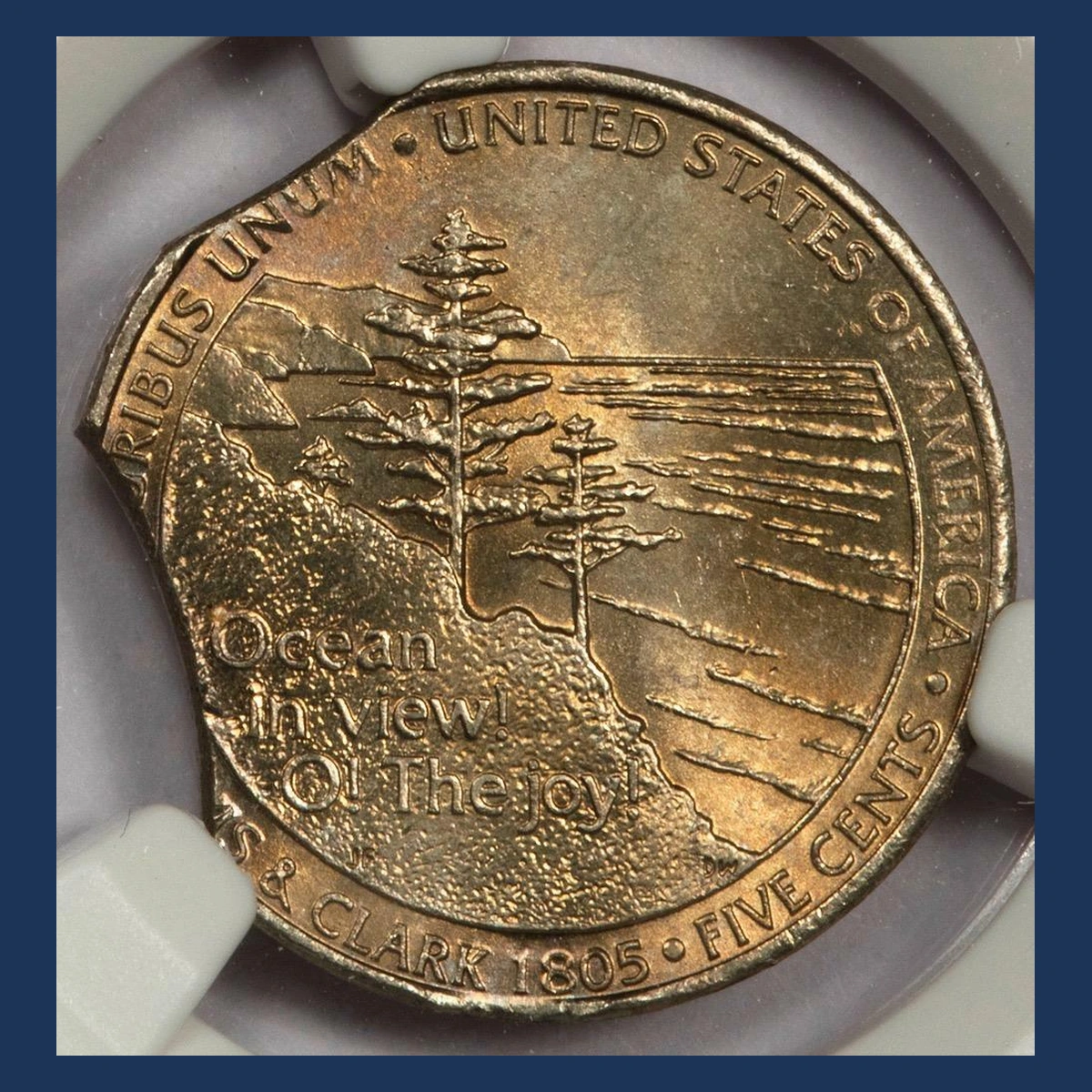
A clipped nickel has a section missing from the metal that was prepared for striking. The cutout may curve inward, run straight, or appear in more than one place.
Both 2005 back designs have examples. Ocean coins include a double clip and a Philadelphia seven-percent clip; Bison pieces include curved and triple clips.
The missing metal came before the design was stamped. This timing matters because a later cut can imitate the outline but usually leaves different marks where the design and missing section meet.
Estimated Value
Expect roughly $40–$300 for clearly identified clips, depending on size, condition, and the number of missing sections. A Philadelphia Bison with a ten-percent curved clip sold for $99 at Heritage in June 2026.
Another Bison with an eighteen-percent triple clip brought $94 in January 2012. Its higher grade did not make the older result higher.
An Ocean seven-percent clip was separately offered by a dealer for $225.
How to Identify
A digital scale should show less than the normal 5.00 grams when a substantial portion of the blank is missing. Use calipers across an intact span, comparing it with the usual 21.21-millimeter diameter.
Under a 10× magnifier, inspect how the struck design ends beside the gap. Metal may flow toward a genuine clip, whereas a saw or file can cut straight through already finished details.
Check the opposite rim for supporting weakness, but do not reject a clip solely because that weakness is absent. On double or triple clips, examine every opening: a later cut added beside one genuine clip still needs to be recognized as damage.
8. 2005 Jefferson Nickel Low-Pressure Strike
A very weak strike can leave Jefferson and the back design shallow even on an unworn coin. The press did not push enough metal into the recessed details of its stamping tools.
A 2005 year guide reports a Denver example as a die adjustment strike. A weak coin cannot, by itself, reveal whether an operator was setting up the press.
Wear, blocked details, and acid damage also make designs faint. Both faces and the edge need to fit low striking pressure.
Estimated Value
For a genuine, substantial low-pressure strike, use an estimated $50–$400. The upper part assumes broad weakness with original surfaces and a clear professional identification.
A guide reports a higher-priced Denver coin, but the exact example is not described well enough for a close comparison. A nickel with one weak word should not inherit that price.
Heavily worn or chemically thinned pieces are excluded from this working error range.
How to Identify
Start with a digital-scale reading near the normal 5.00 grams and a caliper measurement around 21.21 millimeters. Acid treatment can make a coin both lighter and smaller.
Then compare the high points and lower details using a 10× magnifier. Circulation wear normally rubs down exposed areas first; a weak strike can leave shallow details without that rubbing.
Inspect the entire back, not just Jefferson. Grease blocking a small area may erase one word while the surrounding design remains strong.
Examine the rim for signs that metal never fully filled it during striking. Broad weakness across both faces, with intact unworn surfaces, is more persuasive than a faint patch on only one side.
9. 2005 Jefferson Nickel Off-Center Strike
An off-center nickel shows a blank crescent beside a design pushed away from the middle. Part of the design may run off the opposite edge.
A Bison example graded PCGS MS63 appears in a specialist collector’s account. Ocean in View pieces are also reported in year guides, although those accounts provide less detail about individual coins.
The displacement should affect both faces because the blank sat in the wrong place between the tools. A complete design with only one uneven rim points to a different striking problem.
Estimated Value
Use an estimated $50–$500 for genuine 2005 off-center nickels with a readable date. A wider blank area and clearer missing design usually make the error easier to appreciate.
The recorded Bison MS63 example confirms that this type exists, but its account does not supply a sale price. Ocean reports likewise lack a directly matched transaction here.
The estimate is based on comparable modern nickel errors, with damage reducing the appeal.
How to Identify
Place the nickel on a plain background and photograph both faces at the same scale. The unstruck part should correspond on the two sides, rather than appearing only around Jefferson.
Read the remaining date and mint letter with a 10× magnifier. Do not fill in a missing letter from the back design: both Philadelphia and Denver made these designs.
Calipers help record the spread, while a digital scale should still read near 5.00 grams if no metal is missing. The normal starting blank is about 21.21 millimeters across.
Unlike a clip, an off-center strike keeps the unstruck metal. Look for that blank crescent together with design lost at the opposite border.
10. 2005 Jefferson Nickel Partial Collar with Clip and Strike-Through
One Philadelphia Bison nickel combines three visible problems: a straight clip, a stepped edge, and a mark from material caught during striking. PCGS graded the coin MS63.
The stepped edge comes from a partial collar strike. The collar is the ring surrounding the blank, and only part of the coin was held inside it.
The twenty-percent straight clip was already missing before the strike. Material also blocked part of the front, so all three features belong to one coin rather than three separate finds.
Estimated Value
Fred Weinberg offered this combined-error coin for $350 in his major mint error price list. A working estimate for a comparable complete piece is $250–$500.
The asking price covered the whole coin, including the clip and blocked front detail. Adding separate prices for all three features would count the same object several times.
A damaged edge or an unclear striking mark would make that comparison less useful.
How to Identify
Turn the nickel on its side under a lamp. A partial collar can leave a clear step where one part expanded beyond the ring and another part remained confined.
Use calipers to compare those two edge levels with the normal 21.21-millimeter diameter. A 10× magnifier helps distinguish a struck ledge from metal squeezed sideways by later damage.
The straight clip means the digital-scale reading should fall below the usual 5.00 grams. Inspect the cut boundary for struck metal flow rather than file marks.
Finally, photograph the front depression without guessing what caused it. The published description identifies a strike-through but does not name the trapped material; the edge step remains the clearest check for the partial collar.
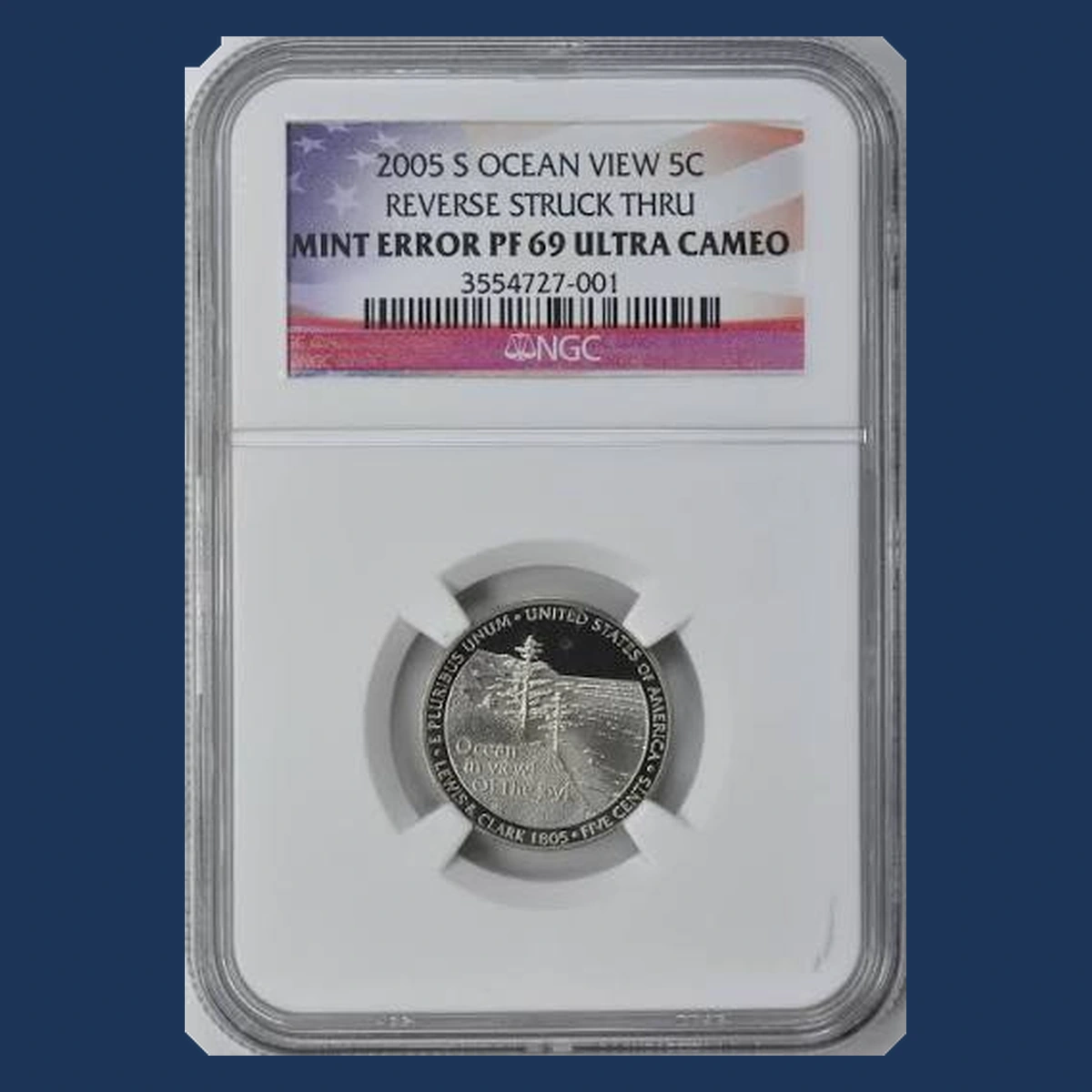
11. 2005 Jefferson Nickel Proof Strike-Through
A broad area of a Proof nickel can lose its normal detail when something gets between the blank and a stamping tool. Collectors call this a strike-through.
A specialist article illustrates a 2005-S Proof with a large affected area on the front. The account does not identify which of the year’s two back designs appears on that coin.
Unlike the Detached Leg feature, this problem involves material blocking a strike rather than details polished off a tool.
The shape may help explain the obstruction, but it does not automatically identify it.
Estimated Value
A broad, genuine Proof strike-through can be estimated at $100–$600. The range allows for differences in size, visibility, and how much of Jefferson remains clear.
The illustrated 2005-S example does not come with a matched sale price, so this is a comparison-based estimate. Proof surfaces also show scratches readily, and those marks can reduce collector interest.
A small hazy spot is not equivalent to a large area blocked during striking.
How to Identify
Keep the Proof surfaces untouched and move a lamp across the affected area. A 10× magnifier helps show whether design fades beneath an obstruction or has been cut away afterward.
Sharp grooves with pushed-up metal point toward later damage. Leave any material still attached to the coin in place.
Read the S mint letter and turn to the back. The large front mark does not establish whether the coin is Bison or Ocean in View.
For a loose nickel, check about 5.00 grams on a digital scale and 21.21 millimeters with calipers. A coin sealed in a grading holder should stay sealed.
Photograph the boundary in several lighting positions. Design interrupted along a struck boundary is more convincing than a ragged, torn gouge.
12. 2005 Jefferson Nickel Speared Bison Die Gouge
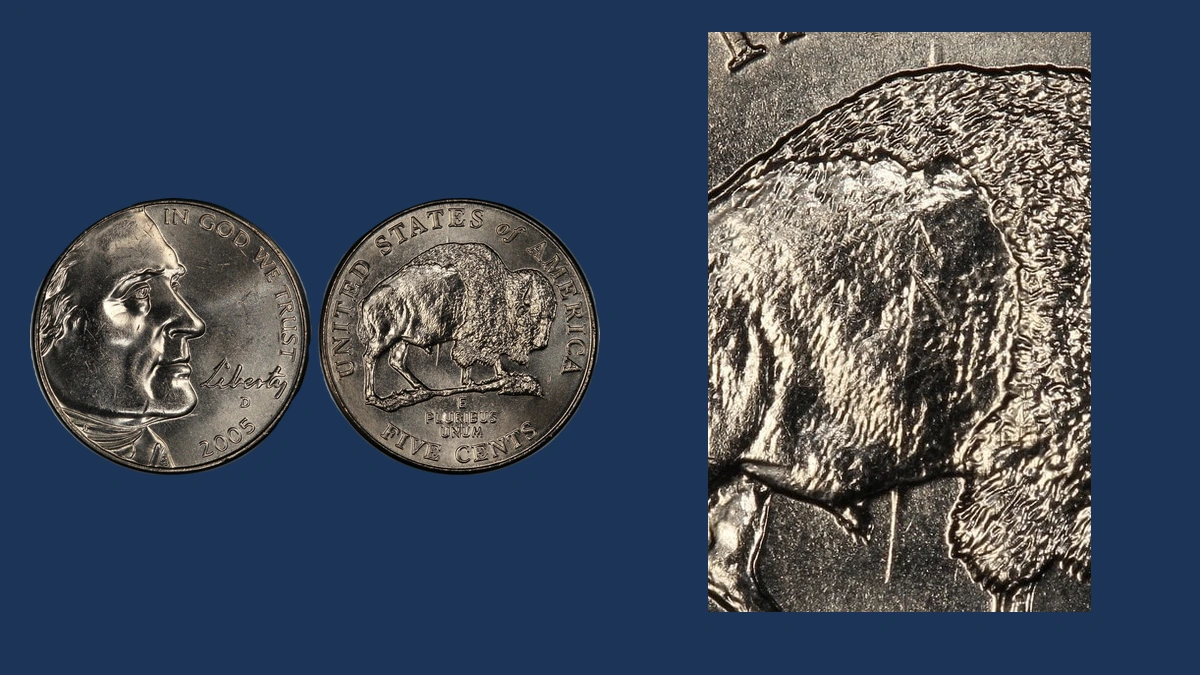
A straight raised line appears to pierce the bison’s back and continue through its body. It is one of the easiest 2005 varieties to recognize with a magnifier.
The line comes from a gouge in the stamping tool. Metal entered that groove during striking, leaving a raised mark on the coin instead of a sunken scratch.
This named variety belongs to the Denver Bison design and is also called FS-901. A random line on a Philadelphia coin, or a winding crack across a bison, is a different feature.
Estimated Value
The estimated range is $100–$3,000, with worn or marked examples below especially clean, high-grade pieces. PCGS CoinFacts lists a $2,650 eBay result from October 2021 for an MS66 example.
That grade describes an unworn coin with few marks. The listed record is not a promise that another coin with a raised line will sell for the same amount.
Correct identification comes before the grade comparison.
How to Identify
The expected coin is a Denver Bison nickel, so read the D before following the spear. Its normal 5.00-gram weight and roughly 21.21-millimeter diameter can be checked with a digital scale and calipers on a loose example.
Place a known Speared Bison photograph beside it and use a 10× magnifier to compare the line’s path. The mark rises from the animal’s back and passes through its body toward the belly.
Rock the light across that line to distinguish a raised ridge from a sunken scratch. A winding crack can be a real error of another kind; the straight raised path through the Denver bison is what identifies this variety.
13. 2005 Jefferson Nickel Bison Design Struck over a Lincoln Cent
The Lincoln Memorial should not appear underneath a bison on a five-cent coin. Here, a finished 2005 cent entered the nickel press and received another design.
The second strike added Jefferson and the Bison nickel back over the existing cent images. Collectors call this a double denomination because two different coin values share the same piece of metal.
The known Philadelphia example retains enough of the original cent to establish the sequence. It is not simply a nickel stamped on an unused copper-colored blank.
Estimated Value
Heritage sold the NGC MS68 Red example for $26,400 in September 2025. A practical estimate for a similarly impressive, authenticated piece is $15,000–$30,000.
Its high grade describes an unworn surface with very few marks, while Red describes its copper color. Clear remains of both designs help explain the strong price.
This same object can appear in a 2005 cent list; that does not represent another separate sale.
How to Identify
Begin with the surviving cent design, especially the Lincoln Memorial beneath the bison. Use a 10× magnifier to follow parts of both images through their overlap.
An unused cent blank would have no earlier Lincoln design. A coin pressed against another after leaving the Mint usually shows different, often sunken or reversed, impressions.
The original 2005 cent normally weighed 2.50 grams and measured 19.05 millimeters across. A nickel normally weighs 5.00 grams and measures 21.21 millimeters, but the second strike can spread the smaller piece.
Use a digital scale and calipers only on a loose coin; leave a certified example sealed. Surviving cent details beneath the newer nickel design provide the essential evidence for the order of striking.
Conclusion
Estimated prices for these 2005 nickels run from $5–$30,000, from small raised breaks to the dramatic nickel struck over a cent. The famous Speared Bison occupies a separate place between those extremes.
A missing leg, weak portrait, or odd color needs more than a nickname. Compare the correct back design and finish, then check the metal itself.
Keep both faces visible when judging clips, rotation, and overlapping designs.