1984 Nickel Error List with Pictures

One tiny 1984-P nickel combines the wrong blank with two separate strikes. The dime-sized error sold for $1,495 in August 2010, while simpler same-year mistakes have traded for only a few tens of dollars.
In this 1984 nickel error list, estimated whole-coin values span $10–$4,000. The examples include missing letters, broken-tool marks, copper-colored blanks, and coins that flipped between blows.
Read on to see which visible clues distinguish these very different minting events.
1. 1984 Jefferson Nickel One Design Shifted toward the Rim
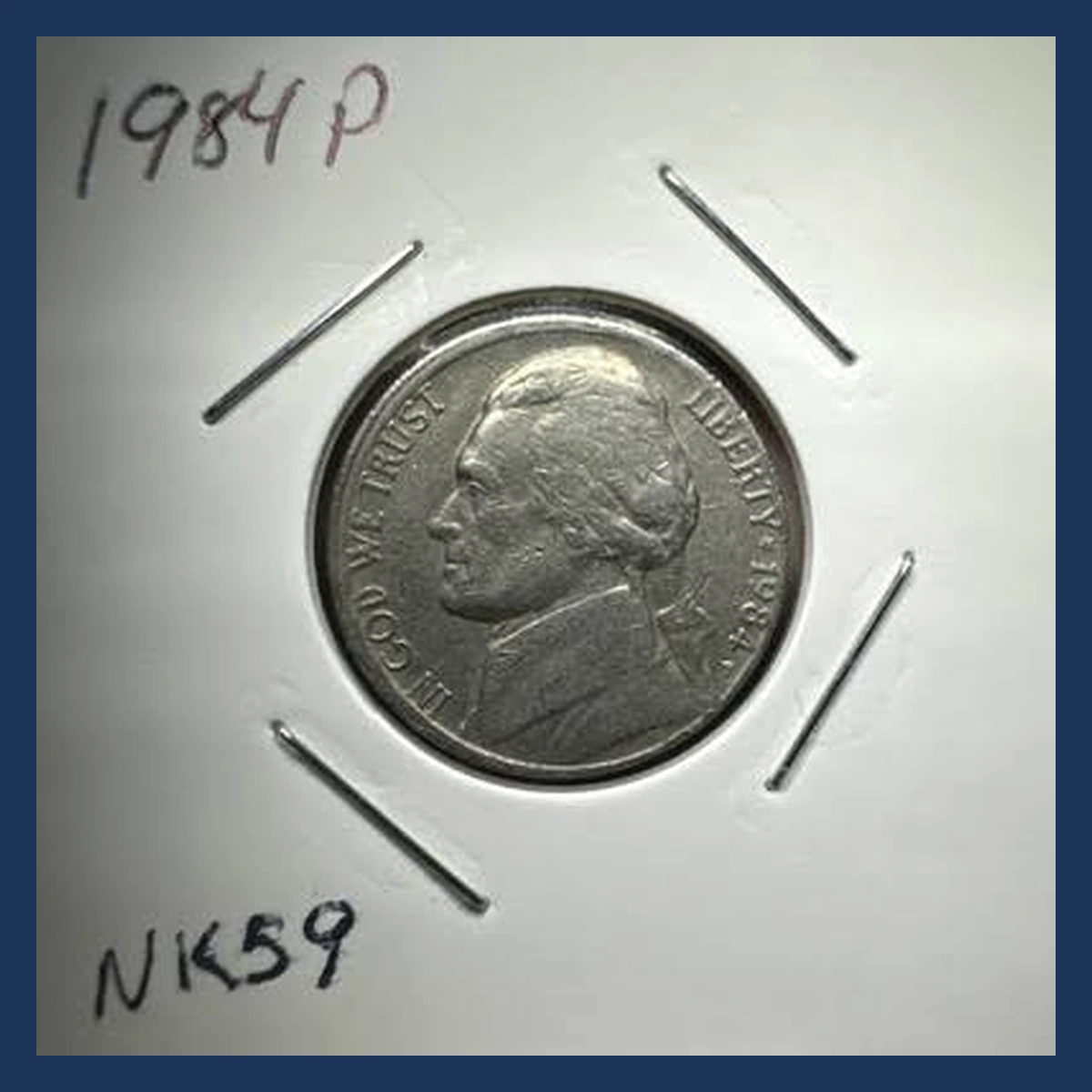
The portrait can sit closer to one edge even when the opposite design is better centered. A misplaced stamping tool can create this unequal relationship between the two faces.
A Philadelphia example was cataloged as having misaligned dies and graded ICG MS62. A die is the steel tool that impresses one side of the coin, and MS62 describes an unworn coin with noticeable marks.
The listing does not establish a specific direction of movement.
A damaged rim or a photograph taken at an angle can also make one margin look narrower than another.
Estimated Value
The cataloged 1984-P misaligned-tool example sold for $14 in December 2008. That modest price belongs to a particular unworn coin.
Estimate $10–$75 for small but clear shifts and $75–$200 for pronounced displacement on attractive examples. These are whole-coin estimates, not premiums to add to any uneven border.
Later rim damage should be excluded before comparing a find with the auctioned mint error.
How to Identify
A sloping camera view can make an ordinary rim look uneven. Photograph both faces straight on before deciding that one stamping tool was misplaced.
Compare the distance between the design and edge around each face. Mark the narrowest and widest margins in the photographs.
For a loose coin, use a scale against 5 grams and calipers against 21.21 millimeters. Look along the plain edge through a 10× magnifier for flattening or pushed-up metal.
A rim impact can explain both a distorted edge and an uneven-looking design margin. Check that possibility before identifying a mint error.
If only one face shows the displacement, tool misalignment fits better than a whole off-center strike. Both designs moving together would require a different explanation.
2. 1984 Jefferson Nickel The Full Design on an Expanded Disk
A nickel normally spreads against a collar, the ring that controls its outside edge during striking. If that ring does not contain the metal, the disk can widen beyond its intended outline.
This is a broadstrike. Recorded Philadelphia examples include ordinary expanded coins without a separate wrong-blank or repeated-strike description.
A simple broadstrike retains the complete design. An unstruck crescent beside missing outer lettering instead points toward an off-center strike.
Since a nickel’s normal edge is plain, the absence of grooves is expected on both ordinary nickels and these expanded errors.
Estimated Value
A 1984-P broadstrike graded ANACS MS64 sold for $20 in August 2021. The grade describes an unworn coin with some marks.
Estimate $20–$100 for straightforward broadstrikes and $100–$250 for unusually attractive expansion. The whole design and condition matter more than width alone.
A nickel widened by later hammering does not qualify for those error values, and the separate prices of complex wrong-blank combinations should not be applied to a simple expanded strike.
How to Identify
Use calipers on a loose specimen to compare two widths with the normal 21.21 millimeters. Then weigh it against 5 grams; a broadstrike spreads the existing metal instead of adding a larger rim.
Examine the entire inscription on both faces through a 10× magnifier. The full design should fit on the expanded disk.
Check the portrait’s high points and the plain edge for hammering. Repeated impact marks crossing completed detail can explain later flattening rather than expansion during minting.
Keep a normal nickel beside the photographs as a size reference. If part of the intended design lies beyond an unstruck crescent, the coin needs an off-center explanation instead of a simple broadstrike.
3. 1984 Jefferson Nickel A Reported Extra D above the Mint Letter
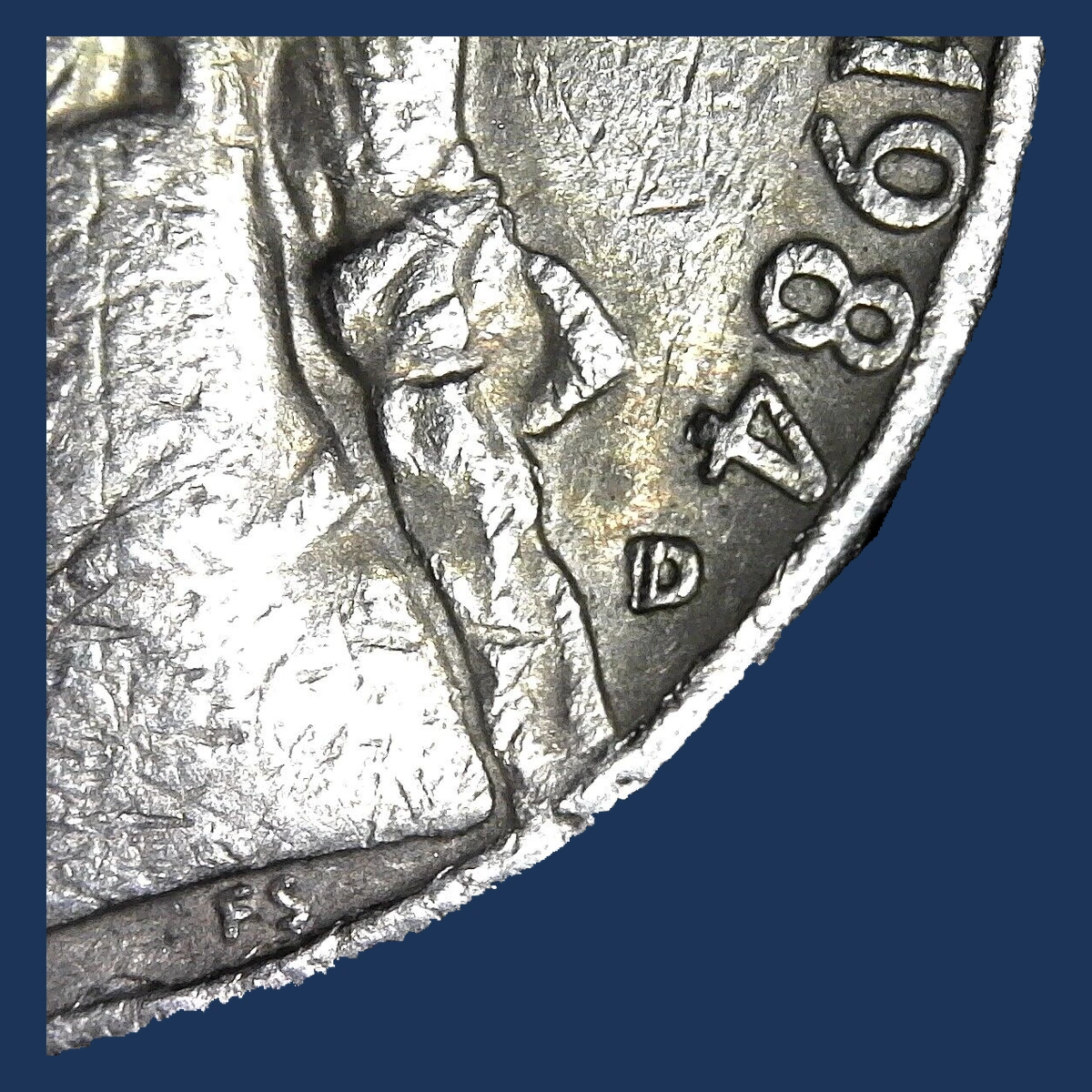
The D beneath the date identifies Denver. During this period, a letter punch could be applied more than once while the stamping tool was being prepared.
A slightly displaced earlier punch could leave part of a second D around the final letter. This is called a repunched mint mark.
A year source reports a 1984-D example with an extra outline above the main D. Its particular catalog number has not been established from a specialist entry here.
The extra-looking mark must be distinguished from a scratch, lighting, or a flat shelf created during striking.
Estimated Value
Use a conditional estimate of $10–$100 for a genuine minor repunched D and $100–$300 for a strong, attractive example. These are estimated values for a correctly identified variety.
The year report does not provide a verified sale for a specialist-attributed specimen. A clear match is needed before applying these figures to a candidate.
Letter thickness alone is insufficient, especially when a bright reflection or flattened edge can resemble the reported upper outline.
How to Identify
Photograph the D together with the date rather than cropping away the coin’s identity. A 10× magnifier should show whether the reported upper trace has the shape of part of the letter.
Move the light across it. A reflection may shift, while an actual extra stroke stays in the metal.
Compare the candidate with a specialist-attributed example before using a catalog number. The year source’s label does not replace that visual match.
Check a loose coin with a scale and calipers against 5 grams and 21.21 millimeters, and inspect the plain edge. Those normal measurements establish the basic nickel, not the repunched D.
A scratch running past the letter needs a different explanation from a leftover punch impression.
4. 1984 Jefferson Nickel Missing Detail and an Absent P
Material lodged in a stamping tool can keep letters or portrait details from forming. Year guides report grease-filled areas on 1984 nickels, affecting local front or back design.
A separate Philadelphia auction specimen was specifically described as missing its P mint letter. Its catalog title identifies the absent mark without establishing the exact cause.
A missing P should therefore not automatically be explained as the same grease blockage. Normal Philadelphia nickels of this date carry that letter.
Wear, polishing, or a removed mint mark can create similar blank-looking spots and need to be excluded.
Estimated Value
The missing-P specimen, graded NGC MS63, sold for $149.50 in August 2010. MS63 describes an unworn coin with some noticeable marks.
Estimate $10–$100 for small genuine blocked areas and $100–$350 for clear larger defects or an authenticated missing-letter example. The exact cause and preservation affect the comparison.
A worn or scraped-off P should not receive the same price merely because the letter can no longer be seen.
How to Identify
For the absent-P form, first establish a readable 1984 date and examine the expected letter position beneath it. Use a 10× magnifier to look for scraped metal or disturbed texture.
Missing local detail elsewhere should be compared with nearby sharp design and ordinary wear. If all exposed high points are equally smooth, blockage may not be the best explanation.
A loose nickel normally weighs 5 grams and measures 21.21 millimeters; record these with a scale and calipers. Include the plain edge and both faces in photographs.
Do not infer grease from every empty patch. The missing-P catalog establishes the feature, while its precise production cause needs evidence beyond the absence of the letter.
5. 1984 Jefferson Nickel Doubled Front or Back Design
A repeated outline can begin in a stamping tool before any coin is made. The tool then passes that doubled design to coins struck from it.
Year sources report Philadelphia front doubling around the motto and date. A separate Denver back report concerns E PLURIBUS UNUM and UNITED STATES OF AMERICA.
These are different sides and mint issues, not one combined pattern required on every coin. Specialist catalog numbers should not be supplied without a matching entry.
A doubled-tool design differs from two separate blows on a coin or a flat shelf created by movement during striking.
Estimated Value
Estimate $20–$125 for genuine minor doubled designs and $125–$400 for strong, attractive examples with little wear. These are estimated ranges for the reported 1984 types.
They are not verified sales of particular specialist-numbered Philadelphia or Denver varieties. A clear visual match is required before placing a coin in either range.
Do not transfer an impressive price for a different year’s major doubled design to a faint 1984 extra edge without comparison.
How to Identify
Start with the mint letter: the Philadelphia report concerns front detail, while the Denver report concerns back inscriptions. With a 10× magnifier, compare the appropriate motto or lettering with a specialist-attributed example rather than combining both reports on one coin.
Change the light to separate a reflection from a fixed extra outline in the metal. A flat shelf cutting into the main stroke can have a different cause from rounded repeated detail.
For a loose coin, use a scale and calipers against 5 grams and 21.21 millimeters, then examine the plain edge. Normal measurements establish the basic nickel, but only a matching repeated design can establish its particular variety.
6. 1984 Jefferson Nickel Separation within the Copper-Nickel Alloy
A thin flap or shallow opening can expose a weak layer inside the alloy. Collectors call this kind of internal metal separation lamination.
Year sources include the type for 1984 without establishing a particular local position on one certified coin. A candidate needs its own surface and edge examination.
A normal nickel is a solid copper-nickel alloy. It does not have a copper core with an outer nickel layer waiting to peel away.
Corrosion, a scrape, or an added coating can also produce roughness, so a peeling appearance alone does not identify a mint-made internal flaw.
Estimated Value
For a genuine 1984 lamination, estimate $20–$100 for small clear separations and $100–$400 for larger, appealing examples. These are estimated ranges for the reported type, not a sale of an identified specimen.
The location and surviving design influence interest. A large missing flap across important details may be less attractive than a smaller well-preserved feature.
Surface corrosion and peeling added coatings do not become mint errors simply because they expose rough metal.
How to Identify
Leave an attached flap in place. Lifting it can remove the very boundary needed to understand the defect.
Shine light from the side while using a 10× magnifier to see whether the opening lies within the metal. A deposit sitting above an intact design is a different kind of surface change.
If a loose coin is stable enough to handle, weigh it against 5 grams. Missing metal may reduce the reading, while an attached flap may leave it close to normal.
Measure an intact span with calipers against 21.21 millimeters and inspect the plain edge without touching loose metal. Do not squeeze the flaw.
Photograph the internal boundary rather than identifying the type solely by its color.
7. 1984 Jefferson Nickel Abnormal Color from Blank Heating
Heating helps prepare nickel blanks for striking. This step, called annealing, can alter the surface if the temperature or furnace conditions go wrong.
Year sources report dark gray or orange-brown 1984 examples, sometimes called Black Beauty nickels. That nickname describes an appearance rather than proving how the color formed.
A normal nickel’s copper and nickel are mixed throughout its metal. The reported heating error is not the loss of ordinary nickel plating from a copper core.
Later heat, chemicals, or long contact with soil can also change the surface and must be considered.
Estimated Value
For a genuine 1984 heating error, estimate $30–$150 on circulated pieces and $150–$500 on attractive unworn coins. These are estimated values after the cause is established.
A 2005-D Bison nickel with improper annealing sold for $119 in December 2022. That different design and year provide a comparison rather than a price for the 1984 report.
A dark color by itself does not justify the range when later environmental damage can look similar.
How to Identify
A coppery nickel that is substantially smaller and lighter may have begun as a different blank, rather than acquiring its color through heating. Check a loose specimen with a scale and calipers against the normal 5 grams and 21.21 millimeters.
Then compare the surface under neutral light with an ordinary nickel, avoiding colored reflections from a lamp or holder. A 10× magnifier can reveal corrosion or deposits on both faces and the plain edge, so preserve them without polishing.
Later heating and chemical exposure can resemble a furnace problem from the Mint. A specific professional error attribution is therefore more useful than the Black Beauty nickname or a photograph showing a similar dark shade.
8. 1984 Jefferson Nickel Two Missing Sections on an Expanded Blank
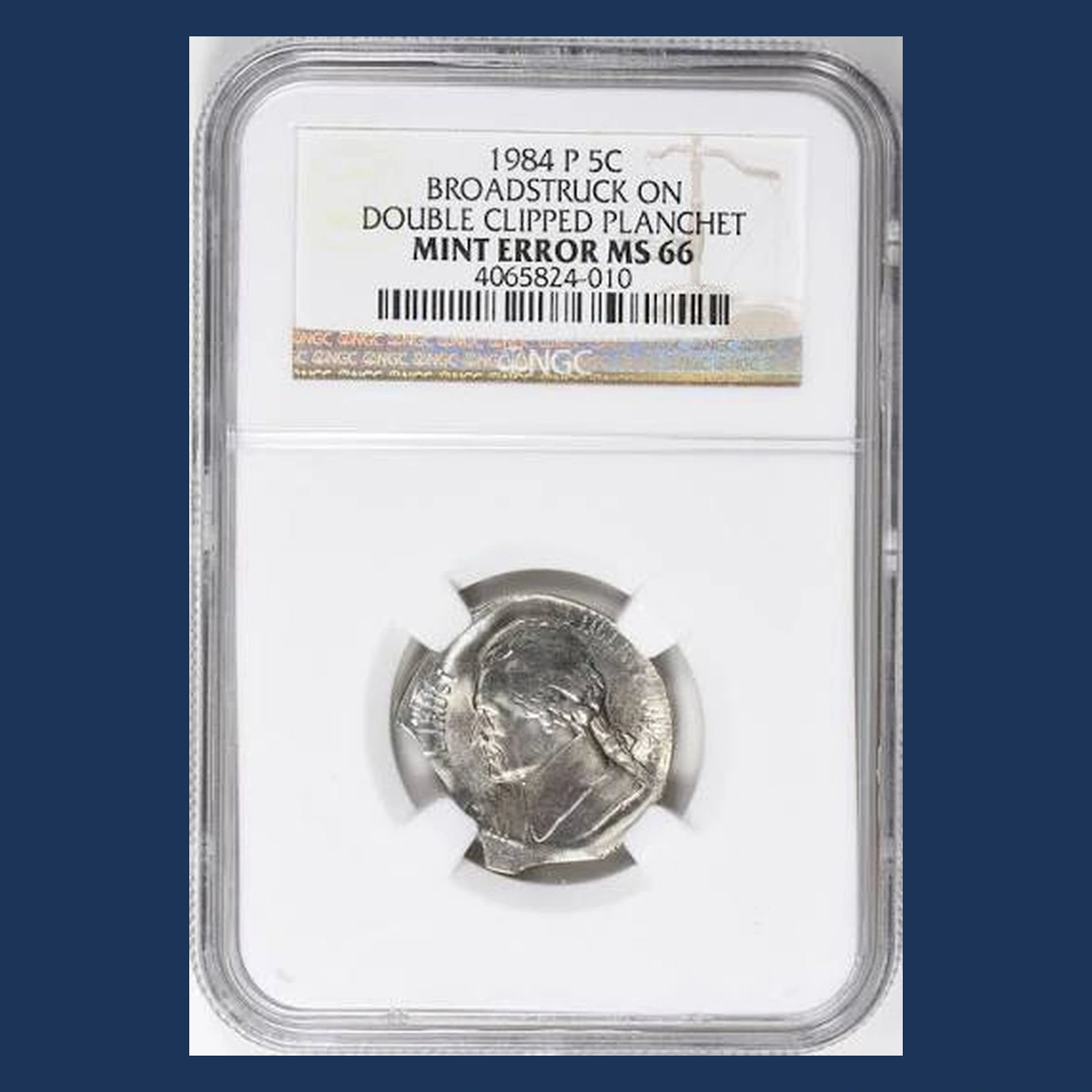
Two missing sections can begin when the blanking punch overlaps earlier holes or an edge in the metal strip. The incomplete blank may still receive a nickel design.
One Philadelphia example combines a double-clipped blank with a broadstrike. Its metal spread without the usual restraint from the surrounding collar.
The two gaps and expanded shape belong to the same coin, graded NGC MS66 for strong unworn preservation. They should be examined as a connected object.
A pair of cuts made after minting can imitate the outline, while hammering can imitate some of the expansion.
Estimated Value
The 1984-P double-clip broadstrike sold for $156 in July 2021. That is the price of the complete combination, not an amount for each missing section.
Estimate $75–$250 for clear examples with ordinary preservation and $250–$600 for striking, attractive combinations. Surviving design and original gap surfaces matter.
Two gaps do not automatically make a coin worth twice as much as one, especially if later damage obscures how the blank was formed.
How to Identify
Weigh a loose specimen before comparing its wider outline with an ordinary nickel. The clips remove metal, so its weight can fall below 5 grams despite expansion beyond the normal 21.21-millimeter diameter.
Record two intact spans with calipers and photograph both gaps. Use a 10× magnifier to inspect where the design approaches each missing section.
Look for cut marks, filing, and surfaces sliced through completed details. Opposite-rim weakness can be helpful, but need not appear clearly on every clipped coin.
Inspect the remaining plain edge and high points for later flattening. The clipping and expansion must both fit the original minting process rather than two kinds of damage added to a normal coin.
9. 1984 Jefferson Nickel An M from Monticello near Jefferson’s Forehead
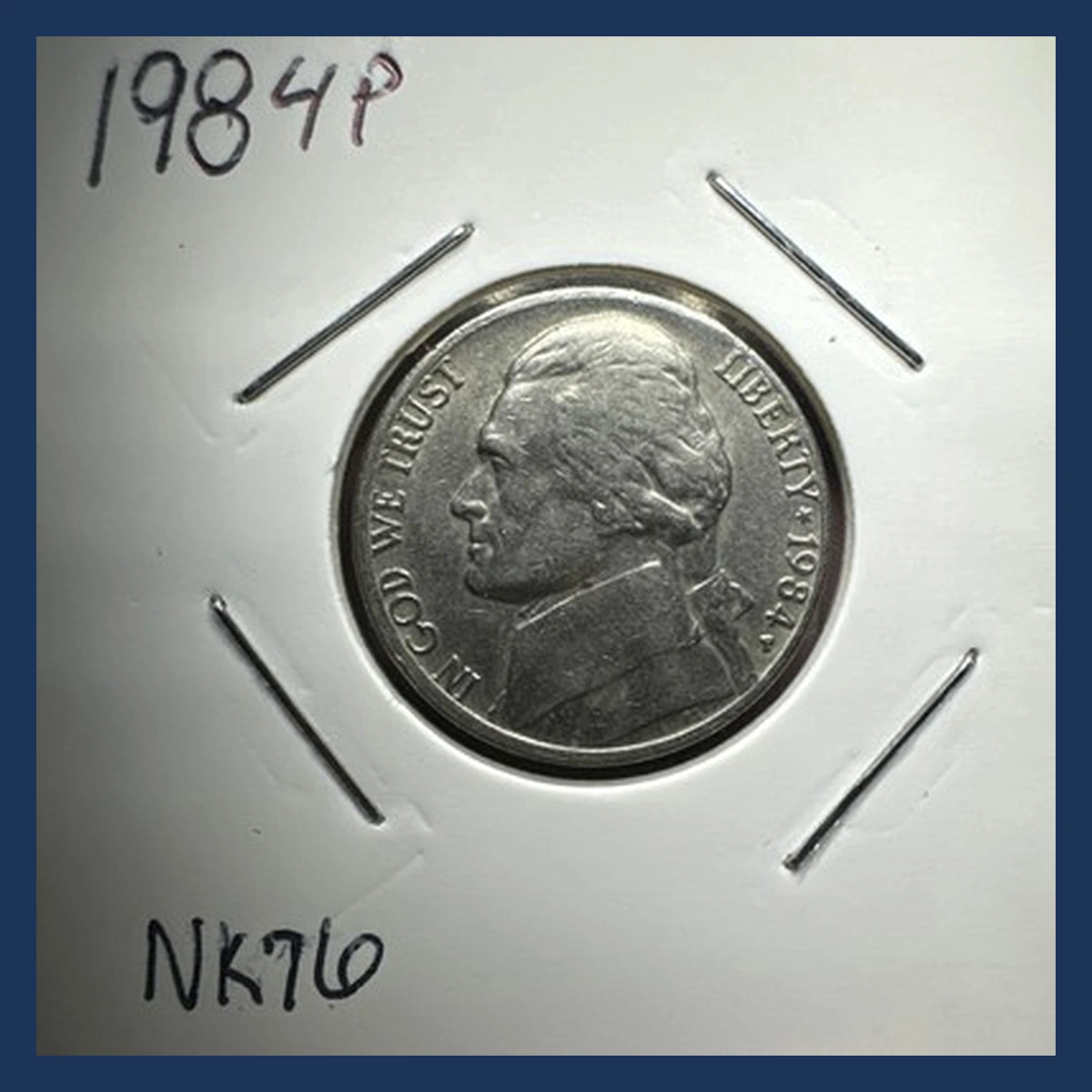
The M from MONTICELLO belongs on the back, yet a strong clash can leave its trace beside Jefferson’s forehead. The two stamping tools struck each other without a blank between them.
A specialist catalog describes a strong single clash whose traces were not polished away. It does not identify the mint letter in the written entry used here.
Later coins received the transferred lines as part of their design. This differs from a second full impression on the coin itself.
Another Philadelphia group combines clashes with broken-tool patches, but its details should not be assumed on this example.
Estimated Value
Estimate $20–$150 for a clear recognizable clash and $150–$600 for a strong, attractive example. These are estimated ranges, not a sale of the illustrated forehead-M specimen.
A different-year Philadelphia nickel with clashes on both faces sold for $408.25 in August 2010. That coin was dated 2000 and had slight wear.
It shows that strong visible clashes can attract interest without setting a fixed price for every transferred letter fragment.
How to Identify
Find the space directly in front of Jefferson’s forehead and compare the unusual mark with the M in MONTICELLO. A 10× magnifier should help follow the surviving letter fragment rather than an imagined complete word.
Use pictures of the normal front and back to understand how the tools could have met. The specialist description says the clash remained unpolished, so do not require lines from later polishing.
Record a loose coin’s weight and diameter with a scale and calipers against 5 grams and 21.21 millimeters. Check its plain edge for unrelated damage.
Read the actual mint letter instead of assigning Philadelphia from a different catalog entry. A separate cud-and-clash coin should be matched to its own marks.
10. 1984 Jefferson Nickel Raised Rim Patches from Broken Tools
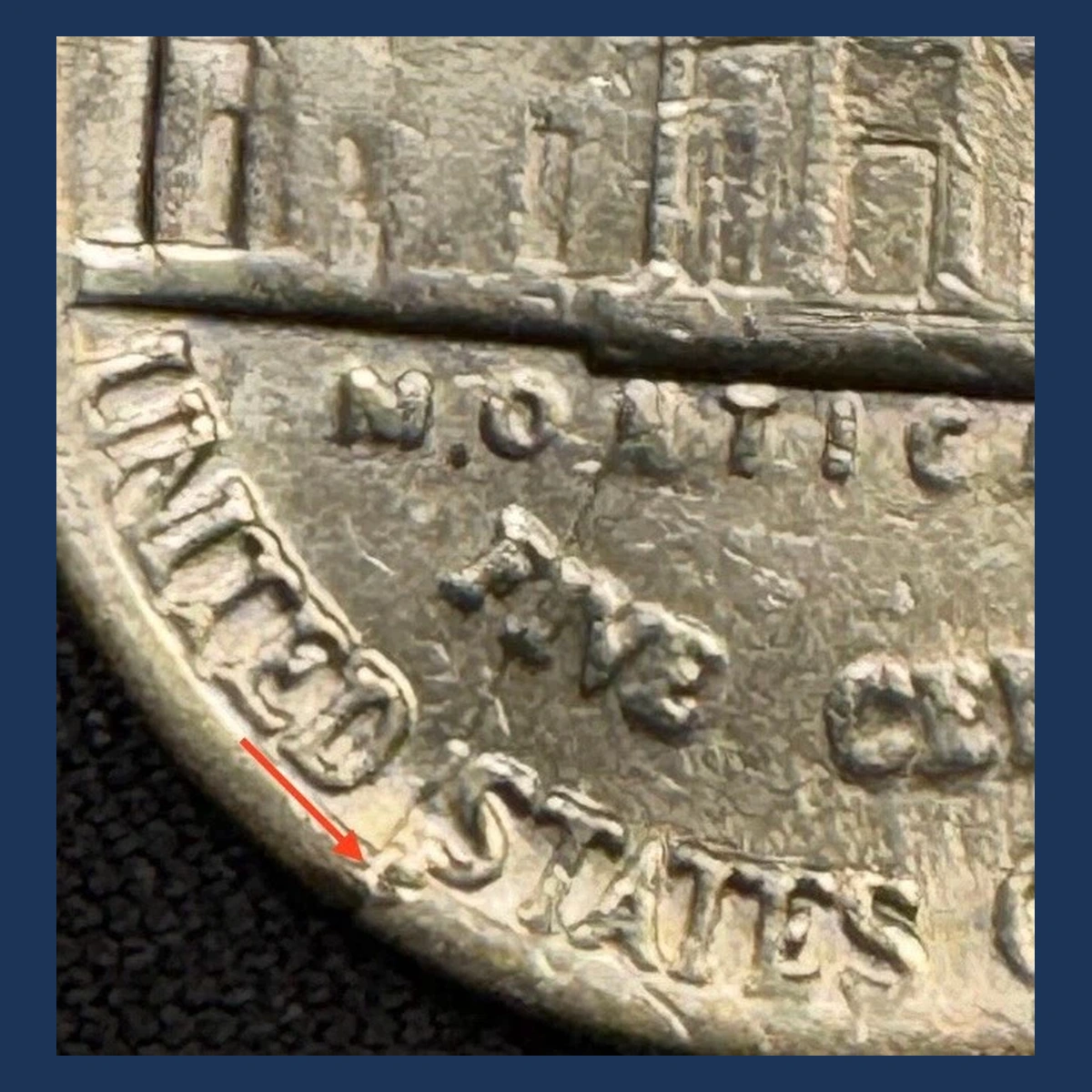
A piece breaking from a tool at its edge can leave a raised, rim-connected patch on the next coins. That patch is called a cud.
Specialist listings show several Philadelphia examples and a Denver example for 1984. One Philadelphia coin has two related patches, while a more complex group combines front and back cuds with strong clash traces.
A reported lower-right front patch is one example, not a required position on every coin. The catalog photographs must keep those different layouts separate.
A narrow crack or an added lump should not automatically be called the same rim-break pattern.
Estimated Value
A Philadelphia nickel with front and back cuds plus clashes sold for $159 in July 2022. PCGS graded it AU58, indicating only slight wear.
Estimate $25–$150 for small clear rim breaks and $150–$700 for dramatic, attractive patches or combinations. These ranges value the whole coin.
Multiple catalog labels can describe related features on one specimen, so neither the number of labels nor the number of patches supplies a separate price to add.
How to Identify
Use a 10× magnifier to follow the raised patch toward the rim. A cud connects to that border, while an isolated interior lump needs a different description.
Check for solder, seams, or a rim impact that pushed metal onto the face. Inspect the corresponding area on the other side too.
For a loose coin, record weight and width with a scale and calipers against 5 grams and 21.21 millimeters. Examine the plain edge beside each patch.
Compare the arrangement with the correct 1984 catalog photographs after reading the mint letter. The Philadelphia double-patch example and the multi-patch clash group are separate comparisons.
Do not require the lower-right patch on every coin. Match the complete pattern of breaks and transferred design that actually survives.
11. 1984 Jefferson Nickel Off-Center and Stretched Strikes
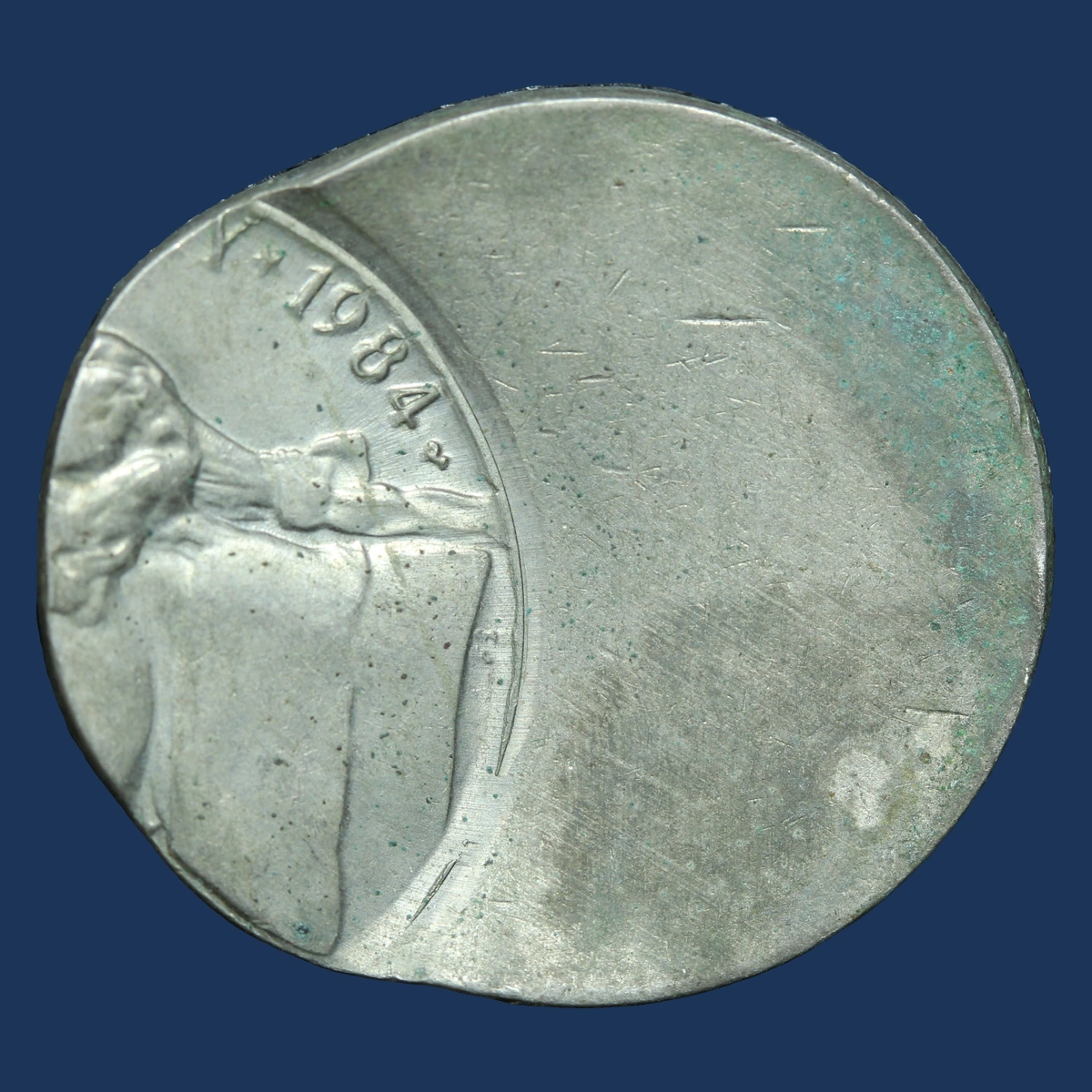
A blank that misses the center of the tools receives only part of the intended design. A Philadelphia example was struck about fifty percent off center toward eleven o’clock.
Another coin combines an eighty-percent off-center strike with stretched design. The small struck portion is pulled into an unusual shape rather than simply sitting as an ordinary impression near the edge.
These are different specimens. The eighty-percent figure should not be assigned to the fifty-percent example or to an unrelated second strike.
The unstruck metal remains part of the disk, unlike a clipped area that is physically missing.
Estimated Value
The fifty-percent 1984-P example sold for $132 in March 2021. The eighty-percent stretch strike brought $168 in May 2021, and both had unworn grades.
Estimate $75–$300 for ordinary dramatic off-center coins and $300–$1,000 for unusually attractive stretched or strongly displaced examples. These are whole-coin estimates.
A readable date and the quality of the untouched metal matter; the percentage alone does not turn every similar outline into an equal-value coin.
How to Identify
Find any surviving date and orient the portrait before comparing a direction. The fifty-percent Philadelphia example shifts toward eleven o’clock; the separate stretch strike has a different layout.
Photograph the complete outline and check the back for the corresponding struck and unstruck portions. An unstruck crescent still contains metal, unlike an open clipped gap.
Use a scale on a loose coin against 5 grams and calipers to record its altered outline against 21.21 millimeters. Inspect the plain edge for cutting.
Now follow the stretched impression with a 10× magnifier. Look for design elongated during the strike rather than scratches, flattening, or a bent section created afterward; the shape must agree with how the tools contacted the blank.
12. 1984 Jefferson Nickel A Sunken Mirror Design with an Altered Edge
A struck coin trapped against a tool can impress a sunken, reversed image into the next blank. That image is called a brockage.
Philadelphia examples combine a front brockage with a partly engaged collar, which can leave a step in the edge. One is described as about twenty percent affected.
Another 1984 coin combines front brockage with unrestricted expansion. Its listing does not establish a mint letter, so it should not automatically become a Philadelphia example.
The different edge forms show how the disk was restrained while the obstruction left its mirror image.
Estimated Value
The twenty-percent partial-collar example sold for $57 in October 2022 and had a PCGS AU55 grade, indicating light wear. The expanded front-brockage coin brought $336 in June 2025.
Estimate $50–$400 for clear partial examples and $400–$1,500 for dramatic, attractive combinations. The latter coin’s Full Steps label describes sharp building steps, not an additional error.
Both figures price complete coins rather than separate charges for the edge and mirror impression.
How to Identify
Begin at the edge to distinguish the two forms. A partial collar can leave a step where restrained and expanded portions meet, while a broadstrike allows wider spreading.
For a loose candidate, measure with calipers against 21.21 millimeters and weigh against 5 grams. The ordinary nickel edge is plain, so grooves are not required on either form.
Now use a 10× magnifier and angled light to see whether the unusual design is sunken and reversed. Compare it with damage produced by pressing two finished coins together later.
Read any surviving mint letter rather than inferring one from the year. Match the front mirror design and edge shape to the same specimen, not to two different descriptions.
13. 1984 Jefferson Nickel Repeated Strikes, Including Coins That Flipped
Extra blows can leave overlapping designs while changing a coin’s outline. Philadelphia records include doubles with later strikes ninety-five or seventy-five percent off center, plus repeated strikes on expanded disks.
Other coins flipped over before the second blow. An in-collar flip stayed within the ring controlling the edge, while another flip had an eighty-percent off-center second strike.
On that latter coin, a fresh blank blocked one tool during the second blow. A separate combination includes doubling, expansion, and off-center design together.
Each layout belongs to its own specimen; the percentages are not interchangeable.
Estimated Value
The in-collar flip sold for $480 in September 2024, while the eighty-percent flip brought $86.25 in April 2002. A ninety-five-percent second strike sold for $99 in May 2021.
Estimate $75–$600 for clear examples and $600–$2,000 for outstanding combinations. Condition and readable earlier detail matter more than the number of error terms.
The seventy-five-percent example has recorded back damage, which must remain part of its individual value assessment.
How to Identify
Find whether both faces contain traces of the opposite design; that can show a flip between blows. In-collar examples may remain close to the normal 21.21-millimeter diameter.
Use a scale on a loose coin against 5 grams, and calipers to record any expansion. Inspect the plain edge without assuming every extra strike made the disk wider.
Under a 10× magnifier, trace the eighty-percent flip’s later strike toward seven o’clock. It crosses earlier E PLURIBUS UNUM and includes parts of IN GOD WE TRUST.
A fresh blank blocked the back tool, distorting the earlier front where the blank touched it. That sequence belongs to this coin, not the in-collar flip.
On other examples, follow each impression before assigning a strike count or transferring a listed percentage.
14. 1984 Jefferson Nickel A Nickel Design on a Cent Blank
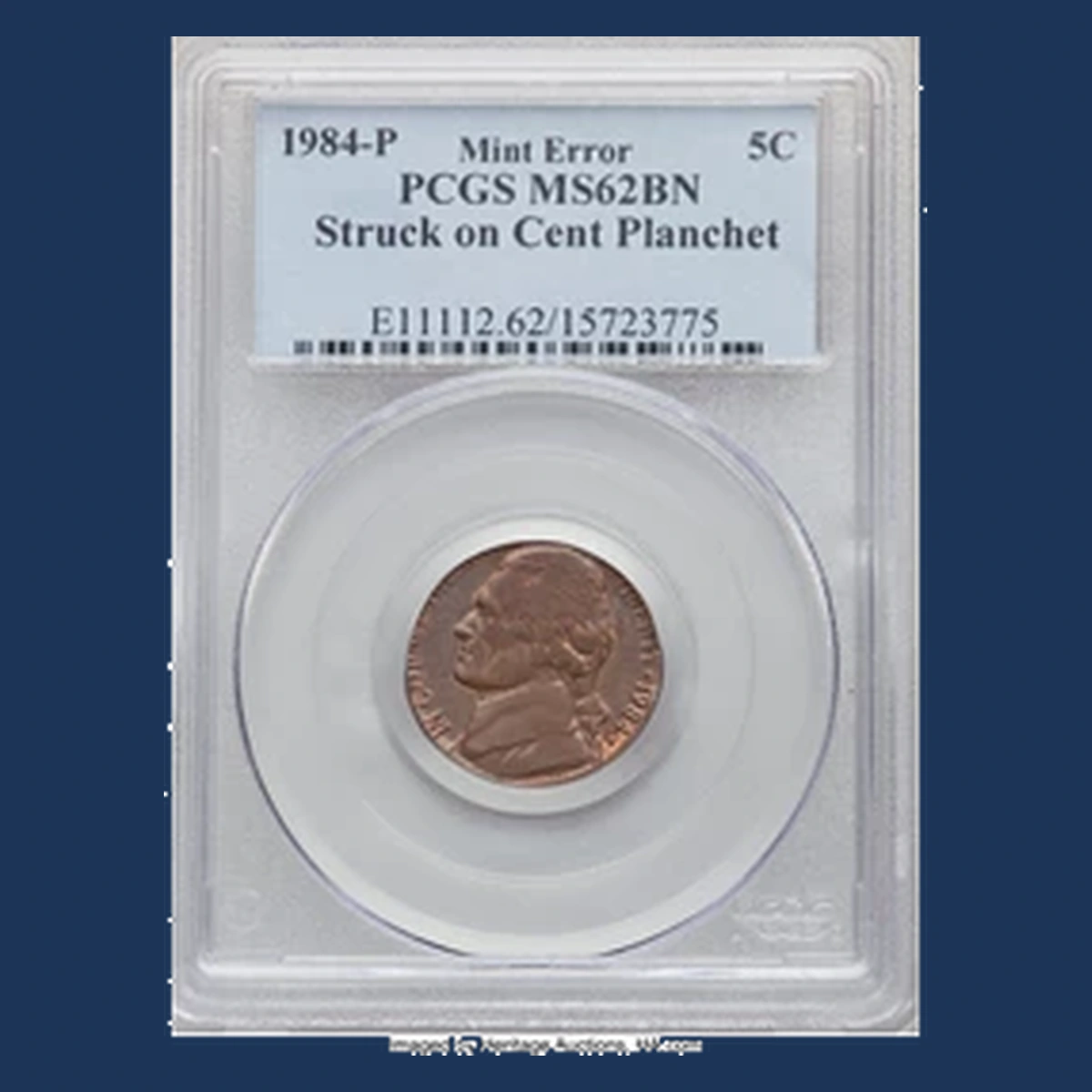
A cent blank can enter the nickel press and receive Jefferson and Monticello on a disk that is too small. The outer design may run beyond the available metal.
A Philadelphia example was graded PCGS MS62 Brown. The grade describes an unworn coin with noticeable marks, and Brown describes color rather than a chemical composition.
Its catalog description does not provide a measured weight or identify which cent alloy was used. Those facts should not be invented from the date or shade.
An unused cent blank also differs from a Lincoln cent that already carries its own design.
Estimated Value
The 1984-P cent-blank nickel sold for $528 in August 2020. That actual result belongs to the PCGS MS62 Brown example.
Estimate $300–$1,000 for clear genuine examples and $1,000–$2,000 for exceptional preservation or presentation. The alloy and physical measurements need to be established for the particular coin.
Neither a brown surface nor the error name alone justifies assigning a different rare metal or a much higher price to a candidate.
How to Identify
Weigh a loose candidate rather than choosing a cent alloy from its brown color. Modern zinc cents normally weigh 2.50 grams, while older copper-alloy cents weigh 3.11 grams; the cataloged specimen gives neither measurement.
Compare its width with a cent blank’s original 19.05 millimeters and a nickel’s 21.21 millimeters using calipers. The nickel strike can spread the smaller disk.
At 10× magnification, inspect the plain edge and the clipped-off outer lettering. Look for grinding, acid damage, or an added copper coating that could imitate a wrong blank.
Search separately for actual Lincoln or cent-lettering remains. If those survive beneath Jefferson, the starting object was an already struck cent rather than the unused blank described here.
15. 1984 Jefferson Nickel The Nickel Design over an Already Struck Cent
A second denomination can appear on a coin that already carried its own design. In this Philadelphia example, nickel tools struck over an existing Lincoln cent.
Pieces of the cent’s portrait or Memorial design remain beneath the newer nickel image. Those surviving features are what distinguish an overstrike from an unused cent blank.
PCGS graded the recorded coin MS65 Red and Brown, describing good unworn preservation with mixed copper color. The description establishes a struck cent but not a clearly identified host date here.
A copper-colored nickel without any lower cent detail does not prove the same sequence.
Estimated Value
The 1984-P nickel overstrike sold for $780 in September 2017. Its PCGS MS65 Red and Brown grade describes the complete coin’s condition and color.
Estimate $400–$1,200 for readable examples with ordinary unworn preservation and $1,200–$2,500 for particularly attractive combinations. These are estimates above and around the recorded result.
A well-displayed lower design helps explain the error, but adding the two face values does not explain what a collector will pay.
How to Identify
Use a 10× magnifier to locate a feature that belongs to the Lincoln cent and trace it beneath the nickel design. A vague copper-colored patch is not a substitute for readable lower detail.
Look for a host date without assuming it is 1984. If it cannot be read, keep the date of the later nickel strike separate from the unidentified cent year.
For a loose coin, weigh it against the relevant cent standards of 2.50 or 3.11 grams rather than a nickel’s 5 grams. Calipers compare its expanded outline with 19.05 and 21.21 millimeters.
Inspect the plain edge for joining or added material. The physical measurements and genuine lower design should explain one struck coin beneath another design.
16. 1984 Jefferson Nickel Nickel Strikes on Dime Blanks
A dime blank is smaller and lighter than a nickel blank. Philadelphia examples include a 2.29-gram single strike and a 2.3-gram blank scratched before striking.
Another 2.3-gram example received two blows, the second about sixty percent off center. A separate coin combines expansion with a front hollow made by an overlapping blank.
On that hollowed example, the other blank was about ninety percent off position and prevented normal collar engagement. The percentage describes the obstruction, not a ninety-percent off-center strike on the dime blank itself.
These four objects preserve different events on the same kind of wrong blank.
Estimated Value
The double strike brought $1,495 in August 2010; the expanded, indented example brought $1,063.75 that month. A straightforward 2.29-gram strike sold for $833.75 in January 2011.
The pre-scratched blank brought $528 in October 2021. Estimate $400–$1,200 for simpler examples and $1,200–$4,000 for outstanding combinations.
Each amount values one complete coin, and the extra defects should not be priced separately and added to the wrong-blank figure.
How to Identify
For a loose coin, a scale should distinguish a roughly 2.3-gram dime blank from a normal 5-gram nickel. Calipers compare its spread outline with the dime’s original 17.91 millimeters and the nickel’s 21.21.
Examine the layered edge at 10× magnification without requiring grooves from a dime collar; an unused blank need not have them.
On the double strike, the first impression leans slightly toward ten o’clock. The later blow is toward seven on the coin, or nine relative to the first impression.
On the expanded indent, inspect the front hollow from ten to twelve o’clock. The overlapping object was described as probably a nickel blank, not positively identified.
For the pre-scratched blank, compare how the strike crosses its scratches. Scratches added afterward would cross already completed detail instead.
Conclusion
Estimated values across these 1984 nickel errors range from $10–$4,000. A slight one-sided shift can be inexpensive, while clear combinations on dime blanks occupy the higher end.
Separate missing detail from missing metal, and an unused cent blank from a cent that already had a design. When extra strikes appear, follow their actual order rather than adding separate prices for every feature.
Preserve each coin’s measurements and photographs together so similar-looking examples do not become mixed.