1996 Nickel Error List with Pictures

Two badly misplaced nickels can tell one story when their touching edges fit the same strike. A paired 1996 example sold for $632.50 in August 2010, covering both coins together.
This 1996 nickel error list also explores missing metal, repeated designs, unusual blanks, and hollows made during striking. Estimated values range from $10 to $2,500, with paired pieces valued as complete pairs.
Follow the comparisons below to work out what you are seeing before matching your coin to a price.
1. 1996 Jefferson Nickel An Expanded Disk with the Full Design
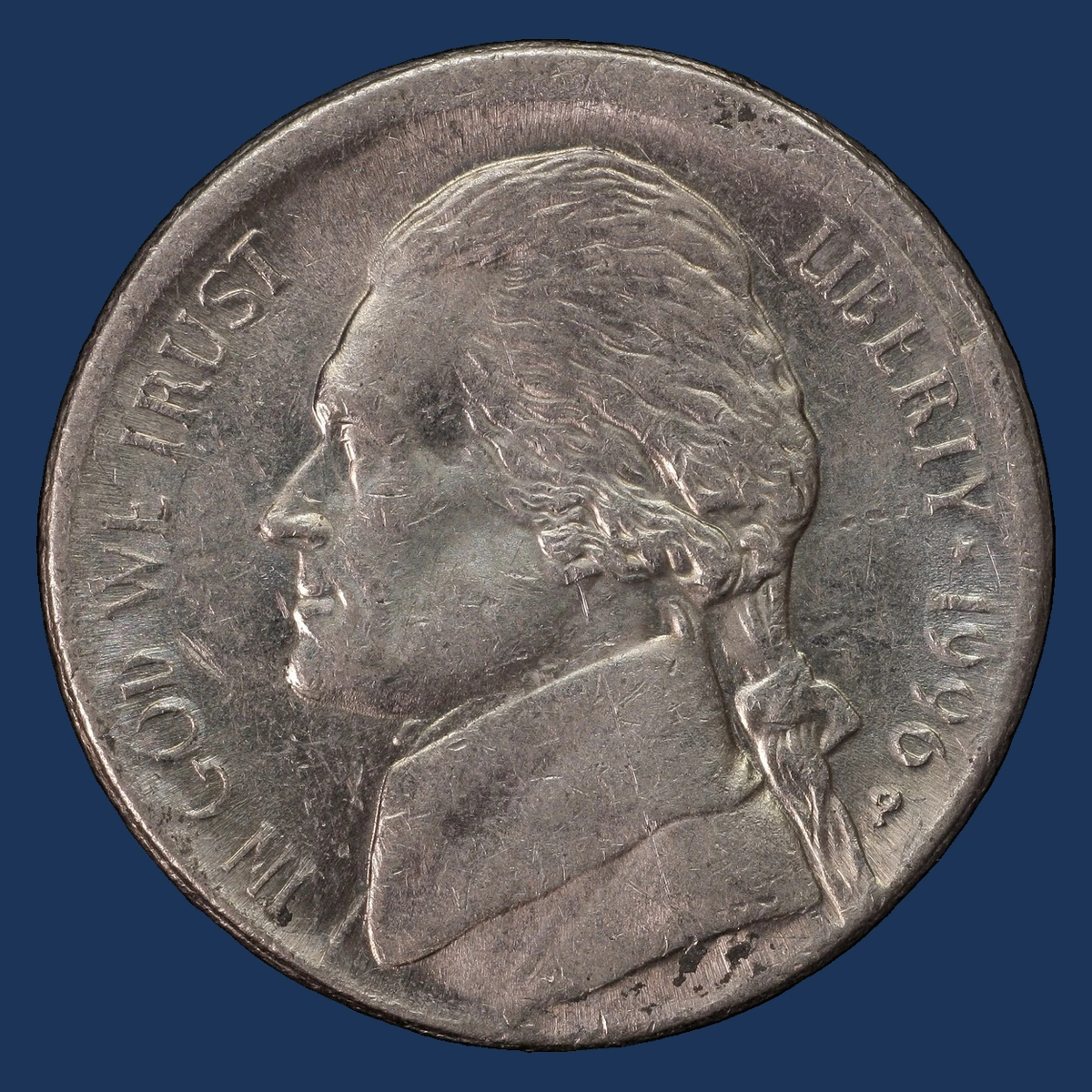
A broadstrike can look unusually wide without losing any of the design. The collar, a ring around the blank, failed to hold the metal within its normal boundary.
A Philadelphia example was cataloged as a straightforward broadstrike with an ICG MS62 grade. That grade describes an unworn coin with noticeable marks.
The nickel’s normally plain edge must not be mistaken for evidence of the error. Width and the complete design matter together.
Other 1996 coins combine expansion with additional mistakes, but a single expanded strike does not require repeated images or a hollow.
Estimated Value
An indexed 1996-P broadstrike sold for about $10 in December 2008. It was graded ICG MS62, and the old result illustrates the modest end of this error’s market.
Estimate $10–$100 for ordinary examples and $100–$250 for especially attractive spreads. These are current estimated ranges, not a new sale of that coin.
A wider disk does not automatically command more money if scratches or flattened details make it less appealing.
How to Identify
Place an ordinary nickel beside the candidate and compare their outlines without stacking them. The usual diameter is 21.21 millimeters; calipers can record a loose coin’s width in two directions.
Next check that all outer lettering remains on the disk. Missing design opposite an unstruck crescent suggests an off-center strike rather than a simple broadstrike.
A scale provides a comparison with the normal 5 grams. The metal should have spread, rather than being added to make the coin wider.
Inspect the plain edge and the highest design points with a 10× magnifier. Later hammering can flatten the portrait and create impact marks over details that were already fully formed.
2. 1996 Jefferson Nickel A Strike from a Split Tool
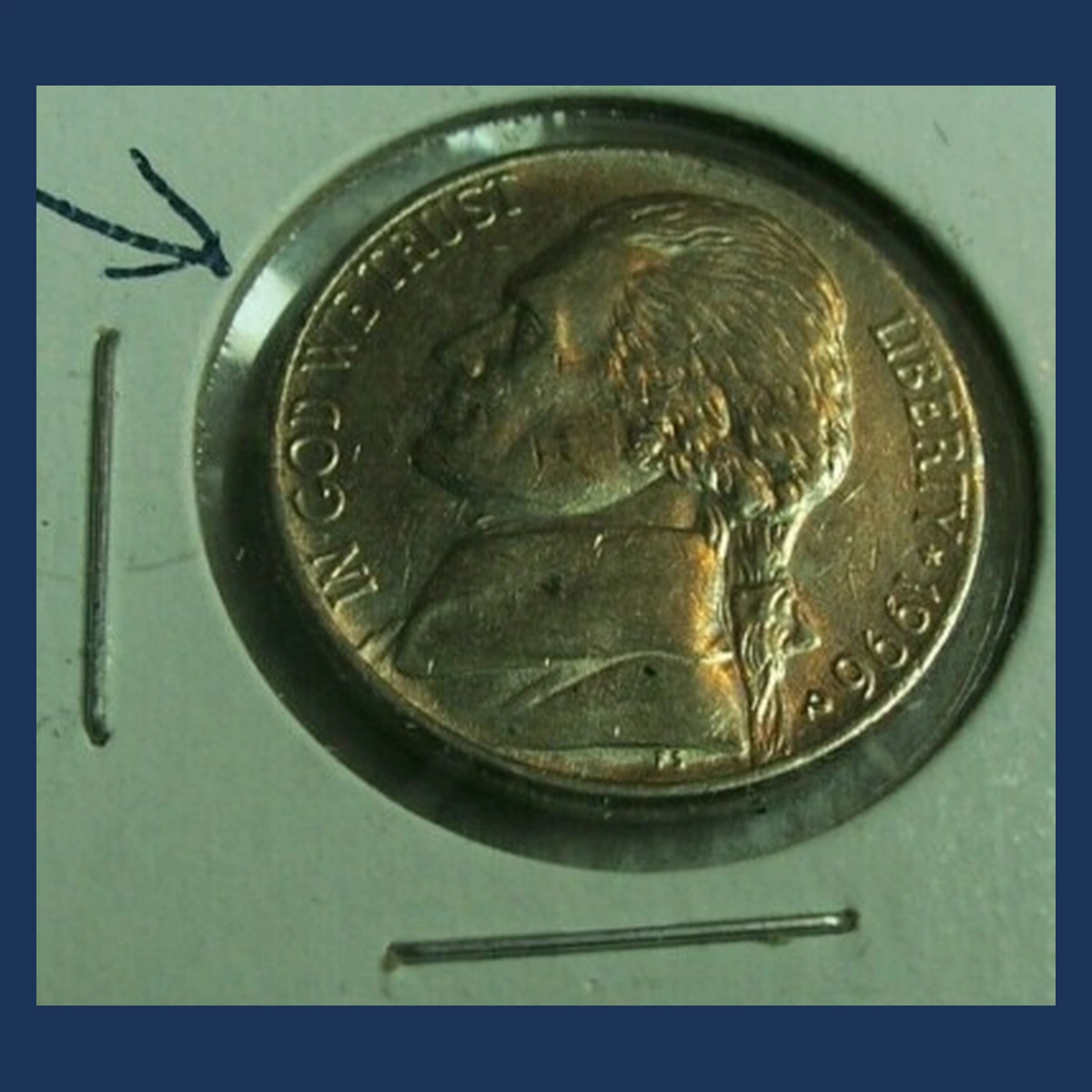
A split die is a damaged steel stamping tool, not a coin that has split into two pieces. The opening in the tool can leave a strong raised break across the coin.
Parts of the design may also move when the broken tool sections separate. A Philadelphia example is listed as a split-die strike graded ANACS MS60, an unworn grade with substantial marks.
Its catalog entry does not locate the break on a particular face or give its direction.
A thin scratch or a crack within the coin’s metal needs a different explanation.
Estimated Value
The auction index reports $192 in January 2023 for the 1996-P ANACS MS60 split-die strike. That is a reported sale for a specific unworn example.
Estimate $75–$250 for clear but less attractive pieces and $250–$500 for stronger, appealing examples. The amount of visible tool failure matters alongside preservation.
Do not apply the same range to an ordinary scratch or a coin that somebody bent until its own metal cracked.
How to Identify
Check whether the nickel itself is cracked before studying the raised design. An opening through its own metal would be different from an impression made by a split steel tool.
For a loose coin, use a scale and calipers to compare 5 grams and 21.21 millimeters, then inspect the plain edge. A severe blow or bend may explain both a distorted outline and a crack in the metal.
Now move a light across the line while looking through a 10× magnifier. A raised tool-break impression should be distinguished from a scratch with a cut floor and pushed-up edges.
Compare the surrounding design for movement that follows the break. The 1996 listing does not establish a required face or direction, so match the specimen rather than guessing a particular path.
3. 1996 Jefferson Nickel Missing Pieces of the Original Blank
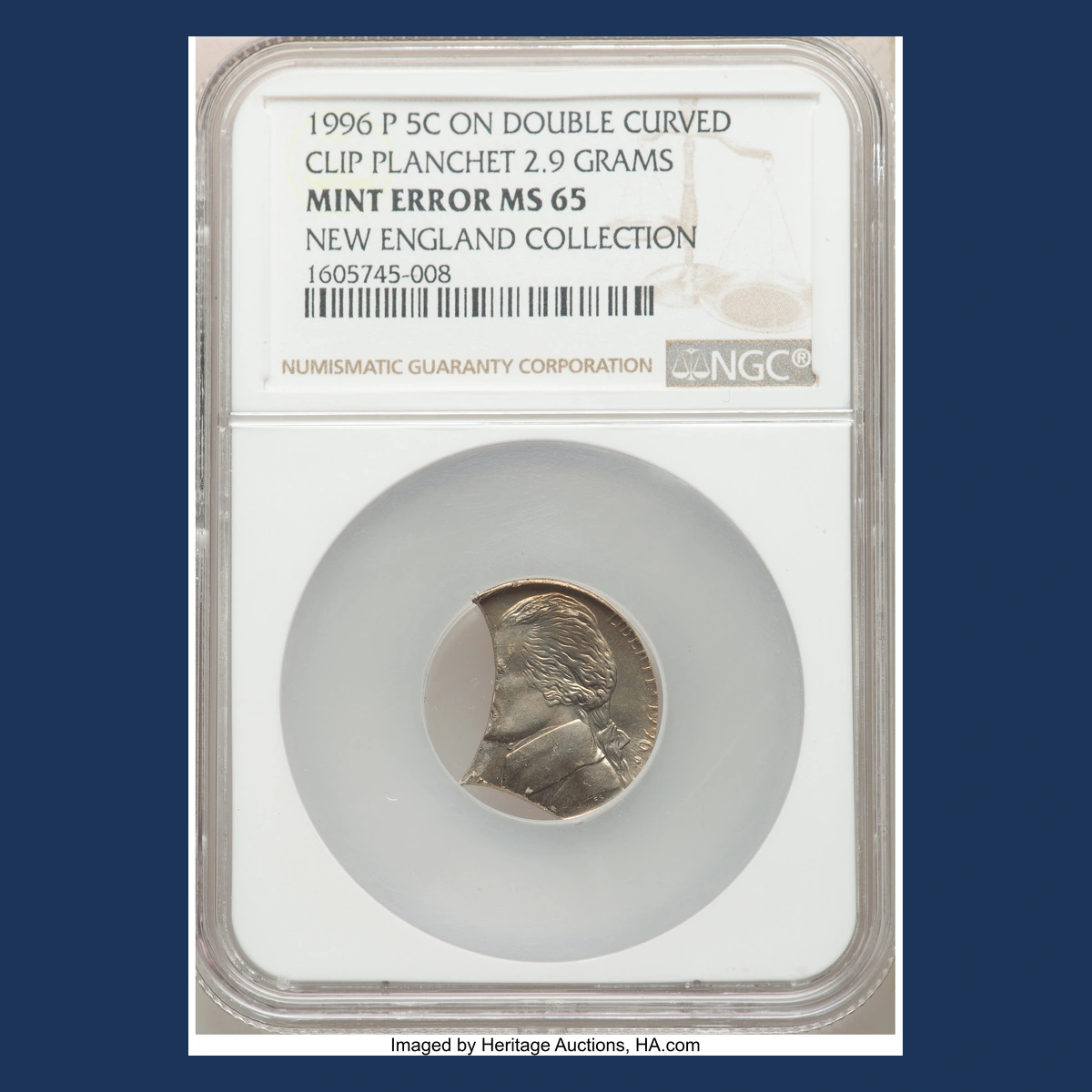
Two curved gaps can begin before the coin has any design. A blanking punch cut into openings left by earlier punches, producing an incomplete metal disk.
A Philadelphia double-clip example was cataloged at 2.9 grams. Its two missing areas explain why it is much lighter than an ordinary nickel.
Another Philadelphia coin combines a ten-percent clip with a strike about sixty-five percent off center. The missing metal and misplaced design are separate features of that one object.
A gap cut into an already finished nickel may look similar until its edge is examined closely.
Estimated Value
The 2.9-gram double-clip example sold for $99 in October 2021. A comparable catalog record brought $94 in August 2010, though those listings need not prove two different coins.
Estimate $50–$200 for clear clipped blanks and $200–$600 for dramatic, attractive combinations. The indexed clip-plus-off-center specimen brought about $69 in February 2015.
That lower result is a reminder that combining two error names does not automatically create a high price.
How to Identify
Weigh a loose coin before comparing the two gaps. A normal nickel is 5 grams; the cataloged double clip is 2.9 grams, so low weight alone would not make it a wrong blank.
With a 10× magnifier, follow the design where it approaches each gap. Saw grooves, a sharp cut through finished lettering, or fresh filed metal suggest removal after striking.
Use calipers across the intact portion against the normal 21.21 millimeters, and photograph the plain edge at both gaps. Do not assign their clock positions from a different specimen.
On the compound example, separate the missing crescent from the blank area left by the off-center blow. One is absent metal; the other is metal that received no design.
4. 1996 Jefferson Nickel One Strike Away from the Center
Only part of the blank may fit between the stamping tools when they come together. The resulting design sits to one side, leaving the rest of the metal unstruck.
A Philadelphia example was cataloged as sixty percent off center and graded NGC MS65. That grade describes good preservation without circulation wear.
The record appeared in a four-coin auction lot, so its total price cannot be assigned to this nickel alone.
A complete design on a wide disk is a different situation. So is a shift affecting only one face while the other stays centered.
Estimated Value
Estimate $40–$200 for readable ordinary examples and $200–$750 for dramatic, attractive off-center nickels. A surviving date and clear surfaces make comparisons easier.
The 2010 lot containing the sixty-percent example sold for $126.50, but included four coins. That figure is a group total, not a single-coin valuation.
As a different-year comparison, a 2000-P off-center nickel sold for $52 in April 2022; its displacement and condition should not be assumed identical.
How to Identify
Look for an uninterrupted blank area next to the design on both faces. A single off-center strike should explain the relationship between those two affected areas.
Check how much of 1996 and the P survives before relying on a year label. A missing date cannot be reconstructed simply from the shape of the blank portion.
Through a 10× magnifier, compare the unstruck surface with the struck boundary. Grinding or cutting after minting can leave lines that cross rather than follow that boundary.
For a loose specimen, use a scale against 5 grams and calipers against the usual 21.21-millimeter outline. Record any expansion separately, and check the plain edge for later damage where the design approaches it.
5. 1996 Jefferson Nickel A Cup-Shaped Coin Stuck to a Tool
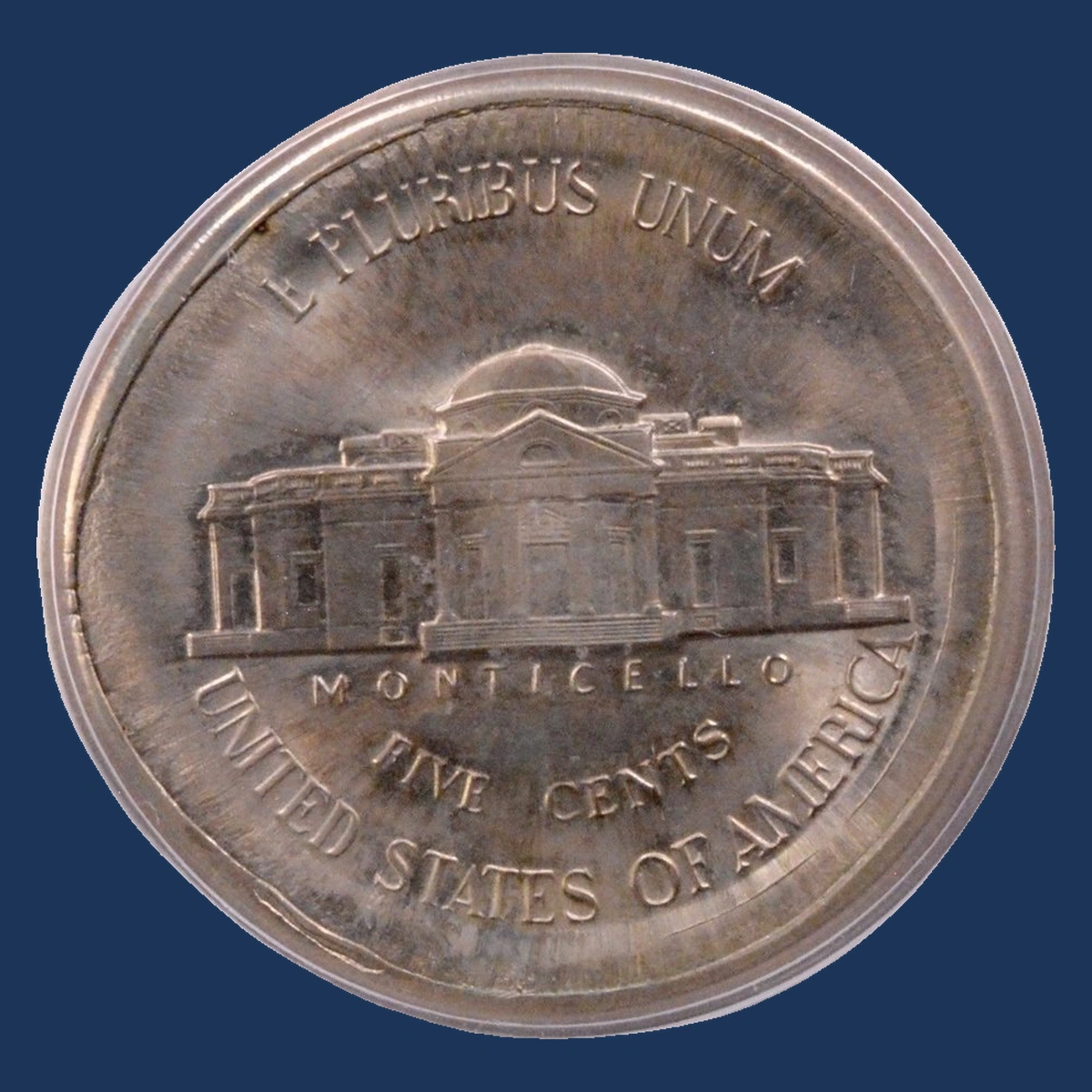
A coin that sticks to a stamping tool can change shape as the press continues operating. Its metal spreads and rises around the tool, forming an object called a die cap.
An auction index lists a Philadelphia cap graded ANACS MS65. The description establishes the cap category without identifying which face formed its base.
This is the stuck coin itself. A later coin struck underneath that cap is a separate object and may remain relatively flat.
A cupped appearance also needs to be distinguished from someone bending an ordinary nickel after it left the Mint.
Estimated Value
The indexed 1996-P cap sold for about $80 in August 2013. Its ANACS MS65 grade indicates an unworn example with good surface preservation.
Estimate $80–$350 for shallow or less dramatic caps and $350–$1,000 for strong, attractive shapes. The depth and surviving design can make a large difference.
These ranges value the cap as one object. A price for a flat coin struck beneath a cap is a different comparison.
How to Identify
An intact cap may keep the normal nickel weight even though its shape has changed greatly. For a loose example, use a scale to compare 5 grams before recording the height and width with calipers.
Avoid squeezing the wall. The disk began 21.21 millimeters across with a plain edge, but it need not retain that outline.
Photograph the object from the side and directly above. Look for the wall rising from the struck base, not merely a folded outer rim.
With a 10× magnifier, follow the design as it stretches toward the wall. Cuts, plier marks, or repeated scratches can expose later shaping.
Do not force the cap flat to see more detail. Its cup shape is part of the evidence, and the listing does not identify which face formed the base.
6. 1996 Jefferson Nickel Hollows Combined with Other Strike Errors
When another object overlaps a blank, it can press a hollow into the coin during striking. This depression is called an indent.
A Philadelphia example combines a front indent with an expanded strike outside the collar. Its Full Steps description refers to the building’s well-defined steps, not another error.
A separate example has repeated strikes and a front indent. Another catalog describes a ninety-eight-percent indentation, a figure that belongs only to that particular coin.
These combinations differ in how much design survives. A hollow without a reversed design does not automatically identify a finished coin as the obstruction.
Estimated Value
The multiple-strike Philadelphia coin with a front indent sold for $373.75 in September 2010. It was graded NGC MS64, an unworn grade with some marks.
The indexed ninety-eight-percent example brought about $129 in February 2015. Estimate $100–$400 for straightforward combinations and $400–$1,000 for especially clear, attractive ones.
These are whole-coin ranges. Neither the percentage nor the number of error terms supplies an amount to add separately.
How to Identify
An indent displaces metal instead of removing a crescent from the disk. On a loose example, weigh the coin against 5 grams and use calipers to compare its outline with 21.21 millimeters.
Expansion can increase that width, while an indentation alone does not require a major weight loss. Inspect the plain edge beside the hollow for later cuts or impacts.
Then use a 10× magnifier inside the depression. A recognizable sunken mirror image would indicate a different obstruction from a featureless hollow.
Trace the surviving ordinary design on both faces, distinguishing repeated outlines from one complete expanded strike. Keep the ninety-eight-percent description attached to its own specimen rather than using it to identify every 1996 front indentation.
7. 1996 Jefferson Nickel Repeated and Rotated Strikes
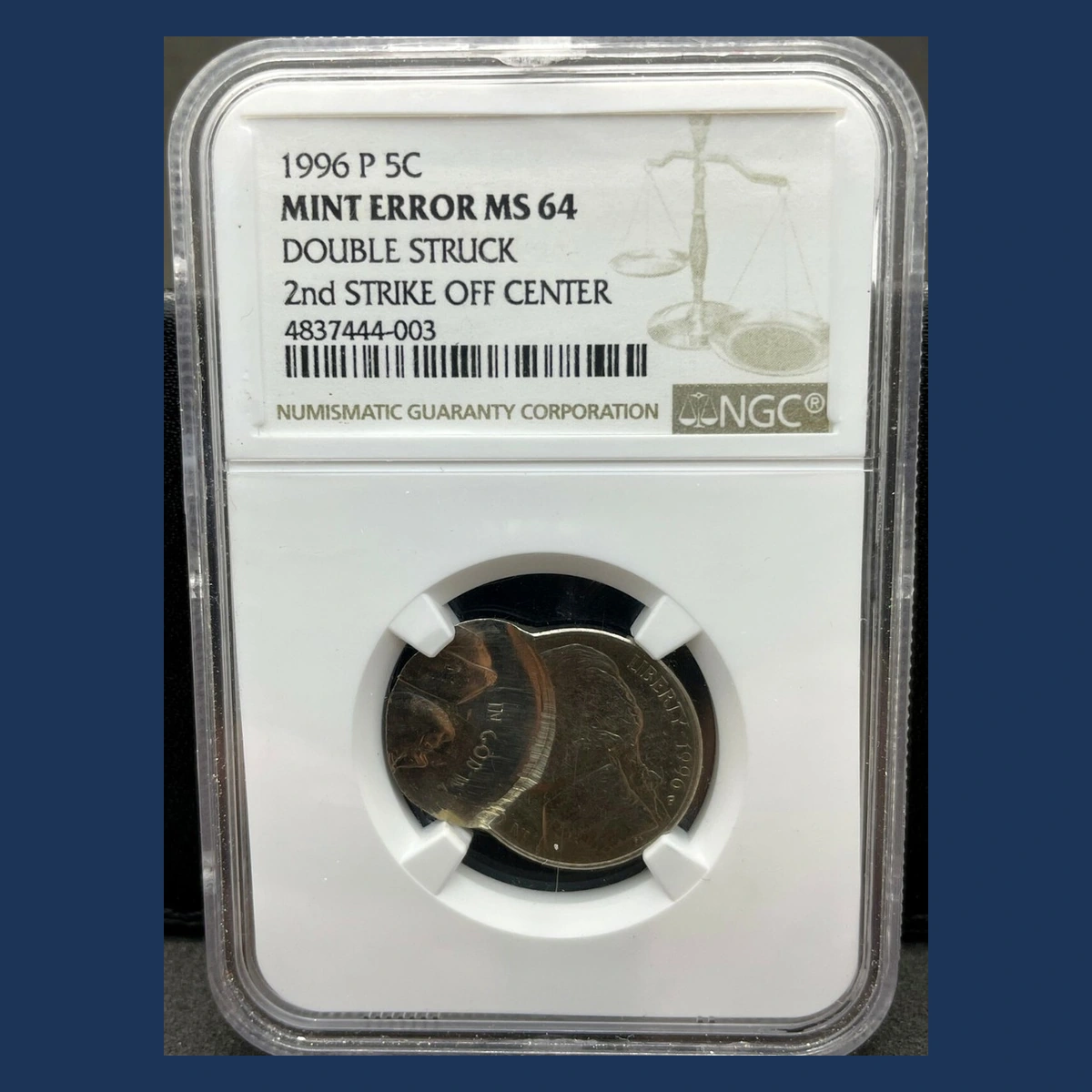
A second blow can leave another design beside or across the first. One Philadelphia coin has its second strike thirty-five percent off center; a Denver example also has a displaced second strike.
Other Philadelphia coins stayed inside the collar while rotating or expanded outside it during repeated striking. The collar is the ring that controls the edge.
A reported triple strike has later blows seventy and eighty-five percent off center, with one face blocked in those areas.
These are different layouts produced by repeated striking, rather than separate varieties for every percentage or grading label.
Estimated Value
The Philadelphia thirty-five-percent second strike sold for $282 in July 2014. Indexed sales also include about $161 for a rotated double strike in January 2010 and $66 for an expanded double strike in May 2014.
Estimate $25–$500 for straightforward doubles and $500–$1,500 for particularly dramatic multiple strikes. The low end accommodates an indexed $26 double strike.
Value the whole layout, not an added amount for each blow.
How to Identify
Begin with the oldest surviving impression and try to follow its lettering into the portrait or building. Mark it on a photograph before tracing the next impression with a 10× magnifier.
For the triple-struck form, the first date and P are complete while the later date is weak. Its seventy- and eighty-five-percent strike areas have partly blocked faces, not necessarily missing metal.
The repeated designs can rotate without greatly widening a coin that stayed inside the collar. Check a loose example with calipers against 21.21 millimeters and a scale against 5 grams.
Compare the plain edge with the proposed sequence. Expansion fits the broadstruck example, whereas a narrow flat ledge along one letter cannot by itself establish a second blow.
8. 1996 Jefferson Nickel A Sunken Mirror Image with an Altered Edge
A struck coin caught in the press can stamp a reversed, sunken version of its design into another blank. That mirror impression is called a brockage.
Cataloged Philadelphia examples combine brockage with unrestricted spreading of the disk. One is described as eighty percent affected, while another has a twenty-percent front brockage.
A separate front-side example has about fifteen-percent brockage and a partly engaged collar. Its edge can show a step between differently restrained portions.
These percentages and edge forms belong to separate coins. The eighty-percent description does not establish which face received its mirror image.
Estimated Value
Estimate $150–$600 for clear partial brockages and $600–$1,500 for dramatic, attractive examples with strong expansion. A stepped-edge combination should be valued as one coin, not two errors added together.
These are estimated ranges for the reported 1996 forms. One Heritage listing combines the 1996 nickel with 1997 and 1999 errors in a three-coin lot.
That group is not a single-coin sale comparison, even though its title begins with the 1996 brockage.
How to Identify
A normal nickel has a plain edge, so the partial-collar example needs a step rather than edge grooves. Look from the side to see where one portion was restrained while another expanded.
For a loose coin, use calipers and a scale to compare 21.21 millimeters and 5 grams. The broadstruck examples can be wider without having that same stepped edge.
Next examine the unusual image under angled light with a 10× magnifier. It should sink into the surface and show reversed design, unlike an ordinary raised impression.
Compare the surrounding surface for later pressure damage from another coin. Keep the fifteen-percent front brockage with the stepped-edge description; the eighty-percent example does not specify an affected face.
9. 1996 Jefferson Nickel A Four-Gram Blank of Unidentified Origin
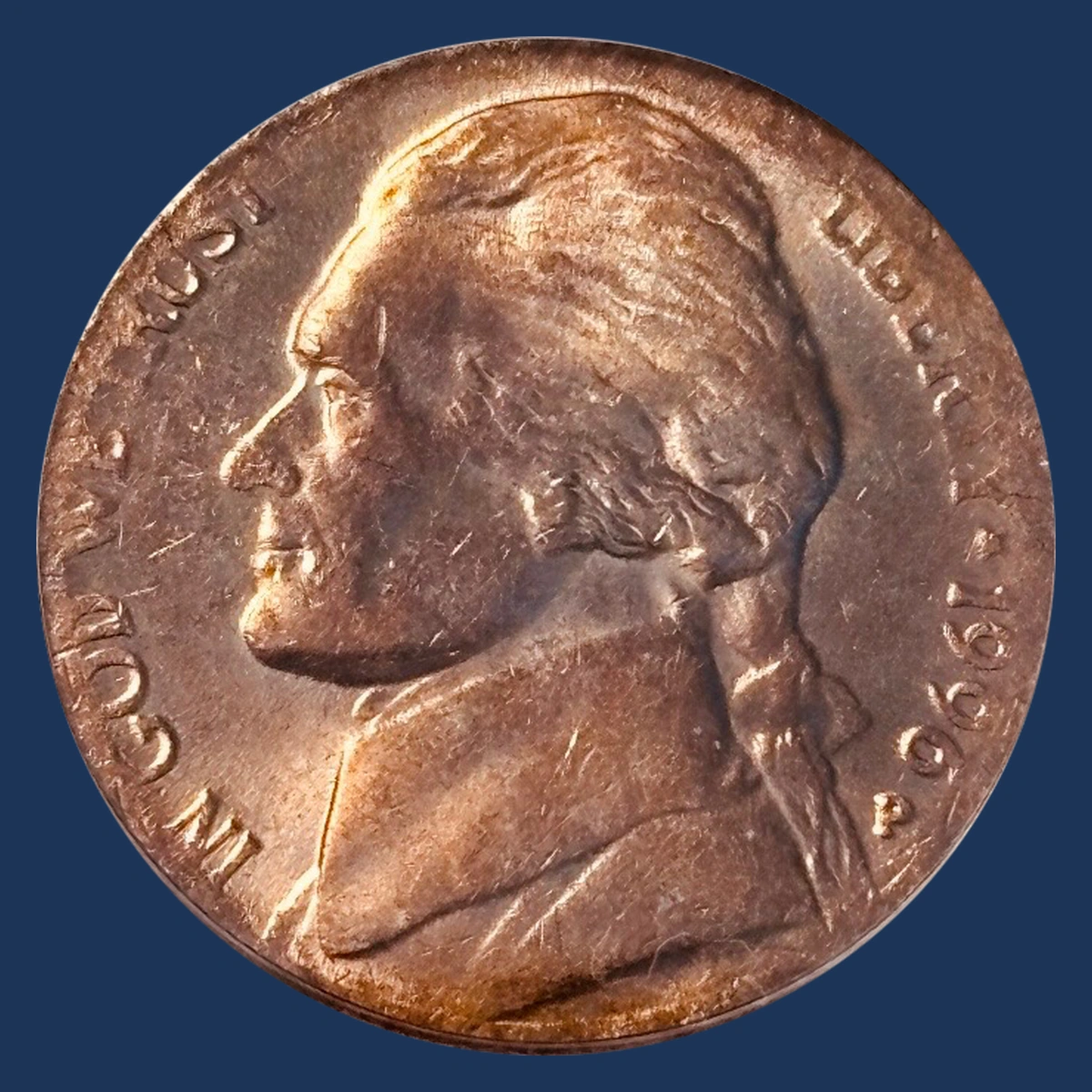
A nickel design on a small copper-colored disk raises questions about the metal that entered the press. The cataloged Philadelphia example weighs four grams, rather than the normal five.
Heritage called it a foreign-planchet error, meaning a strike on a blank intended for another coin. A later dealer description says the copper blank does not match a known foreign issue.
Its country and denomination should therefore remain unnamed. The useful facts are the unusual blank, reduced weight, and incomplete outer design.
A nickel made lighter by acid or grinding would be a different object.
Estimated Value
The four-gram 1996-P example brought $373.75 in August 2011. PCGS graded it MS63, meaning an unworn coin with some noticeable marks.
Estimate $300–$800 for a genuine comparable wrong-blank strike and $800–$1,500 for stronger preservation or especially clear features. These are estimates, not a later sale of that coin.
No premium should be assigned to an invented country or foreign denomination.
How to Identify
The recorded four-gram weight is the first comparison for this particular type. For a loose candidate, use a scale and compare it with a normal five-gram nickel before deciding what the color means.
Calipers can document the smaller disk against the normal 21.21-millimeter diameter. Through a 10× magnifier, check where the nickel’s outer lettering runs beyond the available metal.
Inspect the plain edge for filing and the surface for acid damage. Those processes can reduce weight without placing the design on a genuinely different blank.
A copper-colored surface alone cannot identify a metal recipe. Professional weight, size, and composition checks can support a wrong-blank finding without pretending that four grams names a specific foreign coin.
10. 1996 Jefferson Nickel A Nickel Design on a Dime Blank
A dime blank is much smaller than a nickel blank and uses a different metal structure. A 1996 year guide reports a Philadelphia nickel struck on that smaller disk.
The expected starting weight is about 2.27 grams. Nickel lettering near the outside may fail to fit, while the layered metal can show at the edge.
This report concerns an unused dime blank, not an already struck Roosevelt dime. It does not establish surviving Roosevelt details underneath Jefferson.
The four-gram copper blank described elsewhere is also a separate type; the two weights should not be exchanged.
Estimated Value
For an authenticated 1996 nickel struck on a dime blank, estimate $300–$1,000, or $1,000–$2,000 for outstanding preservation and clear design. These are conditional estimates for the reported type, not a recorded sale of its specimen.
The same-year four-gram wrong-blank nickel sold for $373.75 in 2011, but uses a different blank. Its result provides only broad context.
A specific dime-blank valuation needs the correct weight, metal structure, and complete coin examined together.
How to Identify
A scale can quickly separate two explanations for a light nickel: this type begins near 2.268 grams, while the four-gram example does not. Use calipers to compare a loose coin with a dime blank’s original 17.91 millimeters and a nickel’s 21.21 millimeters.
The later strike can expand the smaller disk. Under a 10× magnifier, inspect the layered edge and the incomplete outer nickel lettering without expecting pre-existing dime edge grooves.
A blank receives those grooves when struck in the proper dime collar, so they are not required here. Look for any recognizable Roosevelt design as a separate question.
If an older dime image survives, the object began as a struck coin rather than the unused blank described in this report.
11. 1996 Jefferson Nickel Two Coins Struck Side by Side
Two blanks can meet at their edges while both are being struck. Their contact limits the spreading metal and leaves related shapes where the coins touched.
An auctioned 1996 pair contains left and right pieces, each about sixty percent off center. Both were placed together in a single NGC holder.
Another listing describes a chain-strike pair with the year and Philadelphia attribution in parentheses. Such labels preserve information that may not be fully visible on each piece.
Two unrelated off-center nickels do not become a genuine pair merely because their edges can be placed near one another.
Estimated Value
The sixty-percent pair sold for $632.50 in August 2010, covering both pieces together. A chain-strike pair listing brought $470 in August 2013.
Those records do not by themselves establish whether the same pair appeared twice. Estimate $400–$1,000 for clear genuine pairs and $1,000–$2,000 for especially attractive examples.
The relationship between the pieces contributes to their value; do not quote either pair total as the price of each individual nickel.
How to Identify
Photograph the pieces together without rubbing their contact edges. Include the gaps between them rather than pushing them into a seemingly perfect fit.
Look for filing or glue through a 10× magnifier. Either can explain why two unrelated coins appear to match.
Then compare how the designs and spreading metal approach each contact boundary. A real pairing should explain those features on both pieces.
For loose coins, weigh each separately against 5 grams and measure each outline with calipers against 21.21 millimeters. Inspect the plain edges away from the contact as well.
Read each surviving date and letter independently. Keep parentheses when the identification comes from the pair as a whole, rather than assuming both pieces show complete 1996-P details.
12. 1996 Jefferson Nickel Two Matching Coins from an Overlapping Strike
This pair tells a different story from two coins meeting side by side. One overlapped the other, leaving a hollow whose shape relates to the other coin’s strike.
The first coin is broadly expanded and about twenty-five percent indented. The second was struck twice, with its later blow about seventy-five percent off center.
A dealer catalog lists both coins at PCGS MS64, an unworn grade with some marks. It describes the second coin as fitting the first coin’s indentation.
The available description does not establish the mint letter, so neither piece should automatically be labeled Philadelphia.
Estimated Value
The dealer catalog listed the pair for $850. That was an asking price for both coins, not a recorded winning auction bid.
Estimate $600–$1,200 for a genuine matching pair with comparable preservation and $1,200–$2,500 for exceptionally attractive examples. The strength of the physical relationship matters.
Do not value the indent, broadstrike, and extra blow as separate purchases; they describe the shared event preserved by these two objects.
How to Identify
Begin with the hollow on the expanded coin and compare it with the other piece in photographs. Their boundaries should explain the reported overlap without forcing the coins together.
Trace the second coin’s two strikes through a 10× magnifier, separating its earlier design from the later seventy-five-percent displacement. The first coin’s twenty-five-percent hollow refers to its own affected area.
A scale and calipers can record each loose piece against a normal nickel’s 5 grams and 21.21 millimeters. Expansion may alter their widths, while the original edges are plain.
Inspect the hollow for later pressure damage and the matching piece for altered edges. A convincing pair needs the strike details and contact shape to agree, not simply a shared year.
Conclusion
A four-gram blank, a missing crescent, and a matching two-coin pair each require a different comparison. Estimated 1996 nickel error values run from $10 to $2,500, depending on the type and preservation.
Read both faces before counting strikes, and keep the two pieces of a pair’s value together. For a light coin, distinguish metal missing from an ordinary blank from metal that began as a different blank.
Those checks make the price comparisons far more useful.