1980 Nickel Error List with Pictures

One matching 1980-P error pair contains two different blanks: a normal nickel disk and a copper cent disk. Mint Error News records a $7,475 Heritage auction result for the pair.
The 1980 nickel errors below range from small missing details to complex strikes on the wrong metal. Estimated values span $10–$12,000, with pairs priced together.
Follow the examples to separate light blanks from missing metal, and to see when a visible 1980 date belongs to an earlier coin underneath.
1. 1980 Jefferson Nickel Small Areas of Missing Detail
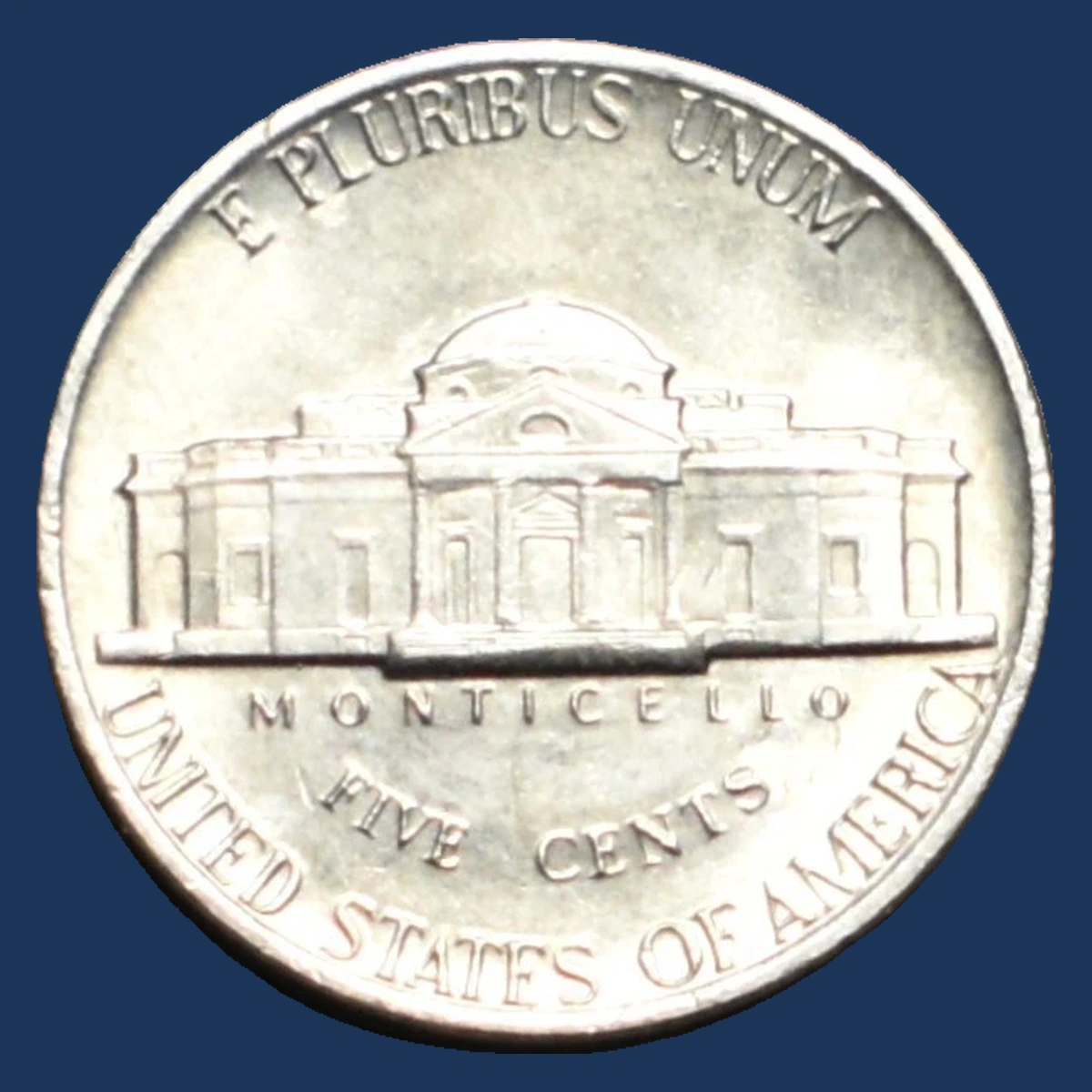
Grease or other material can fill a recessed part of a stamping tool. Metal cannot enter that blocked space during the blow, leaving weaker or missing detail on the coin.
Collectors often call this a grease-filled die; a die is the steel tool that stamps the design. Year sources report this type for 1980.
The descriptions do not establish a separate cloth, wire, or hard-object specimen for every possible obstruction. One missing patch should be judged from its own surface.
Normal circulation wear can also smooth detail, especially on the highest parts of Jefferson’s portrait.
Estimated Value
For a genuine local blockage, estimate $10–$75 on ordinary examples and $75–$250 on strong, attractive pieces. These are estimated values for the reported 1980 type.
A different-year 2000-P nickel with a front struck-through error sold for $84 in February 2015. Its affected area and preservation are separate from a new 1980 find.
A weak date or worn letter alone does not establish an error premium without evidence that something interrupted the original strike.
How to Identify
One weak letter should be compared with both exposed portrait details and protected lettering before calling it a blocked strike. Similar smoothness across the exposed high points may simply show ordinary wear.
Use a 10× magnifier along the boundary between weak and sharp areas, looking for polishing or scratches that removed finished detail. Photograph the opposite face too, since the two sides help show how the original strike formed.
For a loose nickel, use a scale and calipers against 5 grams and 21.21 millimeters and inspect the plain edge. Describe the actual interruption visible on the coin rather than choosing grease, cloth, or wire merely from the missing design.
2. 1980 Jefferson Nickel A Reported Repeated Mint Letter
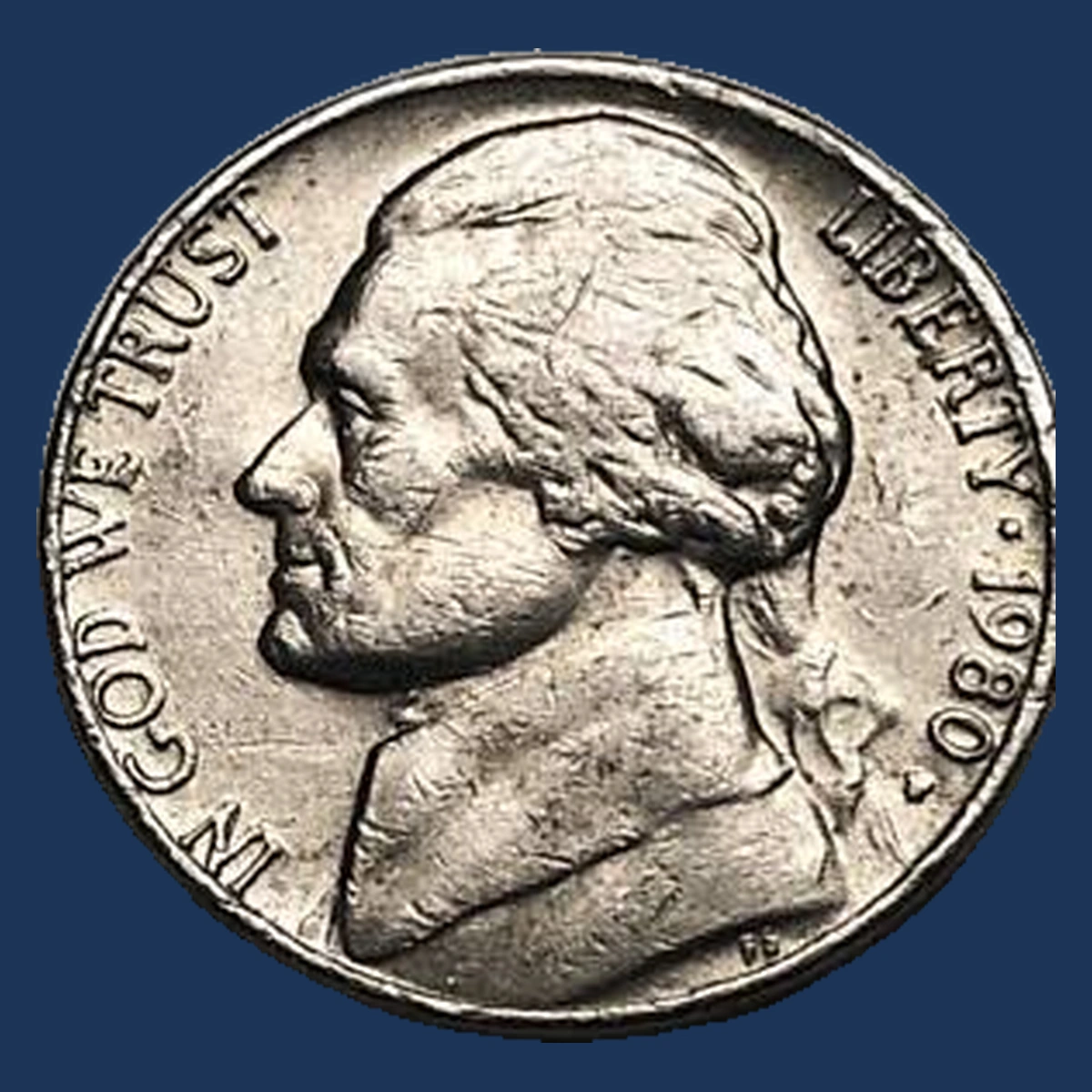
The mint letter was added to individual working tools with a punch during this period. If the punch landed twice in slightly different positions, part of an earlier letter could remain.
Collectors call the result a repunched mint mark. Year sources list the type for 1980 Philadelphia and Denver nickels.
They do not establish a specialist-confirmed catalog number or one direction of displacement here. An apparent extra P or D therefore needs a specific visual match.
Damage, reflected light, and movement during striking can all imitate a second edge without leaving an earlier punched letter.
Estimated Value
For a genuine minor repunched letter, estimate $10–$100, rising to $100–$300 for a clear, attractive example. These are conditional estimates for a properly identified 1980 variety.
No specialist-confirmed sale is established by the year report alone. An extra-looking edge must first match an actual earlier letter impression.
A number borrowed from another listing does not add value when the coin’s shape, mint, or date has not been matched to that variety.
How to Identify
Read the date and mint letter before taking an enlarged photograph. Keep both in the picture so a candidate P cannot be confused with a reported D variety.
At 10× magnification, compare the extra stroke with the main letter’s curves and straight parts. A line that continues randomly into the background may be a scratch instead.
Shift the lamp to rule out glare. The extra metal should remain fixed rather than follow the reflection.
For a loose coin, use a scale and calipers against 5 grams and 21.21 millimeters, then inspect the plain edge. These normal figures cannot establish repunching.
Obtain a specialist match before adopting a catalog number or a claimed direction absent from the actual evidence.
3. 1980 Jefferson Nickel A Gap in the Original Blank
An incomplete blank can pass through the press and become a nickel with a piece missing from its edge. The gap may originate when the blanking punch overlaps an earlier opening in the metal strip.
Year sources report clipped 1980 nickels without establishing a particular mint letter, percentage, or certified example. The shape must be read from the actual coin.
A weak rim opposite a clip can support the explanation but is not always visible.
An ordinary nickel cut after striking may resemble the outline until its gap surface and surrounding design are inspected.
Estimated Value
Estimate $25–$150 for ordinary genuine clips and $150–$400 for large, attractive gaps or multiple clips. These are estimated ranges for the reported 1980 type.
A 1997-P nickel with a twenty-percent curved clip sold for $124 in March 2025. Its date and percentage belong to that separate comparison, not automatically to a 1980 candidate.
A later cut or filed opening should not receive the same premium simply because some metal is missing.
How to Identify
Photograph the gap’s two ends before focusing on its deepest part. Use a 10× magnifier to see whether the design meets an original incomplete edge or has been cut through afterward.
Look for sawing lines or file marks inside the opening. Do not clean away deposits to make its surface brighter.
A loose coin can be weighed against 5 grams, while calipers compare intact spans with the normal 21.21 millimeters. Low weight establishes missing metal but cannot by itself date the removal.
Inspect the remaining plain edge and the rim opposite the gap. Treat opposite-rim weakness as supporting evidence rather than a rule every worn or damaged example must satisfy.
4. 1980 Jefferson Nickel A Wider Disk with the Complete Design
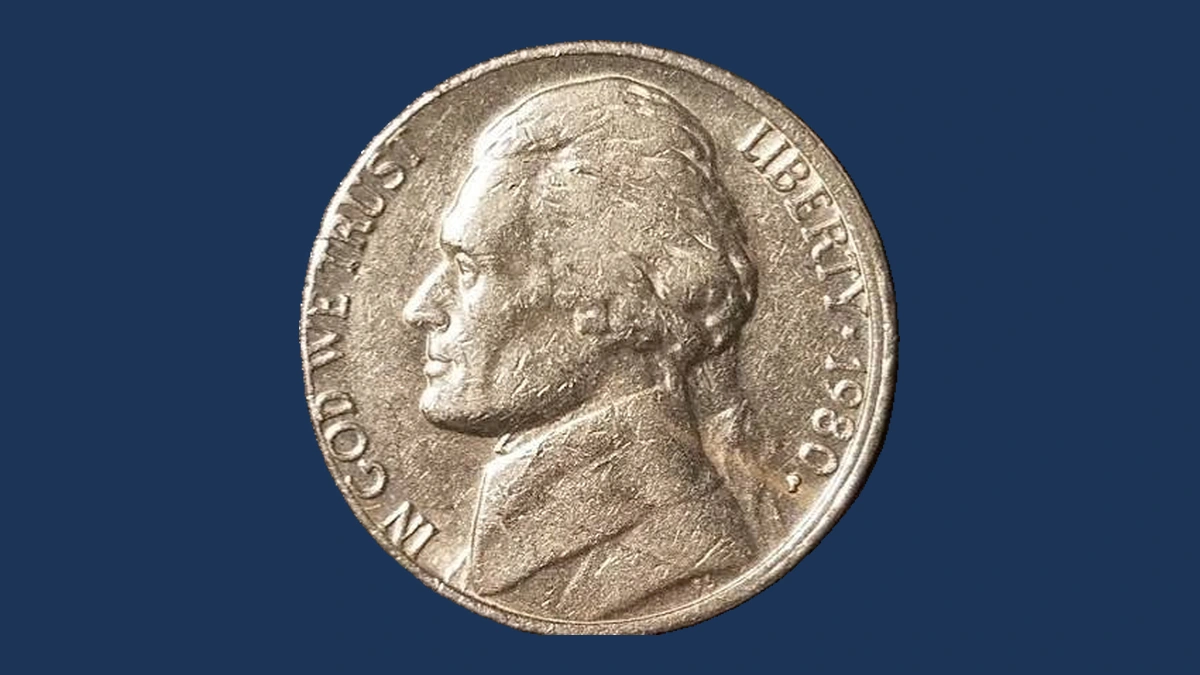
The ring around a blank normally stops the metal from spreading too far during striking. That ring is called the collar.
When it does not restrain the blank properly, the coin can expand and become broadstruck. Year reports include Philadelphia and Denver examples for 1980.
The full design should remain on a simple broadstrike, even when the outline becomes uneven. Part of the design missing beyond the blank instead suggests an off-center blow.
A nickel’s edge is naturally plain, so having no grooves is not evidence that the collar failed.
Estimated Value
Estimate $20–$125 for straightforward broadstrikes and $125–$400 for especially attractive, pronounced expansion. These are whole-coin estimates for the reported 1980 examples.
A same-design Philadelphia broadstrike dated 1984 sold for $20 in August 2021. That different year gives a modest market comparison without establishing a 1980 transaction.
A coin pressed wider after minting should be separated from a genuine broadstrike before either the outline or the claimed error name affects its price.
How to Identify
Measure a loose coin across two intact directions with calipers. Compare those widths with 21.21 millimeters and use a scale against the ordinary 5 grams.
If the original metal spread during striking, the disk may be wider without having lost much weight. Now follow every outside inscription with a 10× magnifier.
A complete design supports a broadstrike, while missing outer detail beside a blank crescent needs a different explanation. Check both faces rather than judging the portrait alone.
Examine the plain edge and high points for hammer marks, squeezing, or flattened finished detail. Those later changes can make a nickel wider without reproducing the surfaces formed during an unrestricted original strike.
5. 1980 Jefferson Nickel Doubled Design in the Stamping Tool
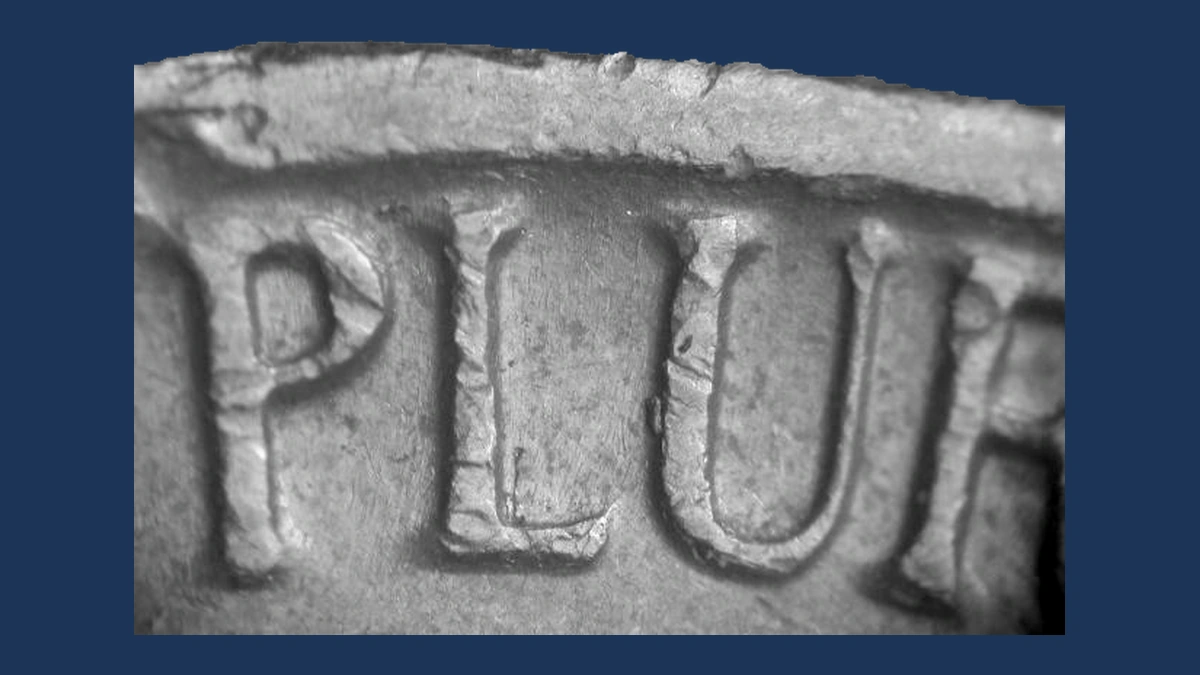
The Philadelphia back variety WDDR-001 has thickened lettering with some visible separation. Its affected areas include E PLURIBUS UNUM, the country name, and the right side of Monticello.
This doubling began in the stamping tool, which then passed the repeated design to later coins. It does not require each coin to receive two blows.
Separate year reports describe front doubling around the date, LIBERTY, or portrait. Those reports do not establish a shared specialist number across Philadelphia and Denver.
The cataloged back variety should therefore be matched separately from a candidate with unusual front detail.
Estimated Value
For correctly matched minor doubled designs, estimate $20–$125 on worn or modest examples and $125–$500 on strong, attractive coins. These are estimated ranges rather than a verified sale of WDDR-001.
The cataloged back detail offers a specific pattern to compare, while the front reports need their own identification. A thick-looking letter alone does not qualify.
Flat shelves from movement during striking should not be priced as a doubled-tool variety without a matching design.
How to Identify
On the Philadelphia back, examine the cataloged lettering and building detail with a 10× magnifier. Compare both the thickness and small separated portions rather than demanding two widely spaced letters everywhere.
Supporting marks include a raised mark above the G’s crossbar in GOD and a diagonal line near the back’s E. Such small tool marks can change as the tools wear.
For a loose coin, check 5 grams and 21.21 millimeters with a scale and calipers, and inspect the plain edge. Return to the main doubling pattern before naming the variety.
Front doubling reports need a separate match. Do not assign their proposed numbers to the documented back variety or to every 1980 mint letter.
6. 1980 Jefferson Nickel Raised Cracks and Rim Breaks
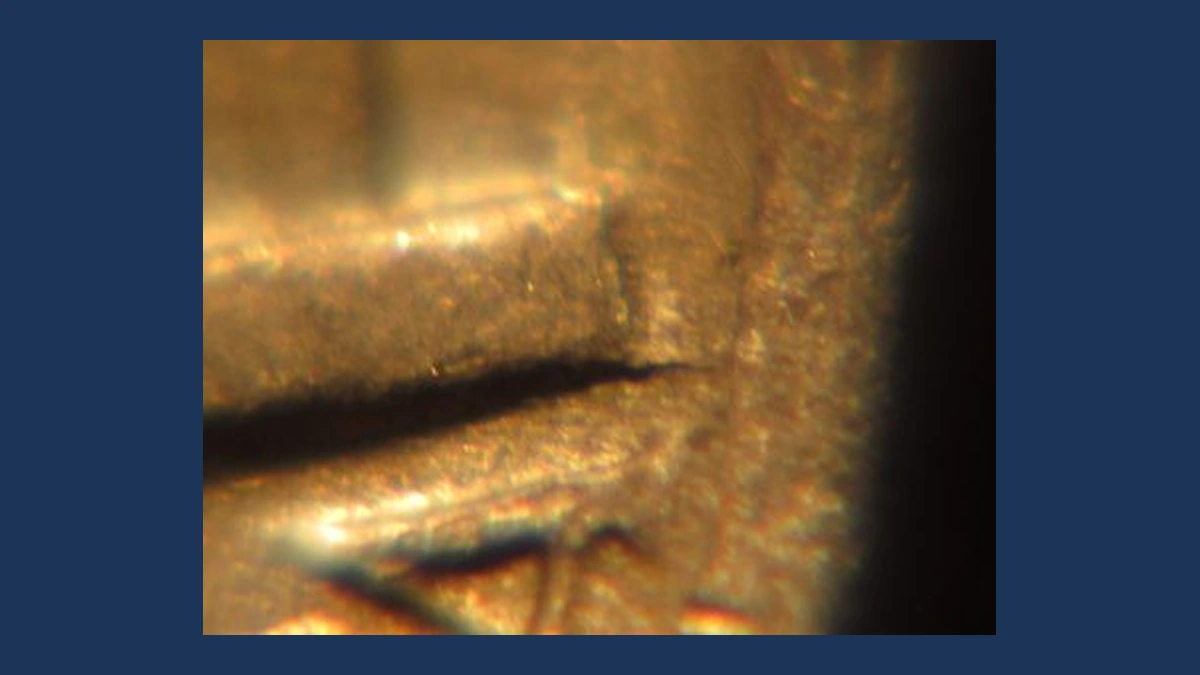
A narrow crack in a steel tool can leave a raised line on the coin. If a larger piece of steel breaks away at the tool’s edge, it can leave a raised patch joined to the rim.
Collectors call that rim-connected patch a cud. A specialist catalog includes a Philadelphia back cud for 1980 under two cross-referenced names.
Those names identify the same pattern, not two separate errors to add together. Other year reports also list ordinary cracks and larger breaks.
The specific back-cud entry does not supply a clock position in the written description used here.
Estimated Value
Estimate $10–$100 for small clear crack lines and $100–$600 for larger, attractive rim breaks. These are estimates for genuine original features on the complete coin.
A different-year Philadelphia nickel with cuds and clash marks sold for $159 in July 2022. That 1984 example combined defects and had slight wear.
It provides a comparison without making every 1980 line or mound equally valuable; size, condition, and the exact pattern still matter.
How to Identify
A line and a mound require different comparisons. Use a 10× magnifier to separate a raised crack ridge from a scratch with a cut floor.
For a mound, follow the whole boundary toward the rim. A cud joins that border; an isolated interior lump needs another description.
Inspect the plain edge and opposite face for an impact, added solder, or other alteration. A loose coin can be checked with a scale and calipers against 5 grams and 21.21 millimeters.
Compare the Philadelphia back cud with its actual catalog photograph. Its two cross-referenced names do not require two separate patches.
Do not guess a clock position or demand a front crack alongside the back cud. Match the pattern that survives on the individual specimen.
7. 1980 Jefferson Nickel A Thin Blank with the Usual Nickel Outline
A full-size nickel can be underweight because its blank was too thin. That differs from using a cent blank, which starts with a smaller diameter.
One Philadelphia example is cataloged as struck on a blank of cent thickness and weighs 3.7 grams. A separate year report describes a 4.4-gram Philadelphia coin.
The two weights belong to different specimens and should not be blended into one description. Neither figure equals the weight of the small copper cent blanks discussed below.
Grinding, chemical attack, or loss of metal can also make a normal nickel lighter after striking.
Estimated Value
The 3.7-gram example has an indexed sale of $156 in October 2021. Its NGC AU50 grade describes a circulated coin with much detail remaining.
Estimate $75–$250 for genuine thin blanks with wear and $250–$750 for attractive unworn examples. The 4.4-gram report does not establish the same sale or specimen.
Thickness, normal-size outline, and original surfaces must agree before applying the estimate to a light nickel.
How to Identify
Compare diameter before deciding that a light nickel used a cent blank. A normal nickel is 21.21 millimeters across, whereas the period’s cent blank starts at 19.05 millimeters.
For a loose candidate, use calipers on intact areas and a scale against the normal 5 grams. Keep the reported 3.7 and 4.4 grams attached to their separate specimens.
Record thickness without measuring over raised letters or squeezing the rim. A thin full-size disk and a small cent disk are different objects.
Under a 10× magnifier, inspect both faces and the plain edge for grinding or chemical attack. Those later processes can also reduce weight.
The phrase cent thickness describes the 3.7-gram blank’s thickness. It does not turn that full-size nickel blank into an ordinary 3.1-gram cent blank.
8. 1980 Jefferson Nickel A Seventy-Five-Percent Off-Center Strike
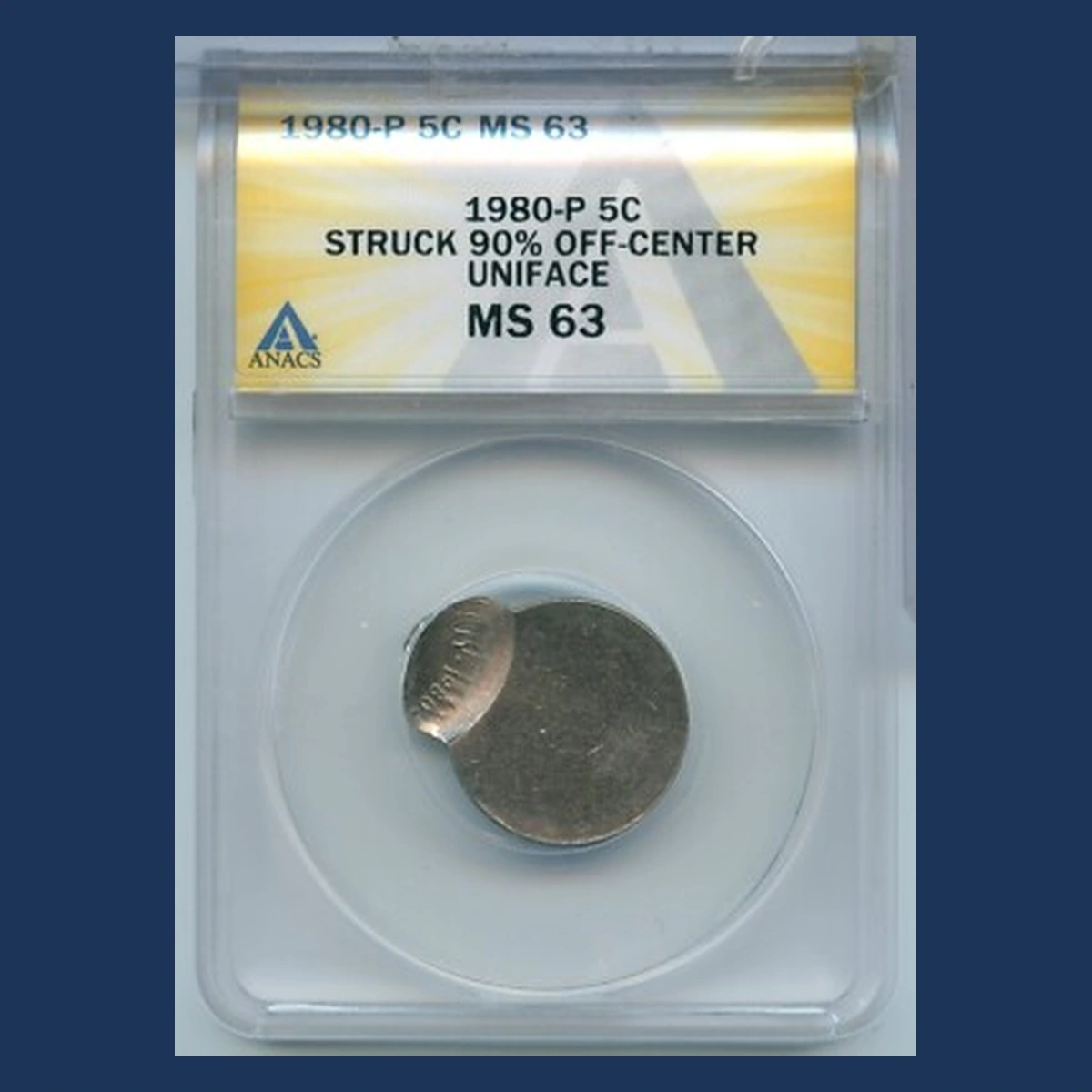
A large area of blank metal can remain when most of the disk misses the stamping tools. The design survives only where the tools actually contact the metal.
The recorded Philadelphia example is seventy-five percent off center toward eleven o’clock. Its ANACS MS62 grade indicates an unworn coin with noticeable marks.
The displaced portrait and surviving date should be examined together. An isolated photograph of a small struck patch can conceal how it fits the rest of the disk.
This example received a misplaced strike; its appearance does not by itself prove a second blow or an unusual blank.
Estimated Value
Estimate $75–$300 for clear, dated off-center examples and $300–$1,000 for dramatic, attractive pieces. These are individual-coin estimates for this reported 1980 type.
For comparison, a 1984-P nickel struck fifty percent off center sold for $132 in March 2021. Its different displacement and condition should not be transferred to the seventy-five-percent example.
A readable date and undamaged blank area help support the comparison; percentage alone is not a complete pricing guide.
How to Identify
Hold the surviving portrait upright before marking eleven o’clock. Photograph the entire disk, keeping the date and P visible rather than cropping around the small struck area.
Compare the back with the front to see how one misplaced disk explains both designs. Another surviving impression would require an additional-strike explanation.
A loose nickel can be weighed against 5 grams and measured with calipers against the normal 21.21 millimeters. Inspect the plain edge for trimming that might change the apparent displacement.
Use a 10× magnifier across the struck boundary to look for grinding or removed lettering. The unstruck portion should be original metal that missed the tools, not a patch from which somebody erased the design.
9. 1980 Jefferson Nickel Repeated Blows on the Faces or Edge
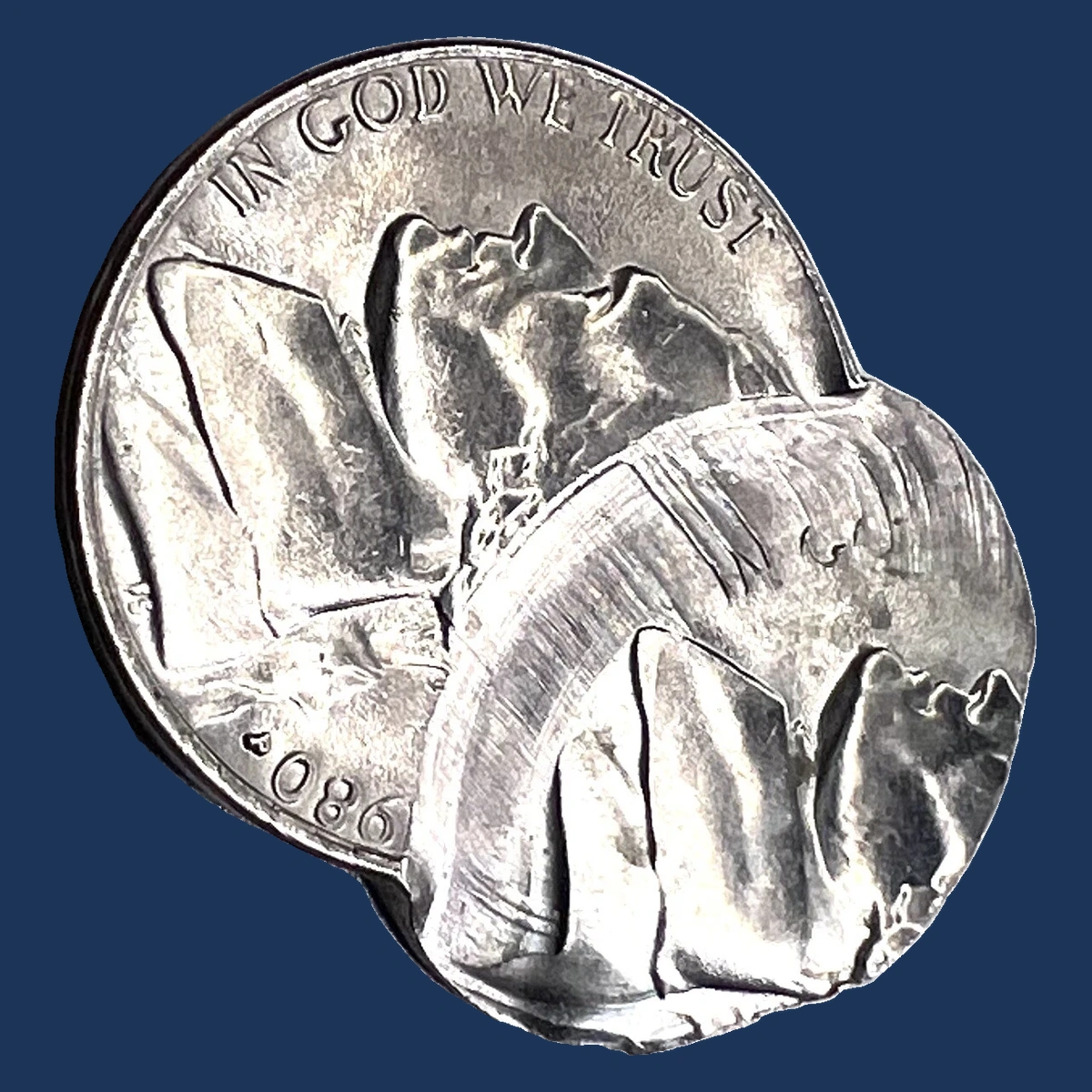
A coin can remain in the press for another blow or return in a changed position. Philadelphia examples include a ninety-five-percent second strike with one face blocked and another second strike seventy percent off center.
A cataloged triple strike has later blows seventy-five and ninety percent off center. Another double stayed within the collar, retaining a more ordinary outline.
One example received its second strike on the edge itself. Its Five Full Steps wording describes the building’s sharp steps, not another error.
These different sequences must be read from their own surviving details.
Estimated Value
The seventy-percent second strike sold for $336 in December 2024. The indexed ninety-five-percent example, graded ANACS AU50 with visible wear, brought $35 in August 2021.
Estimate $35–$500 for readable ordinary double strikes and $500–$1,500 for exceptional triples or edge-strike combinations. These are whole-coin estimates.
A small extra strike is not necessarily expensive, and a catalog’s D/S abbreviation here means double struck rather than a Denver-over-San-Francisco mint letter.
How to Identify
An edge strike needs a side view, so determine where the later impression landed before counting letters. Photograph the whole edge and both faces without forcing the coin to stand on a damaged section.
For a loose example, use a scale against 5 grams and calipers against 21.21 millimeters. An in-collar double can retain a normal-sized outline, and the original edge is plain.
Trace each repeated portrait or building fragment with a 10× magnifier. Connect it to related lettering rather than counting one flat shelf as another blow.
The ninety-five-percent second strike has a blocked face, where another complete design should not be demanded. Keep that double separate from the triple with later strikes seventy-five and ninety percent off center.
10. 1980 Jefferson Nickel Nickel Designs on Copper Cent Blanks
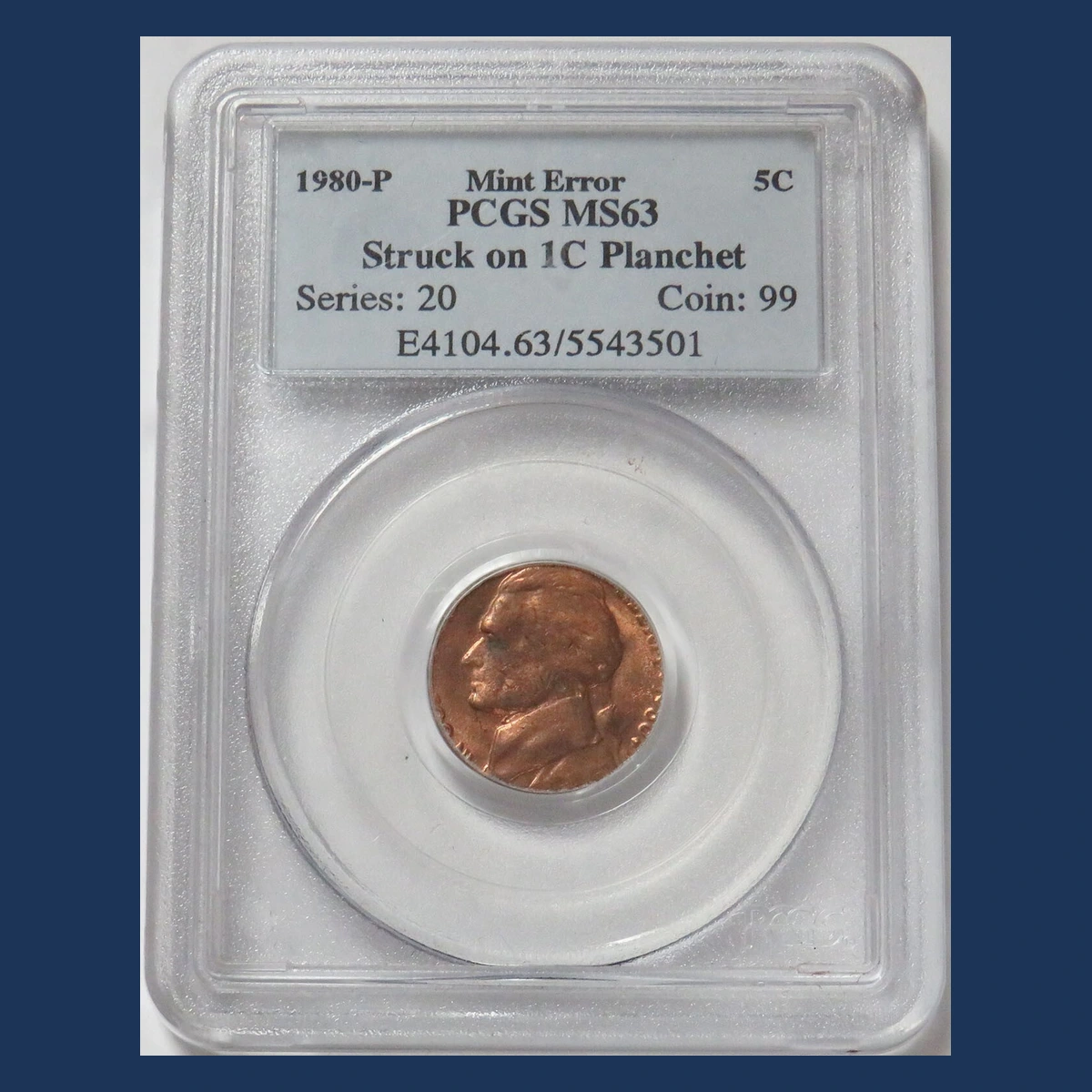
A copper cent blank can receive Jefferson and Monticello if it enters the nickel press. The smaller disk cannot accommodate the full outer nickel design.
Recorded Philadelphia and Denver examples weigh about 3.1 grams. A separate Philadelphia specimen is listed at 3.05 grams, and those measurements belong to their own coins.
Another Philadelphia cent-blank error was struck about twenty percent off center. It combines the wrong blank with an incomplete impression rather than simply losing outer letters through its smaller size.
These blanks began without Lincoln designs; a surviving earlier cent design would describe a different sequence.
Estimated Value
The Denver 3.1-gram example sold for $431.25 in August 2010. A separate Philadelphia 3.1-gram specimen brought $384 in December 2024.
Estimate $150–$800 for clear ordinary cent-blank strikes and $800–$2,000 for particularly attractive or off-center combinations. These ranges are whole-coin estimates.
The P and D coins have different grades and color descriptions; their weights do not make them one specimen or establish a price for the twenty-percent example.
How to Identify
On a loose candidate, use a scale to compare the period’s copper cent standard of about 3.11 grams with a nickel’s 5 grams. Calipers can compare the smaller disk with 19.05 millimeters rather than assuming the nickel’s 21.21.
Striking can spread the copper blank. Examine its plain edge and cut-off outer lettering through a 10× magnifier for signs of original metal flow.
A copper coating on a normal nickel would not establish the smaller, lighter blank. Check for altered surfaces before accepting color as supporting evidence.
For the twenty-percent example, locate the unstruck area separately from letters that simply failed to fit. Keep its displacement and condition separate from the 3.05- and 3.1-gram records.
11. 1980 Jefferson Nickel A Triple-Struck Fragment Attributed to This Year
An irregular scrap can enter the press instead of a complete round blank. The cataloged piece weighs only 1.3 grams and is described as struck three times.
Its year appears in parentheses as (1980)-P. That form preserves a catalog attribution without claiming a fully readable 1980 date on the object.
NGC graded the fragment MS66, indicating strong unworn preservation. The broken outline and overlapping designs are separate features that must agree with its description.
A piece cut from a finished nickel can be light and irregular too, but it does not automatically reproduce the same striking history.
Estimated Value
The attributed fragment has an indexed auction result of $720 in December 2022. That amount belongs to the triple-struck 1.3-gram object, with its parenthesized year retained.
Estimate $400–$1,200 for a clear comparable fragment and $1,200–$2,500 for especially attractive, well-supported combinations. These are whole-object estimates.
A later-cut scrap should not receive the same range merely because it weighs little or carries part of a nickel design.
How to Identify
Photograph the irregular boundary before trying to read the tiny design. At 10× magnification, follow where each of the three reported impressions approaches an edge.
Look for later cutting that crosses already completed detail. A scrap struck repeatedly in the press needs a different explanation from a piece cut off a finished nickel.
Weigh a loose piece against the cataloged 1.3 grams, compared with 5 grams for a normal nickel. Calipers record its irregular dimensions rather than requiring the usual 21.21-millimeter diameter.
Any surviving original nickel edge would be plain. Inspect it without filing or straightening the fragment.
Keep the year in parentheses if relying on the catalog attribution. An incomplete date should not be presented as a clearly readable 1980 just because the object appears in a year list.
12. 1980 Jefferson Nickel Jefferson Struck over a Finished Lincoln Cent
A cent may already have its Lincoln design when it reaches the nickel press. A later Jefferson strike can partly erase that design while leaving recognizable traces underneath.
The recorded Philadelphia example is described as a double-denomination overstrike and graded NGC MS64 Brown. That grade describes an unworn coin with some marks, while Brown refers to its copper color.
The surviving cent’s exact date is not established in the description. It should not automatically be called a 1980 cent.
An unused copper blank cannot leave genuine lower Lincoln details because it never received them.
Estimated Value
An indexed 1980-P nickel on a struck cent sold for $444 in December 2025. It provides a same-year type comparison, without proving it is the separate GreatCollections specimen.
Estimate $350–$1,200 for readable examples and $1,200–$3,000 for strong, attractive overstrikes. The clarity of the lower design and overall condition matter.
Those ranges value one coin carrying two denominations; they are not prices to add for each portrait or inscription.
How to Identify
Find a recognizable Lincoln cent feature before relying on the copper color. A 10× magnifier can help follow an older letter or portrait fragment beneath the later nickel impression.
Look for a host date without filling in one that cannot be read. The visible nickel date identifies the later design, not necessarily the earlier cent year.
For a loose coin, a scale can compare the expected copper-cent weight near 3.11 grams with a nickel’s 5 grams. Calipers compare its expanded outline with the cent’s original 19.05 millimeters and the nickel’s 21.21.
Inspect the plain edge for joining seams or added metal. A colored surface alone cannot establish that a finished cent was genuinely struck by nickel tools.
13. 1980 Jefferson Nickel A Half-Off-Center Strike on a Dime Blank
The recorded Denver coin combines a wrong blank with a badly misplaced strike. It received the nickel design on a dime blank about fifty percent off center toward nine o’clock.
The small disk weighs 2.3 grams, and the date and D remain complete. Its edge shows the layered metal expected from a dime blank rather than the uniform nickel alloy.
NGC graded it MS67, indicating very strong unworn preservation. The high grade describes its surfaces despite the incomplete strike.
The blank had no Roosevelt design beforehand, so this is different from striking over an already finished dime.
Estimated Value
The Denver dime-blank error sold for $1,495 in August 2010. That actual price covers the wrong blank and off-center strike together.
Estimate $600–$1,500 for clear comparable combinations and $1,500–$3,500 for exceptional preservation and presentation. A complete date helps identify the recorded specimen.
Do not add a separate fifty-percent-off-center price to the wrong-blank estimate; the collector is buying one complete coin.
How to Identify
Start with weight: the cataloged example is 2.3 grams, close to the dime standard of 2.268 rather than the nickel’s 5 grams. Use a scale on a loose candidate and calipers to compare its altered outline with 17.91 and 21.21 millimeters.
The layered edge should be examined with a 10× magnifier. A blank need not have the grooves normally added by a dime collar during striking.
Hold the remaining portrait upright and check the shift toward nine o’clock. Confirm that both the 1980 date and D remain visible on a proposed match.
Look for any older Roosevelt design as a separate question. That would indicate a finished dime host rather than the unused blank described here.
14. 1980-P Roosevelt Dime with an Undated Jefferson Nickel Overstrike
The visible 1980-P date belongs to the dime underneath this unusual coin. The later Jefferson nickel strike is undated, so its own striking year is not established.
A Stack’s Bowers catalog describes Jefferson’s portrait impressed over the dime’s back. Both denominations remain recognizable, and the edge retains grooves from the earlier dime strike.
NGC graded the coin MS65, indicating good unworn preservation. Its catalog title keeps the 1980-P attribution in parentheses.
This is a finished dime receiving another design, not an empty dime blank that lacked Roosevelt details before entering the nickel press.
Estimated Value
For a genuine nickel overstrike on a readable 1980-P dime, estimate $600–$2,000, rising to $2,000–$4,000 for exceptional preservation and clear overlapping design. These are estimated values, not a reported sale of the cataloged specimen.
The 1980-P nickel-over-cent type’s $444 December 2025 result is a simpler cross-denomination comparison on a different host. The metal and design differ.
Preserve the later nickel’s undated status when making any price comparison.
How to Identify
Identify the 1980 date and P on the underlying dime before trying to date the later strike. A clear host date does not supply a missing date from the nickel tool.
Through a 10× magnifier, compare Jefferson’s portrait with the older dime back beneath it. Both sets of genuine design must survive to support this sequence.
A normal dime started at 2.268 grams and 17.91 millimeters, compared with a nickel’s 5 grams and 21.21 millimeters. Use a scale and calipers on a loose coin, allowing for expansion.
Unlike an unused dime blank, this host already had edge grooves from its first strike. Inspect those grooves and the overlapping detail rather than assuming the outer nickel design establishes a 1980 production date.
15. 1980 Jefferson Nickel A Matching Nickel-and-Cent-Blank Pair
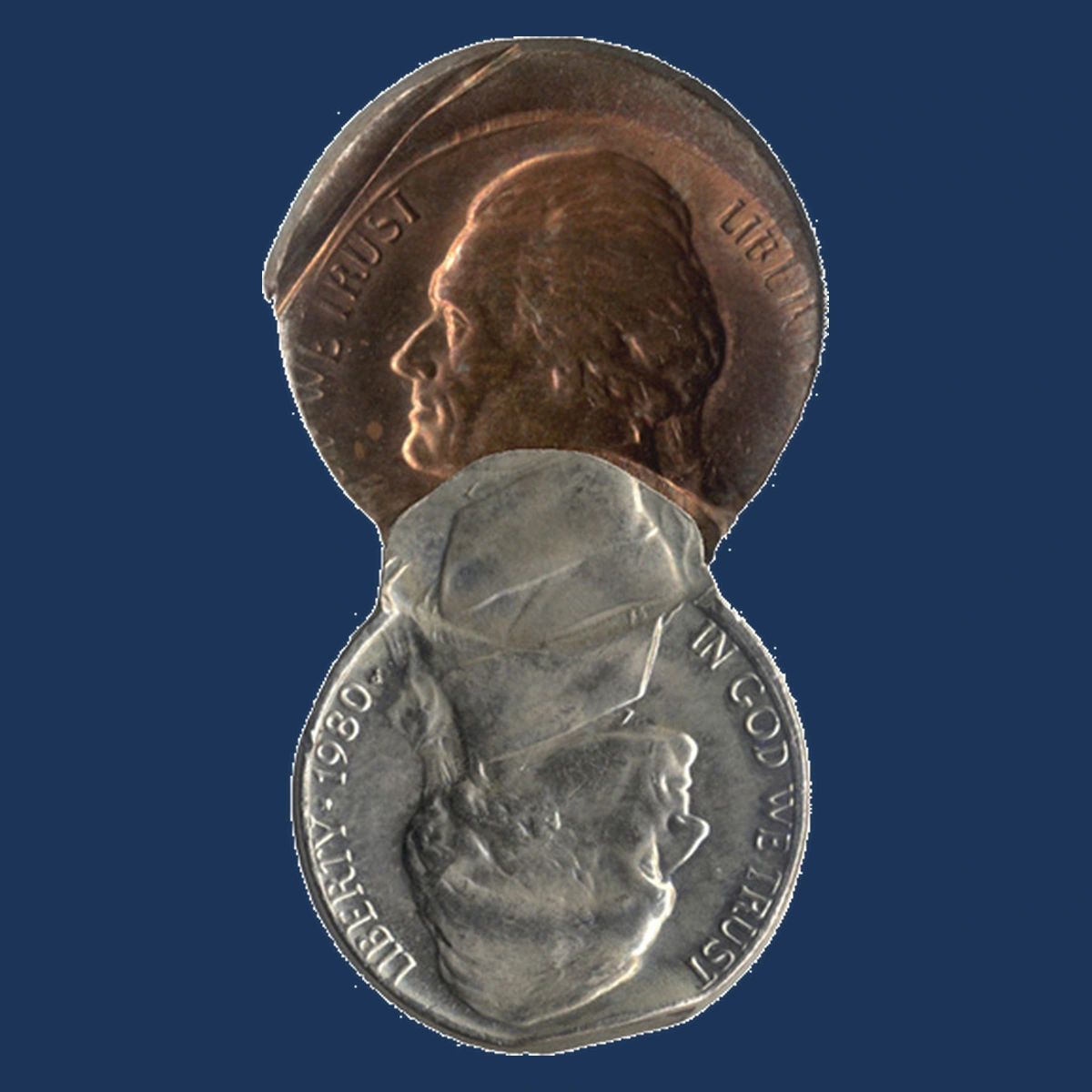
Two pieces preserve a shared minting event: one on a normal nickel blank and the other on a copper cent blank. Both received nickel designs.
The expanded part of the normal nickel shows faint RIBUS UN letters. The copper piece carries matching letters in reverse as a sunken impression, called a partial brockage.
These features connect the two objects rather than adding a third cent between two nickels. NGC graded the pair MS66 and MS66 Red and Brown for strong unworn preservation.
The matching surfaces and different metals need to be considered together when explaining the pair.
Estimated Value
Mint Error News lists a $7,475 Heritage result for this two-piece type in its published auction-record table. The figure covers the pair, and that table does not give the transaction date.
Estimate $3,000–$8,000 for a clear matching pair with strong preservation and $8,000–$12,000 for an exceptional example. These are pair values.
Neither splitting the result evenly nor adding an independent wrong-blank price captures the value of the relationship between the pieces.
How to Identify
Compare the two contact areas in photographs without pressing the pieces together. The normal nickel’s faint RIBUS UN and the copper piece’s reversed letters should describe the same interaction.
At 10× magnification, confirm that the reversed letters sink into the copper. Keep that mirror impression separate from ordinary raised nickel lettering.
If loose, weigh each object separately: the normal nickel begins near 5 grams, the period’s copper cent blank near 3.11 grams. Calipers compare their changed outlines with the starting diameters of 21.21 and 19.05 millimeters.
Both blanks originally had plain edges. Check the edges and contact surfaces for later alteration, and assess the pair together rather than treating two unrelated copper-colored and silver-colored coins as a match.
Conclusion
Estimated values for the 1980 nickel types here range from $10 to $12,000, with the highest range reserved for a matching two-piece error. Light weight can come from a thin full-size blank, a smaller wrong blank, or an irregular fragment.
Read surviving dates carefully when one denomination covers another. The 1980-P dime host does not establish the undated nickel’s year, and a cataloged fragment’s parenthesized date should remain qualified.
Keep each coin’s shape, metal, and strike sequence together.