1951 Nickel Error List with Pictures

The lower edges of IN can show three outlines on a specially made 1951 Proof nickel. A high-grade FS-101 example sold for about $494 at Heritage in July 2015.
Other 1951 Jefferson Nickel errors reveal themselves through weight, missing metal, or a shifted design. The estimated range here is $5–$750.
These are copper-nickel coins, not wartime silver nickels. Use the individual checks below to compare your coin with the right kind of error.
1. 1951 Jefferson Nickel Repeated D or S Mintmark
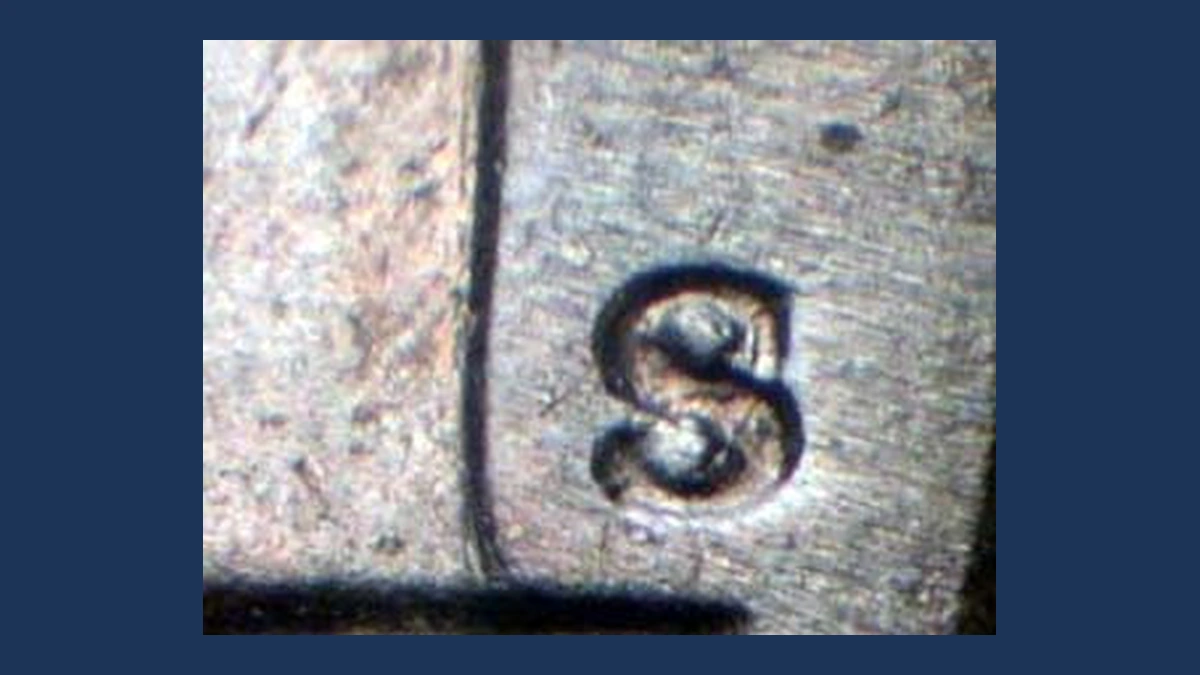
On Denver and San Francisco nickels, the small D or S sits beside Monticello. An extra part of the same letter can survive when the mintmark was punched into the stamping tool more than once.
That mistake is known as a repunched mintmark. It affects the letter before the tool begins striking coins, rather than sending one finished coin through the press twice.
D-over-D and S-over-S examples are reported for 1951. Their secondary outlines can differ, so the direction and shape need to be checked against the particular specimen being identified.
Estimated Value
Use an estimated $10–$50 for a modest identified example and $50–$150 for a clearer, attractive unworn coin. These ranges do not assign an auction result to the reported D/D or S/S pieces.
An easily recognized second letter is more useful to a collector than an indistinct swollen mintmark. Wear, scratches, and cleaning can reduce the premium, and the surrounding coin’s condition remains part of its total value.
How to Identify
Turn to Monticello and identify the letter on its right. A Philadelphia nickel has none, so an apparent mark elsewhere cannot establish a D/D or S/S variety.
Use a 10× magnifier to trace the extra curve or upright stroke. Compare it with a photograph showing the same letter shape, not merely another mintmark with a similar shadow.
The date and ordinary lettering should be considered separately from this small feature. Repetition confined to the mintmark does not establish a doubled design across the coin.
Check a loose coin with a scale and calipers against 5 grams and 21.2 mm, including its plain edge. Confirm a recognizable second D or S outline before assigning a variety number.
2. 1951 Jefferson Nickel Lamination Cracks and Peeling Metal
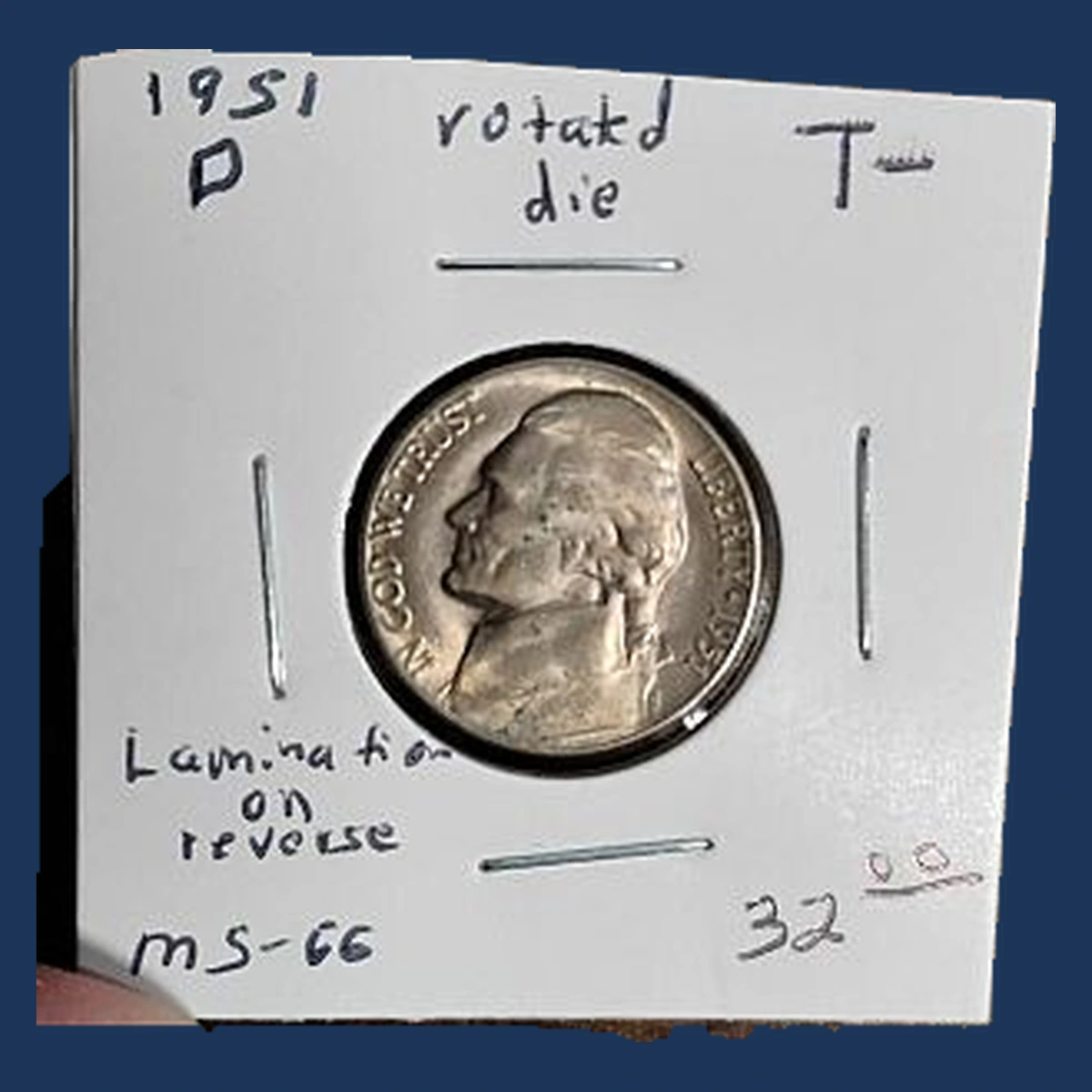
A shallow line can open into a thin flap when the coin’s metal separates internally. If the flap falls away, a rough patch may remain where it once covered the surface.
This is a lamination error. It starts with weakness in the original metal, rather than a crack in the tool that stamps the coin.
Lamination cracks are reported for 1951 without one specific mint or surface location. Ordinary corrosion and scratches can also disturb the surface, so the presence of a rough patch alone is not enough to identify an original metal flaw.
Estimated Value
Estimate $5–$50 for a small genuine separation and $50–$250 for a larger or more attractive example. These are estimates for original metal flaws, not a recorded sale of a specific 1951 specimen.
A retained flap can make the cause easier to understand, but heavy peeling that destroys the design may limit interest. Later scraping, chemicals, or corrosion do not add an error premium just because they leave a similar-looking patch.
How to Identify
Look for a place where the surface opens into the metal, instead of beginning with the overall roughness. A 10× magnifier and light from the side can reveal that opening without touching it.
If a flap survives, photograph any design on it and leave it attached. Compare its surface with the surrounding coin rather than pulling it up to inspect underneath.
The loose coin may still weigh near 5 grams if no metal has fallen away. Record the weight with a scale and compare its diameter with 21.2 mm using calipers.
Inspect the plain edge if the separation reaches it. A natural split within the original metal, rather than a coating or scraped trench, is the key distinction.
3. 1951 Jefferson Nickel Curved Clip
A curved gap takes away part of the recorded 1951-D nickel’s outline. The year guide describes it as a seventeen-percent clip, without fixing a clock position for the missing section.
The gap begins when a blank-cutting punch overlaps a hole already present in the metal strip. The incomplete disk can still reach the press and receive its design.
This leaves less metal than a normal nickel. It differs from an off-center strike, where an empty-looking crescent is still present but has not received the design, and from a coin cut after circulation.
Estimated Value
For an authenticated curved clip, estimate $20–$100 with wear and $100–$300 for a clear, well-preserved example. The seventeen-percent description alone does not establish a sale price.
A 1997-P nickel with a twenty-percent clip brought $124 in March 2025, offering a useful different-year comparison. Original edges and a readable date are important; heavy scratches or a questionable cut can greatly weaken the case for a similar value.
How to Identify
Use a scale to document the loose coin’s reduced weight against the normal 5 grams, then measure its intact spans with calipers against 21.2 mm. Those measurements describe missing metal but cannot separate a Mint clip from metal cut away later.
Examine the curve and plain edge through a 10× magnifier, following softened details and natural metal flow toward the missing section. Watch for filing, sawing, or sharp burrs that would support a later cut instead.
Then check the opposite rim for weakness, remembering that wear may hide this supporting clue. Photograph the original-looking boundary with the readable date and back’s D, keeping the seventeen-percent report separate from any unmeasured candidate.
4. 1951 Jefferson Nickel Thin Blank
The recorded 1951-S nickel is much lighter than normal but is described as struck on a thin blank. Its actual weight is 3.5 grams, compared with the usual 5 grams.
A blank is the disk of metal that receives the design. When it contains too little metal through its thickness, the finished coin can remain unusually light.
The NGC MS66 example establishes that a thin-blank error exists for this date and mint. It does not by itself establish a different alloy, a foreign denomination, or a split that removed a layer before striking.
Estimated Value
The NGC MS66 thin-blank nickel sold for $149.50 on September 26, 2010. Estimate $75–$200 for a verified example with some wear and $200–$400 for especially attractive pieces.
These are value ranges, not a claim that every unworn coin must exceed the earlier sale. The weight, original surface, and confidence in the Mint-made thinness all affect buyer interest.
Compare similar preservation levels.
How to Identify
Weigh a loose coin on a scale reading hundredths of a gram. Compare the result with the recorded 3.5 grams and the ordinary nickel’s 5 grams.
A low reading is only the start. Use calipers to compare its thickness and diameter with an ordinary 21.2 mm nickel.
If the outline is substantially smaller, consider whether a different blank or later cutting offers a better explanation. Thinness does not automatically name the metal.
Inspect both faces and the plain edge through a 10× magnifier for grinding, acid damage, or an exposed split. Confirm the date and S beside Monticello.
Original struck surfaces on a thin, light blank are the evidence to present for authentication.
5. 1951 Jefferson Nickel Die Chips and Rim Cuds
A small raised lump can form when part of the stamping tool breaks away. Metal fills the empty space in the broken tool and creates an extra feature on the coin.
A tiny missing piece produces a chip-shaped lump. A larger break reaching the tool’s edge can create a blob joined to the coin’s rim, called a cud.
Both forms are reported for 1951, but they do not share one fixed position. A lump in the middle of a face should not be called a rim cud unless it actually connects to that rim.
Estimated Value
For small genuine chips, estimate $5–$50. More obvious rim-connected cuds can be estimated at $50–$500, depending on their size and the coin’s condition.
A 1959-D cud graded MS65 sold for $504 in May 2021, providing a different-year comparison for a substantial break. That amount should not be copied onto a tiny bump in a letter, and glue, solder, or metal displaced by impact does not earn the same premium.
How to Identify
Check whether the lump connects to the rim before giving it a cud label. An isolated interior bump and an edge break are different visible forms.
Move a lamp across the feature while viewing it through a 10× magnifier. Look for a natural continuous surface, not an attachment seam or a dent with metal pushed around it.
Inspect the opposite face for weakness corresponding to a substantial rim break. That can support the explanation, although its absence does not settle every small chip.
The loose coin should remain close to 5 grams and 21.2 mm when checked with a scale and calipers. Examine the plain edge where any blob joins it.
Trace the original surface into the raised feature to distinguish struck metal from something added later.
6. 1951 Jefferson Nickel Off-Center Strike
A portion of the nickel can carry no design while Jefferson and Monticello are pushed toward the opposite edge. The blank sat away from the center when the press struck it.
Because the stamping tools did not cover the entire blank, some design fell outside its outline. The untouched portion remains as solid metal beside the struck area.
Off-center examples are reported for 1951 without a confirmed common percentage or direction. A single uneven rim can also come from one tool being misaligned, so both faces need to support the off-center explanation.
Estimated Value
Estimate $50–$200 for modest authenticated offsets and $200–$750 for stronger examples with an identifiable date. These ranges depend on condition and how much of the design survives.
A 1955-D nickel struck fifteen percent off center, graded MS66, sold for $402.50 in October 2010. It provides a different-year comparison, not a measured percentage for the 1951 report; losing the date can reduce appeal even when the offset is large.
How to Identify
Place front and back photographs side by side and compare where the designs leave the blank. The same misplaced blank should affect both sides, while a shift on just one face calls for another explanation.
Under a 10× magnifier, inspect the border between struck and untouched metal for natural flow rather than scraping. Keep the date and any mintmark visible in your photographs.
An ordinary blank starts at 5 grams, so a scale can check whether a loose coin has lost substantial metal. Use calipers against the normal 21.2 mm diameter and inspect the plain edge, allowing for spreading during the strike.
Find solid unstruck metal beside the cut-off design before classifying the coin as off center.
7. 1951 Jefferson Nickel Doubled and Tripled Letters
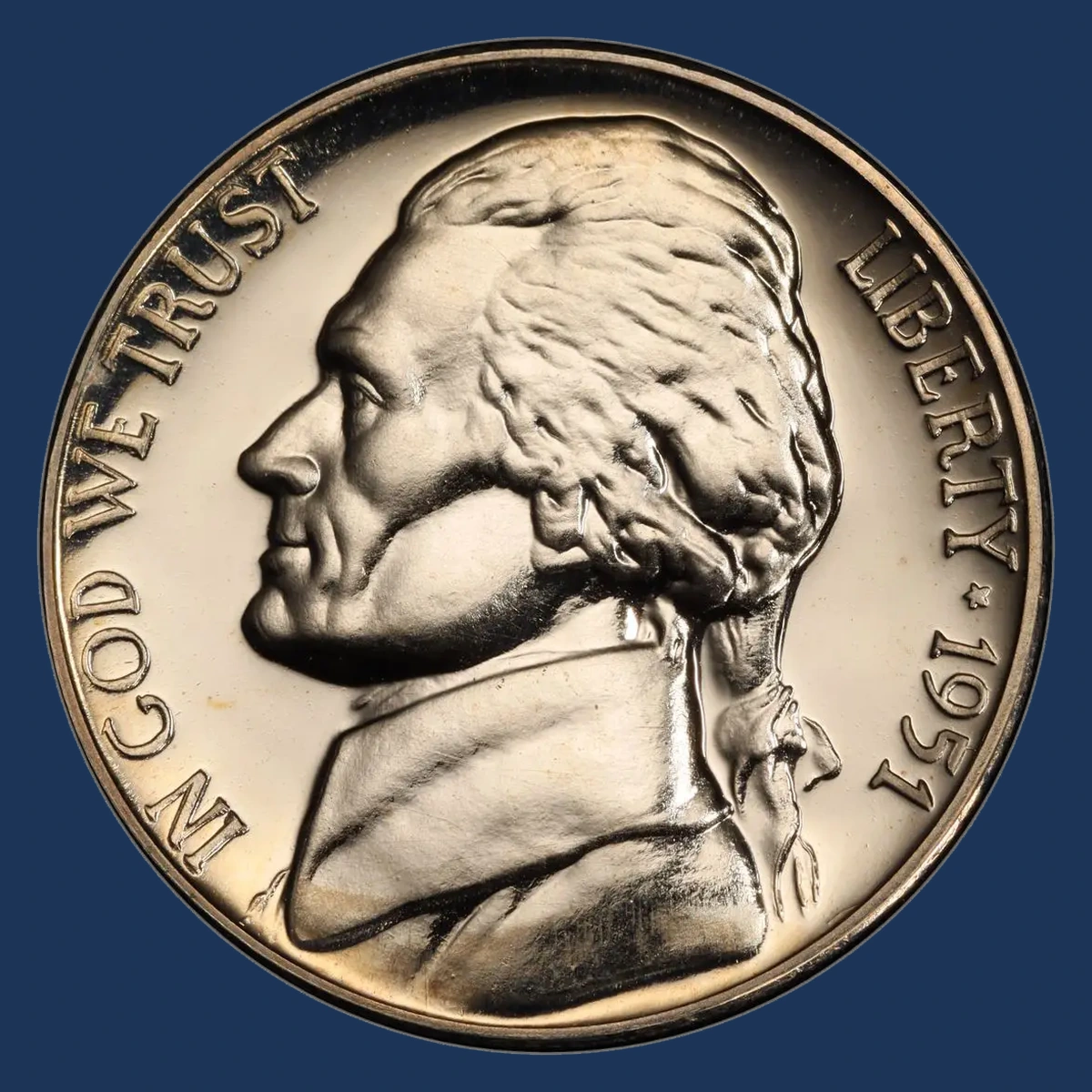
The bottom of IN can show three separate outlines on the recognized 1951 Proof front variety. Proofs are specially made collector coins, and this pattern comes from the tool’s preparation.
The same front is paired with a back showing close doubling in several letters. Other Proof backs have different tripling patterns, while a Denver variety has very close doubling in E PLURIBUS UNUM.
These details should stay with their own examples. They are not evidence that a finished coin received three misplaced blows, and a flat shelf beside a letter can have another cause.
Estimated Value
PCGS records an FS-101 Proof graded PR68 at about $494 from a July 2015 Heritage auction. The exceptional condition contributes to that whole-coin price.
Estimate $10–$75 for minor identified doubling and $100–$750 for stronger Proof examples. Those ranges do not make the subtle Denver back variety equivalent to the prominent Proof front, and ordinary strike damage should not receive a doubled-die premium.
How to Identify
Find the best repeated letters before deciding which variety to compare: lower IN points toward the Proof front, while Denver back doubling is much closer. Confirm the finish and mint, since ordinary Philadelphia coins and Proofs both lack a mintmark.
Through a 10× magnifier, compare the Proof’s IN with its paired back at UNITED STATES OF AMERICA, CENTS, and the second O of MONTICELLO. For Denver, examine E PLURIBUS UNUM instead, without expecting the Proof’s strong tripling.
A normal loose nickel weighs 5 grams on a scale and measures 21.2 mm with calipers, with a plain edge. Match the rounded extra outlines on the correct finish, rather than naming a variety from thick letters or flat shelves alone.
Conclusion
Estimated values for these 1951 Jefferson Nickel errors range from $5 to $750. Small peeling patches or tool chips can be inexpensive, while sharp Proof varieties and dramatic striking errors can cost more.
The recorded thin-blank coin is 3.5 grams, and the Proof’s repeated lettering offers a separate visual test. Let those specific clues guide your checks rather than assuming every light coin or doubled-looking letter has the same cause.