1902 Nickel Error List with Pictures

Liberty’s portrait and the large V belong on opposite faces of a nickel. A coin that flips over inside the press can mix those designs together.
One such 1902 example brought $5,750 at Heritage in January 2012. The 1902 Liberty Nickel errors below span estimated whole-coin values of $15–$7,500, from modest metal flaws to a dramatic second strike.
Use the following surface and design clues to separate these mistakes from damage.
1. 1902 Liberty Nickel Repunched Date
A short extra curve beside a date digit can be a trace of an earlier date punch. During tool preparation, the date was punched into a steel stamping tool, sometimes more than once in slightly different positions.
The finished coins then repeated those extra outlines. This is called a repunched date, rather than a coin struck twice.
The 1902 date is listed in Liberty Nickel Varieties. Matching an identified example matters because thick digits, scratches, and flat doubling beside a numeral can all suggest an extra stroke at first glance.
Estimated Value
Allow an estimated $40–$500 for a confirmed repunched date on an ordinary 1902 coin. This is a working range, not a recorded auction result for the listed variety.
If the coin is also confirmed as a Proof, a specially made collector issue, estimate $200–$1,000 for the whole coin. That higher range includes the value of the Proof itself.
An extra-looking line alone does not justify either premium; condition and a clear variety match come first.
How to Identify
Put a normal 1902 date beside your coin and inspect all four digits with a 10× magnifier. Turn the light slowly so that a reflection cannot pass for a permanent extra stroke.
An earlier punched digit should leave a recognizable piece of a numeral. A scratch crossing the date or a broad flat shelf is a weaker explanation for a repunched date.
Check an identified variety photograph before deciding which digit or direction should match. A scale and calipers can also check a loose coin against 5 g and 21.2 mm, with a plain edge.
Those measurements establish normal nickel size, not the variety. Compare the shape and exact placement of the extra digit outline with the identified example.
2. 1902 Liberty Nickel Peeling Metal on Ordinary and Proof Coins
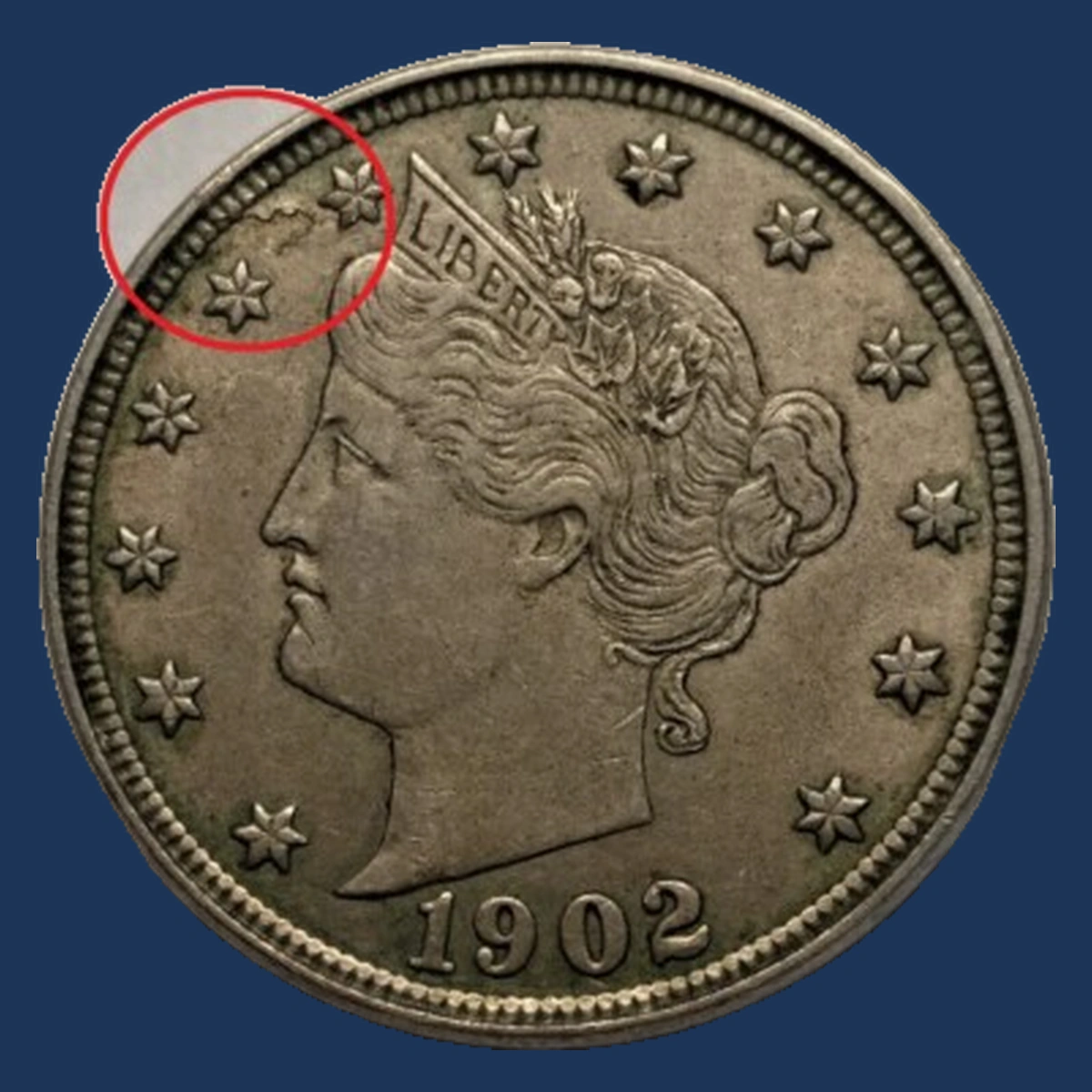
A thin piece of metal may peel up while remaining attached at one end. Called lamination, this happens when part of the copper-nickel mixture separates inside the coin.
An ordinary 1902 example graded NGC MS63 has peeling on the back. MS63 describes an unworn coin with visible marks.
A different coin, reported by a collector as a Proof, has a small flap on Liberty’s cheek. That reported Proof and the certified ordinary coin are separate examples; a small cheek flaw alone does not establish Proof manufacture or add a large premium.
Estimated Value
Estimated whole-coin values span $15–$1,000, with ordinary worn pieces near the bottom and attractive Proofs potentially higher. A small flap may add little to a Proof’s existing value.
For perspective, a normal 1902 Proof graded NGC PR63 sold for $184 in September 2010. That was not a lamination sale.
The NGC MS63 back-lamination coin was offered in April 2022, but no selling price is assigned to it here.
How to Identify
Leave the flap alone. Trying to lift it can turn an intact error into a damaged coin.
For the reported Proof, examine Liberty’s cheek under low side lighting and a 10× magnifier. Follow the thin layer to its attached root, looking for a natural separation rather than metal pushed up by a blow.
On the ordinary example, inspect the back instead; the cheek location does not apply. A loose coin can be checked with a scale against 5 g and calipers against 21.2 mm.
Examine the plain edge for further separation if the flaw reaches it. A retained flap may leave the weight unchanged, so the visible layer boundary is the useful first test.
3. 1902 Liberty Nickel Off-Center Strike
Part of the design disappears beyond the coin’s outline when the metal disk enters the press out of position. An unused crescent remains on the opposite side.
The disk before striking is called a blank. Its position, rather than a missing piece of metal, explains an off-center strike.
A Sullivan example is described as 15% off center and graded PCGS XF40, indicating noticeable wear with clear details. A separate cleaned coin has its own direction and condition, so its appearance should not be used to fill in details about the Sullivan piece.
Estimated Value
A readable 1902 off-center nickel suggests an estimated $100–$1,500 range. The amount of missing design, remaining detail, and surface damage can each change the result.
A different 1902 example, struck 20% off center and graded PCGS XF40, sold for $561.20 in March 2026. That same-year comparison is not a sale of the recorded 15% coin.
A complete date helps establish the year, while cleaning can reduce what collectors will pay for otherwise similar displacement.
How to Identify
Hold the coin so the unused crescent is easy to see, then turn it over without changing its position. Both faces should show the effects of a misplaced blank.
If only one face has an uneven border while all the design remains, consider a shifted stamping tool instead. A 10× magnifier helps locate where the struck design ends and untouched metal begins.
Weigh a loose coin on a scale: an offset alone should not remove metal from the normal 5 g. Calipers can record any spread beyond the usual 21.2 mm diameter.
Inspect the plain edge for grinding, and check that the date still reads 1902. The clearest sign is design lost at one side with unused original metal opposite it.
4. 1902 Liberty Nickel Second Strike After Flipping Over
Look for parts of the portrait where the V or wreath should be, or back details mixed into the portrait face. A coin that turns over before another strike can carry both designs on the same side.
The second blow partly flattens the first design while adding a new one. Collectors call this a flip-over double strike.
A recorded 1902 example was graded PCGS AU53, meaning light wear remains visible. The important feature is the exchange of front and back designs, not an assumed direction or percentage of displacement.
Estimated Value
The PCGS AU53 flip-over example sold for $5,750 on January 8, 2012, at Heritage. Estimate $1,500–$7,500 for comparable authenticated 1902 pieces, depending on visibility and preservation.
This range describes the complete coin with both strikes. It is not two separate error premiums added together.
Collectors generally favor clear surviving evidence of the first design; a confusing overlap with damage is harder to identify and less attractive at the same condition level.
How to Identify
Lay normal front and back photographs beside the suspect coin. Find a recognizable letter, leaf, or portrait outline from the wrong face before trying to reconstruct the second strike.
A 10× magnifier can show where the later design crosses and flattens an earlier feature. Shallow duplicate edges beside the same letters do not, by themselves, show that the coin flipped.
For a loose coin, compare its weight with 5 g on a scale and its outline with 21.2 mm using calipers. Repeated striking can change the outline without removing metal; check the plain edge for later squeezing or grinding.
Follow one recognizable back-design feature across the portrait face, or a portrait feature across the back, to establish the reversal directly.
Conclusion
A small peeling patch and a coin struck again after turning over occupy very different parts of the $15–$7,500 estimated range. For 1902 Liberty Nickels, the manufacturing mistake matters alongside wear and surface quality.
Keep ordinary coins separate from specially made Proofs when comparing prices. Examine both faces before focusing on one detail, and leave any attached metal flap untouched.