1953 Nickel Error List with Pictures

A Lincoln cent’s date survived on Jefferson’s clothing in a 1953-S nickel that sold for $4,025 in September 2010. The nickel had been struck over an already finished cent.
Other 1953 nickel errors require a closer look, from a second mint letter to a thin split blank. Estimated prices across this guide range from $5–$6,000.
Read on to compare the visible clues and see which prices match your kind of coin.
1. 1953 Jefferson Nickel Die Cracks and Breaks
A raised line or lump can form when a damaged stamping tool leaves its mark on the coin. A crack in the tool fills with metal, while a missing piece can leave a larger raised patch.
A patch joined to the rim is called a cud. A small isolated lump is a different shape of tool damage.
Year guides mention these features for 1953, but the older claim specifically naming San Francisco needs confirmation. An S mint letter by itself does not establish a known crack pattern or a particular cud location.
Estimated Value
For a confirmed small crack or break, estimate $5–$100. The raised feature must be clear enough to identify, and the rest of the coin’s condition still matters.
This range does not certify the older San Francisco claim or assign a sale price to a specific cud. Dirt inside a letter, solder on the surface, and metal pushed up around a dent should not receive the same Mint-error premium.
How to Identify
Locate the mint letter before using a San Francisco comparison. The S belongs on the back beside Monticello, not under Jefferson’s front portrait.
A 10× magnifier and light from the side can separate a raised crack from a scratch. A scratch may have raised edges but still has a groove down its middle.
For a larger lump, check whether it joins the rim. A cud must reach that boundary.
Use a scale and calipers for the normal 5.00 g and 21.21 mm checks on loose coins. Inspect the plain edge for a blow that pushed metal upward.
The feature should rise as part of the original coin, rather than sit over completed design.
2. 1953 Jefferson Nickel Clipped Blank
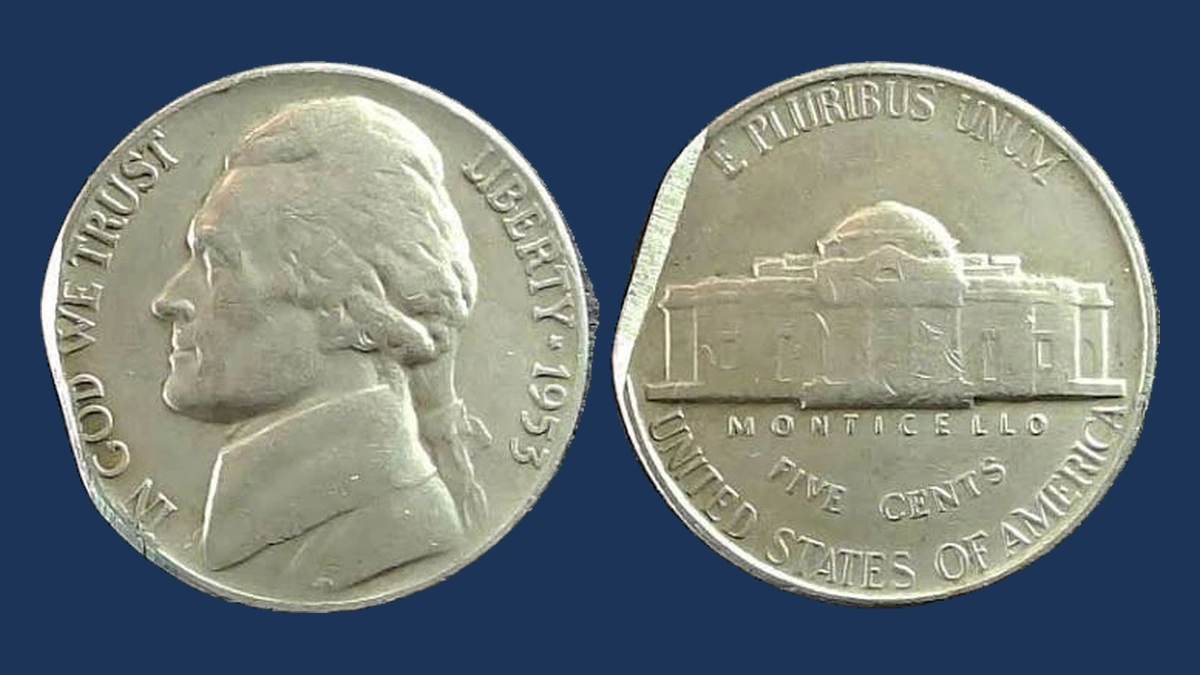
A clipped blank lacks part of its metal before the coin is struck. The defect can begin while round blanks are being cut from a strip of metal.
The remaining piece goes through the press, so the design and rim must form beside an already existing gap. That relationship can help distinguish a genuine clip from a finished coin cut later.
A 1953 year list reports clips without fixing their shape, percentage, or mint. A particular curved or straight opening therefore needs its own examination rather than details borrowed from another date.
Estimated Value
Estimate $20–$150 for a confirmed 1953 clip, depending on the amount missing and the coin’s condition. A clear date and a natural-looking struck boundary make the piece easier to assess.
The year-list report does not provide an individual selling price or a fixed clip size. A larger gap is not automatically better if it removes the identifying details, and a freshly cut edge does not qualify for this estimate.
How to Identify
A natural clip is best judged where the design reaches the missing section. Under a 10× magnifier, follow the rim and lettering toward both ends of the opening.
Letters may weaken as metal spreads toward the gap. The opposite rim may also be weak, although not every genuine clip shows that feature clearly.
Check weight with a digital scale against the ordinary 5.00 g. Calipers can measure the intact spans against 21.21 mm without treating the gap as a reduced full diameter.
Look for saw marks, filing, or a sharply bent edge. The useful clue is an opening that fits the way the design was struck, not matching color alone.
3. 1953 Jefferson Nickel Lamination and Split Blanks
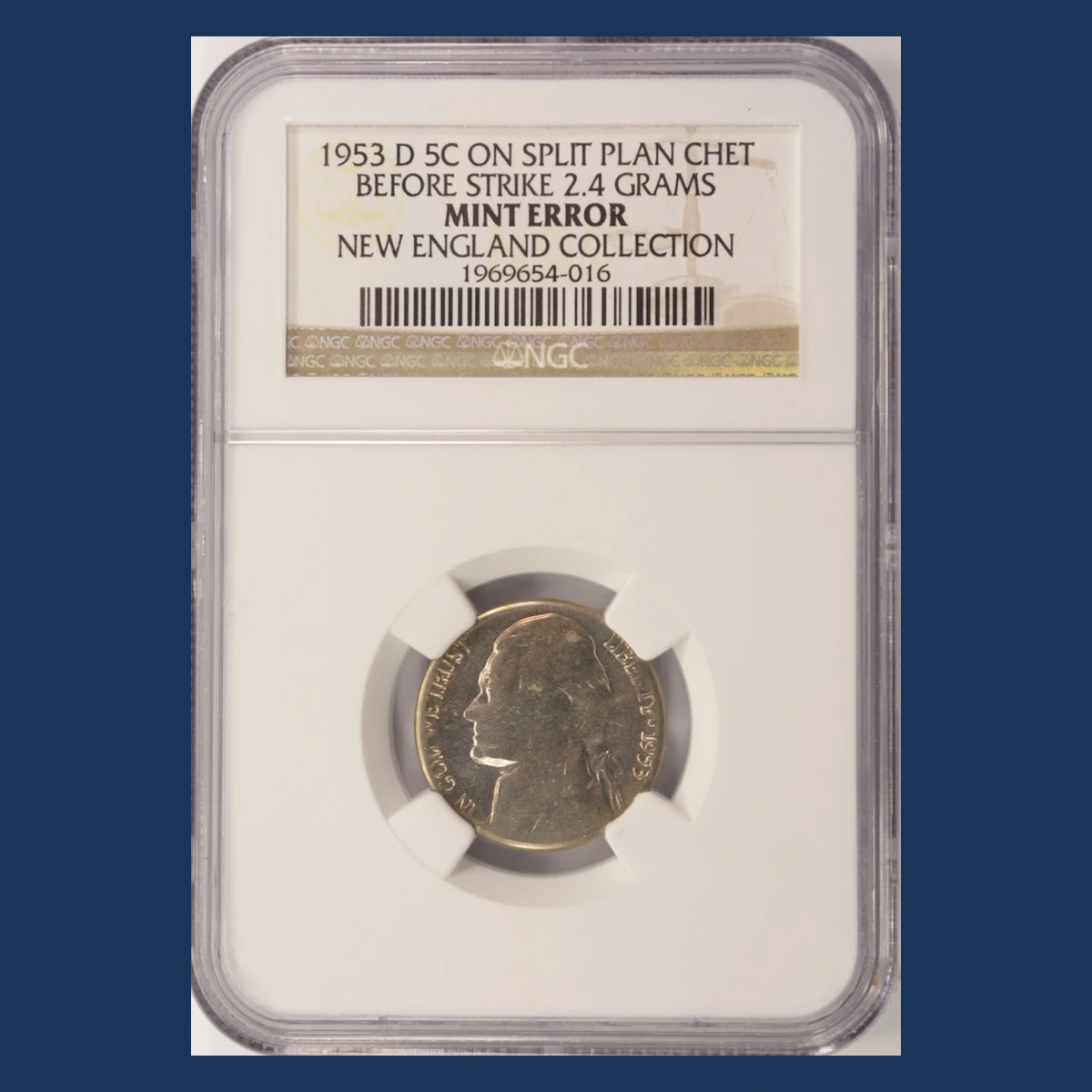
Weakness inside the metal can allow part of a nickel to separate. A small surface flake is called lamination, while a deeper split can divide much of the coin’s thickness.
Timing changes the appearance. A blank that splits before striking can receive design on the exposed surface; a split afterward reveals an interior that did not receive that direct strike.
The documented Denver split-before-strike piece weighs 2.4 g and has soft central detail. Separate 1953 reports describe surface peeling and splitting after striking, without establishing the same mint or weight.
Estimated Value
Small genuine laminations are estimated at $10–$75, with more obvious split pieces around $40–$250. The timing and surviving design should be identified before choosing a comparison.
The 2.4 g Denver coin sold with a separate 1960-D split blank for $126.50 in October 2010. That is a two-coin total, not the individual value of the 1953 piece, and the other coin’s 2.5 g weight does not belong to it.
How to Identify
Compare the exposed surface with the remaining design before touching any loose metal. A 10× magnifier may reveal stamped detail on a split-before-strike surface, while a later split exposes the previously hidden interior.
A thin flap should stay attached if possible. Pulling it away removes the connection that explains how the layer separated.
For loose pieces, a digital scale shows how the remaining weight differs from 5.00 g. Calipers can compare the diameter with 21.21 mm, but avoid pressing across a fragile opening.
This nickel uses one copper-nickel mixture throughout. The visible distinction is whether struck design crosses the exposed metal, not whether a supposed outer coating is missing.
4. 1953 Jefferson Nickel Repunched and Inverted Mint Marks
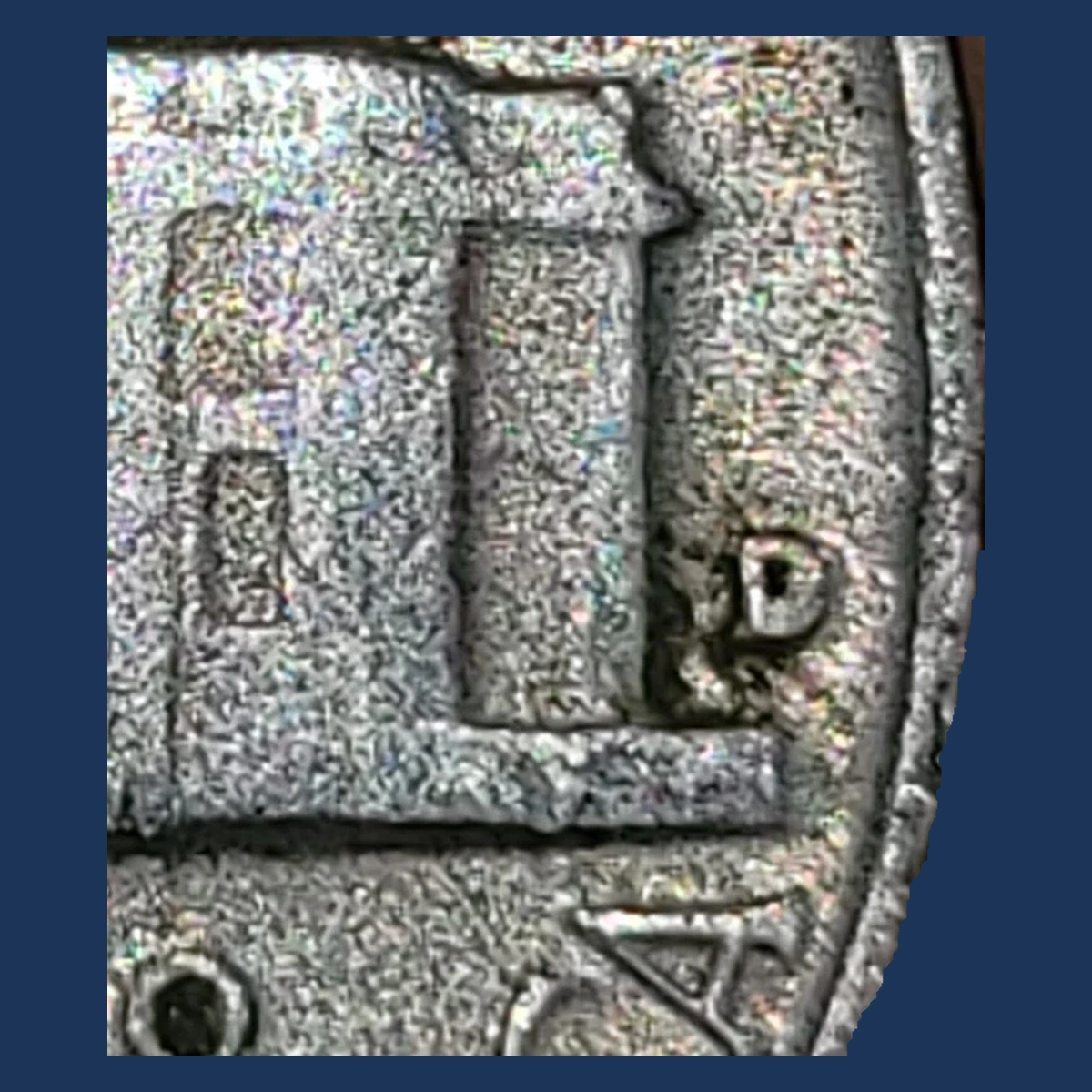
An extra S can appear to one side of the main mint letter. It comes from a misplaced punch used to add the letter to the die, the steel stamping tool.
Listed 1953-S forms include extra S details to the left or right. Denver also has a different variety with remnants of an inverted D beneath the stronger D.
The inverted letter was an earlier tool impression, not a coin stamped upside down. These marks sit on the back beside Monticello, and their shapes should be compared with the correct mint’s example.
Estimated Value
Identified S repunching is estimated at $5–$100. A confirmed D over inverted D can fit roughly $30–$400, depending on condition and how clearly the earlier impression remains.
These are estimated ranges, not individual auction records for the listed forms. A faint shelf from movement during striking does not establish an inverted letter, and the catalog number for a similarly named quarter variety cannot identify a Jefferson nickel.
How to Identify
The unusual Denver mark should be examined as two letter impressions, one inverted beneath the other. Enlarging only its thickest corner can hide the shape needed for that comparison.
On the San Francisco forms, inspect the S under a 10× magnifier and use Wexler’s images to compare the direction of the extra stroke. A matching stem or curve matters more than a generally thick letter.
A loose normal nickel should be near 5.00 g and 21.21 mm on a scale and calipers. Move the light across the back mint mark to distinguish a rounded secondary impression from a flat ledge caused by movement during striking.
5. 1953 Jefferson Nickel Proof Doubled Die
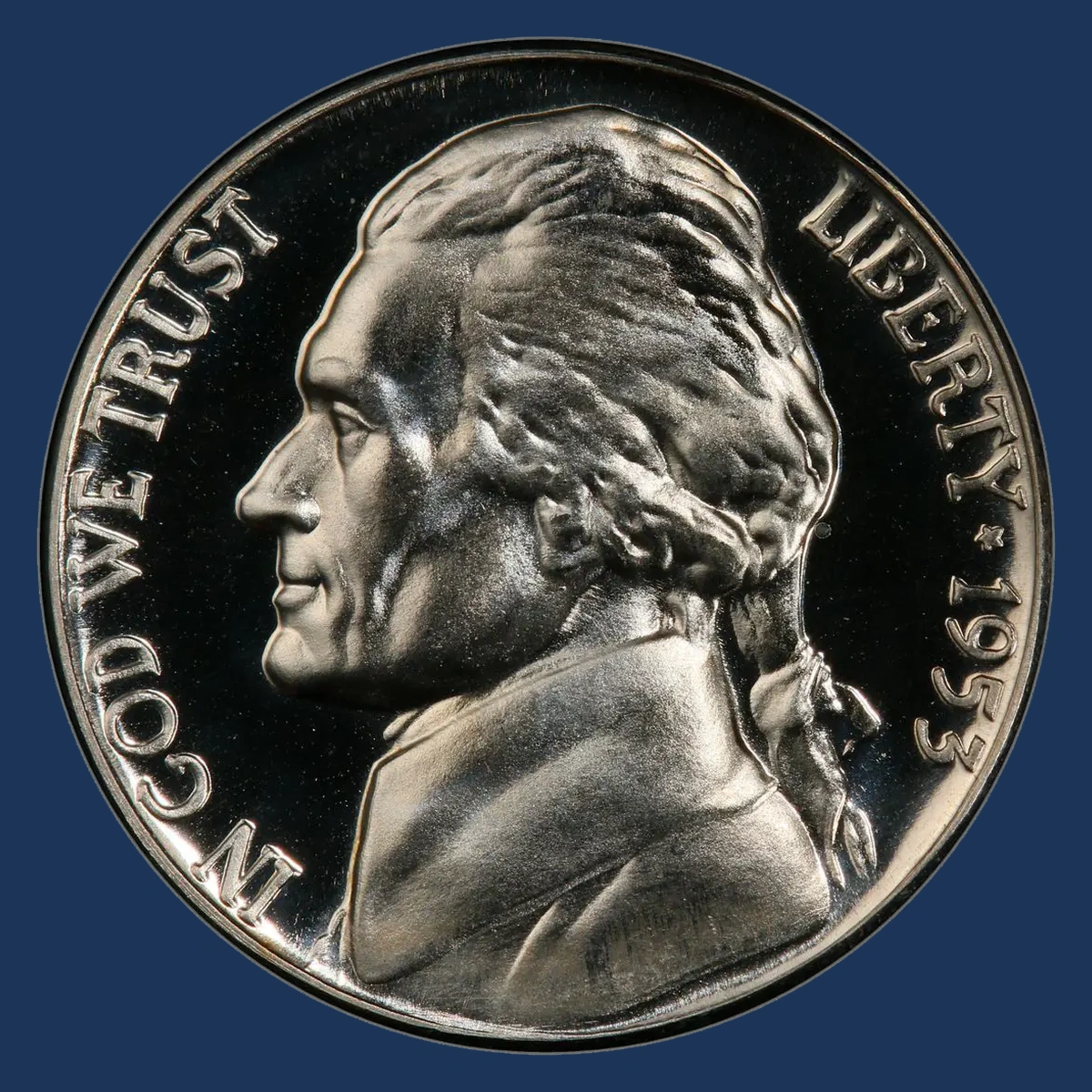
A 1953 Proof can show extra outlines in its front design. A Proof is a specially made collector coin, and the doubled pattern was already present in the tool that stamped it.
The recognized FS-101 variety has been recorded in PR67 Cameo. That describes a high-grade Proof whose raised design contrasts with a reflective background.
The extra outlines are the variety feature, rather than the contrast itself. A polished regular coin should not be identified as this Proof merely because it shines, and flat shelves beside letters need a different explanation.
Estimated Value
Use an estimated $75–$500 range for identified FS-101 Proofs, with preservation and the clarity of the doubled details affecting the price. Strong contrast can also influence collector interest.
PCGS listed a $250 guide value for a PR67 Cameo example. That is a price-guide figure rather than an actual auction result, and it should not be applied to a regular coin or every bright nickel showing thick lettering.
How to Identify
Confirm the Proof finish before matching the doubled details. Keep a graded coin protected in its holder, since fingerprints and wiping can damage the reflective surfaces.
Use a 10× magnifier to compare the front lettering and date with an identified FS-101 example. Look for repeated rounded outlines or split details rather than a low flat shelf.
Change the light angle while keeping the coin still. A reflection can disappear, while the extra shape in the metal remains.
For a loose example, a scale and calipers check the normal 5.00 g and 21.21 mm. Those numbers cannot identify a doubled die.
Match the extra detail in a specific letter or digit, instead of judging brightness or overall thickness.
6. 1953 Jefferson Nickel Double Strike
This nickel received another blow before it left the press. The second design partly covered the first, leaving overlapping details that do not fit one normally centered strike.
An auctioned 1953 example was described as MS63, an unworn coin with noticeable marks. Its second strike overlapped approximately 40% of the first image.
That figure describes overlap, not a stated 40% off-center strike. Confusing the two changes how the coin would look.
A doubled die instead repeats close details already present in the tool, usually without two widely shifted design centers on the finished coin.
Estimated Value
The cataloged MS63 double strike sold for $195.50 in January 1997. Comparable clearly identified examples are estimated at $150–$700, depending on separation, surviving identity, and condition.
The older sale is a useful example, not a current guarantee for every repeated impression. A readable date and an easy-to-follow second design can help, while later dents or scratches can reduce appeal even when the original double strike is genuine.
How to Identify
Pick a recognizable feature and follow both impressions across the coin. A second date or portrait in another position is stronger evidence of repeated striking than one thick letter.
Under a 10× magnifier, inspect where the later design crosses and partly flattens earlier detail. Compare both faces so the overlapping pattern tells the same story.
For a loose coin, check weight against 5.00 g with a digital scale and record its outline with calipers against 21.21 mm. Repeated strikes may spread the metal, but the key observation is two intersecting stamped images; the catalog’s 40% describes their overlap rather than missing design.
7. 1953 Jefferson Nickel Struck Through Material
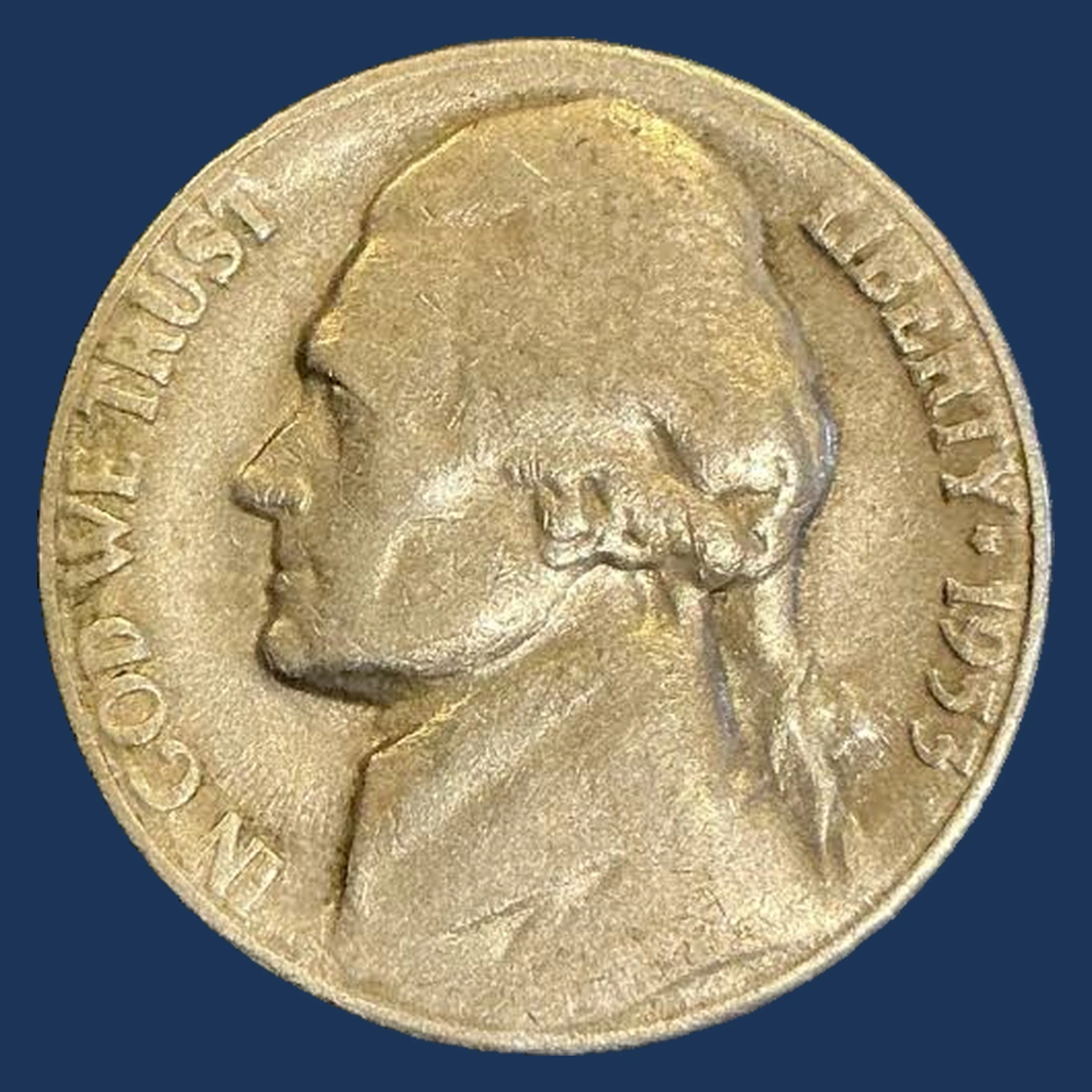
Something between the blank and a stamping tool can block part of the design. The resulting weak patch or depression is called a struck-through error.
Regular 1953 nickels are reported with this type, without one fixed material or location. A separate auction catalog identifies a Proof with a struck-through area on the back.
That Proof was described as Proof67 and appeared with another coin in a two-piece group. The other piece was a 1938-D with an affected front, so its face and mint letter should not be transferred to the 1953 coin.
Estimated Value
For a clear obstruction on a regular nickel, estimate $20–$200. A comparable identified Proof with a back impression may fit about $100–$700, depending on the size of the affected area and preservation.
These ranges are estimates rather than a completed individual price for the cataloged Proof. Its two-coin listing does not assign a separate sale value here, and an unnamed impression should not be priced as a specific retained object.
How to Identify
On the Proof, begin on the back rather than copying the affected front of the other coin in its auction group. The auction catalog identifies the two pieces separately.
With a 10× magnifier, inspect the transition from normal detail into the affected patch. Fresh cutting through completed letters can indicate later scraping instead.
Do not name cloth or wire without the texture or shape to support it. A smooth weak area does not supply that information.
A digital scale and calipers check loose nickels against 5.00 g and 21.21 mm. Follow one nearby design line into the patch to see where the obstruction stopped the strike.
8. 1953 Jefferson Nickel Proof Re-Engraved Hair Ribbon
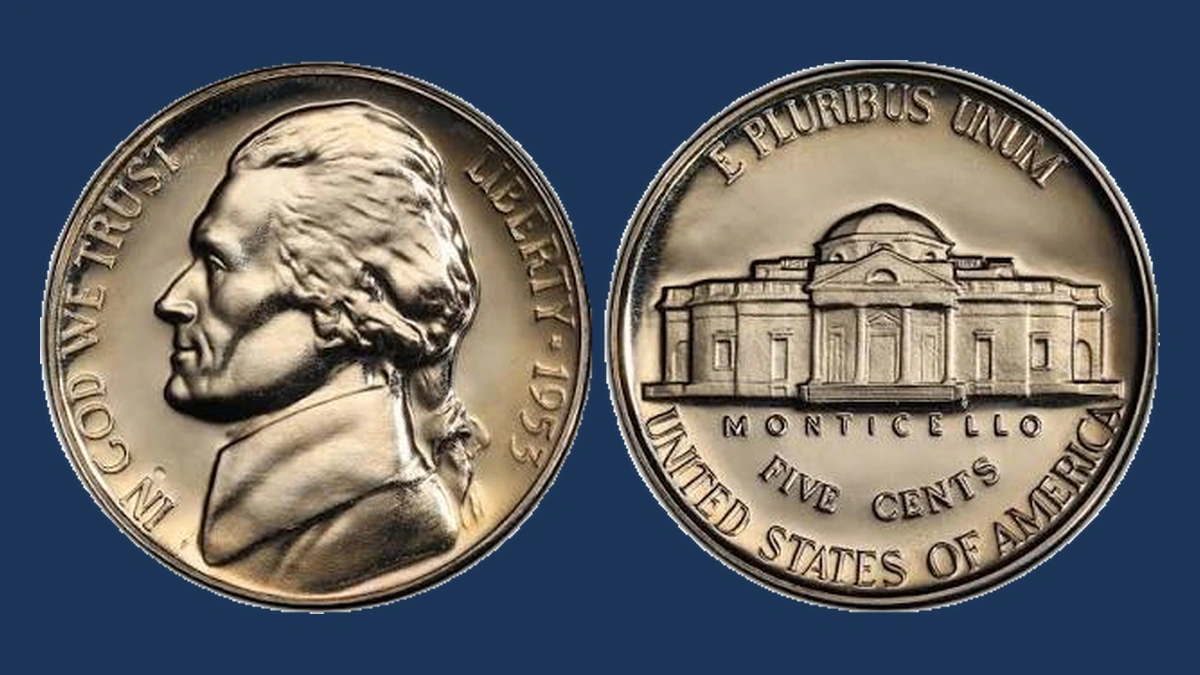
Some 1953 Proofs have unusually strong lines in Jefferson’s hair ribbon. The feature comes from extra engraving on the stamping tool, and collectors know it as the re-engraved design variety.
FS-401 is its catalog number. The extra lines are copied onto the coin during striking, rather than being cut into the finished nickel afterward.
The ribbon is the important location. Thick lettering elsewhere does not identify this feature.
It also differs from doubled lettering, because the tool was reworked rather than carrying a close second copy of the whole affected design.
Estimated Value
PCGS records a $646 auction result in March 2017 for a PR67 FS-401. Its auction-price archive separately lists a PR67 at $210 in a January 2023 eBay Best Offer record.
Estimate $100–$700 for comparable identified Proofs. Surface quality, contrast, and the ribbon details influence the price; neither a bright regular nickel nor random scratches through the ribbon qualify simply because their lines look strong.
How to Identify
Compare Jefferson’s hair ribbon with a normal 1953 Proof under a 10× magnifier. Concentrate on the reinforced ribbon lines instead of searching the entire coin for thicker design.
A scratch added afterward cuts into the finished surface and can leave displaced metal beside it. Lines copied from a reworked tool belong to the original struck design.
Check that the coin is a Proof before applying the FS-401 comparison. A scale and calipers provide normal checks of 5.00 g and 21.21 mm on a loose coin, while holdered examples should stay protected.
The identifying match is the same strengthened ribbon detail, not extra brightness or a heavy-looking date.
9. 1953 Jefferson Nickel Off-Center Strike
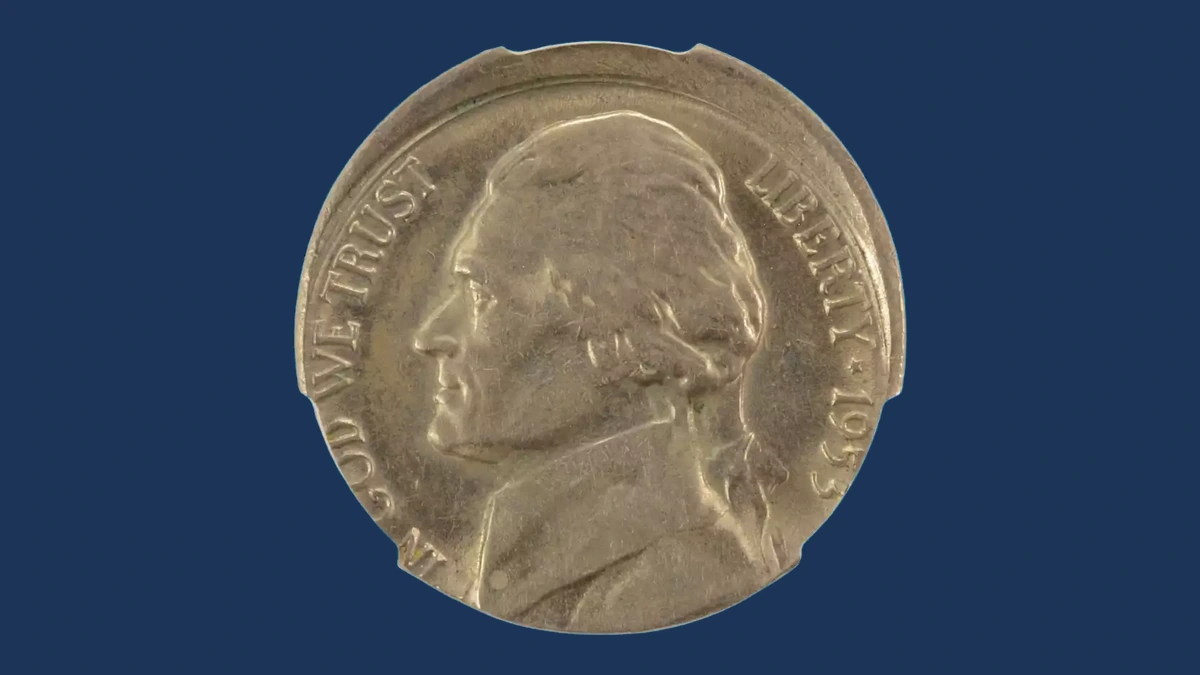
A small shift can interrupt the edge of the design even when most of the coin looks normal. A 1953-S example was struck 5% off center and graded NGC MS65 Five Full Steps.
The grade describes an unworn coin with relatively few marks. Five Full Steps refers to well-defined stair lines on Monticello, not another minting error.
The offset and the sharp stairs belong to the same coin. They help explain why its sale should not be used as a blanket price for every slightly uneven 1953 nickel rim.
Estimated Value
The 5% off-center San Francisco example brought $546.25 in September 2010. Estimate $75–$900 for confirmed dated examples across different conditions and amounts of shift.
The recorded coin combined an error with sharp stair detail and an attractive grade. Its whole price cannot be assigned to the 5% shift alone, so compare a worn or weakly struck candidate with its own condition rather than assuming the same result.
How to Identify
Look at the outer design before the stair detail. A true off-center strike loses part of the image beside an unstamped section, while an uneven rim alone may come from a shifted tool.
Use a 10× magnifier to compare both faces and find the S to the right of Monticello. Do not mistake missing step lines from ordinary weak striking for the off-center error.
A scale should read near the normal 5.00 g if no metal is missing. Calipers can record the outline against the usual 21.21 mm, allowing for spreading.
Keep the stairs and the offset as separate observations. The error itself is shown where the design fails to land fully on the blank.
10. 1953 Jefferson Nickel Foreign or Unusual Alloy Blank
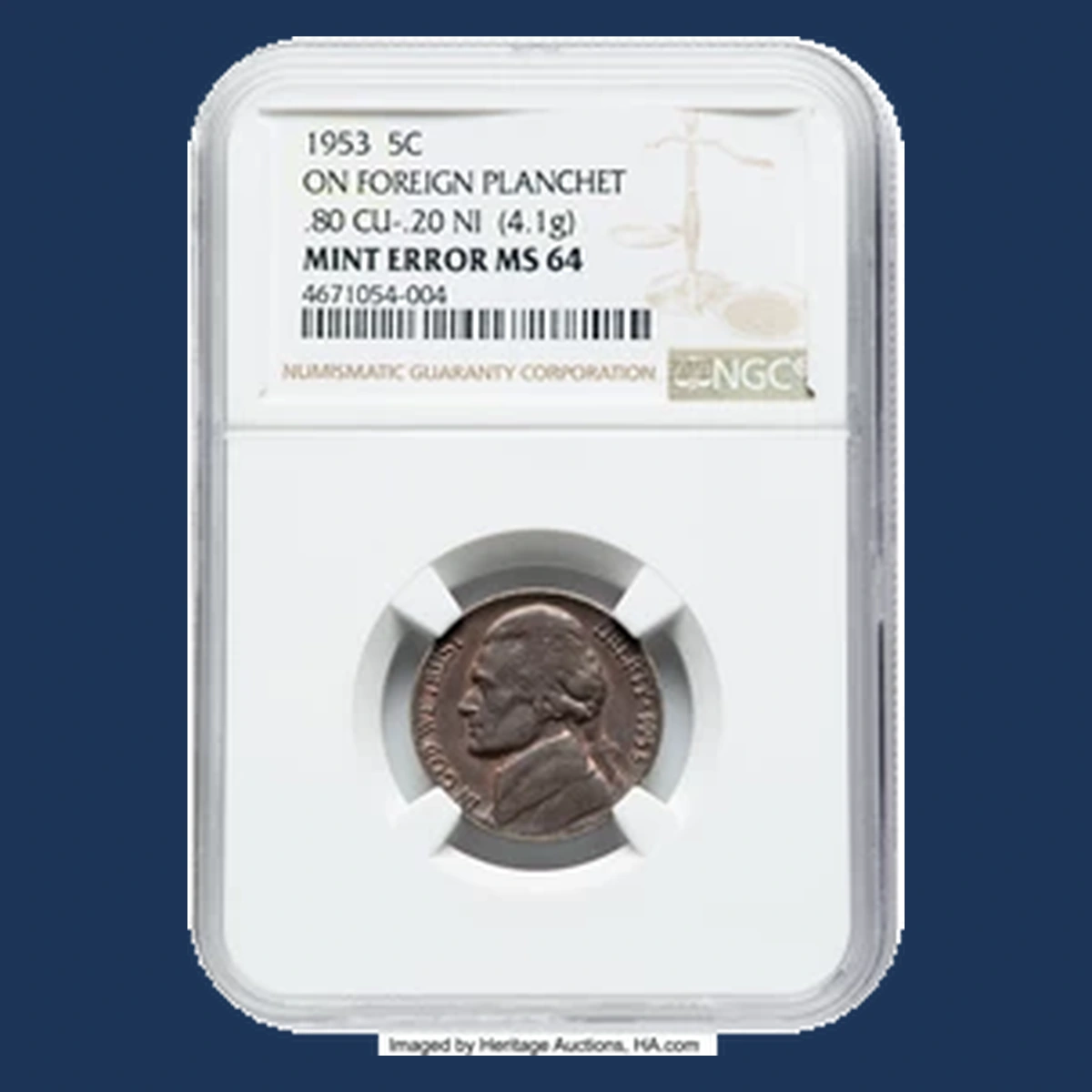
This nickel was struck on metal that does not match the normal blank. The recorded piece weighs 4.1 g and contains about 80% copper and 20% nickel.
A normal Jefferson nickel weighs 5.00 g and uses a 75% copper, 25% nickel mixture. Both the weight and composition therefore matter here.
The auction identifies a foreign blank without assigning a definite country. A comparison with a Haitian coin does not settle the question, because that proposed blank has a different weight and includes zinc.
The coin’s unusual metal is established more clearly than its intended foreign denomination.
Estimated Value
The NGC MS64 example sold for $444 in March 2023. Comparable identified unusual-alloy blanks are estimated at $300–$1,200, depending on appearance and the strength of the metal identification.
This range does not attach a special Haitian-denomination premium. The recorded weight and alloy form the basis for the comparison.
A discolored nickel or a light piece damaged by corrosion should not receive that value simply because its appearance or weight seems unusual.
How to Identify
Start with the measured composition, not a resemblance to a foreign coin’s color. The recorded 80% copper and 20% nickel differs from the normal nickel alloy.
For a loose candidate, use a digital scale to compare with 5.00 g and calipers against 21.21 mm. The documented coin weighs 4.1 g.
Inspect both faces and the plain edge with a 10× magnifier for corrosion, grinding, or plating. Those can change appearance or weight without proving that the Mint used another blank.
A professional metal test can check the alloy. Weight and composition must agree with the proposed blank before a specific foreign denomination is assigned to it.
11. 1953 Jefferson Nickel Struck over a Finished Lincoln Cent
The older cent’s date can still be seen on Jefferson’s clothing. A finished 1953-S Lincoln cent entered the nickel press and received another denomination’s design over its own.
The recorded coin was graded NGC MS65 Red and Brown. That describes an unworn piece with relatively few marks and a mixture of red and brown copper color.
This differs from using an unused cent blank, which has no earlier Lincoln design to preserve. The surviving date and other old details show that the smaller coin had already been struck before Jefferson was added.
Estimated Value
The two-denomination coin sold for $4,025 on September 24, 2010. An estimated $2,500–$6,000 range suits comparable identified examples with clearly visible traces of both designs.
The older cent’s readable date helps make the process understandable. This is one complete object, so an ordinary cent price cannot simply be added to a nickel price.
A different overstrike with less readable underlying detail may attract less interest, even when the date and mint match.
How to Identify
The old cent date on Jefferson’s clothing gives you a specific feature to locate. Use a 10× magnifier to see where the nickel design crosses it.
A scale reading for a loose example should be compared with the period cent’s starting weight of about 3.11 g. The normal nickel weighs 5.00 g.
Calipers can record how far the metal spread beyond the cent’s original 19.05 mm. The standard nickel diameter is 21.21 mm.
Inspect the edge for a join or coating before drawing conclusions from the brown color. Two coins pressed together later can leave misleading marks.
The old date must belong beneath Jefferson’s struck design. That surviving earlier image distinguishes a finished cent from an unused copper blank.
Conclusion
From $5–$6,000, the estimated prices depend on what actually happened to the 1953 nickel. A copied tool flaw, a split blank, and an older cent beneath Jefferson each leave different evidence.
Check both sides, the edge, and the correct mint-mark position. Keep regular coins separate from specially made Proofs.
A two-coin auction total is not an individual price, and an unusual alloy needs more than color to identify it.