1990 Nickel Error List with Pictures

A 1990-P nickel struck by a broken tool through a covering coin sold for $312 in December 2024. A different Philadelphia coin, struck on a smaller dime blank, brought $299 in January 2011.
This 1990 Jefferson Nickel error list covers estimated values from $5–$800. Some clues appear around the edge, while others need a closer look at letters or overlapping designs.
Compare the visible feature below before choosing a price range.
1. 1990 Jefferson Nickel Unusual Color from Blank Preparation
Blanks are the metal disks that become coins. Before striking, they are heated to soften the metal, a process called annealing.
Problems during heating can affect the finished color, and this type is reported for 1990. A brown or dark gray nickel needs more than a color match.
Normal nickels contain copper and nickel mixed throughout. Their color can also change from soil, chemicals, or heat applied after minting.
An original preparation error should retain evidence of the surface made by the press. Darkness by itself does not establish when the change happened.
Estimated Value
For an identified preparation error, estimate $20–$150, depending on preservation and how clearly the original surface remains. A dark, corroded coin should not receive the same comparison.
A 2005-D improperly annealed nickel graded MS62 sold for $119 in December 2022. That later-year example provides a related price reference, not a laboratory finding or completed sale for a 1990 coin.
The range applies to the whole coin, including its underlying condition.
How to Identify
Do not clean a test spot.
The untouched surface is needed to tell a preparation problem from color acquired after minting.
For a loose coin, check near 5 grams with a scale and 21.21 millimeters with calipers. Inspect its plain edge for an added coating or a change that also covers the faces.
Tilt it under a neutral lamp and watch how the light moves. Original mint luster means the moving shine left by striking, which may survive beneath unusual color.
A 10× magnifier can reveal crust, pits, or residue instead. If those visible clues do not explain the color, preserve the coin for professional surface examination.
2. 1990 Jefferson Nickel A Step around the Edge
A small change in width around the edge can be easier to feel than to see from above. It forms when part of the blank sits above the ring that normally holds the coin to size.
That ring is called the collar. Metal outside it can spread farther, leaving a step between two levels.
A 1990-P example was graded PCGS MS66+, indicating an unworn coin with particularly well-preserved surfaces. The error concerns the edge shape, not the grade itself.
Normal nickels already have plain edges. A lack of grooves is therefore no evidence of this mistake.
Estimated Value
The PCGS MS66+ Philadelphia example sold for $99 on June 23, 2025. A practical estimated range for comparable partial-collar nickels is $20–$200.
A clear edge step and attractive surfaces support a stronger comparison than a barely visible swelling on a worn coin. The grade can affect the total even when the error is small.
This price range does not apply to an edge squeezed or rolled after the coin was made.
How to Identify
Place the coin beside a normal nickel and compare their plain edges from the side under a 10× magnifier. The error has a step between the portion held inside the ring and metal that spread beyond it.
On a loose coin, calipers can compare the two levels with the normal 21.21-millimeter diameter, while a scale checks against 5 grams. A large weight loss suggests that metal was removed, rather than merely pushed outward.
Rotate the coin through the light, looking for file marks, crushed metal, or a seam joining separate pieces. Find an original step around the edge before treating a slightly uneven front border as evidence of this error.
3. 1990 Jefferson Nickel Design Blocked by Debris
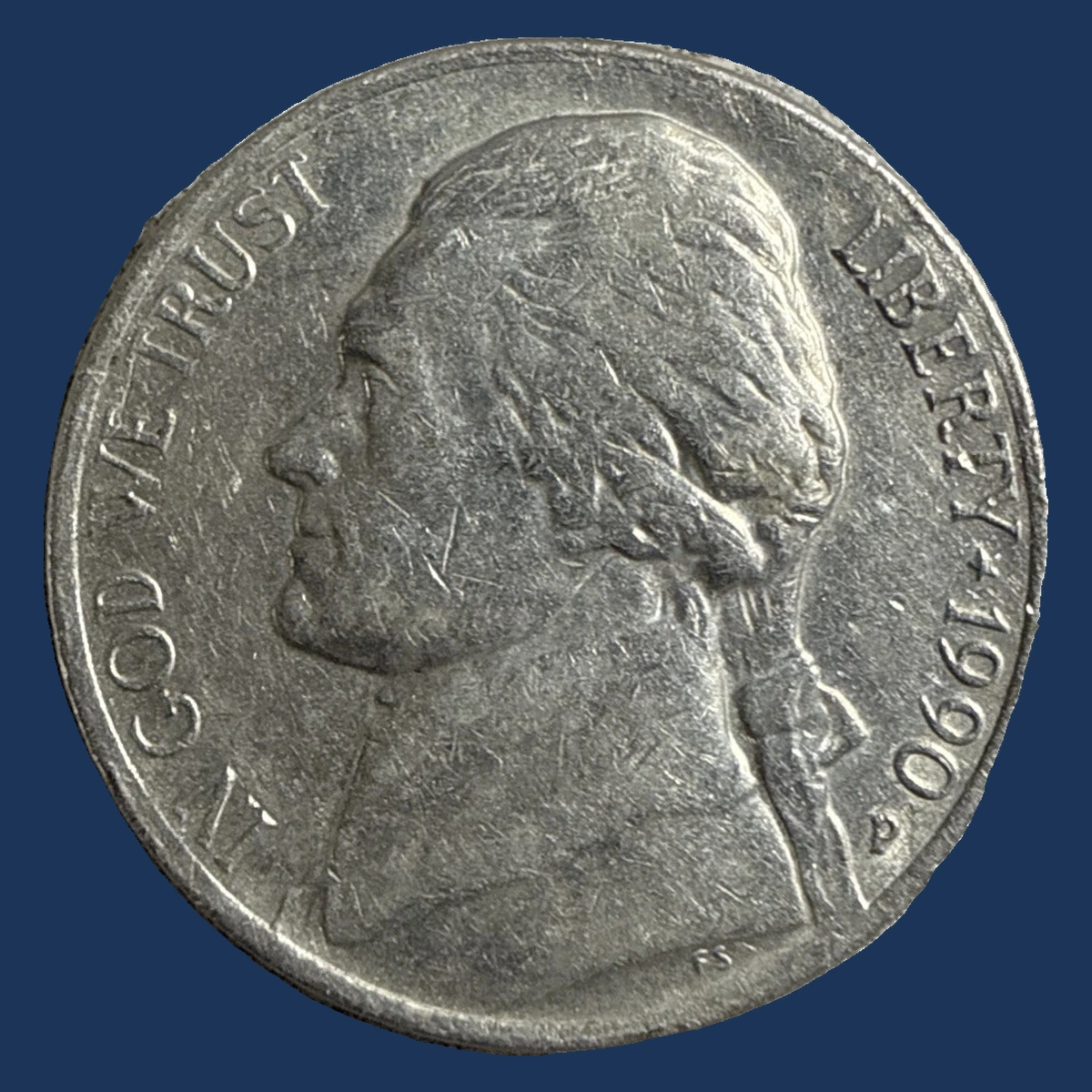
A piece of unwanted material can sit between a blank and the stamping tool. When the press closes, that material prevents part of the design from reaching the metal.
This is a struck-through error. Its outline depends on the obstruction, so the affected area may be weak, rough, or depressed.
A recorded 1990-P example was graded ANACS MS66 with 5.5 Steps. That notation describes preserved stair detail on Monticello, not another error.
The catalog identifies debris without specifying its material or exact position. It does not establish that cloth, wire, or grease caused this particular impression.
Estimated Value
Estimate $20–$250 for a comparable identified debris strike-through. A sharply defined impression on an attractive coin can be more desirable than a faint patch of missing detail.
The recorded ANACS example has no individual selling price assigned here. As a different-year comparison, a 2000 Philadelphia struck-through nickel sold for $84 in February 2015.
The price range depends on original striking evidence. Wear, grinding, or a dent made afterward does not qualify simply because design is missing.
How to Identify
Compare the affected area with the nearest clear letters. Wear usually reaches several exposed high points, whereas an obstruction can interrupt one patch beside sharper detail.
Under a 10× magnifier, follow the boundary between that patch and the original surface. Save photographs under light from two directions to show its shape without naming an unseen material.
The ANACS-graded example provides the recorded identity. Its stair notation should remain separate from the blocked area.
Check a loose coin against 5 grams and 21.21 millimeters with a scale and calipers. Include the plain edge when looking for later squeezing, scraping, or other changes.
4. 1990 Jefferson Nickel Missing Sections of the Blank
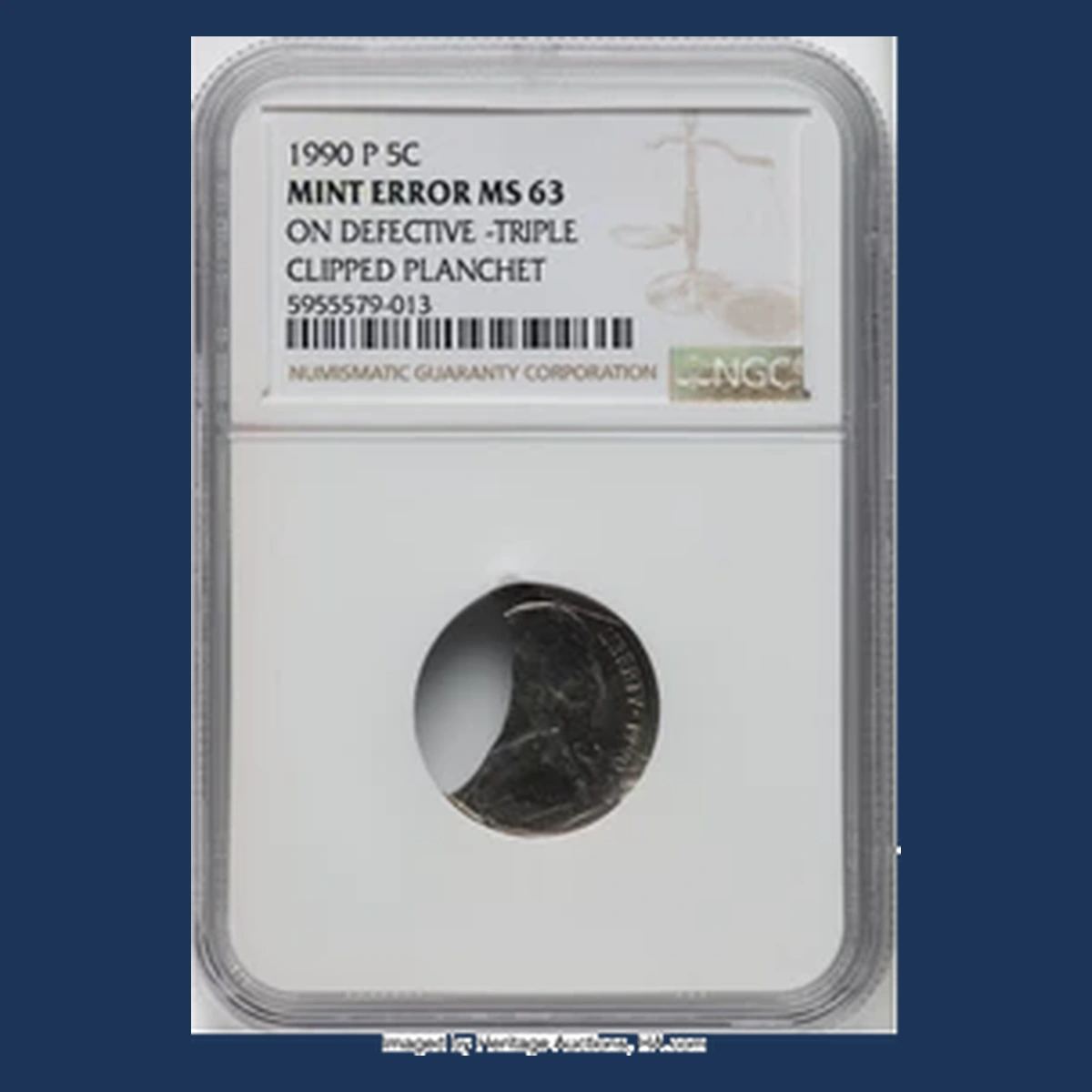
An incomplete metal blank can still enter the press and receive a design. Its missing section becomes part of the finished coin’s outline.
One 1990-P nickel was cataloged as a defective blank with three clips and graded NGC MS63. The three gaps belong to that one coin, but their shapes should not be assumed from the title.
A separate Philadelphia nickel has a thirty-percent straight clip and weighs 3.5 grams. It graded NGC MS64 Full Steps.
Full Steps describes clear stair detail on Monticello. It does not add another error to the missing section.
Estimated Value
The triple-clipped MS63 example sold for $79 in June 2023. Estimate $20–$300 across genuine 1990 clips, allowing for the missing area, visible date, and condition.
The separate 3.5-gram straight clip has no sale amount used here. Its large gap should not inherit the triple-clipped coin’s exact price.
Count and shape alone do not decide value. Original boundaries beside a readable design matter more than several gaps cut into a normal coin afterward.
How to Identify
Weigh a loose example before comparing the outline. The straight-clipped specimen’s 3.5 grams is a measured value, while a complete ordinary nickel normally weighs 5 grams.
Use calipers across intact spans against 21.21 millimeters. Missing metal reduces weight without necessarily changing the diameter between two surviving points.
At each gap, use a 10× magnifier to examine the struck rim and the exposed boundary. Parallel saw marks, sharp filing lines, or folded metal suggest later alteration.
Photograph both faces and the remaining plain edge, including any weak rim opposite a gap. Such weakness can support a clip, but each missing section still needs its own natural boundary.
5. 1990 Jefferson Nickel A Wide Coin with Its Complete Design
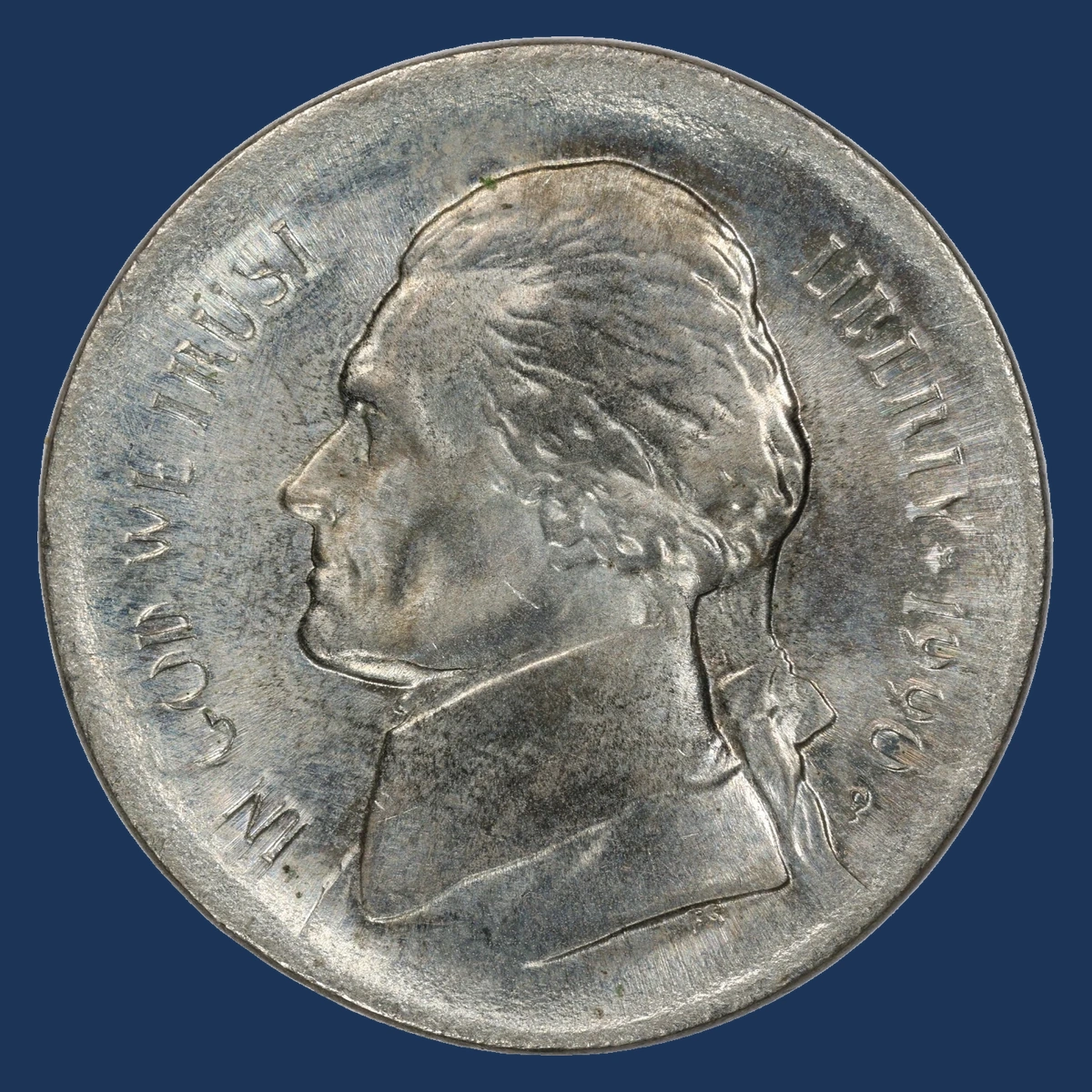
A nickel can spread wider than usual if its edge is not held by the surrounding ring during striking. Collectors call this a broadstrike.
The ring, or collar, normally controls the finished diameter. Without that restraint, the metal can expand while keeping the full portrait, building, and outer lettering.
The type is reported for 1990 without a measured specimen or fixed mint. A broad outline needs to be considered together with the completeness of the design.
A coin flattened later can also become wide. Its damaged surface tells a different story from natural spreading under the original stamping tools.
Estimated Value
An estimated $25–$300 covers genuine ordinary-strike broadstrikes, from modest expansion to stronger examples with attractive surfaces. It is not a recorded sale range for every 1990 mint.
A 1998-P broadstrike sold for $57.50 in July 2002, and a 1999-P example brought $89 in March 2025. These related dates show that clear broadstrikes can remain affordable.
Extra width alone does not earn that premium if hammering or other later pressure created it.
How to Identify
Measure the widest and narrowest spans with calipers, using 21.21 millimeters as the normal diameter. Then use a scale: natural spreading should leave a loose nickel near 5 grams.
Now follow the outer lettering on both faces to see whether the complete design still fits. Missing design at one side calls for an off-center comparison, even if the coin also looks wide.
Inspect the extra metal with a 10× magnifier, including the plain edge and the surface next to the letters. Hammer marks or crushed details can explain a larger diameter without a Mint error.
A broadstrike should retain its full design within metal that spread naturally during striking. Check the last outer letters before treating width alone as proof.
6. 1990 Jefferson Nickel Raised Lines and Lumps from Broken Dies
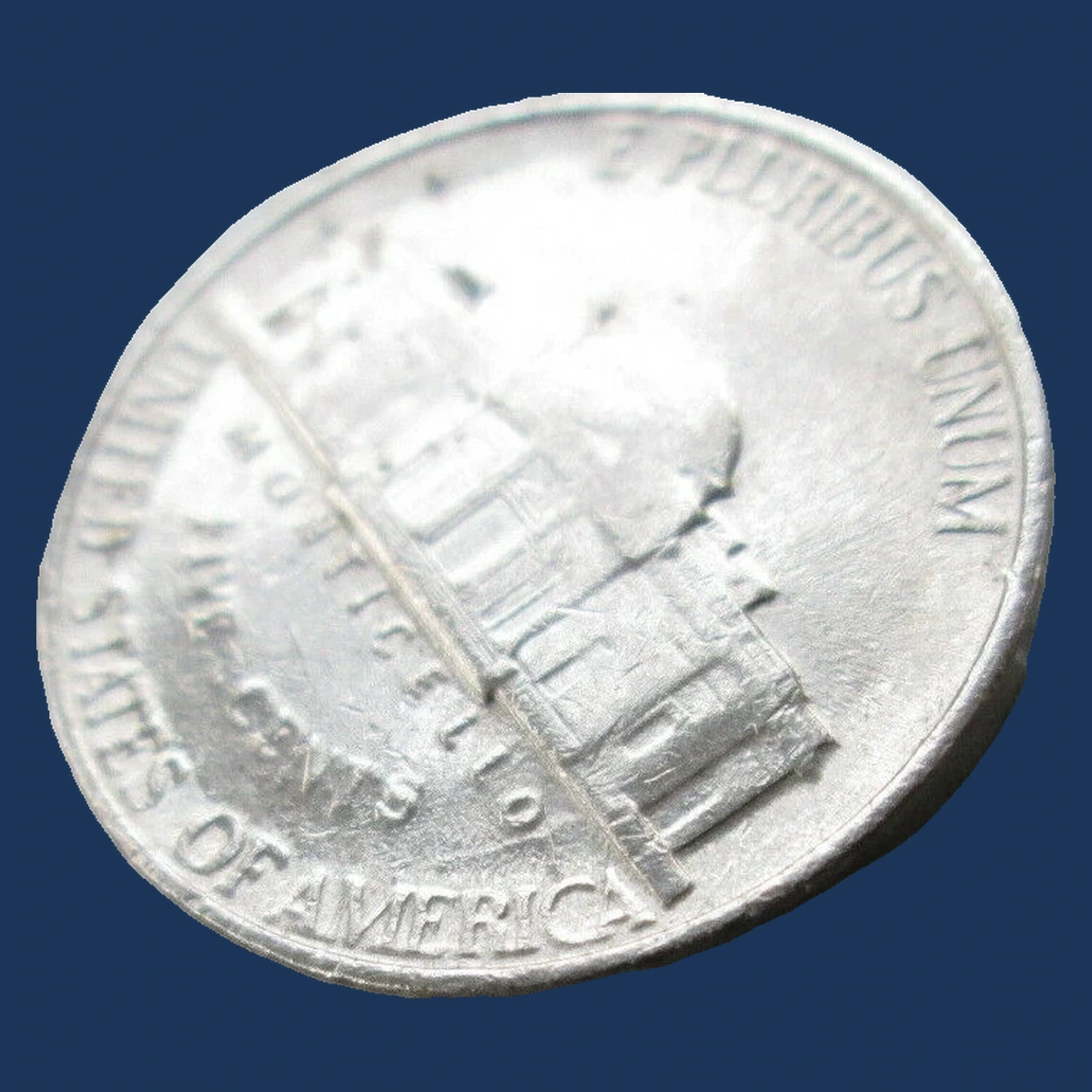
A stamping tool can develop a crack or lose a small piece. Metal pressed into that opening leaves an extra raised feature on the next coins.
The tool is called a die. A narrow crack produces a ridge, while a larger break can create a lump.
A substantial break connected to the rim is called a cud. Small isolated bumps are not automatically cuds.
These types are reported for 1990 without one established route across the design. A specific mint and crack pattern should come from the actual coin rather than a generic example of the same year.
Estimated Value
Estimate $5–$50 for small original cracks and $30–$350 for larger, clearly identifiable breaks. A substantial rim-connected lump usually attracts more attention than a faint line.
A worn 1983-P cud sold for $63 in July 2022, providing a related-date comparison. That sale does not identify a location or mint for the reported 1990 type.
The complete coin’s condition still matters. A lump attached after minting should not be valued as a broken-die impression.
How to Identify
Light the suspected line from both sides. With a 10× magnifier, check whether its center is raised or whether only the edges of a scratch stand above a groove.
A crack in the coin itself can have an actual opening. That differs from a ridge copied from a crack in the stamping tool.
For a larger lump, follow its connection to the rim and inspect the plain edge for solder or crushing.
Use a scale and calipers on a loose coin against 5 grams and 21.21 millimeters. Normal measurements support the basic coin identity but do not establish a die break.
Photograph the complete path and its surrounding letters so the raised feature can be compared consistently.
7. 1990 Jefferson Nickel Off-Center Strikes
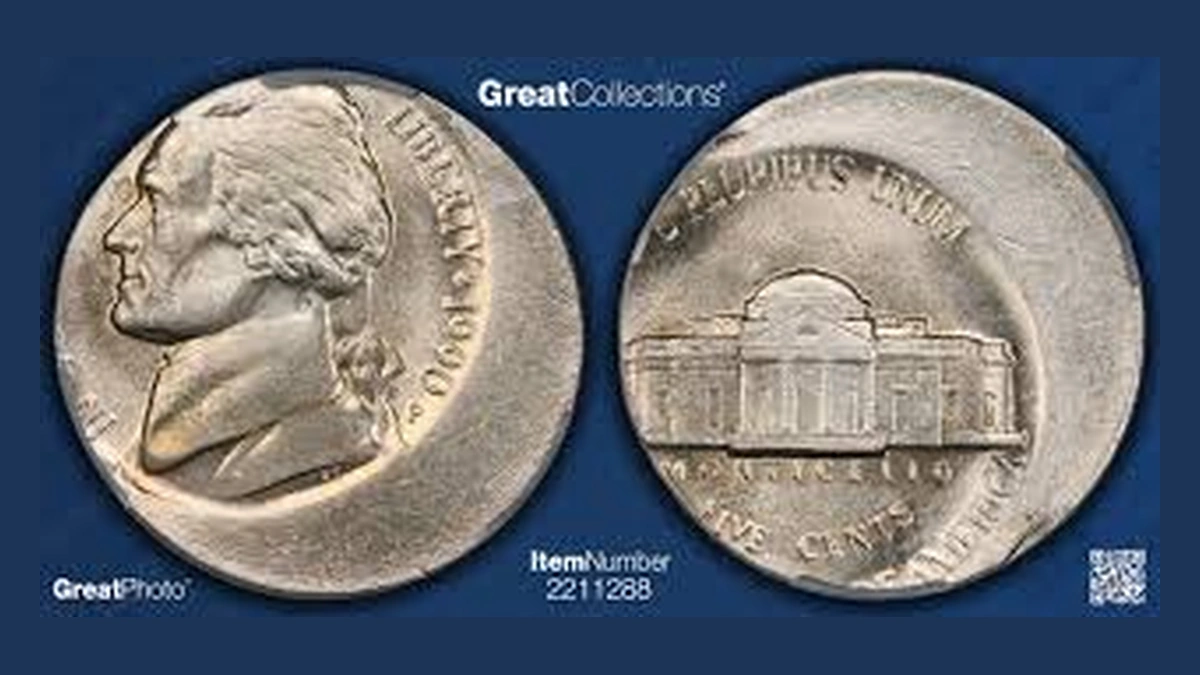
A blank that enters the press out of position receives only part of the intended design. One side retains unstamped metal while some outer details miss the blank altogether.
This is an off-center strike. The error can occur on Philadelphia and Denver nickels from 1990.
The year report does not give a fixed percentage or direction for every example. A readable date and mint letter help establish which coin is being examined.
A merely uneven border is different. If the complete design remains on both faces, the coin needs a different comparison before it is called off center.
Estimated Value
For genuine dated examples, estimate $30–$400, depending on displacement, readable identity, and preservation. An obvious offset with a complete date is often easier to collect than a piece missing its year.
A 1999-D nickel struck sixty-five percent off center sold for $75 in September 2024. This later-year sale illustrates the market without assigning that percentage to a 1990 specimen.
An undated fragment should not be given a 1990 identity simply because its design resembles these examples.
How to Identify
Find 1990 and the P or D first, then examine both faces. The blank area and the lost outer design should correspond to the same misplaced strike.
Check the transition under a 10× magnifier for original unstruck metal. Grinding can remove detail but leaves a worked surface rather than a natural blank crescent.
On a loose coin, compare weight with 5 grams and use calipers against the usual 21.21-millimeter outline. The press can change the shape without removing metal.
Inspect the plain edge around the unstamped portion. Finally, include the entire outline in photographs so an uneven rim is not mistaken for a genuinely incomplete design.
8. 1990 Jefferson Nickel Doubled Front Design on the San Francisco Proof
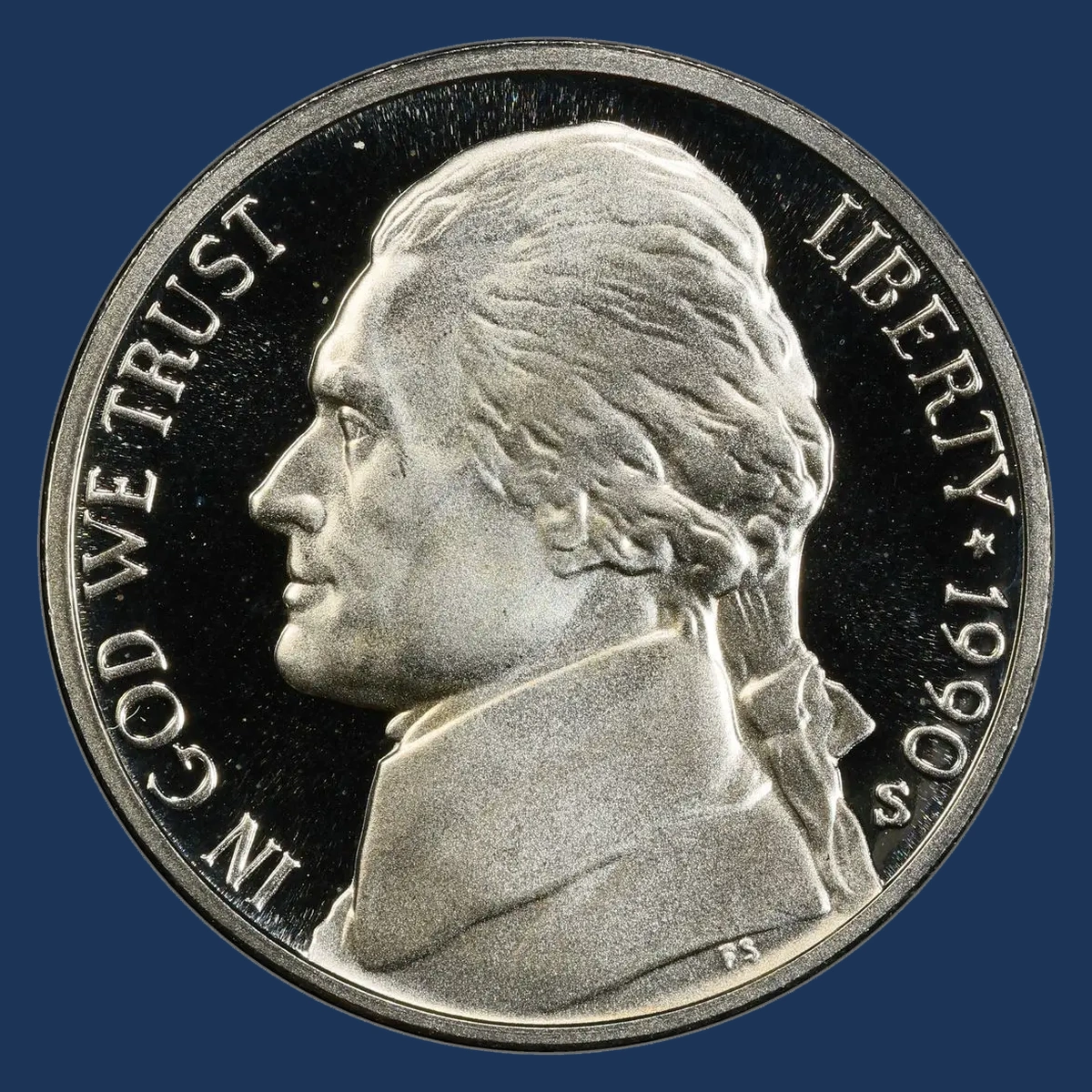
A San Francisco collector nickel can show extra outlines in three places. They are the motto, the small designer initials, and Jefferson’s upper eyelid.
This is a doubled die: the repeated details were already in the steel tool that stamped the coin. They are not evidence of two widely separated blows.
The FS-101 variety occurs on a 1990-S Proof, a specially made collector coin. IN GOD WE TRUST spreads toward the right.
The small FS initials near the base of the portrait spread toward the upper left. These initials name the designer and are separate from the catalog number.
Estimated Value
Estimate $30–$500 for an identified example, depending on preservation and how clearly its repeated details show. Clean Proof surfaces and well-defined separation support the stronger end.
This is a comparison-based range rather than a claimed auction result for the recorded variety. A reflective ordinary coin or a Proof with only flat striking movement should not receive the same variety premium.
Check the specific pattern before using a high grade to justify the price.
How to Identify
Keep a graded Proof in its holder; the S mint letter identifies San Francisco. The tiny FS beside the portrait names the designer, while FS-101 is a catalog label.
Under a 10× magnifier, compare IN GOD WE TRUST with the NGC variety description. The extra motto strokes extend rightward, but the extra FS impression points toward the upper left.
A loose candidate can be checked against 5 grams on a scale and 21.21 millimeters with calipers. Its plain edge is normal and does not establish the variety.
Look at the upper eyelid for the lighter third sign. Compare these three locations under changing light to separate raised doubled outlines from glare or a flat shelf.
9. 1990 Jefferson Nickel A Second Strike with a Sunken Mirror Image
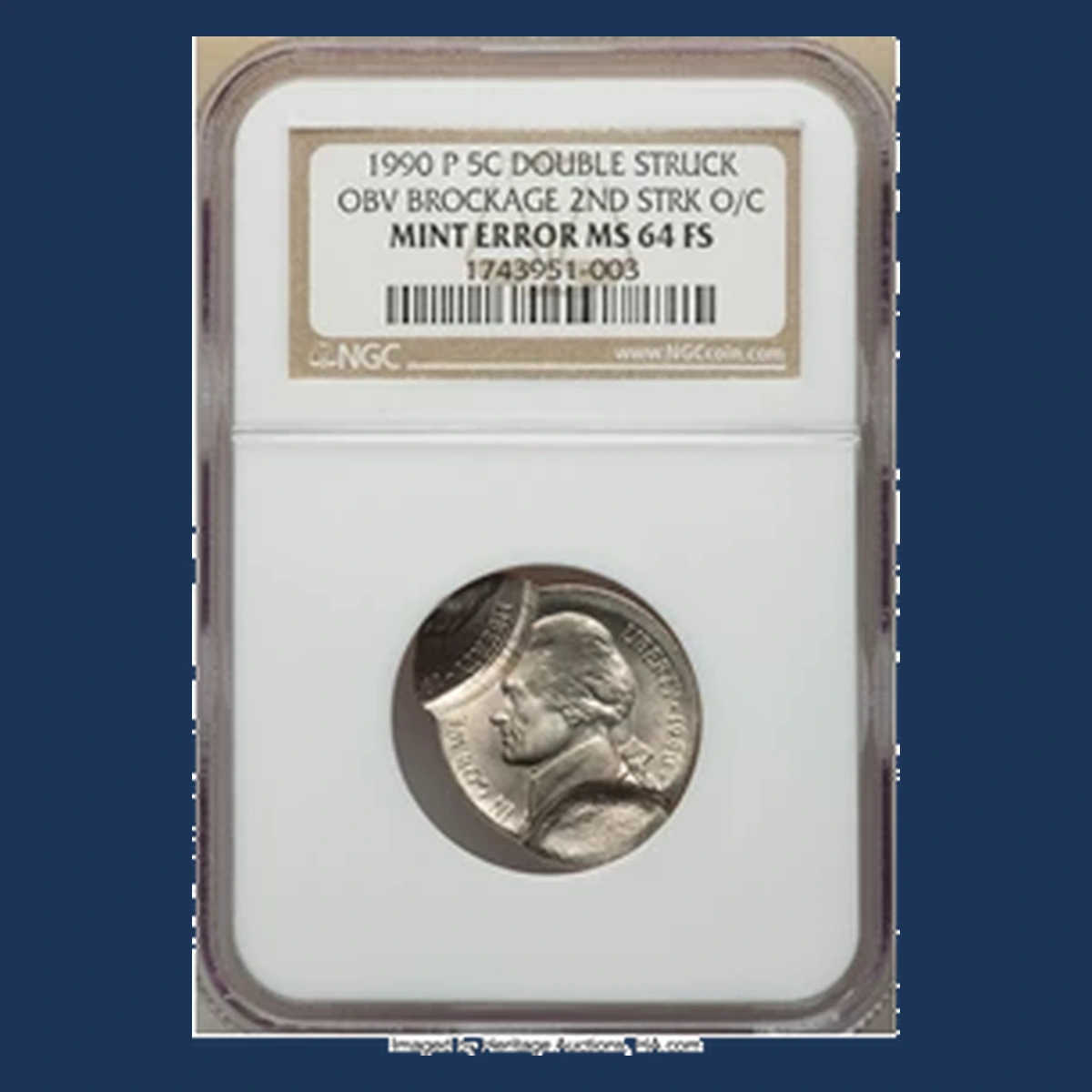
This Philadelphia nickel received a second strike away from the center. It also carries a sunken, reversed impression caused by contact with another struck coin.
That mirror-image impression is called a brockage. It is different from an ordinary raised portrait or the close extra letter edges of a doubled die.
The recorded piece graded NGC MS64 Full Steps. Full Steps refers to clear stairs on Monticello and does not create another error category.
The catalog does not give a turning angle or exact displacement percentage. The double strike and brockage describe one combined error coin.
Estimated Value
The NGC MS64 Full Steps example sold for $139 in October 2022. Estimate $100–$650 for comparable double-struck nickels with clearly identifiable brockage.
The amount depends on how much of the overlapping and reversed design survives, along with condition. A dramatic shape is less useful if the repeated details cannot be recognized.
This is a whole-coin estimate. The second strike and sunken mirror impression should not be priced separately and then added together.
How to Identify
A reversed photograph of a normal nickel makes a useful comparison for the sunken image. Match a recognizable letter or portrait feature to it before looking at the overlapping raised designs.
Through a 10× magnifier, distinguish the image pressed below the surface from the normal raised detail.
An ordinary second raised portrait is not a brockage.
On a loose coin, a scale can compare the weight with 5 grams, while calipers record spreading beyond 21.21 millimeters. Examine its plain edge for signs of later squeezing, and inspect both faces for damage from another coin.
Trace where the second struck design crosses the first. The sunken mirror image must fit that original overlap, rather than sitting in a separate dent made afterward.
10. 1990 Jefferson Nickel A Split Die and a Blocked Strike
Two problems affected this Philadelphia nickel during production. Its catalog identifies both a split die and a strike through a die cap.
A die is the steel stamping tool. When it splits, the opening can leave an unusual raised feature on the coins it strikes.
A die cap forms when another coin sticks to a tool and covers its design. A new blank struck through that covering may receive weakened or distorted detail.
The recorded 1990-P coin received the affected strike; it is not automatically the cup-shaped covering itself. PCGS graded it AU58, indicating only slight wear.
Estimated Value
The combined split-die and die-cap strike sold for $312 on December 23, 2024. Estimate $150–$750 for a comparable identified combination, allowing for clarity and preservation.
The two effects belong to one object. They should not be assigned separate full values and added together.
A scratched or broadly worn nickel is a different comparison. Both the damaged-tool impression and the blocked strike must be supported by its surface.
How to Identify
First decide whether the suspicious line is raised metal or an opening in the coin. A split stamping tool leaves a raised impression; a cracked coin can have a real gap.
Use a 10× magnifier to examine that line and the nearby weakened design. Compare both with photographs of the identified example, since no single letter or fixed route is specified.
A scale and calipers can check a loose nickel against 5 grams and 21.21 millimeters. Include the plain edge when looking for later cutting or pressure.
Then inspect the faint design for wear or scratches that could explain it instead. The identified example’s raised feature and blocked design provide the comparison, not a split in the coin itself.
11. 1990 Jefferson Nickel A Nickel Design on a Dime Blank
A dime blank is too small and too light to carry an ordinary nickel design comfortably. If it enters the nickel press, some outer details can fall beyond the metal.
A 1990-P example weighed 2.3 grams and graded NGC AU55, indicating light circulation wear. The blank’s layered construction also differs from a normal nickel’s uniform metal mixture.
This was a blank intended for a dime, not a finished Roosevelt dime struck again. A second denomination’s completed design should not be assumed.
Weight, edge metal, and the way the design meets the small outline all contribute to its identity.
Estimated Value
The 2.3-gram AU55 example sold for $299 on January 9, 2011. An estimated $200–$800 suits comparable authenticated 1990 nickels struck on dime blanks.
Less wear and a particularly clear surviving date can support a stronger price. The range requires the correct smaller blank, not simply a normal nickel with reduced weight.
A later ground-down or chemically altered coin should not inherit this comparison because it happens to measure close to the auctioned specimen.
How to Identify
The scale is especially useful here: the recorded error weighs 2.3 grams, far below a normal nickel’s 5 grams.
A modern dime blank starts near 2.27 grams before striking.
Inspect the edge through a 10× magnifier for the dime’s copper center between outer layers. A normal nickel has a plain edge and copper and nickel mixed throughout, rather than this layered construction.
Use calipers to compare the outline with the normal nickel’s 21.21 millimeters, allowing for spreading of the smaller blank. Look for a surviving 1990-P date and mint letter, plus outer design that naturally runs out of metal.
Grinding can imitate a small, light coin. Check the edge and the cut-off design for tool marks before relying on the weight.
Conclusion
The estimated $5–$800 span covers several very different checks. An edge step needs a side view, a Proof doubled die needs matching raised details, and a dime-blank error needs the right metal as well as low weight.
Keep each coin’s features together when comparing prices. Photograph its date, both faces, and edge, leaving the original surface and any attached material untouched.