2000 Half Dollar Error List with Pictures

The eagle tilts 75 degrees clockwise on a documented 2000-P half dollar when the coin is flipped normally. Graded PCGS MS61, it sold for $79 in March 2025.
Other 2000 half dollar errors have missing pieces, doubled details, or a copper-colored surface. Estimated values across the examples below run from $5 to $500.
Read on to compare both sides and the edge, including the different checks for a silver collector coin and an ordinary layered-metal half dollar.
1. 2000 Kennedy Half Dollar Doubled Die Obverse (Estimated Up to $75)
A second-looking edge beside the date can catch your eye. The reported front-side doubling for 2000 calls for comparisons around the date, LIBERTY, and IN GOD WE TRUST.
A doubled die has extra detail in the steel tool that stamps coins. Coins made from it repeat that changed shape as part of their original design.
Glare, wear, and movement during stamping can create different doubled-looking effects. An unusual outline alone does not show what caused it.
The year guide gives no particular die number or mint for this report. Those details need to come from the actual example being identified.
Estimated Value
An estimated $10–$75 suits modest, identifiable doubling on an ordinary layered-metal coin. Clear separation and attractive surfaces support stronger prices.
This is an estimate, not a sale of a numbered 2000 die variety. Bright edges exaggerated by a photograph do not establish added value.
A Proof is specially made for collectors. That finish, or an exceptionally high grade, needs a separate whole-coin comparison rather than being assumed within this ordinary price range.
How to Identify
Use photographs of the same mint and finish, then inspect the suspected areas with a 10× magnifier. Move the light to see whether the extra shape stays visible.
The normal diameter is about 30.61 millimeters. Check accessible coins with calipers and a digital scale: layered-metal halves weigh 11.34 grams, while 90% silver Proofs weigh 12.50 grams.
Inspect the edge grooves, and remember that S alone does not establish silver content. Flat shelves, reflections, and wear can all imitate another outline.
The useful match is stable extra raised detail repeated on a documented die. Every digit need not show the same strength, but one blurry corner cannot establish the variety.
2. 2000 Kennedy Half Dollar Doubled Die Reverse (Estimated Up to $75)
The eagle has many closely spaced details even on a normal coin. A doubled back design needs a specific extra shape, not just an impression that the feathers look thick.
The year guide reports this category without identifying a particular die. It does not establish a certain feather, letter, or direction as the place to check.
The term doubled die reverse means the back die carried altered detail before striking the coin. Each coin from it could reproduce the change.
Compare a candidate with the normal design first. Nearby ordinary shapes can resemble extra lines in a close crop.
Estimated Value
A modest, visible doubled back design on an ordinary layered-metal example has an estimated $10–$75 range. No sale of a specifically identified 2000 back die establishes this bracket.
A repeatable extra feature matters more than a general claim of doubled feathers. Its clarity and the surrounding surfaces affect appeal.
Collector Proof status, silver content, and exceptional grade need separate confirmation. They should not be added to the comparison merely because the coin looks bright.
How to Identify
Compare the suspected extra shape with that exact area on a normal back design. Use a 10× magnifier and two lighting angles to distinguish raised metal from reflections.
Keep surrounding detail in the photograph so the feature can be found again. A tiny crop may hide a normal neighboring shape or make flattening look like a separate element.
Record mint and finish, then inspect the edge grooves. For accessible coins, calipers should show about 30.61 millimeters; a digital scale compares with 11.34 grams for layered metal or 12.50 grams for silver Proofs.
The strongest clue is an extra raised shape that matches a known doubled-die example. Apparent thickness in a single image does not.
3. 2000-P Kennedy Half Dollar Rotated Dies (Estimated Up to $150)
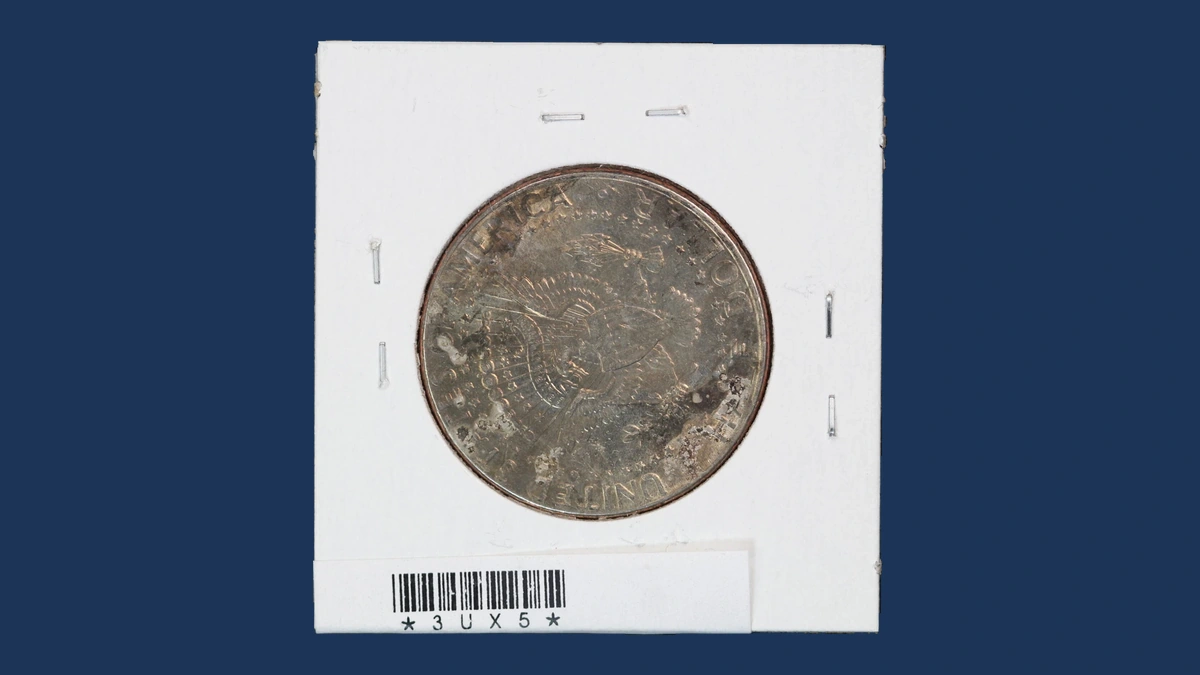
Hold Kennedy upright and flip the coin top to bottom. On a normal half dollar, the eagle should then appear upright too.
The cataloged 2000-P instead finishes 75 degrees clockwise from that position. PCGS graded it MS61, an unworn coin with noticeable marks.
The error concerns how the two dies were aligned when they struck. It does not mean the design moved toward one edge of the metal.
A continuous flip makes the difference easier to demonstrate. Turning two photographs upright separately can hide a real rotation or make a normal coin appear to have one.
Estimated Value
The 75-degree PCGS MS61 example sold for $79 on March 31, 2025. An estimated $60–$150 suits a similar clearly demonstrated rotation.
That grade describes the auction coin, not a requirement for the error. A cleaner example may attract a different offer.
A small incidental tilt is not the same as the illustrated 75-degree difference. Compare the actual angle and the whole coin’s condition before using the range.
How to Identify
Set Kennedy upright against a fixed reference and flip top to bottom without a sideways twist. Measure the eagle’s final angle against the same reference.
Repeat the movement and record it in a short video if possible. A coin sliding inside its case or separately straightened images cannot demonstrate the relationship reliably.
Check P, confirming the ordinary layered-metal issue. A digital scale and calipers can compare an accessible coin with 11.34 grams and about 30.61 millimeters.
Use a 10× magnifier around the grooved edge to check for seams or alteration. A repeatable clockwise tilt of 75 degrees during the controlled flip matches the cataloged error.
4. 2000 Kennedy Half Dollar Struck Through Foreign Material (Estimated Up to $250)
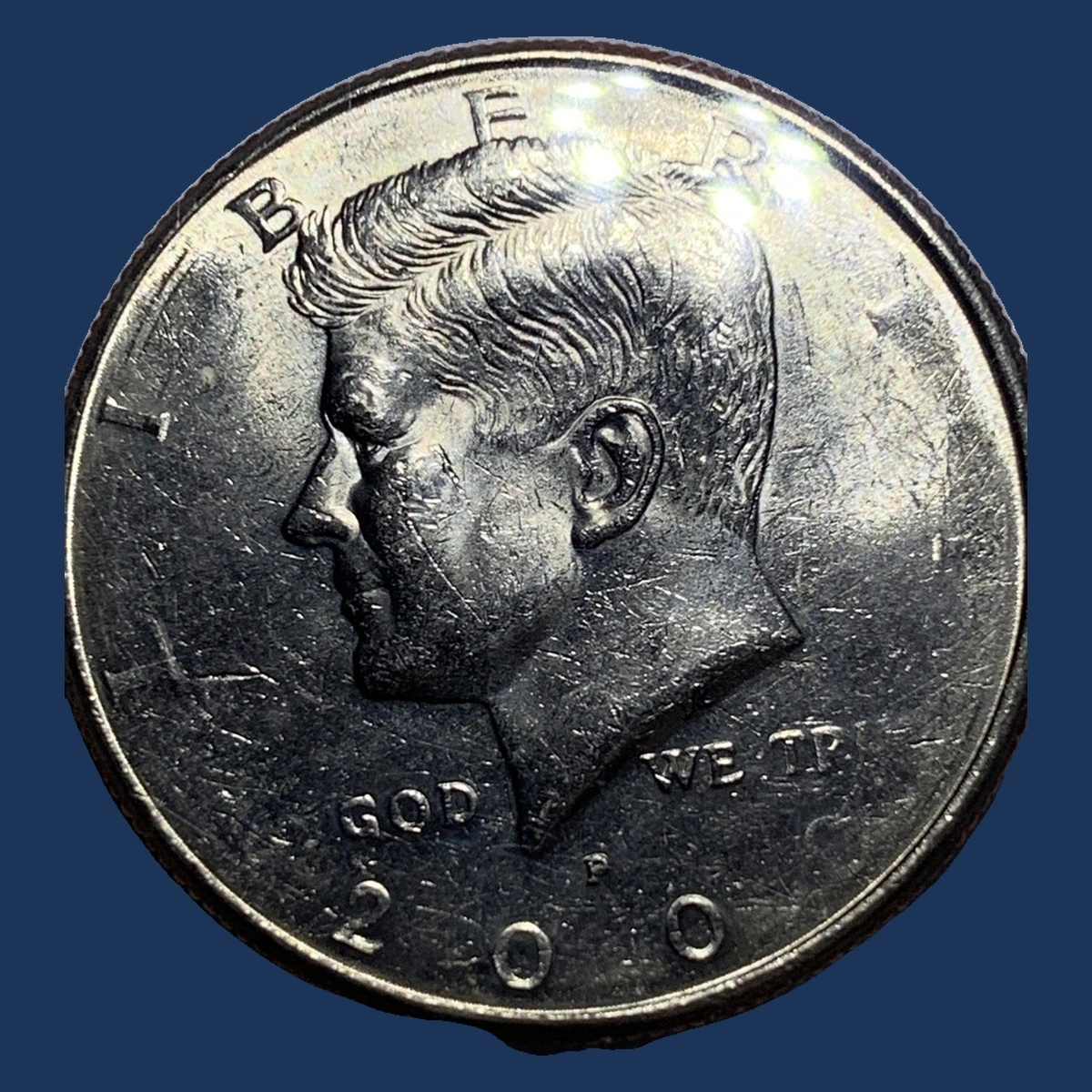
A narrow mark on a 2000-S silver Proof led its owner to submit it to ANACS. The owner reported a PR69 Deep Cameo grade and an impression from a fragment.
Deep Cameo describes strong contrast between frosted designs and reflective backgrounds. The thin mark alone does not prove that the fragment was wire.
A separate seller reports grease blocking detail on a regular 2000-P. Both are strike-throughs, where material comes between die and coin during stamping.
A solid fragment can leave a distinct hollow. Grease may suppress detail across a less outlined patch, so the two examples need separate comparisons.
Estimated Value
The reported silver Proof has an estimated $75–$250 range. Small grease-blocked areas on a regular 2000-P are estimated at $5–$40.
The P example was offered for $7, an asking price. A different-year 1976-D struck through on both sides sold for $114 in March 2025.
That sale gives context for a visible obstruction. The silver Proof’s material, finish, and reported condition still need their own evaluation.
How to Identify
The owner’s silver Proof report describes a fragment impression. With a 10× magnifier, inspect its margins and the reflective surface beside it.
A scratch cuts an already formed surface and may push metal up along the sides. On the P example, look where weak detail meets normal design, checking for later abrasion.
Confirm the metal before weighing: a silver Proof should weigh 12.50 grams. A regular layered-metal P coin should weigh 11.34 grams.
Both normally measure about 30.61 millimeters across. Use calipers for this check when the coin is outside a sealed grading case.
Inspect the edge grooves and visible metal layers too. A naturally formed boundary around interrupted design supports an obstruction during stamping, while disturbed cuts point to later damage.
5. 2000 Kennedy Half Dollar Clipped Planchet (Estimated Up to $300)
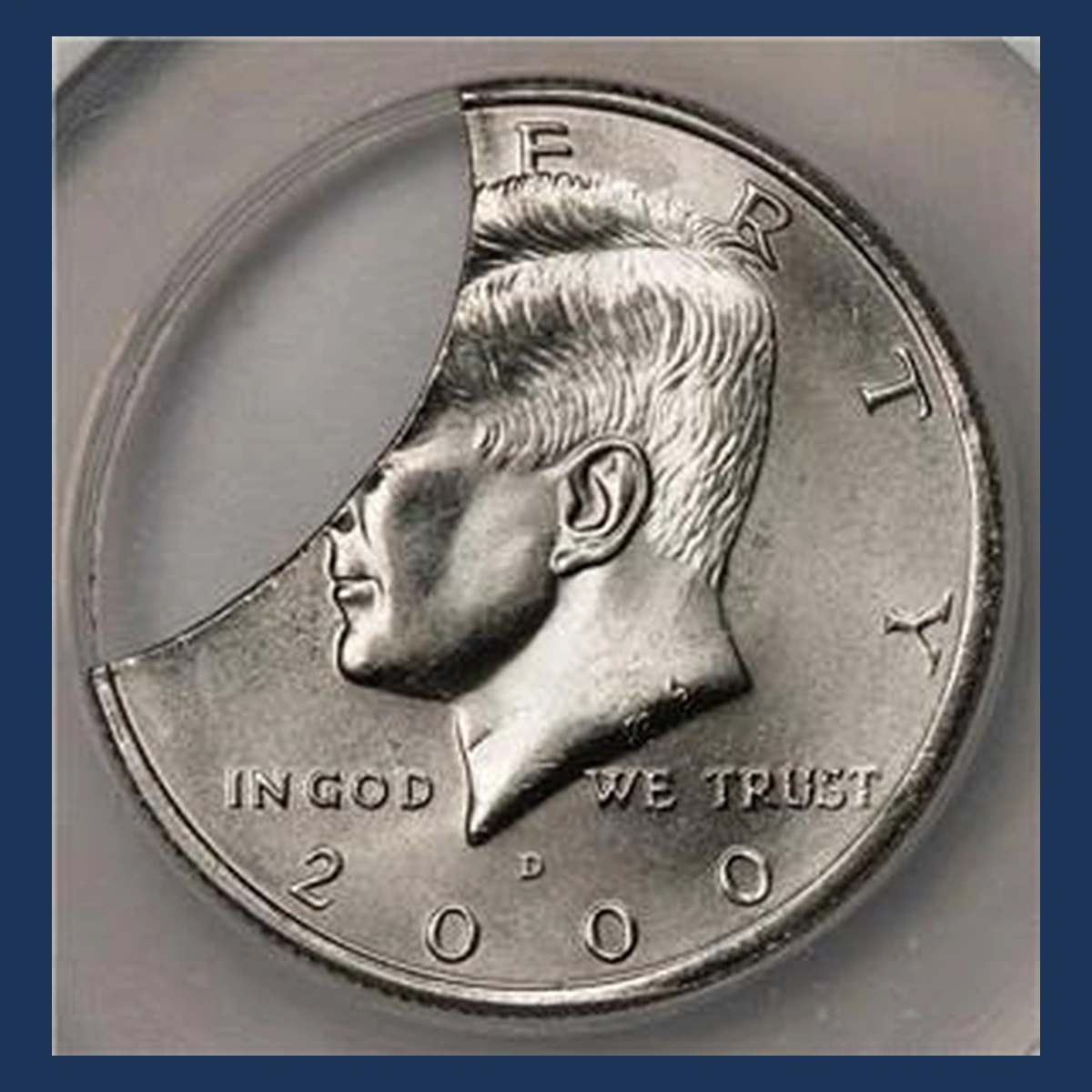
A large gap removes about 30% of the 2000-D, illustrated in Mint Error News and graded NGC MS63. A separate year-guide example is a 2000-P with two curved clips, graded NGC MS64.
Both began with incomplete blanks. A blank is the round metal disc punched from a strip before receiving its design.
If a punch overlaps a previous hole, the next disc comes out with a curved section missing. More than one overlap can leave several gaps.
The coin is then stamped around that missing metal. Its rim and edge therefore carry clues beyond the shape of the gap itself.
Estimated Value
Modest curved clips have an estimated $25–$125 range. Conspicuous multiple clips or a large gap on a well-preserved coin are estimated at $100–$300.
NGC graded the illustrated 30% Denver example MS63, but the feature gives no sale price. Its large missing section is more noticeable than a tiny rim clip.
The Philadelphia double clip is a different MS64 coin. Keep its grade separate rather than transferring it to the Denver example.
How to Identify
Inspect the surviving rim before focusing on the gap. Weakness opposite a curved clip may help explain how the incomplete blank formed, though that clue alone is not proof.
Examine every boundary with a 10× magnifier for filing, sawing, or fresh cuts. Two claimed clips need convincing evidence at both places.
Calipers may measure the normal 30.61 millimeters across an intact section. A digital scale reading below 11.34 grams should broadly fit the missing amount when the coin is safely accessible.
Check the exposed metal layers and remaining edge grooves. Natural stamped detail meeting an incomplete boundary supports an original clip more strongly than a neatly curved cut alone.
6. 2000 Kennedy Half Dollar Off-Center Strike (Estimated Up to $400)
The design can run off one edge while leaving a bare crescent opposite it. That happens when the blank sits away from the dies’ center during stamping.
The year guide lists off-center errors for 2000 without naming a certified example, mint, or percentage. A readable date is needed to assign a particular coin to this year.
Both sides should support the blank’s misplaced position. If only one design crowds the rim, one die may have been misaligned instead.
An undated Kennedy cannot become a 2000 just because it looks similar. The actual surviving details must establish its identity.
Estimated Value
A dated example with clear displacement has an estimated $100–$400 range. Larger visible shifts generally attract more interest than small ones in similar condition.
A 1996 Kennedy struck 5% off center appeared in a 2016 dealer list at $135. It was graded PCGS MS64.
That is a different-year historical asking price, not a recent auction result. Use it as a rough comparison, then check the 2000 coin’s date, amount of shift, and condition.
How to Identify
Photograph both sides using the same physical orientation. Locate the unstamped area and compare it with design pushed beyond the opposite edge.
Read the date directly and record any surviving mint letter. A 10× magnifier helps distinguish original blank surface from metal flattened or ground down after minting.
The blank still contains its metal, so compare an accessible regular coin on a digital scale with 11.34 grams. Calipers record its actual outline against the normal 30.61 millimeters.
Inspect changes in the edge grooves as well. Corresponding displacement on both sides, together with original unstamped metal, supports an off-center blank rather than an uneven border on one face.
7. 2000-D Kennedy Half Dollar Improper Annealing (Estimated Up to $500)
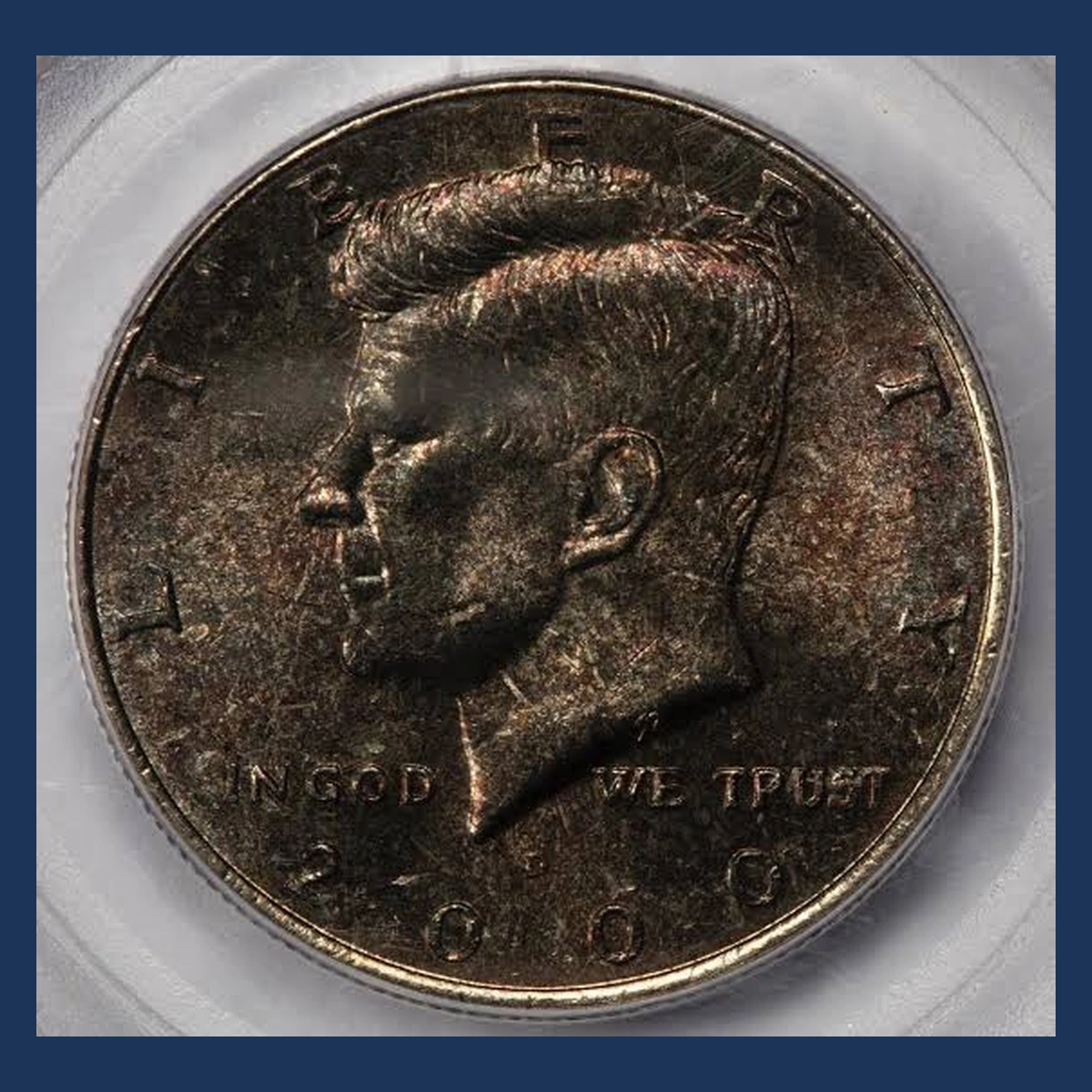
Both sides look copper-colored on documented Denver examples. Fred Weinberg’s inventory described PCGS MS64 and MS65 coins with a complete copper wash, including a lighter-colored piece.
The catalog called the effect improper annealing or sintering. These terms concern heating conditions that can change a blank’s surface before stamping.
The coin does not have to be black to show the reported effect. These examples are specifically described as copper-colored.
Color alone cannot identify the cause. Environmental changes, added plating, or a missing outer metal layer offer different explanations, so the structure and surface must be examined together.
Estimated Value
Weinberg’s historical inventories listed examples at $375–$450. They included an MS64 at $400 and MS65 offers at $375 and $450.
Those were asking prices. An estimated $300–$500 suits a similarly identified unworn coin with substantial copper-colored surfaces.
Grade alone does not explain the different offers. Color, original surface quality, and the individual example matter; an unexplained brown coin is not automatically a match.
How to Identify
Compare color in sheltered areas beside letters, raised designs, and smooth backgrounds under neutral light. Use a 10× magnifier to look for coatings, residue, or disturbed surface that might explain a later change.
Inspect the edge for its normal layers. Missing outer metal and added plating can create different evidence from the documented copper wash.
A digital scale and calipers can check an accessible candidate against 11.34 grams and 30.61 millimeters. Examine the edge grooves without heating, polishing, or applying chemicals to test the color.
Look for copper-colored surfaces on both sides, with the normal metal layers still present. A grading service can help confirm the cause; brown color alone does not prove a mint error.
Conclusion
Flipping both sides together reveals the $79 rotation example, while edge and surface checks answer different questions about clips and copper color. The silver Proof also needs its own weight and finish comparison.
Estimated values range from $5 to $500. Keep the $375–$450 heating-error offers labeled as historical asking prices, and match each coin’s physical evidence before treating an unusual photograph as a mint error.