1965 Half Dollar Error List with Pictures

Two coins trapped in one striking accident can be worth keeping together. A matched 1965 die-cap pair sold for $8,400 in 2024.
Individual 1965 half dollar errors have estimated values of $50–$12,000, from straight clips to unusual silver-alloy pieces. Normal coins from this year contain 40% silver.
Some examples came from Special Mint Sets, made for collectors, while others have regular finishes. Read on to compare the visible marks, missing metal, and unusual weights that identify each error.
1. 1965 Kennedy Half Dollar Straight Clip (Estimated Up to $300)
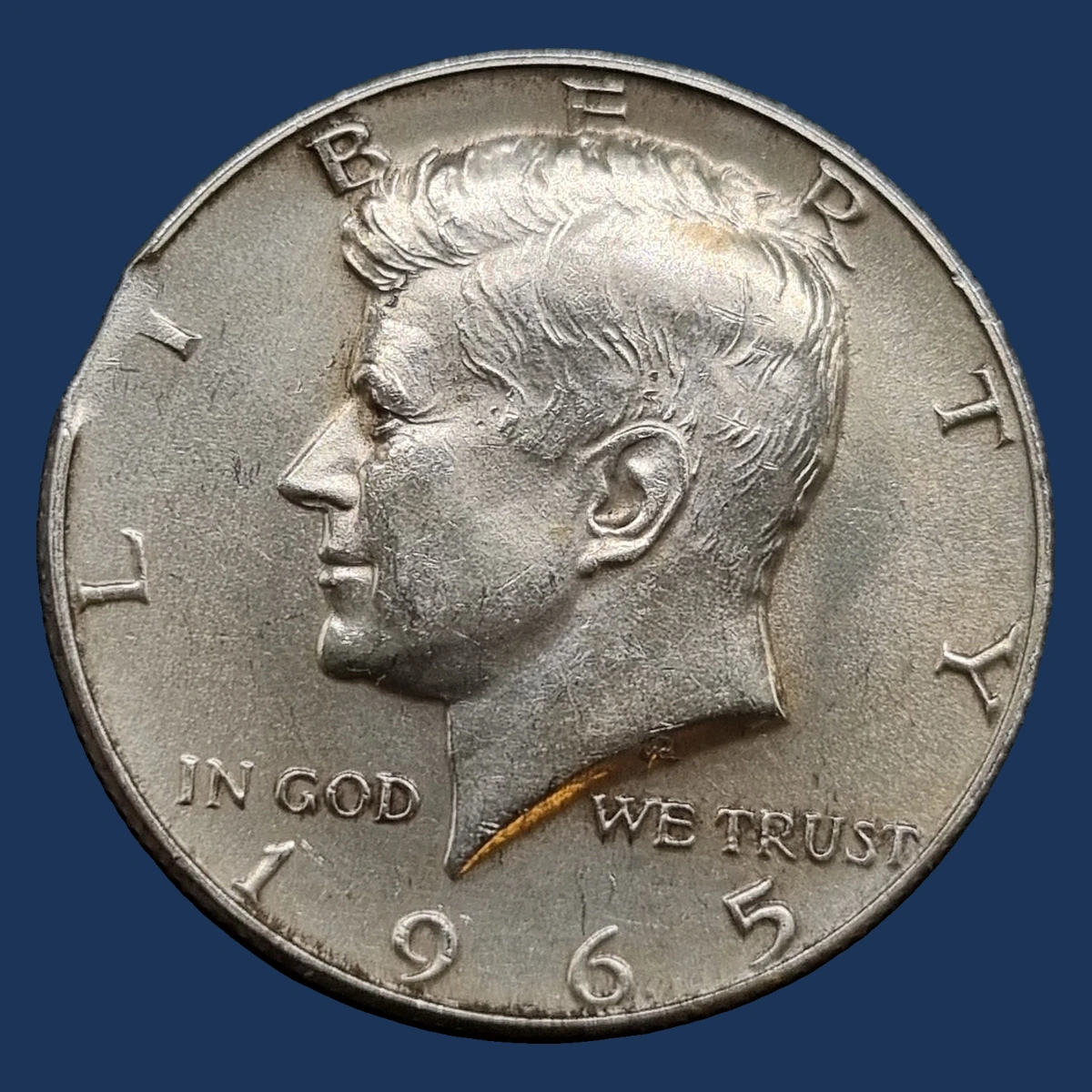
A straight section is missing from the edge of the reported 1965 example. This can happen when a round blank is cut across the straight boundary of a metal strip.
The incomplete blank then receives the coin design. Nearby letters or the rim may form weakly because some of the metal is missing.
A collector’s collection lists this example without establishing whether it came from a Special Mint Set. A straight gap is only the first clue.
Someone can also cut a straight section from an already finished half dollar.
Estimated Value
The estimated range is $50–$300 for a genuine straight clip with a readable date and reasonably preserved surfaces. Larger, clear clips can attract more interest than tiny missing sections.
A published $90 figure for a 1966 straight clip offers a nearby comparison using the same normal alloy. It is a guide figure rather than a traced auction sale, and no sale price is established for the collector’s reported 1965 example.
How to Identify
Use a 10× magnifier where the rim and letters meet the straight gap. Look for details that formed beside the missing metal, rather than sharp saw marks cutting through a completed design.
The opposite rim may be weak, which can help support an original clip. That clue should be considered with the cut wall and both ends of the opening.
Weigh a loose coin on a scale against the normal 11.50 g. Use calipers across the surviving outline against about 30.6 mm, and inspect the remaining edge ridges.
Normal 1965 halves contain 40% silver.
A bright edge does not prove a collector-set finish. Begin with the way the struck rim and letters approach the gap, then compare the missing metal with the weight loss.
2. 1965 Kennedy Half Dollar Clamshell Lamination (Estimated Up to $400)
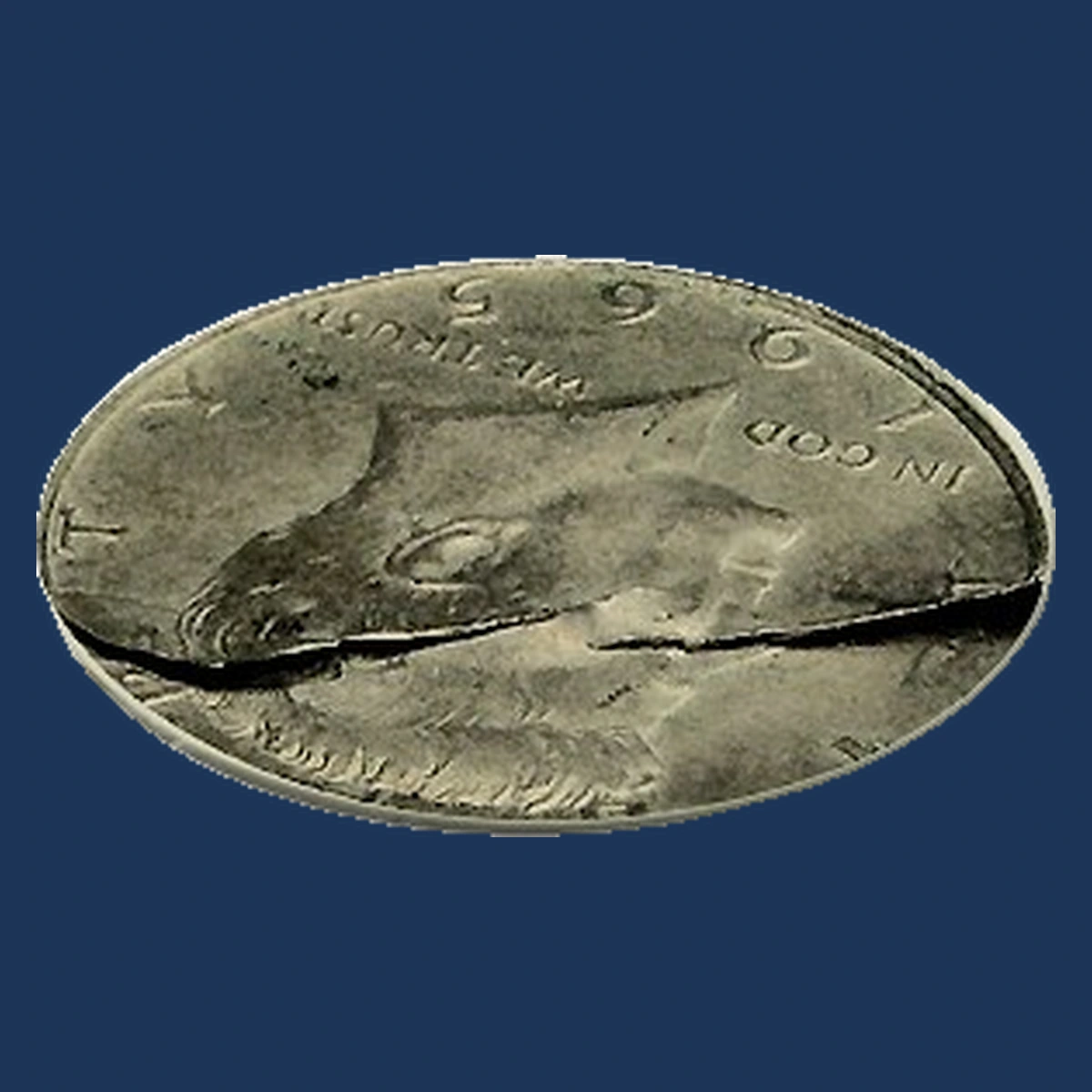
A loose layer opens like a flap on this kind of lamination. Part of the metal splits inside the blank, while an attached section keeps the lifted layer connected.
That shape gives it the name clamshell. The attached metal is important evidence, so it should never be pulled farther open.
Heritage listed a 1965 example with this defect on the front, graded NGC MS64, meaning no circulation wear and relatively few marks. The listing does not place the flap at a particular point on Kennedy’s portrait, and later prying can imitate a separation.
Estimated Value
The NGC MS64 example sold for $144 in July 2021. It provides a direct 1965 sale comparison for an estimated $100–$400 range.
The flap’s size, condition, and surviving attachment all affect its appeal. A clear opening with undisturbed metal can be easier to identify than a damaged separation.
Opening a flap farther does not increase its value.
Repeated handling or tool damage can weaken the evidence and lower the price.
How to Identify
Do not move the flap. Start with a side view and a 10× magnifier to see where the layers separate and where they remain joined.
Look for tool marks, glue, or a freshly cut groove. A natural split within the coin’s metal should have a different appearance from a piece forced apart or attached later.
A normal 1965 half contains 40% silver and weighs 11.50 g. A scale can still show almost that weight when the separated layer remains attached.
Use calipers carefully to compare the undamaged outline with about 30.6 mm, without squeezing the flap.
Use recorded measurements for a sealed coin. The clearest clue is the lifted layer continuing into an original attachment, rather than a loose piece sitting on the surface.
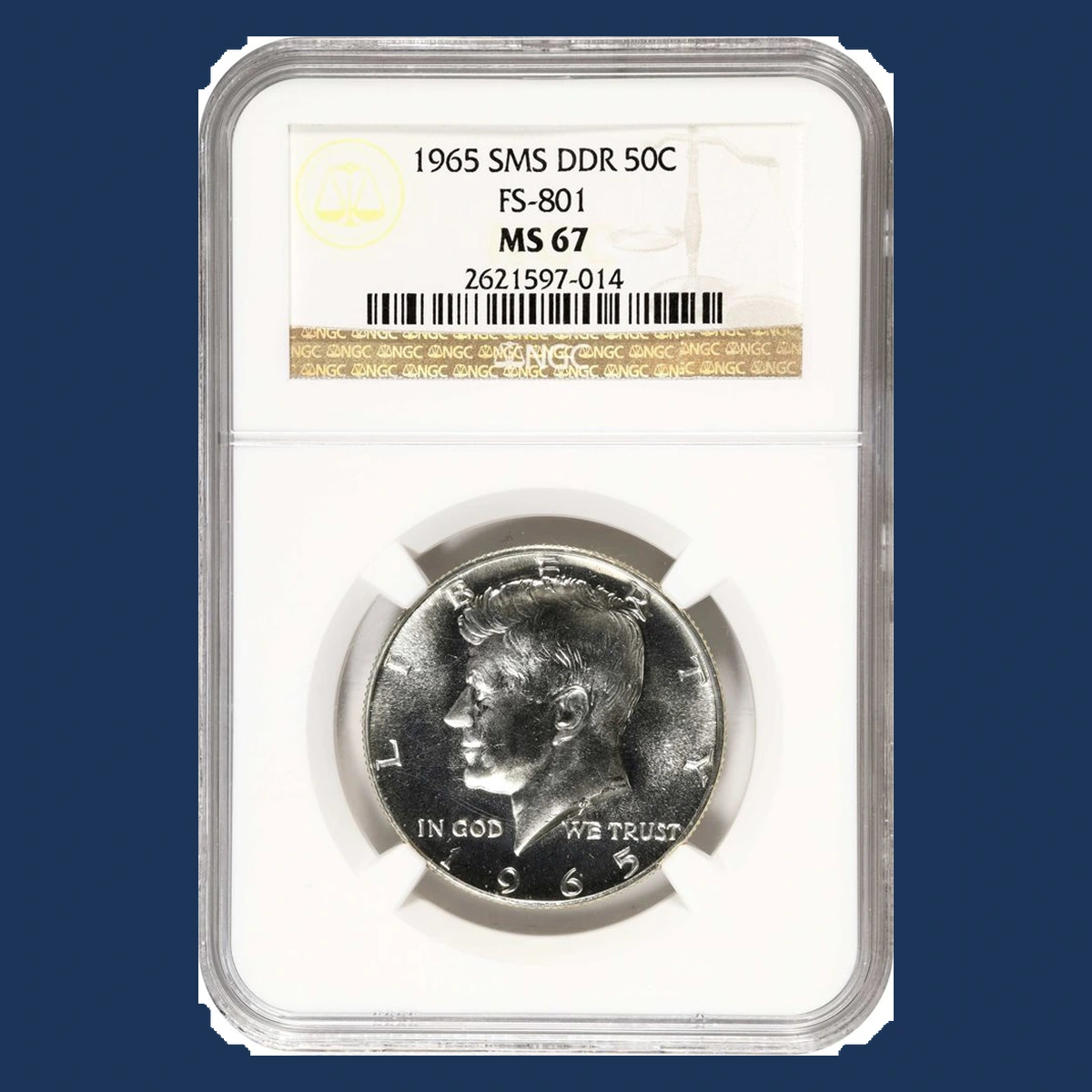
3. 1965 Kennedy Half Dollar Doubled Die Reverse, Regular and SMS (Estimated Up to $450)
Extra outlines can appear around the letters or stars on the back. A doubled die is a steel stamping tool that carries a doubled design, which it passes onto the coins it makes.
Regular 1965 reports mention UNITED STATES OF AMERICA and HALF DOLLAR. Special Mint Set coins, called SMS coins, include the recognized FS-801 variety with its own doubled stars and letters.
The two finishes need separate comparisons. A regular coin and an SMS coin may share the same date, but their extra outlines must match the correct example.
Estimated Value
An estimated $60–$450 covers identifiable reverse doubling, depending on the exact variety, finish, and condition. A worn regular coin is a different purchase from a well-preserved SMS example.
PCGS records $282 for an SMS FS-801 in January 2019. Its SP66 grade describes a well-preserved specially made coin.
That historical price supports the SMS comparison, rather than setting the value of every 1965 doubled reverse.
How to Identify
On a regular coin, examine the outer lettering with a 10× magnifier. Look for two rounded outlines or small splits at letter corners, rather than a flat shelf cutting into a letter.
For SMS FS-801, compare the stars and letters with photographs of that particular variety. Change the light angle so reflections do not look like extra raised lines.
A scale should show about 11.50 g, and calipers should measure roughly 30.6 mm. Both formats normally contain 40% silver and have ridged edges, so those measurements cannot distinguish the doubling.
Bright surfaces alone do not make a coin SMS or a conventional proof. The useful first check is a matching pattern of doubled stars and letters on the correct regular or SMS example.
4. 1965 Kennedy Half Dollar Struck Through Twine (Estimated Up to $1,500)
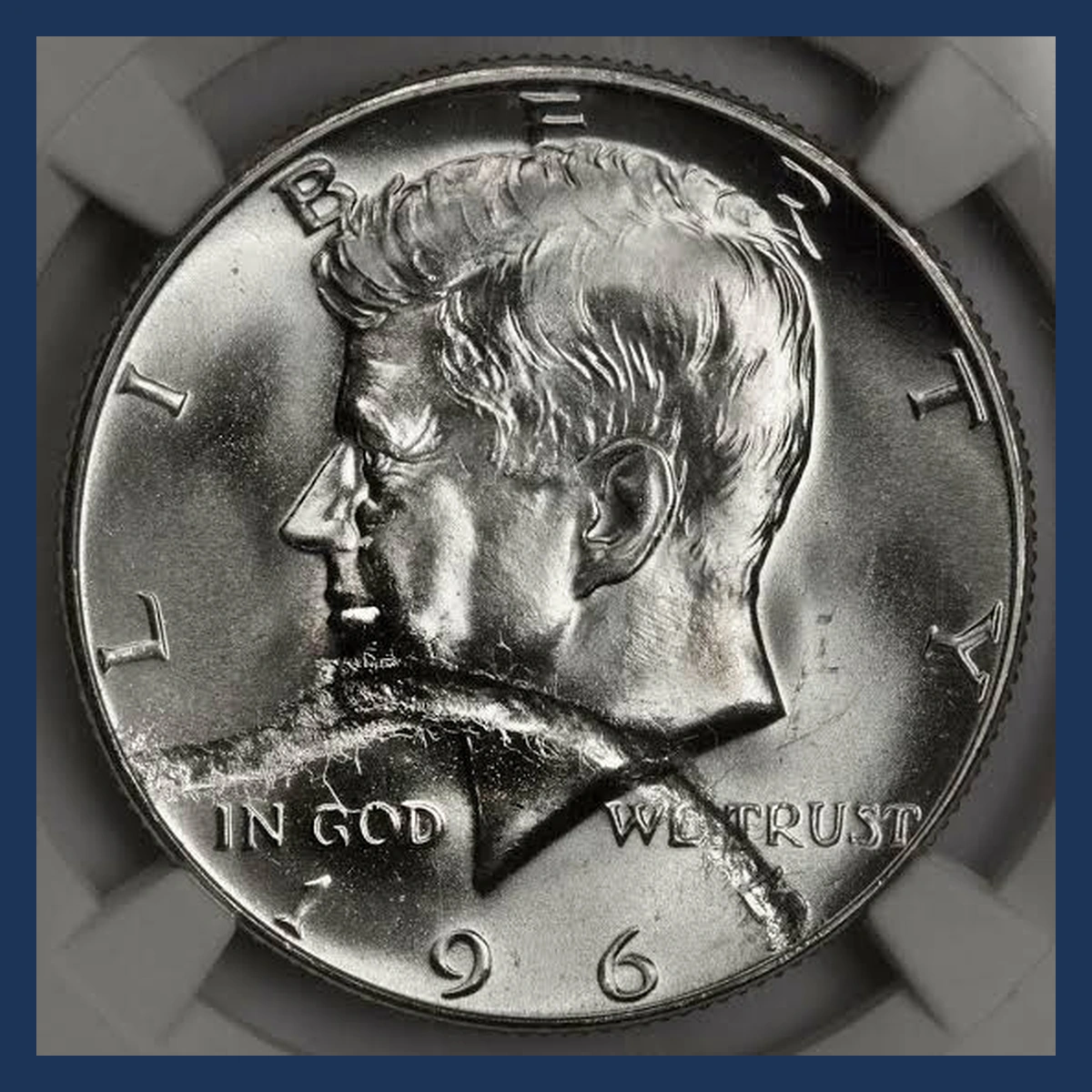
A strand of twine left a hollow across Kennedy’s portrait on the example pictured in Mint Error News. It lay between the blank and the stamping tool, blocking part of the design.
The missing strand can leave its shape or texture behind. This is different from a raised line made by a cracked tool or a scratch across a finished coin.
NGC graded the example MS67, meaning no circulation wear and very few marks. Its label does not establish the suggested Special Mint Set origin, and other struck-through 1965 coins need not involve twine.
Estimated Value
A pronounced, genuine impression on an attractive coin has an estimated value of $150–$1,500. The pictured MS67 twine example shows the kind of clear feature that may support the upper end.
A different 1992-D half struck through a metal fragment sold for $336 in July 2021. Its NGC MS64 grade, later copper-nickel layers, and metal obstruction differ from this coin.
That sale gives context, not a price for the 1965 twine example.
How to Identify
Shine light across the portrait from the side and examine the hollow with a 10× magnifier. Look inside for fine texture and along its edges for the point where normal design stops.
A later gouge often pushes metal upward beside the cut. An object caught during striking instead changes the way the design forms around it.
Compare the whole coin with the published MS67 photographs before identifying the material as twine. A smooth hollow alone does not reveal what caused it.
A scale and calipers can check 11.50 g and about 30.6 mm, with 40% silver and a ridged edge expected normally. Leave the hollow untouched.
The first clue is the strand-shaped impression crossing the portrait, including any surviving fiber texture.
5. 1965 Kennedy Half Dollar Struck on a Clad Quarter Planchet (Estimated Up to $2,200)
The date and eagle fit on the listed coin, but HALF DOLLAR runs beyond its edge. A smaller quarter blank entered the press and received the half-dollar design.
Heritage describes the PCGS MS65 example as slightly oval, with partial edge ridges and the design positioned near six o’clock. MS65 means no circulation wear and relatively few marks.
The blank has copper-nickel outer layers instead of the intended half dollar’s silver-bearing layers. A normal half dollar cut down later may also look small, but its cut edge tells a different story.
Estimated Value
The PCGS MS65 sold for $1,560 in January 2018. This direct sale supports an estimated $1,000–$2,200 range for similar genuine quarter-blank strikes.
A clear date, recognizable half-dollar design, and attractive surfaces help the coin’s appeal. Professional identification is particularly useful when the wrong metal and smaller size must agree.
This range concerns a quarter blank, not a full-size coin made from an unusual alloy or one with a missing outer layer.
How to Identify
Start at the edge with a 10× magnifier. Compare the complete central design, missing outer lettering, slightly oval shape, and partial ridges with the listed example.
A half dollar trimmed afterward can show a continuous band of cutting or grinding marks. Those marks are different from an edge shaped as the smaller blank was struck.
Use a scale to compare the quarter blank’s usual 5.67 g with the half dollar’s 11.50 g. Calipers can compare its original 24.3 mm width with the normal half-dollar width of about 30.6 mm, allowing for expansion.
The quarter’s bonded copper-nickel layers also differ from the intended 40%-silver coin. Look first for the complete date and eagle inside a naturally struck small edge, with HALF DOLLAR cut off.
6. 1965 Kennedy Half Dollar SMS 85% Off-Center Strike with Reverse Brockage (Estimated Up to $4,000)
Only a narrow part of this SMS coin received a design. Most of the blank sat outside the stamping tools, producing an 85% off-center strike.
Another struck half dollar remained in the press and touched the incoming blank. Its raised design left a sunken, backward copy on the back, called a brockage.
The PCGS SP63 example keeps most of the date, part of the motto, and the portrait’s lower tip. Corresponding backward details appear on the other face.
SP63 describes a specially made coin with noticeable marks, rather than a regular circulation finish.
Estimated Value
The PCGS SP63 sold for $2,640 in May 2022, giving a direct auction comparison for this SMS combination. An estimated $2,000–$4,000 fits similar examples with clear backward details and a readable date.
Both errors contribute to the complete coin’s appeal. An 85% shift does not translate into a price percentage, and an ordinary off-center coin without the copied design belongs in a different comparison from this unusual piece.
How to Identify
Read the narrow struck area using a 10× magnifier. The raised date on the front should correspond to a sunken, backward date on the back.
Photograph both faces with the same edge position at the top. This makes it easier to compare the date and the portrait’s lower tip without losing their relationship.
The normal SMS blank contains 40% silver, weighs 11.50 g, and begins at about 30.6 mm wide. Use a scale and calipers, or recorded measurements for a sealed coin, allowing for the distorted outline.
Inspect the empty metal and any surviving edge ridges for later crushing. The clearest starting clue is a normal raised date opposite its backward, sunken copy within the small struck section.
7. 1965 Kennedy Half Dollar Double Strike with Broadstrike and Obverse Indent (Estimated Up to $5,000)
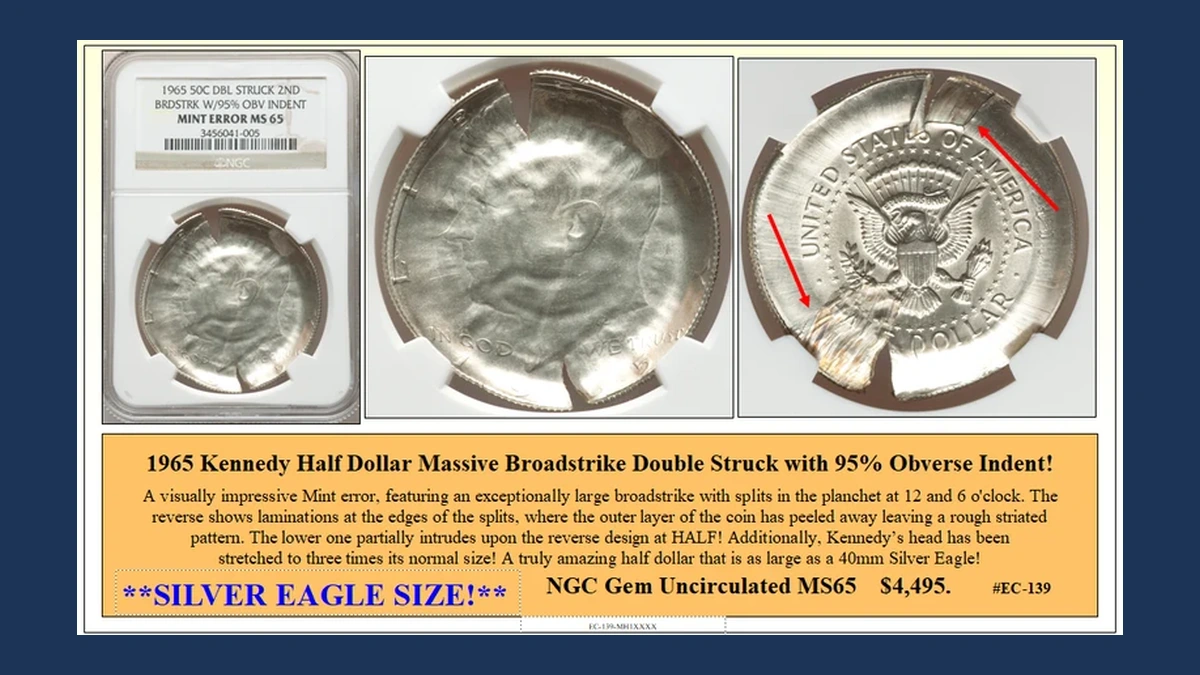
A large hollow covers most of the front on this combined error. The NGC label describes two strikes, with the second spreading the coin outward and leaving a 95% front indent.
An indent forms when another blank or object blocks part of the coin during striking. It need not contain the backward design seen in a brockage.
Mint Error News pictures the example graded MS65, meaning no circulation wear and relatively few marks. Its overlapping impressions, wider outline, and hollow must be examined together because they record different parts of the same accident.
Estimated Value
The estimated range is $1,500–$5,000 for a genuine example with a large indent and clear evidence of both strikes. No sale price is established for the illustrated NGC MS65.
A related 1965 pair sold for $5,175 in February 2007. It included an indented double strike and a separate expanded coin with a brockage.
That price bought both pieces, so it cannot be assigned to this single coin.
How to Identify
Follow the hollow’s boundary under side lighting and a 10× magnifier. Separate its smooth depression from any backward, sunken design, which would suggest a brockage rather than a plain indent.
Find raised details from the two strikes. Their overlap should show how one impression meets the other, instead of the crushed surfaces left by squeezing finished coins together.
Photograph both faces and the edge before comparing with the published example. The intended 40%-silver blank weighed 11.50 g and measured about 30.6 mm, with a ridged edge.
A scale checks retained weight, while calipers show expansion beyond the normal width. Begin with the separate overlapping designs and the large front hollow.
A wide outline alone does not prove two strikes.
8. 1965 Kennedy Half Dollar Obverse Die Cap (Estimated Up to $8,000)
High walls give this half dollar the shape of a small cup. A coin can form a die cap when it sticks to a stamping tool and keeps striking other blanks.
Its edges rise as the repeated pressure spreads the metal. The side against the tool may keep a clear portrait, while the other side becomes stretched and changed.
Stack’s Bowers described a deep 1965 front cap graded NGC MS64, meaning no circulation wear and relatively few marks. It retained Kennedy’s portrait and a stretched reverse brockage, but its label does not establish SMS manufacture.
Estimated Value
A matched 1965 cap and its related second coin sold for $8,400 in August 2024. The auction price covers the pair, graded PCGS MS64–65.
For one substantial genuine cap, estimate $2,000–$8,000. Depth, condition, and readable transferred design affect the price.
The earlier NGC MS64 cap is not established as part of that later PCGS pair, so their identities and values should stay separate.
How to Identify
Look from the side before looking down into the cap. Check how the rising walls connect with the retained portrait and the stretched design on the opposite face.
Use a 10× magnifier to inspect the metal for sharp bends, hammer marks, or other signs of reshaping. A cup shape alone can be made after minting.
The original 40%-silver blank weighed 11.50 g and began at about 30.6 mm wide, with edge ridges. Weigh a loose cap carefully on a scale and record its changed outline.
Calipers may measure safe, accessible areas, but never squeeze the walls or flatten the coin. The useful first view shows continuous rising walls alongside the preserved portrait and stretched opposite design.
9. 1965 Kennedy Half Dollar on an Anomalous Alloy Planchet (Estimated Up to $10,000)
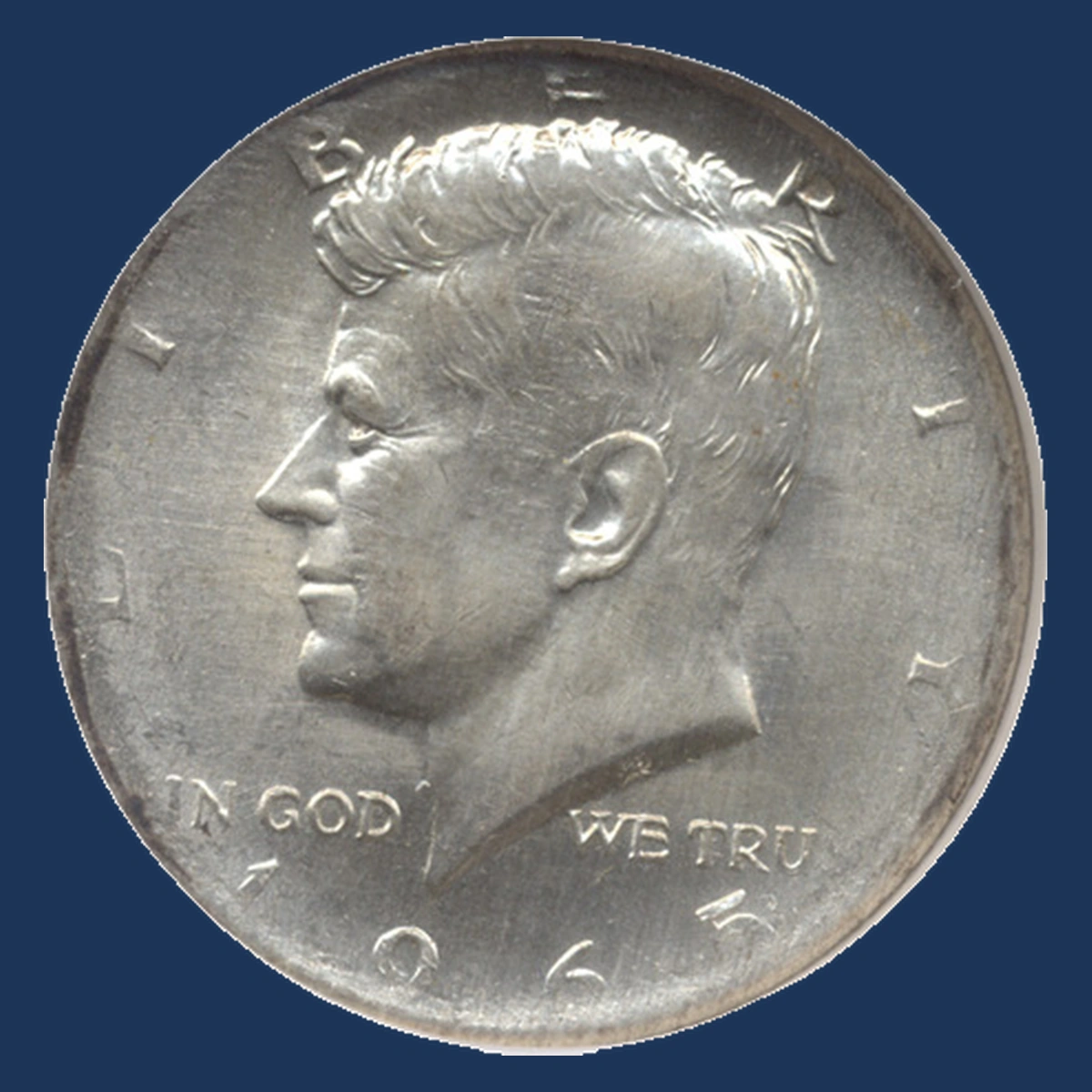
This reported half dollar has a normal overall size but weighs only 7.62 g. Mike Byers describes testing that found 25% silver and 75% copper.
Those figures differ from a normal 1965 half dollar’s 11.50 g and 40% silver. They also distinguish the reported piece from a smaller quarter-blank strike.
The report does not identify a foreign coin blank with matching measurements. It also does not establish an experimental issue.
Unusual metal can make a coin important without revealing exactly where its blank came from or why it entered the press.
Estimated Value
A professionally identified example of this kind has an estimated value of $2,500–$10,000. This range reflects the unusual size, weight, and metal together, rather than a recorded sale of the reported coin.
For comparison, a 1974 Kennedy struck on a Taiwan five-dollar blank sold for $2,880 in September 2023. PCGS graded it AU55, meaning light circulation wear.
That different coin had an identified blank, unlike this 1965 report.
How to Identify
The discovery report gives a 7.62 g weight and 25% silver content for a full-size coin. Check weight on a calibrated scale and use calipers to compare the width with about 30.6 mm.
Inspect both faces and the ridged edge with a 10× magnifier. Grinding, chemical damage, or added plating can change a coin’s weight or apparent metal content.
A specialist should compare the original surfaces with non-destructive metal testing. A reading from the surface alone does not show what the entire coin contains.
None of these checks names the blank’s origin by itself. Begin with the large weight difference on a full-size coin, then have its original surfaces and metal content checked together.
10. 1965 Kennedy Half Dollar Reported 90%-Silver Transitional Planchet (Estimated Up to $12,000)
A 1965 date on an older 90%-silver blank would cross an important change in coinage. The normal half dollar dropped from 90% silver in 1964 to 40% in 1965.
Coin World reports that some 1965 halves were struck in the earlier alloy. Such a piece is called a transitional error because old material received the new date.
A white edge is not enough to identify it. Ordinary 1965 halves already contain silver, so weight, metal testing, and an unaltered date must agree before the older blank can be identified.
Estimated Value
The estimated range for a genuine 1965 half on an old-composition blank is $3,000–$12,000. This is a comparison-based estimate, not a claimed half-dollar auction result.
A 1965 Washington quarter struck on 90%-silver metal sold for $5,880 in January 2023. NGC described it as having light circulation wear and cleaning.
That different denomination illustrates demand for silver-transition errors, but its price and condition cannot be transferred directly to a half dollar.
How to Identify
Weigh the coin on a scale before judging its edge color. The older blank’s normal weight is 12.50 g, compared with 11.50 g for an ordinary 1965 half.
Both measure about 30.6 mm across and have ridged edges, so calipers cannot separate the alloys. Use a 10× magnifier on the date and nearby metal to look for alteration.
A specialist must interpret non-destructive alloy testing alongside the coin’s surfaces. Added plating or one unusually heavy reading does not prove a 90%-silver blank.
Coin World reports the 1965 claim without identifying every example. Start with a clear, unaltered 1965 date and a weight near 12.50 g, then have the silver content professionally checked.
Conclusion
Missing metal, a strand-shaped hollow, and a backward date each tell a different story on a 1965 half dollar. Compare the visible feature before choosing a price.
The estimated range runs from $50–$12,000. Keep regular and SMS coins separate, preserve matched pairs together, and leave loose layers or raised walls untouched; unusual silver claims need both reliable weight and professional metal testing.