1918 Half Dollar Error List with Pictures

A 1918 half dollar struck ten percent off center sold for $11,500 at Heritage in 2004. Much of Liberty remained visible, and the date could still be read.
Other 1918 half dollar errors are much smaller: missing initials or soft detail in the design. Estimated prices across these four types range from $40–$11,500.
Read on to learn where to look and why an uneven strike can matter more than a tiny missing letter.
1. 1918-D Walking Liberty Half Dollar No AW Error (Estimated Up to $300)
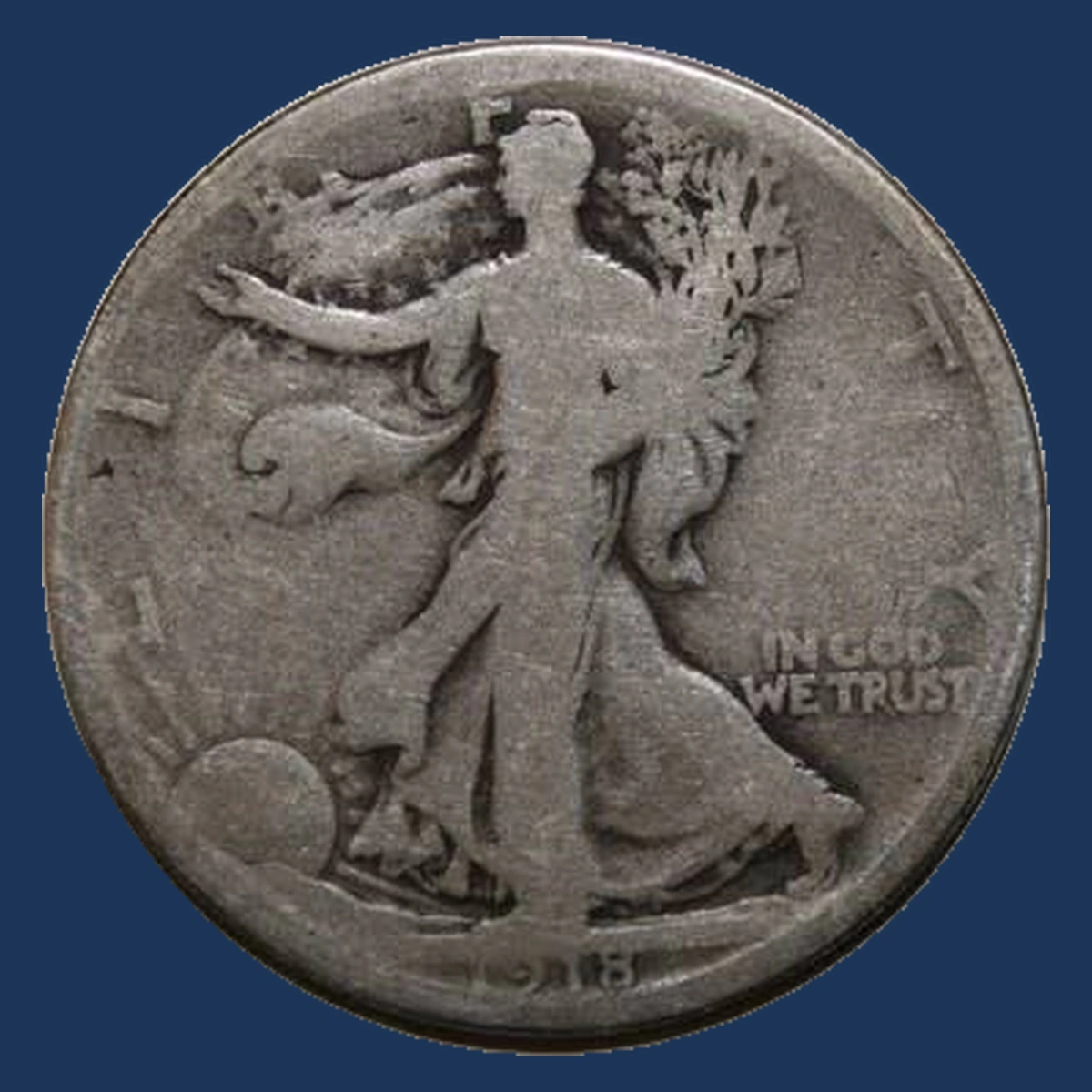
The small AW below the eagle’s tail can be missing on a 1918-D half dollar. Those letters are the initials of designer Adolph A. Weinman.
On the variety called No AW, polishing removed the shallow initials from the die. The die is the steel tool that stamps the design onto coins.
Coins made with that tool then lacked the letters, even though their Denver mintmark remained. The catalog name FS-901 identifies this variety.
Check more than the empty space. Heavy wear can also erase these small letters, so their absence alone does not prove a No AW coin.
Estimated Value
The estimated range is $40–$300 for worn examples graded Good through Very Fine. A dealer asks $209 for a Fine-to-Very-Fine coin; that is not a completed sale.
GreatCollections also auctioned an ANACS G4 example in February 2024, showing that collectors buy lower-grade pieces. Its public sale price was not available.
The remaining detail and a reliable No AW identification matter more than simply finding two missing letters.
How to Identify
Turn the eagle upright. With a 10× magnifier, find the space below its tail and compare it with a normal 1918-D back design.
Look closely at the surrounding metal. Scratches, an unusually shiny patch, or a shallow hollow may mean someone removed the letters later.
Heavy wear across the eagle can also explain their absence. A clear photograph of a known No AW example helps separate the variety from ordinary wear.
Check for the D on the back and inspect the grooved edge. An unworn coin should weigh near 12.50 g on a scale and measure about 30.6 mm with calipers.
A matching reverse and a verified grading label give the quickest useful confirmation.
2. 1918 Walking Liberty Half Dollar Weak Strike (Estimated Up to $1,500)
Liberty’s fingers may look flat even on a coin that never circulated. If the strike did not fully form the design, the hand and nearby leaves can lack detail from the start.
The eagle’s breast can show similar softness. This is called a weak strike, and 1918-S coins are especially known for it.
A weak strike is not automatically a valuable mint error. Collectors usually prefer sharper detail when two coins have the same overall condition.
The surface helps tell the story: original mint shine may remain across a soft area that was never fully formed.
Estimated Value
Allow an estimated $40–$1,500 for ordinary worn coins through examples around MS63, a grade for coins without circulation wear. Weak detail does not add an automatic premium.
A regular PCGS MS63 1918-S sold for $1,260 in May 2025. That price belongs to the collectible coin, not a separately certified weak-strike error.
Mintmark, surface quality, and wear determine the useful comparison. A sharper example can bring more at the same grade.
How to Identify
Watch the surface under one lamp. Tilt the coin slowly and look for moving bands of mint shine across the weak detail.
Wear tends to dull the exposed high points, while an incomplete strike may leave that shine intact. A 10× magnifier helps you compare Liberty’s branch hand and the eagle’s breast with sharper lettering.
Cleaning can hide these clues. Scratches or polished areas make the difference between weak strike and wear harder to judge.
Check an unworn example against 12.50 g on a scale and about 30.6 mm with calipers. The edge should have normal edge grooves.
Soft detail with intact mint shine is the most useful first clue, rather than a smooth eagle alone.
3. 1918-S Walking Liberty Half Dollar Broadstrike Error (Estimated Up to $7,000)
Extra metal below the date makes the reported 1918-S broadstrike easy to notice. Heritage described that feature on an NGC MS62 example.
A broadstrike happens when the collar fails to contain the blank as it spreads. The collar is the ring that controls the coin’s width and shapes its edge.
Without that support, silver can spread outward under the dies. The coin becomes wider or uneven, but both designs can remain complete.
Look around the whole outline. If part of the design fell beyond the blank, the coin is off center rather than simply broadstruck.
Estimated Value
The estimated $3,000–$7,000 range follows the July 2025 Mint Error News guide for Walking Liberty broadstrikes. It covers lightly worn through uncirculated coins, with size and condition affecting price.
These are guide estimates for the series, not a recorded 1918 sale. Heritage’s NGC MS62 example did not sell in January 2004.
A more obvious spread can increase appeal, but collectors also consider surface marks and the quality of the remaining design.
How to Identify
Check for a complete design first. Follow the lettering and main details around both faces with a 10× magnifier.
Compare the outline with a normal half dollar, then use calipers in several directions. The usual diameter is about 30.6 mm, but a broadstrike can spread beyond it.
A scale should still show close to 12.50 g if the coin is unworn and no metal is missing. Examine the edge for missing or uneven edge grooves where the collar failed to hold it.
Hammering can also flatten a coin and make it wider, but it crushes existing detail. Complete designs with natural outward metal flow give the quickest useful distinction.
4. 1918 Walking Liberty Half Dollar Off-Center Error (Up to $11,500)
Part of the design is missing, yet a blank crescent remains on the other side. The blank sat out of position when the dies struck, sending some of the design beyond its edge.
The recorded 1918 examples are about ten percent off center. Heritage described the MS65 coin’s shift toward eleven o’clock, with its date still readable.
The detail can remain sharp. The auction description noted Liberty’s rounded thumb, even though the design was displaced.
Off center describes where the strike landed. It does not mean that every part of the impression was weak.
Estimated Value
Heritage sold a PCGS MS64 example for $11,500 in August 2004. A PCGS MS65 brought $10,575 in April 2013.
An estimated $10,000–$11,500 suits comparable certified 1918 examples at these well-preserved grades. Both prices are historical sales, and neither sets a price for every ten-percent offset.
The higher grade did not bring the higher price. Surface appeal, the readable date, and competition between buyers also affect the result.
How to Identify
Match the blank crescent on both faces. A 10× magnifier helps you trace where each design stops at the edge of the struck area.
If only one face shifts while the other stays centered, a misplaced die may explain it. A wider coin with complete designs points instead toward a broadstrike.
Read the date and examine the reverse mintmark area when comparing the Philadelphia example. Look for cut edges or fresh tool marks around the blank crescent.
Use a scale and calipers, taking 12.50 g and 30.6 mm as normal starting figures. The error can alter the outline and edge grooves.
Matching both faces to a certified example is more useful than judging one uneven rim.
Conclusion
A missing AW and a displaced design belong at very different price levels. The estimates here start at $40 for worn examples and reach $11,500 for a high-grade off-center coin.
Check whether the design is complete, then study the surface for wear or weak striking. These simple steps help you choose the right comparison instead of assigning a major-error price to an ordinary worn area.