1893 Half Dollar Error List with Pictures

An 1893 Barber half dollar with tripled lettering on the back sold for $2,644 in August 2016. HALF is the clearest word to inspect on that variety.
Other 1893 half dollar errors can appear below the date, across Liberty’s face, or along an oddly shaped border. Estimated ranges span $75–$8,500, using the examples and comparisons explained below.
Start with the feature you can see, then use the checks for that type.
1. 1893-O Barber Half Dollar Misplaced Date (Estimated Up to $650)
The space beneath the date may hide part of an extra numeral. A Barber Coin Collectors’ Society survey reports this feature on an 1893-O half dollar.
The mistake happened when the date punch entered the die, the steel tool that stamps coins, in the wrong place. Part of that misplaced impression could survive below the finished date.
This differs from an extra outline immediately beside a correctly placed digit. The report does not establish exactly which hidden numeral every example should show.
Look among the border’s small tooth-like marks, keeping the whole date in view.
Estimated Value
Estimated values of $75–$650 cover heavily worn through moderately preserved examples of the reported variety. The condition of the New Orleans coin itself contributes much of the value.
PriceCharting records an ordinary 1893-O graded AU50 at $573 in July 2026. AU50 means slight wear.
That sale does not identify a misplaced date. A clear match and visible extra numeral are needed before paying more than for a comparable ordinary coin.
How to Identify
Find O below the eagle on the back. Then use a 10× magnifier to scan beneath 1893, including the tiny border marks.
Look for a recognizable piece of a numeral outside the normal date. Do not decide it must be 1 or 8 simply because a shadow resembles one.
Change the light angle to separate raised detail from cuts or damaged border metal. Photograph the complete date rather than just the suspected fragment.
An ordinary example weighs 12.50 grams and measures 30.6 mm, with edge grooves. Use a scale and calipers when safely accessible, allowing for wear.
Compare the extra fragment’s exact position with a documented 1893-O example; a vague shape among the border marks is not enough.
2. 1893-O Barber Half Dollar Reported Face Strike-Through (Estimated Up to $1,000)
Shallow curved hollows on Liberty’s face led one collector to suggest grease had interfered with the strike. He also pointed to the eye and wreath above it.
Material caught between a blank and its stamping tool can prevent parts of the design from forming normally. Collectors call this a struck-through error.
The owner described several examples, including coins graded AU50 and AU58, both indicating slight wear. Those grades do not certify the cause of the hollows.
The surfaces still need inspection. A later hit can also leave a depression, often pushing metal up around its edge.
Estimated Value
Use an estimated whole-coin range of $500–$1,000 for slightly worn examples with the reported facial feature. Remaining detail and surface quality account for much of that value.
Ordinary 1893-O comparisons include $573 for AU50 in July 2026 and $840 for AU55 in September 2025. Both grades describe slight wear.
Those Heritage results concern ordinary coins listed by PriceCharting. They are not sales of the collector’s pictured examples or measured prices for a grease mark.
How to Identify
Begin with the owner’s illustrated examples, then compare one coin at a time. Use low light and a 10× magnifier across the face, eye, and wreath.
Watch how each hollow meets the surrounding surface. A sharp dent or pushed-up border may point to damage after striking.
Smoothness alone does not settle the cause, and a normal grade on a holder does not confirm a mint error. Keep the date and O mint letter with each photograph.
Check accessible coins with a scale and calipers against 12.50 grams and 30.6 mm. Inspect the edge grooves too.
The useful comparison is the hollow’s shape and undisturbed surface around it, rather than the grade printed on the holder.
3. 1893 Barber Half Dollar Tripled Die Reverse (Estimated Up to $2,800)
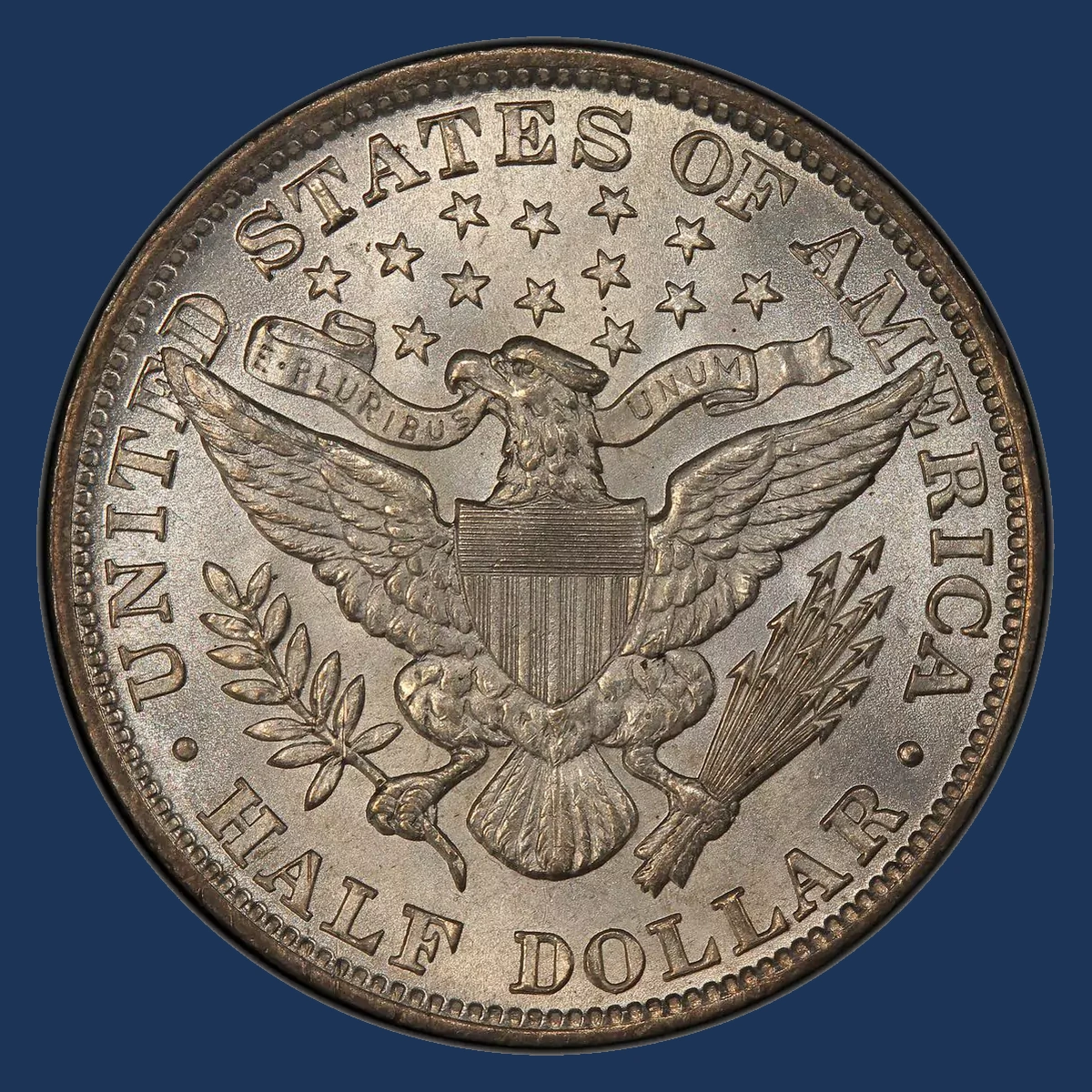
HALF can show three outlines on this Philadelphia variety. Other lettering and nearby parts of the eagle design show doubled detail.
The repeated picture was already in the stamping tool. A single strike could therefore place several outlines on the coin without striking it again.
Collectors identify this variety as FS-801. That number names the same unusual back design, rather than a separate mistake for each doubled letter.
Make sure the coin is a Barber half dollar. The United States also made an 1893 Columbian commemorative half with a different design, which needs a different comparison.
Estimated Value
PCGS records a $2,644 sale in August 2016 for an MS65 example. That grade means well-preserved and unworn.
Greysheet also lists a $600 result from May 2025. Estimated values of $500–$2,800 cover slightly worn through MS65 examples.
The variety name alone cannot set a price. Clear lettering, remaining detail, and original surfaces help explain why one example can sell for much more than another.
How to Identify
Place HALF under a 10× magnifier. Look for several rounded outlines that still follow the shapes of the letters.
Then check the outer lettering and nearby details: arrows, olive-branch leaves and stem, wing tips, ribbon, and outer stars. They provide other places to compare.
Flat shelves from movement during striking can look doubled, as can bright reflections beside a single edge. Change the light and compare with a sharp FS-801 photograph.
This Philadelphia Barber half has no mint letter below the eagle. Normal weight is 12.50 grams and diameter 30.6 mm; check with a scale and calipers when safely accessible, and inspect the edge grooves.
Tripling in HALF should agree with the extra outlines elsewhere on the back.
4. 1893 Barber Half Dollar Reported Broadstrike (Estimated Up to $3,000)
A broadstrike can look wider than an ordinary half dollar while keeping both complete pictures. The blank spread outward because its retaining ring did not hold it in place.
That ring normally controls the diameter and shapes the edge grooves. Without its full restraint, metal can spread under the stamping tools.
The 1893 year guide reports this kind of error without naming a particular certified example or giving its measurements. It does not document one from every mint.
The border and edge need to agree. Later pressure can also enlarge a coin, but often damages the designs.
Estimated Value
The estimated $2,500–$3,000 range applies to clearly identifiable Barber broadstrikes with wear or slight wear. It comes from an older Mint Error News series guide.
That guide compares smaller and larger broadstrikes around XF and AU grades. It is not a recorded sale of an 1893 example.
Use the range for coins with complete designs and natural spreading. A normal coin widened by later pressure does not qualify for the same error value.
How to Identify
Follow both designs all the way around before measuring. A broadstrike keeps the pictures within an expanded outline; an off-center strike leaves some design beyond the blank.
On a safely accessible coin, measure the greatest and smallest diameters with calipers. Compare them with the usual 30.6 mm.
A scale should show a weight reasonably close to 12.50 grams, allowing for wear. A large unexplained loss suggests a different problem.
Inspect the edge with a 10× magnifier for incomplete grooves from the retaining ring. Filing marks or flattened design may reveal later alteration.
Look for complete pictures surrounded by naturally spread metal, with the edge supporting the same explanation rather than showing damage.
5. 1893 Barber Half Dollar Reported Off-Center Strike (Estimated Up to $8,500)
A coin struck off center has two linked features: an area that stayed bare and part of the picture that is missing. The blank was out of position when the tools struck.
The 1893 year guide reports this category for Barber halves. It does not identify one specific mint or amount of shift.
The date and mint letter may remain visible or fall outside the struck area. That affects both identification and interest.
A suggestion that an 1893-S would be desirable is not evidence that such a San Francisco example has been documented.
Estimated Value
A substantial off-center Barber half with a readable date has an estimated $2,500–$8,500 range. A different-year 1894 example sold for $7,800 in December 2022.
That coin was 40% off center and graded AU53, meaning slight wear. Its result helps explain the upper portion of the range.
It is not an 1893 sale. Smaller shifts and coins without readable dates need different comparisons, even when they are genuine errors.
How to Identify
Keep track of the bare area while turning the coin over. The incomplete pictures on both faces should fit the same displaced blank.
With a 10× magnifier, inspect the boundary between struck design and untouched metal. Cutting or grinding away a finished design leaves a different surface.
If only one face is shifted, a misaligned stamping tool may explain it. If both complete pictures remain, compare the coin with a broadstrike instead.
Record the date and any mint letter. For safely accessible coins, compare scale readings with 12.50 grams and measure the outline with calipers against the usual 30.6 mm.
Check the edge as well, then trace the matching bare area beside the missing design on both sides.
Conclusion
The estimated $75–$8,500 ranges cover very different 1893 Barber half dollars. A tiny fragment below the date needs a close-up, while an off-center piece needs clear photographs of both complete faces.
Start with HALF when checking the tripled-back variety. For the reported facial hollows, compare the surfaces carefully and remember that a holder’s condition grade does not establish how a mark formed.