1914 Half Dollar Error List with Pictures

A recent off-center half-dollar sale gives one useful price comparison: $480 for a 1976 Kennedy in December 2025. That is another year and design, not a documented 1914 sale.
The reported 1914 half dollar errors below have estimated values of $100–$1,500. Their clues range from fine raised lines to peeling metal and a broad blank crescent.
Begin with the shape of the mark, then use the following checks to understand how it formed.
1. 1914 Barber Half Dollar Die Crack Error (Estimated Up to $400)
A line above the surface may have come from a cracked die. A die is the steel tool that stamps the coin’s design.
Silver can enter a narrow crack in that tool during striking. It leaves a raised ridge on the finished coin instead of a scratch cut into it.
The 1914 year guide reports die cracks but does not give a fixed location or mint for an example. Check the actual line rather than expecting it beside one letter.
A normal design edge or later damage can look similar. The line’s height and continuity are the first useful clues.
Estimated Value
A worn 1914 half with a modest genuine crack has an estimated $100–$400 range. Much of its value still comes from the date, mint, and condition.
A regular Philadelphia half graded PCGS Fine 12 sold for $288 in March 2025. That is a worn-coin comparison, not a sale of the crack.
A faint line on a heavily worn San Francisco coin does not automatically earn the same price. Compare the complete coin before assigning extra value to the mark.
How to Identify
Photograph the line with the lamp on one side, then the other. A magnifier helps show whether it is raised or cut below the surface.
Follow it through nearby design and open areas. A loose fiber or a normal letter edge may create a line in one photograph without showing a cracked die.
Record the mintmark below the eagle: S for San Francisco, or no letter for Philadelphia. The normal coin measures about 30.6 millimeters and weighs 12.50 grams before wear.
Use calipers and a scale when safely accessible, and inspect the edge grooves for damage. A continuous ridge that remains clear under changing light is the useful first evidence.
2. 1914 Barber Half Dollar Lamination Error (Estimated Up to $600)
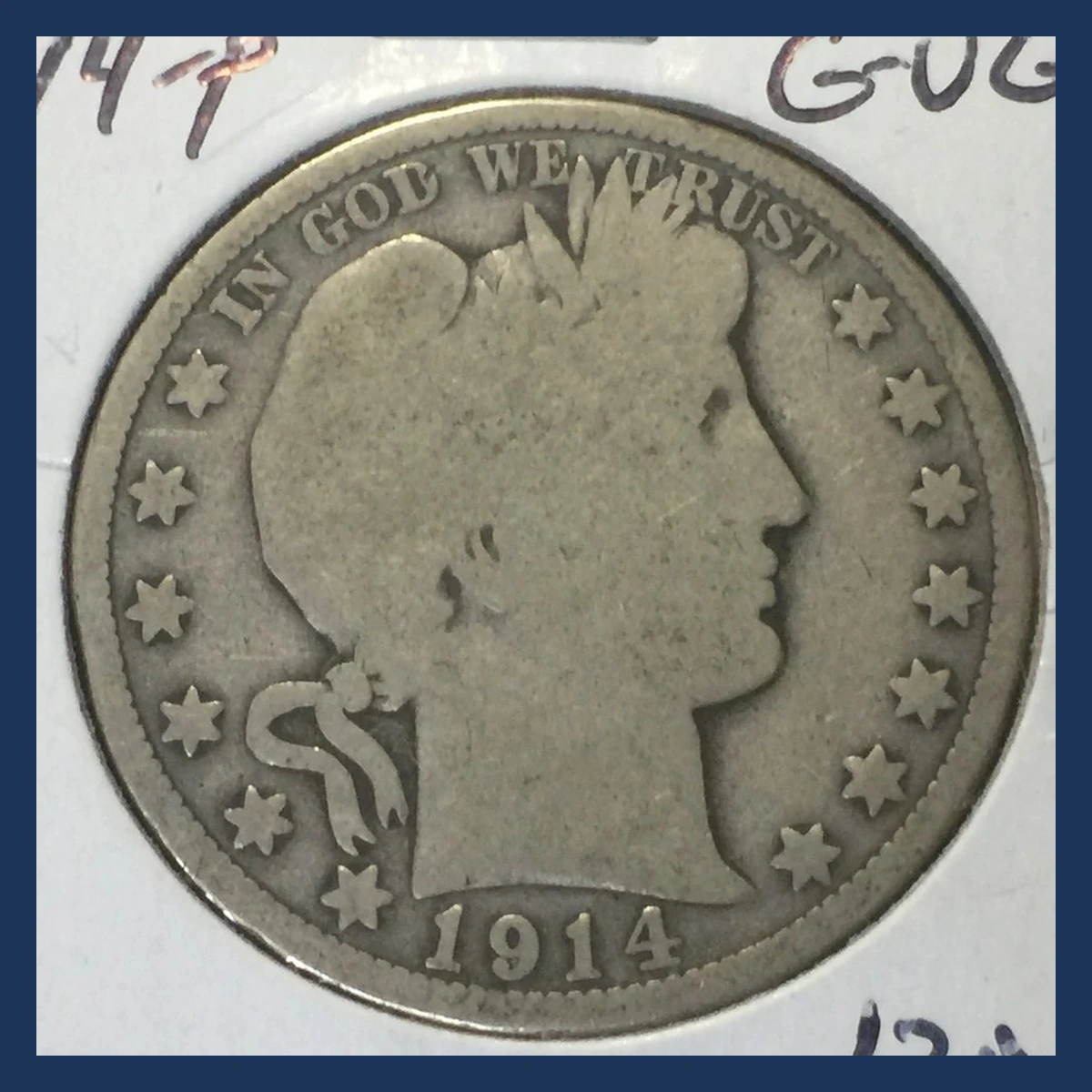
A small sheet of silver may appear to lift from the coin. That kind of separation is called lamination, caused by a weakness inside the metal blank.
The thin layer can separate before or after the strike. Its boundary differs from a single scratch across a solid surface.
The year guide reports lamination for 1914 without placing an example at either mint. It gives no exact position on the front or back.
Inspect the actual peel. A sharp object can remove silver later too, but a cut and metal pushed aside tell a different story from a naturally separating layer.
Estimated Value
Visible laminations on worn 1914 halves have an estimated $100–$600 range. The size of the peel and the coin’s condition both matter.
A 1912-S Barber half with an attached lamination sold for $89 in March 2026. PCGS graded it VG8, a heavily worn grade.
That is another date’s error sale, while the ordinary 1914 Philadelphia Fine 12 sale at $288 gives date context. Neither figure is a recorded sale of a 1914 lamination.
How to Identify
Leave any loose flap untouched. Inspect it from a shallow angle so you can see the layer’s edge rather than just a dark patch.
A magnifier can reveal how the separated silver meets the original surface. Scrapes may show tool lines or sharp cuts, while corrosion can leave rough pits.
Photograph the full date and mintmark area along with the close-up. A peel alone does not identify the year or mint.
When safely accessible, weigh the coin against the normal 12.50 grams and measure its roughly 30.6-millimeter diameter with calipers. Include the edge grooves in your checks; a small lost flake may barely change the weight, but a clear layered boundary explains the error.
3. 1914 Barber Half Dollar Cud Error (Estimated Up to $800)
A raised patch touching the rim can come from a piece of die breaking away. Silver enters the missing section during the strike and leaves an area without its normal detail.
Collectors call this a cud. It covers an area rather than forming only a narrow crack line.
The 1914 guide reports this type without identifying a certified coin or a specific position. Its rim connection must be checked on each candidate.
Something added to a finished coin can imitate a lump. The patch needs to be part of the original struck metal, not solder or material stuck on later.
Estimated Value
For a genuine, easy-to-see cud on a worn 1914 half, estimate $250–$800. The size of the break and the underlying coin affect that range.
A related 1898 Barber half with a retained back-side break sold for $288 in March 2021. It graded PCGS Good 6, showing heavy wear.
A retained break means the fractured die piece stayed in place. It is a useful comparison, but differs from a fully missing piece and is not a 1914 sale.
How to Identify
Inspect where the raised patch joins the rim. The boundary should fit an area where the die could no longer stamp the intended detail.
Use a magnifier to look for a seam, added solder, a different color, or tool marks. A hard hit can also push metal upward beside a dent.
Check the corresponding area on the opposite face and keep both full views. They should preserve the 1914 date and any S mintmark.
The normal half weighs 12.50 grams and measures about 30.6 millimeters, with grooves around the edge. Use a scale and calipers when safely accessible; the key is a broad rim-connected patch of original metal, rather than a thin line or attached lump.
4. 1914 Barber Half Dollar Off-Center Strike Error (Estimated Up to $1,500)
Untouched blank metal beside missing design is the basic pattern of an off-center strike. The metal disc was out of position when the dies came together.
One part missed the design while another received it too close to the edge. Both faces should show the effect.
The 1914 year guide reports off-center striking without a certified example, percentage, or direction. Those details belong to the individual coin being examined.
An unequal rim is not enough. One misaligned die can shift only one face, while later cutting can remove design without leaving a genuine original blank crescent.
Estimated Value
An identifiable worn example has an estimated $400–$1,500 range. A readable date, clear shift, and attractive surfaces support stronger prices.
For comparison, a 1976 Kennedy fifteen percent off center sold for $480 in December 2025. It graded NGC MS64, an unworn grade.
That different design provides general error-market context, not a 1914 transaction. The older Barber date also affects the estimate, while cleaning or only a slight shift can limit collector interest.
How to Identify
Keep the empty margin in the photograph. Locate where the design stops, then turn the coin over to check that both impressions share the shift.
Read 1914 on the struck metal. A guessed or missing date cannot support a price for this year.
Inspect the mintmark area too, since the report does not identify one mint. A missing area should not be mistaken for proof that there was never a mintmark.
With a magnifier, check the blank crescent and remaining edge grooves for filing. A safely accessible scale and caliper check can use 12.50 grams and about 30.6 millimeters as normal references.
The clearest match is missing design on both faces beside genuinely untouched blank metal.
Conclusion
Look at the boundary before choosing a name. A ridge, a peeling layer, a rim-connected patch, and an unstruck crescent each leave different clues.
The estimated $100–$1,500 span uses clearly stated comparisons, including other dates. Keep the full coin in your photographs and match its mint and wear before applying a range; a strange-looking mark alone does not establish a mint error.