1871 Half Dollar Error List with Pictures

A nearly missing S mintmark helped identify an 1871-S half dollar that sold for $7,200 in May 2025. The same coin also had small doubled lines on the front.
Other 1871 half dollar errors include a stray number inside the rock, repeated date strokes, and raised cracks. Estimated values span $75–$7,500 across the conditions below.
Read on to check each feature without assuming that one unusual mark proves every error on the coin.
1. 1871 Liberty Seated Half Dollar Doubled Die Reverse Error (Estimated Up to $1,200)
An extra outline on the back can come from a doubled die. The die is the steel tool that stamps the design, and the repeated image is in that tool.
A collector registry lists an 1871 Philadelphia example graded PCGS AU55. This report concerns the back, not the San Francisco front-side doubling described later.
The listing gives a coin to compare but does not name one specific doubled letter. The repeated shapes need to be checked against that example.
Soft detail, scratches, and flat extra edges can look similar in a photograph. Their cause is not automatically a doubled die.
Estimated Value
Estimate $200–$1,200 for worn through lightly worn examples of the reported Philadelphia variety. The registry’s AU55 coin supplies a reference, not a sale price.
For comparison, an 1853 Arrows and Rays doubled-back half graded PCGS AU50 sold for $1,020 in August 2025. That is a different date and design version.
It offers price context for the same kind of error, but it does not establish a separate doubling premium or a completed 1871 sale.
How to Identify
Compare with the registered AU55 example. Keep the whole back visible beside a clear close-up so you can locate and compare the repeated detail on that same coin.
A 10× magnifier can separate a raised duplicate from a low shelf or a cut. Change the light rather than trusting a dark edge in one photograph.
The Philadelphia coin should have no mintmark. A weak S or doubled front shield belongs to the separate San Francisco comparison.
Check 12.44 g and about 30.6 mm with a scale and calipers, allowing for wear, and inspect the edge grooves. A direct match to the registered back design gives the quickest useful identification.
2. 1871 Liberty Seated Half Dollar Misplaced Date Error (Estimated Up to $2,500)
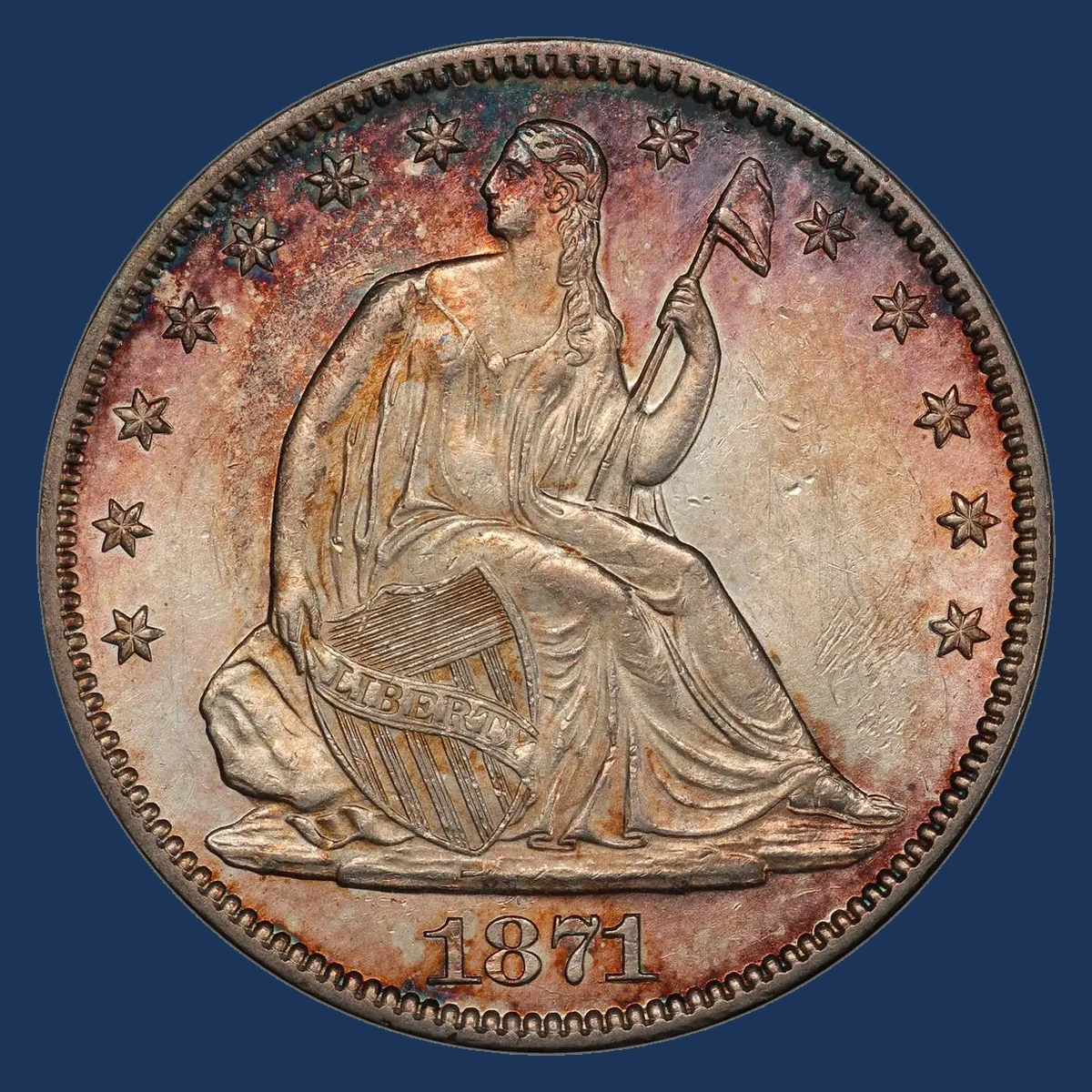
A small part of an extra 1 appears inside the rock beneath Liberty’s shield. It sits above the normal date rather than beside one of its digits.
Stack’s Bowers described the base of that misplaced numeral on an 1871 example called WB-102. The catalog name identifies this particular variety.
The stray mark came from a date punch applied outside its intended position. That differs from a repunched date, where the earlier and later impressions overlap in the usual date area.
Only the surviving base may be visible. A complete extra 1 does not need to stand clear of the rock.
Estimated Value
An estimated $250–$2,500 covers worn through lower-grade unworn examples. A PCGS MS62+ appeared in Stack’s Bowers’ March 2020 sale, providing a graded comparison.
A different-year misplaced-date coin, an 1857-O graded NGC MS65, sold for $5,280 in May 2025. Its higher grade shows stronger preservation than the 1871 reference.
That sale supports collector interest in misplaced dates but is not an 1871 price. The estimate here stays below that much better-preserved comparison.
How to Identify
Find the point of Liberty’s shield. Move directly below it into the rock and use a 10× magnifier to search for the extra numeral base.
Compare its shape with the March 2020 auction example. Keep the normal date visible in a wider view to show how far apart the two impressions sit.
Natural rock lines can look like number fragments. A scratch or a long die crack should not be accepted just because it occupies the right area.
Use a scale and calipers against 12.44 g and about 30.6 mm, and check the edge grooves. Matching the stray base below the shield point gives the quickest reliable answer.
3. 1871 Liberty Seated Half Dollar Die Crack Error (Estimated Up to $3,500)
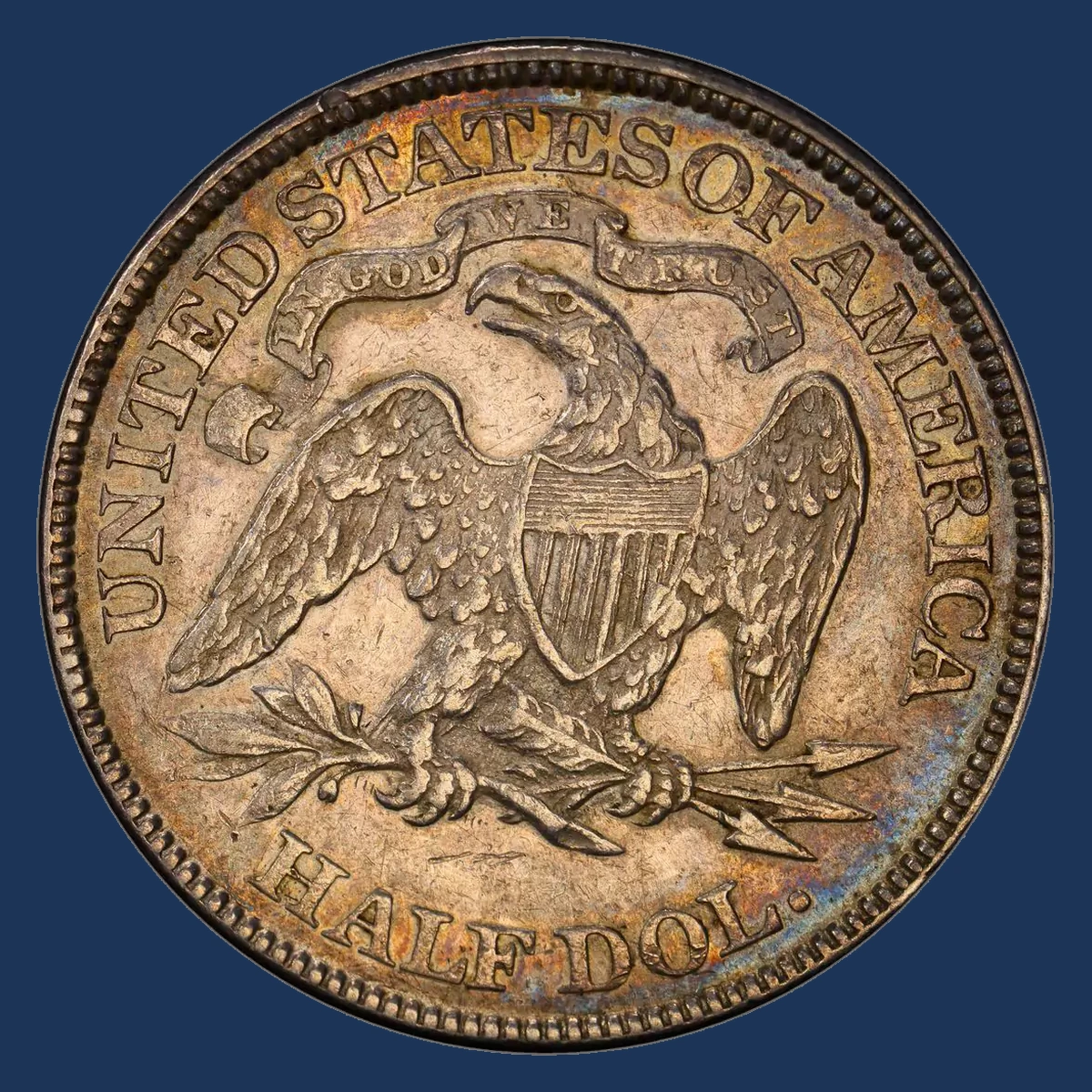
A raised line through MER in AMERICA appears on the 1871-CC variety. The steel die used to stamp that back had also been used for 1870 half dollars.
The old crack could appear again with a new date on the front. An 1870 photograph, however, cannot establish that a particular coin is dated 1871.
San Francisco has a separate reported path from AMERICA toward the right wing. The S and CC marks identify different mints, with different lines to compare.
Both are die cracks. Silver entered narrow openings in the tool during striking and formed raised ridges on the coins.
Estimated Value
An estimated $75–$3,500 spans worn San Francisco coins and scarcer Carson City examples. A cleaned PCGS VF35 Details 1871-CC WB-1 sold for $1,920 in March 2026.
That is a complete-coin price for the relevant variety, not a separate payment for one crack. The Details label flags its cleaning problem.
Undamaged surfaces can change the comparison substantially. The Carson City result should not be copied directly onto a coin with an S mintmark.
How to Identify
Identify the mint before following the line. For CC, inspect MER; for S, compare the reported path from AMERICA toward the right wing.
A 10× magnifier and side lighting should show a ridge above the surface. A scratch cuts into it, even when nearby displaced metal catches the light.
Compare connected paths rather than joining unrelated marks. The Carson City reference links its crack to the correct dated coin.
Check a scale against 12.44 g, calipers against about 30.6 mm, and the edge for normal grooves. A matching raised path on the correct mint and date gives the fastest identification.
4. 1871 Liberty Seated Half Dollar Clashed Dies Error (Estimated Up to $3,500)
Extra shapes appear in different places on the two mint examples. The Carson City report points to the lower-right shield on the back, while San Francisco’s points above Liberty’s knee on the front.
These traces can form when the dies collide without a blank between them. The dies are the steel tools that stamp the two faces.
The collision transfers marks between the tools, and later coins pick up traces of the opposite design. This is called a die clash.
Several faint outlines can come from repeated collisions. They do not prove that the individual coin was struck several times.
Estimated Value
Use an estimated $75–$3,500 for worn examples, with San Francisco generally more affordable than Carson City. The scarce CC date already adds value before the clash is considered.
The cleaned PCGS VF35 Details WB-1 sold for $1,920 in March 2026 provides the same comparison used for the crack. It is not a second sale.
Clash strength and surface quality still matter, but adding two full error estimates to that one coin would overstate its value.
How to Identify
Begin above Liberty’s knee on an S coin, or inside the shield’s lower-right area on a CC coin. Use a 10× magnifier to separate unfamiliar shapes from normal detail.
Compare those shapes with parts of the opposite design. Fine polishing lines and random scratches do not show that same relationship.
Move the light to reveal shallow traces without rubbing the surface. Keep each mint’s example separate instead of borrowing marks from the other.
A scale and calipers should be compared with 12.44 g and about 30.6 mm, and the edge should have grooves. An opposing-design shape at the documented location gives the quickest clash confirmation.
5. 1871 Liberty Seated Half Dollar Repunched Date Error (Up to $4,920)
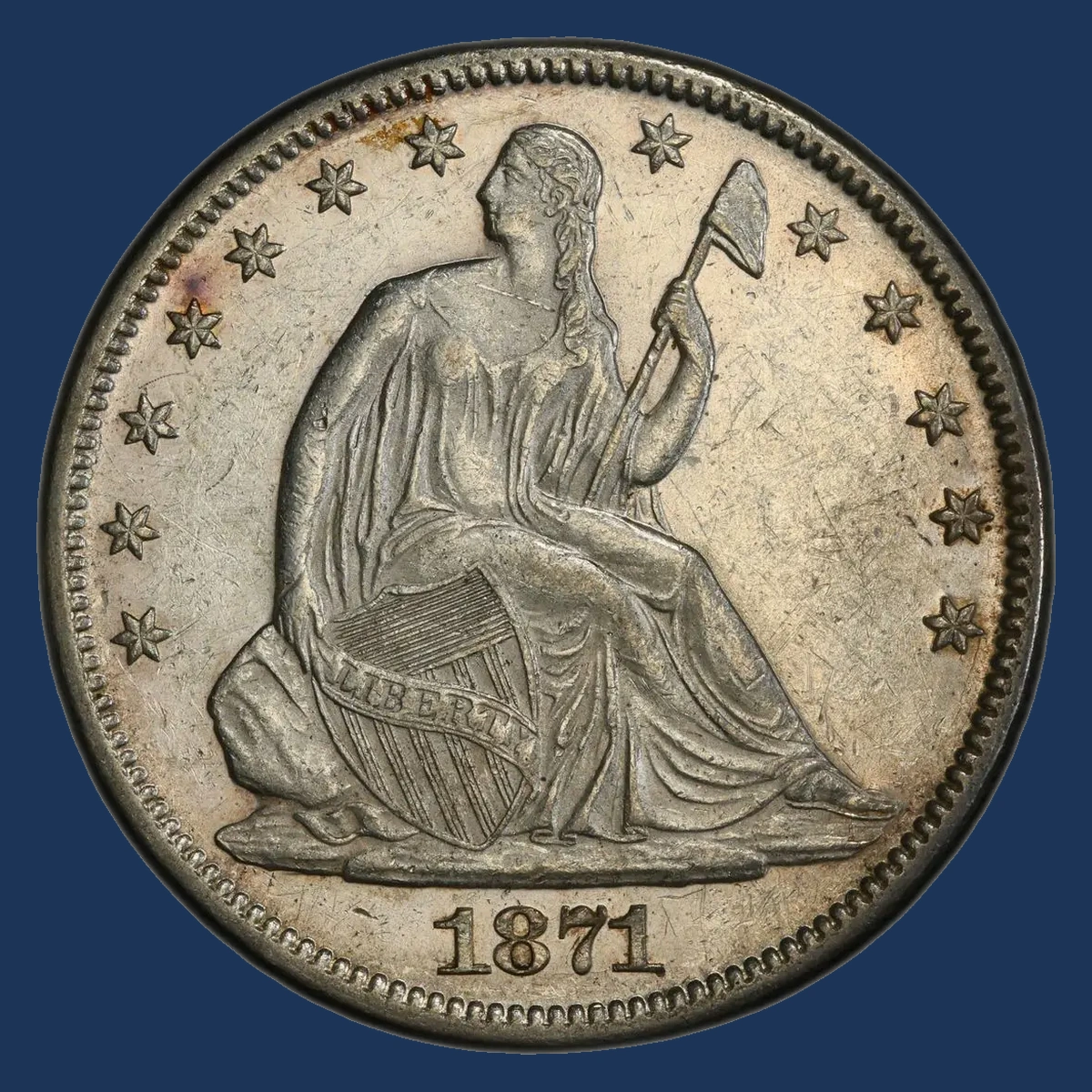
Extra strokes above the 7 and final 1 identify the Carson City repunched-date example. The first punch impression sat higher than the final digits.
Workers applied the date to the die, the steel stamping tool, more than once. Parts of the earlier position remained and later appeared on the coins.
The same front die could be paired with more than one back die. That does not change how the repeated date formed.
Philadelphia has a reported repunched date and needs its own comparison. A mirrorlike Carson City surface does not turn a regular circulation coin into a specially made proof.
Estimated Value
An 1871-CC WB-4 graded NGC VF35 sold for $3,600 in October 2025. An NGC AU53 WB-3 brought $4,920 in March 2023.
Those recorded sales support an estimated $150–$5,000 across worn Philadelphia and selected Carson City examples. VF35 and AU53 describe different levels of remaining detail and wear.
The low end is an estimate for Philadelphia coins. The cited sales are Carson City pieces, whose rarity contributes heavily to their prices.
How to Identify
Confirm the CC mintmark, then inspect above the 7 and final 1 with a 10× magnifier. Look for earlier digit strokes rather than general thickening.
A Philadelphia coin needs its own identified comparison. The Carson City positions should not be applied to it merely because both dates read 1871.
Check the surrounding metal for cuts, dents, or pushed-up edges. Mirrorlike shine alone does not prove a special proof finish.
Use a scale against 12.44 g and calipers against about 30.6 mm, allowing for wear, and inspect the edge grooves. For CC, matching the extra strokes above 71 gives the quickest confirmation.
6. 1871-S Liberty Seated Half Dollar Incomplete S Mintmark Error (Up to $7,200)
The top of the S below the eagle can be weak. On some examples, so little remains that the mintmark is difficult to recognize.
Collectors call this Incomplete S because the name describes the visible feature. It does not require an assumption that the original mintmark punch broke.
The coin remains a San Francisco issue even when much of the S has vanished. Ordinary wear or later removal can also weaken a mintmark, so the surrounding detail matters.
This variety is linked to doubled lines on the front shield. That separate feature needs its own close-up before it is accepted.
Estimated Value
A PCGS MS65 Incomplete S example sold for $7,200 in May 2025. MS65 is a high grade for a coin without circulation wear.
An estimated $100–$7,500 covers worn identified examples through coins of similar quality. The auction price also includes the doubled-front variety paired with that back.
A nearly missing S on a worn coin does not imply MS65 value. The result should not be counted again as a separate payment for the front doubling.
How to Identify
Compare the top and bottom of the S with a 10× magnifier. Keep nearby detail visible so the letter’s weakness can be judged against the rest of the surface.
Wear can reduce the letter, while deliberate removal may leave a hollow, scratches, or altered texture. Neither is proved to be the variety just because the S is hard to read.
If the mark has almost vanished, compare the complete designs rather than assuming Philadelphia. Check the edge grooves and use a scale and calipers against 12.44 g and about 30.6 mm.
A weak-top S matching the known variety, with undisturbed nearby detail, gives the quickest confirmation.
7. 1871-S Liberty Seated Half Dollar Doubled Die Obverse Error (Up to $7,200)
The vertical lines and outer border of Liberty’s front shield can show slight doubling. These repeated shapes identify the San Francisco front die paired with the Incomplete S back.
The die is the steel tool that stamps the coin. Its extra outlines repeat on coins made with that tool.
The feature is small. A sharp close-up helps more than a large but blurred image.
The weak mintmark on the back supports the overall match, but it cannot prove what happened to the front shield. Both faces need to agree with the identified variety before the coin receives the same description.
Estimated Value
PCGS records $7,200 for the MS65 WB-1 doubled-front Incomplete S sold in May 2025. It is the same coin cited in the mintmark section.
An estimated $150–$7,500 spans worn examples through similar high-grade coins without circulation wear. The amount values the complete coin with both features present.
It does not show how much the buyer paid for the doubled shield alone. Condition still explains much of the price difference.
How to Identify
Focus on the vertical shield lines and outer border with a 10× magnifier. Adjust the lamp so raised detail stands out without glare.
Compare the extra outlines with the San Francisco reference. Their positions should match, rather than simply look thicker than normal.
Flat ledges, scratches, and wear can create misleading edges. Check the Incomplete S afterward as supporting evidence on the back of the same coin.
Inspect the edge grooves and compare measurements with 12.44 g and about 30.6 mm using a scale and calipers. Matching doubled shield lines together with the correct Incomplete S back gives the fastest complete identification.
Conclusion
A weak mintmark, a repeated shield line, and a stray number in the rock need different checks. Some share the same coin, but finding one does not prove all the others.
Estimated values run from $75 to $7,500 across the mintmarks and conditions discussed. Match the actual feature first, then compare the complete coin’s wear and surfaces before adding value for a small mark.