1877 Half Dollar Error List with Pictures

An 1877/6 half dollar sold for $22,325 in April 2021. Its unusual final 7 identifies a recognized variety, although specialists disagree about whether the extra shape really came from an old 6.
Other 1877 half dollar errors involve tiny bumps, repeated letters, and oddly formed edges. Values here begin with estimates near $75 and extend to that $22,325 exceptional sale.
Follow the ten types below to compare the feature you can actually see.
1. 1877-S Half Dollar Reported Die Chips (Estimated Up to $350)
A small bump can form when a piece breaks from the stamping tool. The die, the steel tool that stamps coins, then has a hole where the piece used to be.
Metal fills that hole during striking and leaves extra raised detail on the coin. The bump may cover part of a fine design.
Reports for 1877-S place small chips around the shield, gown folds, or eagle’s neck. These are local features rather than large breaks reaching the rim.
Inspect the individual lump. Its shape and surface must distinguish a genuine struck bump from later damage or attached material.
Estimated Value
An estimated $75–$350 covers worn 1877-S coins with small genuine chips. Much of that value comes from the condition of the half dollar itself.
An ordinary XF45 example sold for $216 in December 2025. XF45 means worn with strong detail remaining.
That sale does not identify a chip on the auction coin. A clearly visible bump may add modest interest, but no specific transaction is assigned here to the reported chip examples.
How to Identify
Find the reported area under a 10× magnifier and inspect how the lump meets the design. It should grow from the struck surface, rather than sit on top with an attachment seam.
Change the light and inspect the opposite face too. An impact can push metal upward, while corrosion or residue may imitate a bump.
Keep the complete date and S mint letter in your photographs. A rough patch without a clear connection to the design is not enough.
Use a scale and calipers when safely accessible against 12.50 grams and about 30.6 mm. Inspect the edge grooves for alteration.
The useful first check is a raised fill with the same continuous surface as the nearby struck metal.
2. 1877-S Half Dollar Reported Die Gouge (Estimated Up to $400)
An extra curve in Liberty’s lower gown folds is the reported 1877-S feature. It is described as damage to the stamping tool rather than a cut into the coin.
A gouge removes steel from that tool. When silver fills the channel during striking, the finished coin receives a raised line.
The result has the opposite shape from an ordinary scratch made after minting. That later scratch cuts into the silver.
Compare the gown with a normal example first. The intended folds already contain curved lines, so a familiar design edge should not be mistaken for this added feature.
Estimated Value
Estimate $100–$400 for worn examples with a clear line made by tool damage. This is an estimate, not a sale range recorded for the particular curve.
An ordinary 1877-S XF45 sold for $216 in December 2025. It provides a middle-condition comparison for the underlying coin.
More wear or cleaning can reduce the value. A distinct raised curve and attractive surfaces may bring more, but a small gouge usually remains a specialist feature rather than a major error.
How to Identify
Place a normal 1877-S photograph beside the suspected example at the same size. Compare Liberty’s lower gown folds before deciding that a separate curve exists.
With a 10× magnifier, light the line from opposite sides. Tool damage should produce raised detail without a cut down the middle.
A scratch can push up a narrow lip, while residue can sit on top of the design. Check those possibilities before identifying the reported curve.
Confirm the date and S, then inspect the edge grooves. A scale and calipers help check safely accessible coins against 12.50 grams and 30.6 mm.
The extra curve should remain a distinct raised line separate from the gown’s normal folds under changing light.
3. 1877 Half Dollar Rotated Dies (Estimated Up to $750)
A rotated-die coin can have two complete, centered pictures that point in the wrong directions relative to each other. The difference appears when you turn it over.
Hold Liberty upright and flip the coin top to bottom. On normal United States coin alignment, the back should finish upright too.
A year report describes an 1877 example graded F12 with rotated tools. That means a heavily worn coin with recognizable design.
The report gives neither its mint nor a measured angle. Separately straightened photographs cannot supply that angle because they no longer preserve the relationship between the actual faces.
Estimated Value
A genuine worn 1877 half with obvious rotation has an estimated $150–$750 range. The reported F12 grade alone cannot place it precisely because the mint and angle also matter.
An ordinary 1877-CC F15 sold for $264 in April 2025. An 1877-S XF45 brought $216 that December.
Those different-mint sales offer underlying coin comparisons. Neither provides a transaction price or mint identity for the reported rotated example, whose angle still needs measurement.
How to Identify
Hold Liberty upright in a stable position and flip the coin top to bottom without twisting. Keep the camera fixed while photographing before and after.
Use an angle guide to measure the back’s departure from upright. Repeat the flip to rule out movement caused by your hands or the holder.
Inspect the edge grooves with a 10× magnifier. A seam could reveal that unrelated faces were joined together.
Use a scale and calipers when safely accessible against the original 12.50 grams and roughly 30.6 mm. Record the actual mint letter rather than guessing from the date-only report.
The same back angle should appear after repeated controlled flips; a tilt that changes between attempts is not reliable evidence.
4. 1877-CC Half Dollar Die Cracks (Estimated Up to $900)
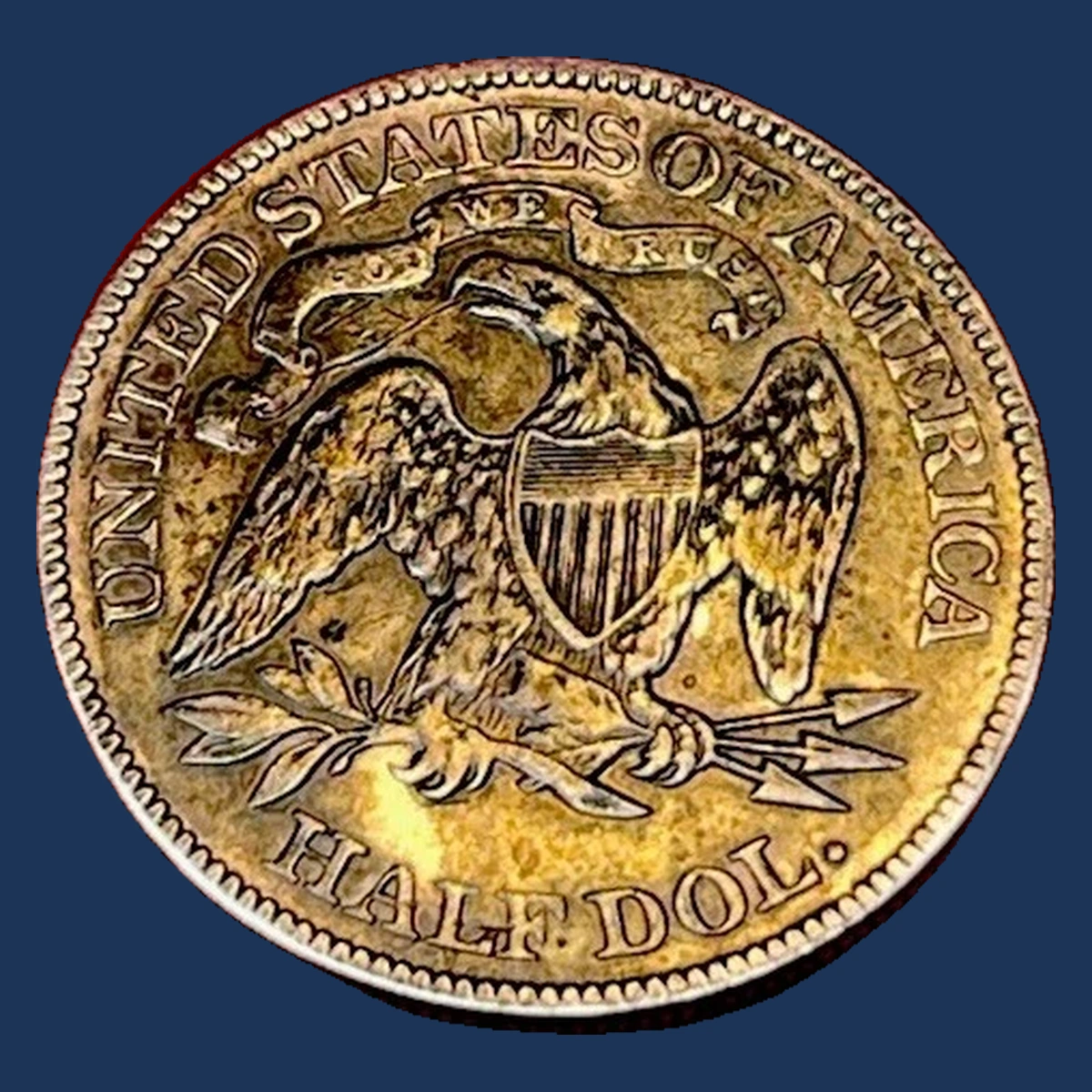
HALF and the surrounding back lettering provide useful landmarks for cracks on Carson City halves. Some documented lines continue toward olive leaves and arrowheads.
The coin itself has not split along those paths. Its stamping tool cracked, and silver entered the narrow openings during striking.
The resulting ridges can cross both letters and flat areas. A strong line may remain visible after finer design details wear down.
Different 1877-CC coins need not show every reported route. The tool’s damage developed over time, so compare the actual path on your example instead of expecting one complete network everywhere.
Estimated Value
Estimated whole-coin values of $250–$900 cover worn Carson City halves with clear modest cracks. A visible network can add interest, but a thin line alone is not a major-error premium.
Ordinary examples sold for $264 in F15 and $552 in XF45 in April 2025. Both grades describe wear, with XF45 retaining more detail.
Those sales compare condition. They do not measure a separate dollar amount added by cracks.
How to Identify
Begin at HALF under a 10× magnifier. Follow a visible ridge into the surrounding lettering and note any connection toward leaves or arrows.
Tilt the coin to distinguish raised metal from a dark color streak. The line should remain physically present as the light moves.
Find CC below the eagle and compare the rest of the coin with the matching reference. Different examples may have different surviving routes.
Use a scale and calipers when safely accessible against the original 12.50 grams and about 30.6 mm. Inspect the edge grooves and both ends of the line for damage.
A continuous raised path crossing a letter and nearby flat surface is more useful than a scratch with a bright raised lip.
5. 1877-CC Half Dollar Die Clash (Estimated Up to $1,500)
Pieces of a front date can appear unexpectedly on the back. Carson City research describes clash traces that include the tops of 87.
They formed when two stamping tools hit each other without a blank between them. The back tool picked up parts of the opposing picture and later passed them to coins.
One cataloged repunched-date example also has this clashed back. That back tool retained marks from an earlier pairing with a different front tool.
The coin was not necessarily struck twice. Its normal current date can coexist with traces transferred during an earlier event in the tool’s life.
Estimated Value
Estimate $300–$1,500 for worn through lower-grade unworn examples. A cataloged MS62 coin with both a repunched date and clashed back had a $920 auction appearance in February 2005.
MS62 means unworn with noticeable marks. That historical result prices the whole coin with both features.
The ordinary 1877-CC XF45 sale at $552 in April 2025 offers a worn comparison. Neither price isolates the amount added by the clash, and the two features should not be priced twice.
How to Identify
Look across the flat areas on the back for shapes related to the front design. A 10× magnifier and correctly oriented photograph help compare the tops of 87.
An isolated scratch is weaker evidence than a recognizable numeral fragment. The transferred outline should explain both the shape and its position.
The cataloged back had served with an earlier front tool. Identify its clash marks separately from the repunching in the date now on the coin.
Inspect the edge grooves and check safely accessible examples with a scale and calipers against 12.50 grams and about 30.6 mm. Preserve the date and CC in photographs.
Recognizable pieces of the opposite picture, especially the documented date tops, provide the useful match.
6. 1877 Half Dollar Repunched Mintmarks (Estimated Up to $2,000)
An extra piece of a mint letter may survive when its punch entered the tool more than once. The finished coin then shows remnants of both placements.
Specialist research compares genuine 1877-S/S detail with flat doubling caused during striking. The two can look similar in a small photograph.
An owner’s registry record separately reports repunching on a Medium CC example. That is another mint and another tool, not the same pattern enlarged.
Neither mint-letter size nor general thickness proves repunching. A direction observed beside S cannot supply a missing direction for the reported CC example.
Estimated Value
Recognizable worn San Francisco examples have an estimated $150–$800 range. Comparable Carson City pieces extend around $300–$2,000 through lower-grade unworn condition.
Ordinary XF45 sales illustrate part of the difference: $216 for an 1877-S and $552 for an 1877-CC. The coins share a grade but not a mint.
Those are not repunched-mintmark sales. Clear earlier letter fragments may add specialist interest, while the coin’s condition and underlying mint value remain part of the total.
How to Identify
Find the mint letters below the eagle, then enlarge them with a 10× magnifier. Decide whether you are comparing S or CC before looking for extra strokes.
The specialist S/S comparison shows why a rounded letter remnant differs from a low, flat shelf. Change the light to inspect that difference.
For CC, use its own example rather than copying a direction from S. Check nearby metal for scratches or signs that the mintmark was altered.
Inspect the edge grooves and measure safely accessible coins with a scale and calipers against 12.50 grams and 30.6 mm.
A separately shaped piece of the earlier letter is the useful clue, rather than an evenly thick or flattened edge.
7. 1877-CC Half Dollar Repunched Date (Estimated Up to $2,500)
Both 7s hold small clues at their bases on this Carson City variety. Pieces of earlier numeral impressions remain beside the final date.
The study describes the repunching as toward the northeast, or upper right. The date was entered into the stamping tool in more than one position.
A cataloged MS62 example also has a clashed back, Medium CC mintmark, and Closed Bud design. The latter name describes a plant bud’s form.
The clash records another event in the tool’s history. The repeated date pieces came from preparing the front tool, so the two features need separate checks.
Estimated Value
Estimated values of $350–$2,500 span recognizable worn examples through selected lower-grade unworn coins. A cataloged MS62 had sold for $920 in February 2005 before a later April 2019 auction appearance.
That old result concerns a repunched-date coin that also has a clashed back. It is one whole-coin price.
The ordinary CC XF45 comparison at $552 provides a more recent worn benchmark. Sharper unworn coins belong in a different tier from examples with faint date remnants.
How to Identify
Inspect the base of each 7 with a 10× magnifier. Look for pieces shaped like earlier numerals, rather than unrelated lines beside the digits.
Keep the whole date in view while comparing its position with the documented example. The Medium CC and closed plant bud on the back provide additional matching details.
Flat doubling from movement during striking can shave a digit’s edge. Repunching should leave the expected extra pieces in the recorded locations.
Check around the numerals for added cuts and inspect the edge grooves. Use a scale and calipers when safely accessible against 12.50 grams before wear and approximately 30.6 mm.
Matching extra numeral pieces at both 7 bases make a stronger identification than one suspicious stroke alone.
8. 1877-S Half Dollar Tilted Partial Collar (Estimated Up to $3,500)
The edge can show that a blank sat tilted when struck. Part stayed inside the retaining ring, while the exposed section spread beyond it.
That uneven contact leaves a sloping boundary around the edge. The grooves and height can change as you follow it.
A documented 1877-S example was graded MS63 and appeared at GreatCollections in March 2016. MS63 describes unworn condition with visible marks.
This is called a tilted partial-collar strike. The auction example identifies one real coin, but its grade and appearance should not be assigned automatically to every 1877 half with an unusual edge.
Estimated Value
Estimate $750–$3,500 for genuine examples in attractive worn through lower-grade unworn condition. The MS63 auction listing confirms a March 2016 sale but does not display its result.
A recent dealer asked $995 for an ordinary 1877-S graded MS62. That offer compares the underlying unworn coin, not the striking error.
The higher estimate allows for a clear unusual edge. It is not an invented transaction price for the photographed auction example.
How to Identify
An edge view is essential here. Rotate the coin slowly under a 10× magnifier and follow the changing height where the retaining ring touched it.
Compare the grooved section with metal that spread beyond the ring. The transition should slope around the coin rather than stay level everywhere.
Use calipers in several directions when safely accessible. Compare with the normal 30.6 mm without expecting every span to match on a deformed coin.
A scale should remain reasonably close to the original 12.50 grams, allowing for wear. Check for filing, an attached band, or later bending.
The sloping boundary should agree with the changing edge grooves and natural metal flow, giving one consistent explanation for the tilted strike.
9. 1877 Half Dollar Reported Off-Center Strike (Estimated Up to $10,000)
A historical advertisement offered an 1877 half described as about ten percent off center. The dealer called it MS63 and linked it to the Abe Kosoff estate.
The description gives no mint or grading-service certification. Its condition label therefore remains the advertiser’s description.
An off-center strike happens when the blank sits out of position under the tools. Some metal stays bare while part of the intended picture misses the opposite edge.
The surviving date and matching shift on both faces help identify the error. A single wide border does not establish the same mechanism.
Estimated Value
A genuine, well-preserved example with roughly ten-percent displacement has an estimated $3,000–$10,000 range. The 1989 advertisement asked $2,900; that was not a recorded sale.
A January 2025 specialist guide places different-series Barber halves ten to fifteen percent off center around $4,000 in worn to slightly worn condition. That is another comparison, not an 1877 result.
The reported coin’s mint and modern certified grade remain unassigned. Both would matter when judging a particular example.
How to Identify
Confirm the surviving date and half-dollar design before estimating the shift. Under a 10× magnifier, inspect the bare crescent and the missing picture at the opposite edge.
Both faces should fit the same displacement. An uneven border alone may have another cause.
Use calipers and a scale when safely accessible against 30.6 mm and the original 12.50 grams. Off-center striking moves metal rather than cutting it away, so a large weight loss needs explanation.
Inspect the remaining edge grooves for filing, clipping, or later pressure. Record any visible mint letter instead of assuming Philadelphia.
A genuine unstruck crescent paired with corresponding design loss on both faces provides the essential off-center check.
10. 1877/6 Half Dollar FS-301 Variety (Up to $22,325)
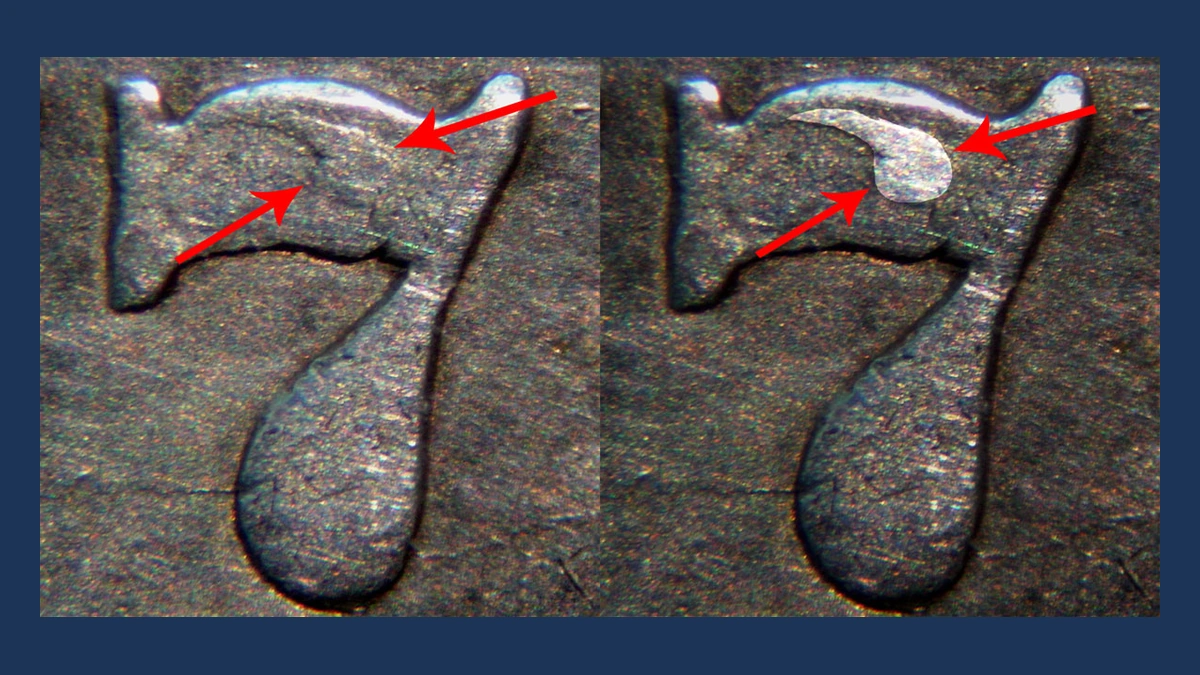
The top of the last 7 carries the unusual feature on this Philadelphia variety. Its traditional interpretation as part of an old 6 produced the familiar 1877/6 name.
PCGS recognizes the variety as FS-301. That name identifies coins with the matching date feature.
Specialists Wiley and Bugert questioned the overdate explanation because the old and new digit shapes do not fit neatly together. The coin remains collectible even while its origin is debated.
Identification therefore starts with the visible final-7 shape. Recognizing the variety does not require pretending that every part of its manufacturing history is settled.
Estimated Value
Recorded 2025 prices include $1,020 for XF40 and $2,280 for AU50, suggesting $1,000–$3,000 for worn through slightly worn examples. An unworn MS64 reached $12,600 that year.
Legend’s catalog history records $22,325 in April 2021 for an MS64+ with CAC quality approval. Its high condition and recognized identity support a different price tier.
These sales show demand for FS-301. The debate over how the feature formed does not remove its established market.
How to Identify
Focus a 10× magnifier on the top of the final 7. Compare its precise raised shape with a verified FS-301 photograph.
A worn or damaged 7 may look curved without matching the variety. Examine nearby metal for added cuts intended to imitate the feature.
The Philadelphia back has no mint letter. The rest of the date and matching tool details should support the comparison; Carson City repunching at the 7 bases is different.
Inspect the edge grooves and check safely accessible coins with a scale and calipers against 12.50 grams and about 30.6 mm.
The useful match is the cataloged upper feature on the final 7, rather than an imagined complete old numeral beneath it.
Conclusion
Prices begin with estimates near $75 for modest reported features and reach the exceptional $22,325 FS-301 sale. The grade, mint, and clarity of the unusual detail explain much of that spread.
Use an edge view for tilted strikes and a controlled flip for rotation. For the traditional 1877/6, match the final 7 while keeping its debated origin separate from the recognized variety and its recorded sales.