1946 Half Dollar Error List with Pictures

Extra outlines in an eagle’s feathers helped a 1946 half dollar sell for $9,400 in 2017. The mistake began on the steel tool that stamped its back.
This 1946 Walking Liberty half dollar error list covers estimated values from $50 to $12,000. Read on to compare doubled designs, missing metal, and shifted strikes.
Start by checking the design: a 1946 Booker T. Washington commemorative half dollar is a different coin.
1. 1946 Walking Liberty Half Dollar Rotated Dies Error (Estimated Up to $500)
The eagle should stand upright after you hold Liberty upright and flip the coin from top to bottom. A repeated lean can indicate a rotated die error.
Dies are the steel tools that stamp the two sides. If one turns out of its intended position, the pictures no longer line up correctly.
The designs can still remain centered. This mistake changes their angle, not necessarily their position on the metal.
A measured 1946 example has not been established here. A tilted photograph alone cannot prove that the coin has this error.
Estimated Value
A confirmed, clearly visible rotation has an estimated value of $50–$500 on a worn or ordinary unworn coin. A slight tilt may add very little to normal value.
A 1941 Walking Liberty half described as lightly worn brought a $70 winning bid at Musick Auction in May 2026. The auctioneer described its rotation and condition; it was not in a grading-service holder.
That comparison is a different year and prices the entire coin.
How to Identify
Place a straight vertical line behind the coin as a guide. Hold Liberty upright, then flip the coin top to bottom without twisting it sideways.
Repeat the movement several times. The eagle must land at the same wrong angle each time before the tilt means anything.
Use a magnifier to inspect both pictures and the grooves around the edge. An edge seam can suggest two coin halves joined into a novelty.
Weigh a loose coin with a scale and measure it with calipers. Normal figures are about 12.50 g and 30.6 mm.
Watch the eagle on the first few flips: the same repeated lean matters, not a slanted holder or photograph.
2. 1946 Walking Liberty Half Dollar Clipped Planchet Error (Estimated Up to $500)
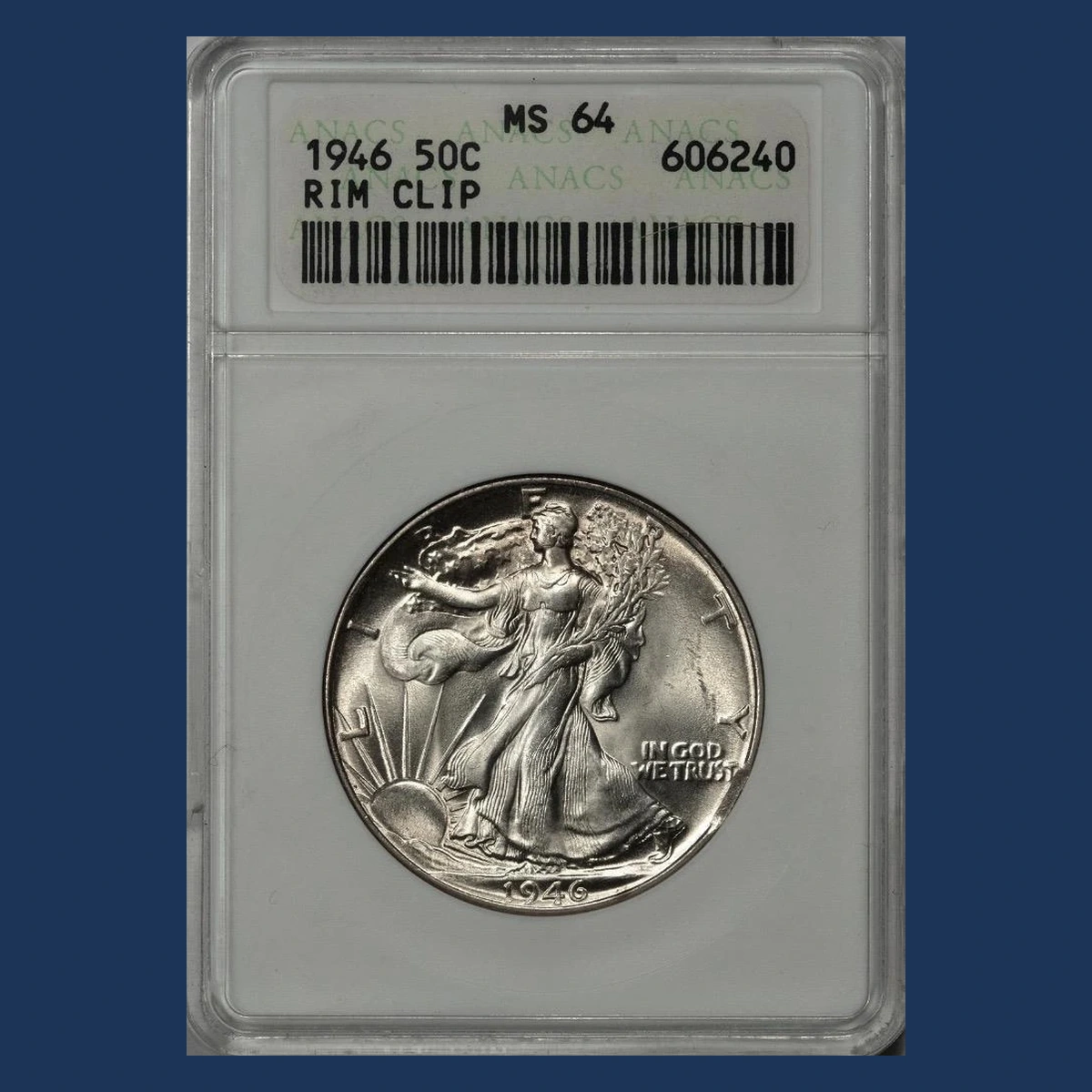
The reported 1946 clip is easy to miss because only a small part of the edge is absent. Mint Error News identifies an example graded ANACS MS64, meaning unworn with some marks.
The error starts with the blank, the round metal disc used to make a coin. A cutting punch can overlap an earlier hole or the edge of the metal strip.
That leaves an incomplete disc. When the design is stamped onto it, metal spreads around the existing gap.
A similar-looking notch cut into a finished coin has a different cause.
Estimated Value
Small confirmed clips have an estimated range of $75–$500, from worn examples to attractive unworn coins. The reported 1946 MS64 grade does not come with a confirmed sale price here.
A 1942-S example graded ANACS MS62 sold for $81.90 including the buyer’s fee in May 2025. That provides a nearby-year comparison for a modest clip.
Better condition or a more noticeable missing piece can raise the value beyond that individual result.
How to Identify
Turn the coin slowly while watching its edge through a magnifier. A small gap may be clearer from the side than from a straight-on view.
Look at how the rim approaches both ends of the opening. Then check the opposite rim for weakness, although a tiny clip may show very little.
A scale may detect missing weight compared with the usual 12.50 g. Measure across an intact part with calipers; it should remain close to 30.6 mm.
Inspect the edge grooves beside the opening for file scratches or sharp metal burrs. Those can indicate later damage.
Original lettering or rim detail fading into the gap gives the fastest helpful clue that it existed before striking.
3. 1946 Walking Liberty Half Dollar Obverse Lamination Error (Estimated Up to $600)
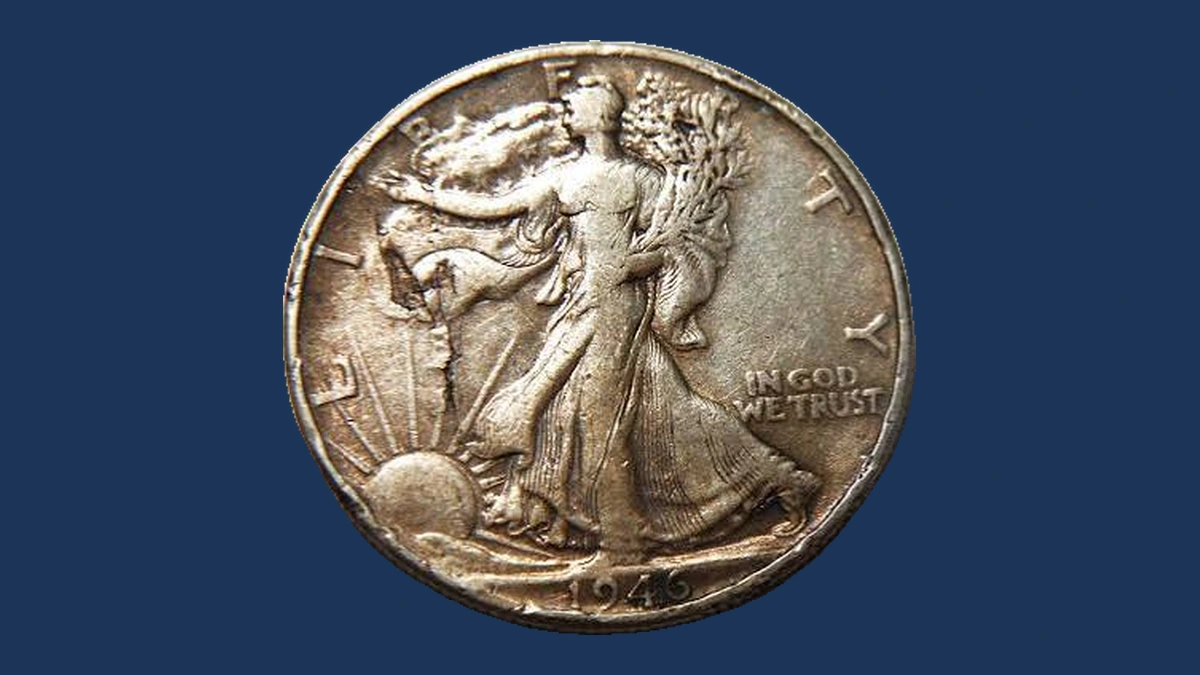
A thin layer has separated from the front of this 1946 half dollar. The defect is called a lamination: metal peels or splits along a weak layer inside the coin.
Sullivan Numismatics lists a Philadelphia example graded PCGS F12. That grade describes a well-worn coin, showing that this mistake can remain visible after years of use.
The split may leave a seam, a flap, or a shallow area of exposed metal. A loose layer should be left alone.
This is a surface-layer defect, not evidence that the entire coin split into two discs.
Estimated Value
Sullivan’s PCGS F12 example has a $100 asking price. That is a dealer’s offer, not a completed auction result.
An estimated $100–$600 covers similar worn through ordinary unworn coins. A larger peel that stays in place can be more appealing than a faint seam.
The condition of the rest of the coin still matters. Heavy scratches or other unrelated damage can lower what a buyer will pay.
How to Identify
A retained flap can leave the weight nearly normal, so weighing alone will not settle this error. Use a scale and calipers to check roughly 12.50 g and 30.6 mm.
Next, shine light across the affected area and examine its boundary with a magnifier. Look for a thin layer lifting from the surrounding surface.
Do not press or pull the flap. Removing it can destroy useful evidence and change the coin’s appearance.
Follow any seam toward the edge and check whether it continues through the grooves. A scratch usually cuts a narrow groove instead of exposing a layered boundary.
Look first for a thin metal layer visibly lifting from the struck surface; that immediately separates peeling from a simple scratch.
4. 1946 Walking Liberty Half Dollar Die Crack or Break Error (Estimated Up to $1,000)
A raised line may look like a scratch until light reveals that it stands above the coin. It can form when metal fills a crack in the steel stamping tool.
A larger break in that tool can leave a broad raised patch with normal design details missing. A patch touching the rim is especially useful to examine.
These marks belong to the coin’s original strike, unlike dents made afterward. Small cracks and large breaks can therefore look very different.
No specific crack path on a confirmed 1946 example is established here.
Estimated Value
The estimated range is $50–$1,000 for confirmed examples, from small raised lines to large breaks connected to the rim. Most minor cracks fall near the lower end.
A 1976-D Kennedy half with a back die break sold for $256 at Heritage in June 2026. NGC graded it MS65, an attractive unworn coin.
That comparison uses a later, copper-nickel coin. A 1946 silver half needs its own condition and break size considered.
How to Identify
Move the light from one side of the mark to the other. With a magnifier, determine whether the mark rises above the surface or cuts into it.
Follow a raised line until it ends. On a larger patch, check whether missing design details fit the same raised area.
A dent can push metal upward too. If the mark touches the rim, inspect the edge grooves for a crushed spot beside it.
Check normal weight and diameter with a scale and calipers: about 12.50 g and 30.6 mm. These measurements cannot prove the crack by themselves.
For a quick distinction from a scratch, look for an uninterrupted raised ridge rather than a cut groove.
5. 1946 Walking Liberty Half Dollar Repunched S Mintmark (Estimated Up to $1,500)
A second outline beside the S can reveal an earlier mintmark placement. Workers once punched this letter by hand into the steel tool used to stamp the back.
If the punch landed again at a slightly different spot, part of the first letter could remain. Coins made with that tool then carried the extra outline.
A 1946-S/S example appears in a GreatCollections listing with a PCGS MS66 grade and a separate VSS RPM-001 variety identification.
The S sits at the lower left of the back. A thick letter alone does not establish the mistake.
Estimated Value
Estimate $75–$1,500 for worn through attractive unworn 1946-S/S examples with a matching extra outline. The listed MS66 coin is well preserved, but no public sale amount is provided here.
A 1939-D/D graded PCGS MS64+ brought $1,292.50 in September 2017. It offers a historical comparison for a mintmark punched more than once.
That coin has a different letter and year. Its price cannot be treated as a recorded 1946-S sale.
How to Identify
Compare an ordinary 1946-S with the listed S/S example before looking at your coin. Notice how the extra outline changes the letter’s shape.
Use a magnifier to study the lower-left mintmark on the back. A flat shelf beside it can come from movement during striking, while a dent may bend the outline.
Keep those effects separate from a second rounded letter shape. PCGS’s condition grade and VSS’s variety name are also separate descriptions of the listed coin.
Inspect the edge grooves, then check about 12.50 g on a scale and 30.6 mm with calipers.
Start with the extra S outline itself and its direction, which tell you more immediately than the letter’s overall thickness.
6. 1946 Walking Liberty Half Dollar Doubled Die Obverse (Estimated Up to $3,000)
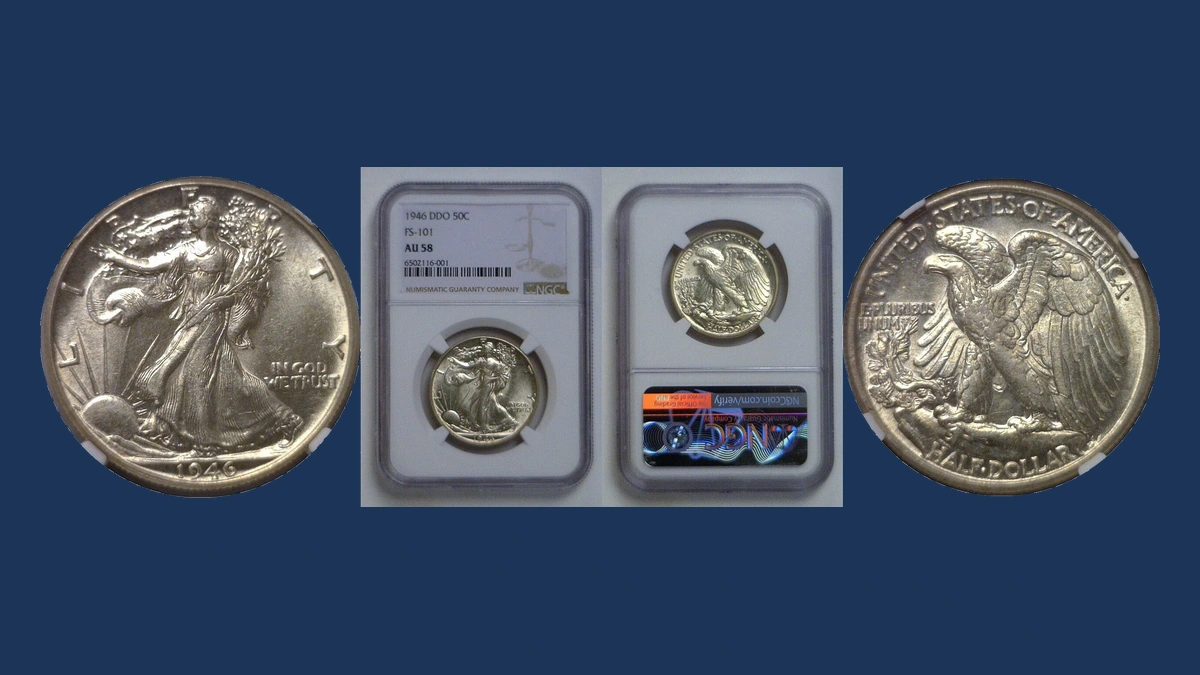
Liberty’s figure is the place to look for this doubled-front variety. Extra outlines appear around her chest, left arm, and nearby flag or clothing folds.
PCGS recognizes this Philadelphia variety as FS-101. The doubled details began when the design was transferred onto the steel stamping tool.
Coins struck with that tool received those same extra lines. The marks were not scratches added after the coins left the Mint.
The normal design already contains many close, parallel folds. Finding two nearby lines is only a starting point; their positions must match the known variety.
Estimated Value
A 1946 FS-101 graded PCGS MS66 sold for $2,585 at Legend in January 2020. MS66 describes a well-preserved unworn coin with few distracting marks.
The estimated range is $75–$3,000, covering worn examples through attractive high-grade coins. A correct match to the doubled pattern is essential before applying those figures.
Wear can hide the extra lines, while better surfaces make them easier to see. A doubled-looking fold alone does not justify the upper estimate.
How to Identify
Align Liberty’s torso with a photograph of a confirmed FS-101 example. Compare it with a normal Philadelphia coin too, because ordinary clothing folds can resemble extra lines.
Under a magnifier, follow the chest, left arm, and neighboring cloth. Keep the coin still and move the light to separate a real outline from a reflection.
Flat shelves or rubbed areas can change the design’s shape without matching this variety. Check the grooves around the edge for other alteration.
A scale should read near 12.50 g, and calipers should show about 30.6 mm. These are ordinary half-dollar measurements.
Matching extra contours around Liberty’s figure is the fastest check; the date is not the main search area.
7. 1946 Walking Liberty Half Dollar Broadstrike Error (Estimated Up to $7,000)
A broadstrike can have a wide, open border around an otherwise complete design. The metal spread outward because the ring that normally limits the coin’s width did not hold it.
That ring is called a collar. Without its restraint, the stamping tools can flatten the metal into a wider shape.
The full design should remain present. A shifted strike that cuts off part of the design belongs to a different category.
No named, certified 1946 example is established here. A coin hammered wider after minting can resemble this error but has crushed original details.
Estimated Value
Mint Error News’ July 2025 guide gives Walking Liberty broadstrikes values of $3,000–$7,000. The lower figure covers a small spread on a worn coin; the upper covers a large unworn example.
Use $3,000–$7,000 as the comparison-based estimate for a similar genuine 1946 error. Those guide figures are not completed 1946 sales.
The amount of spreading, remaining sharpness, and later damage affect where a coin belongs within the range.
How to Identify
Measure the coin across several directions with calipers. A broadstrike should be wider than the usual 30.6 mm, but its outline may not be evenly round.
Now use a scale. Spreading alone removes no metal, so the weight should stay near 12.50 g.
Examine the design with a magnifier for signs of flattening after minting. A genuine broadstrike forms its details as the metal spreads, rather than crushing an existing picture.
Check the edge where the normal grooves would be. A step around part of it may mean the retaining ring only partly caught the coin.
Check first for a complete, originally struck design inside the expanded border; that is the key starting point for a broadstrike.
8. 1946 Walking Liberty Half Dollar Doubled Die Reverse (Estimated Up to $9,500)
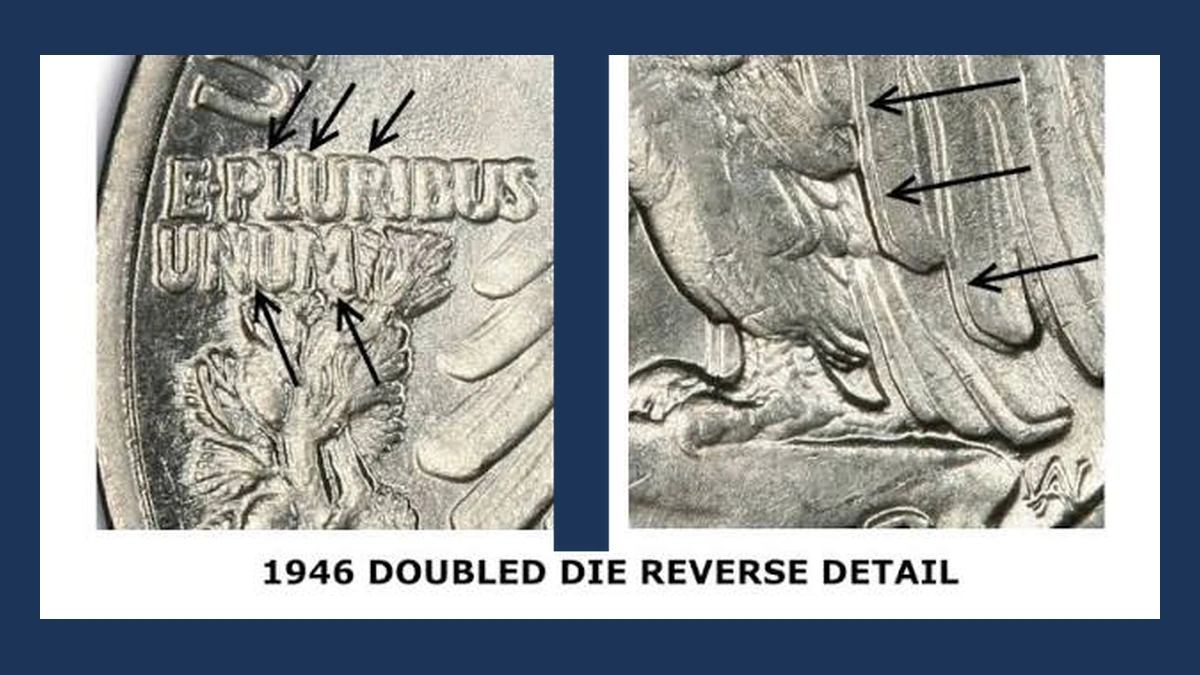
Extra edges in the eagle’s feathers make the Philadelphia doubled-back variety stand out. The motto E PLURIBUS UNUM and the branch at the left provide other places to compare.
The repeated details come from the steel stamping tool, so the same pattern appears on other coins it made. The recognized Philadelphia variety is known as FS-801.
A collector also reports doubling on a separate 1946-S coin. That report does not make the San Francisco coin the same variety.
Check the mintmark before comparing pictures, and keep the two patterns separate.
Estimated Value
The established Philadelphia variety has an estimated range of $75–$9,500. Worn examples cost much less than unusually clean unworn coins.
An NGC MS65 example sold for $2,040 at Heritage in November 2024. A PCGS MS66+ brought $9,400 in 2017; both grades describe unworn coins, with the higher grade allowing fewer marks.
Those prices belong to the Philadelphia variety. They do not set a value for the separately reported San Francisco coin.
How to Identify
Find the mintmark area first. An S identifies San Francisco and rules out a direct match to the Philadelphia variety discussed here.
For Philadelphia, use the PCGS photographs and explanation with a 5× or 10× magnifier. Compare the motto, wing feathers, and branch on the left.
Look for matching rounded extra edges in several places. Bright reflections or a flat shelf beside one letter can be misleading.
A loose coin should weigh about 12.50 g on a scale and measure 30.6 mm with calipers. Inspect its edge grooves for damage as well.
The fastest strong check is the correct mint combined with matching doubled feather and motto details.
9. 1946 Walking Liberty Half Dollar Off-Center Strike Error (Estimated Up to $12,000)
A crescent of plain metal beside a partly missing design can show an off-center strike. The disc was not properly positioned when the stamping tools came down.
The shift affects the picture as a whole. It is more than a slightly uneven rim.
For a year-specific identification, the date must survive clearly enough to read. An undated Walking Liberty half cannot be assigned to 1946 just because its design looks right.
No clearly dated 1946 example is established here. The category remains useful when checking a coin with a visible shifted strike.
Estimated Value
The estimated range is $100–$12,000, from modest shifts on worn coins to striking examples in excellent unworn condition. A readable date and untouched surfaces add appeal.
A 1918 half struck ten percent off center sold for $10,575 at Heritage in April 2013. PCGS graded it MS65, an attractive unworn coin.
That historical sale supports the scale of the upper estimate. It is a different year, not evidence of a 1946 transaction.
How to Identify
Read the date before judging how far the design shifted. If the mintmark area falls outside the design, an absent letter cannot identify Philadelphia.
Inspect both sides with a magnifier. Follow the border between the stamped picture and plain metal, checking that the shift makes sense on both faces.
Use a scale to check near the normal 12.50 g. Calipers may reveal an uneven outline around the usual 30.6 mm size.
Examine the edge grooves and any smooth sections. They should fit the original strike, without cutting or filing that could imitate a missing design.
Read 1946 first, then look directly beside the shifted design for genuinely untouched metal before placing the coin in this year.
Conclusion
Look around Liberty’s arm and the eagle’s feathers for the best-known 1946 doubled designs. Smaller clues include an extra mintmark outline, a peeling layer, or a gap in the rim.
Estimated values range from $50 to $12,000. Match the actual feature before comparing prices, and keep Philadelphia and San Francisco varieties separate.
A clear date, the coin’s condition, and untouched surfaces all help explain what a collector may pay.