1875 Half Dollar Error List with Pictures

A different 1875-S coin, a twenty-cent piece struck off-center, sold for $16,800 in 2022. That sale helps show the appeal of major striking errors, but it was not a half dollar.
For 1875 half dollar errors, estimated prices run from $100 to $25,000. Small raised lines sit near the affordable end; a large blank crescent can bring far more.
Read on to learn which marks to look for, where they appear, and how their prices compare.
1. 1875-S Half Dollar Die Clash (Estimated Up to $450)
Look closely at Liberty’s clothing. Faint extra outlines can also appear near the lower right of the shield on the back.
These are clash marks from a die, the steel tool that stamps a coin. The two tools hit each other when no metal blank sat between them.
Each tool picked up pieces of the other design. Later coins received these unwanted outlines along with their usual pictures.
This 1875-S variety has a small, wide S mintmark. Coins made before the tools clashed can have the same mintmark without the extra outlines.
Estimated Value
Estimate $100–$450 for worn examples with readable clash marks. The amount of wear often matters more than a faint extra outline.
Completed-sale listings include an ordinary PCGS VF30 at $175 in August 2025. Another ordinary coin, graded XF40, brought $250 in June 2025.
These grades describe different amounts of wear. Neither sale shows how much a buyer paid specifically for clash marks.
How to Identify
A normal 1875 half dollar started at 12.50 grams and measures about 30.6 millimeters across. Use a scale and calipers when the coin is safely accessible; wear can lower its weight.
Now tilt the coin under a lamp. Look through a 10× magnifier at the folds in Liberty’s clothing and below the shield on the back.
The extra outlines should resemble parts of the design on the opposite face. Random cuts do not make the same pattern.
Check the small, wide S and the grooves around the edge. Compare both marked areas with clear photographs of this variety, looking for matching faint outlines in the clothing and beside the shield.
2. 1875-S Half Dollar Die Cracks (Estimated Up to $500)
A thin raised line can run below the date on an 1875-S half dollar. Another reported path runs from Liberty’s toes toward the last star.
The steel stamping tool had cracked. Silver filled that narrow opening as the coin was struck, leaving a ridge on its surface.
Other examples show lines through TRUST or parts of STATES OF AMERICA on the back. One coin need not show all these paths.
Length alone does not turn a crack into a larger break. A wider raised lump requires a larger piece of the tool to fail.
Estimated Value
$100–$500 is an estimated range for worn coins with visible cracks. Better detail and attractive surfaces can place a coin toward the upper end.
An ordinary 1875-S graded XF40 sold for $250 in June 2025. That sale provides a comparison for overall condition, not a separate price for a crack.
A thin line rarely adds much by itself. Heavy cleaning or surface damage can outweigh its appeal.
How to Identify
Is the line raised or cut into the silver? Move a lamp from one side to the other while viewing it through a 10× magnifier.
A scratch usually has a sunken channel, sometimes with a raised lip beside it. A crack in the stamping tool leaves a raised line along its path.
Check the S mintmark and the edge grooves for alteration. A safely accessible coin should measure near 30.6 millimeters with calipers and weigh near 12.50 grams on a scale before wear.
Look below the date, beside the toes, and through the back lettering. Follow the line across nearby details: the silver should form a continuous ridge above the surface.
3. 1875-S Half Dollar Die Gouges and Spiked 5 (Estimated Up to $750)
An extra point sticks out from the last date digit on the variety called Spiked 5. A separate 1875-S variety has a raised mark beside the first T in TRUST.
These marks came from damage to the steel stamping tool. A gouge cut a small hollow into that tool.
When silver filled the hollow, it formed a raised mark on the coin. A cut in the tool therefore makes a bump, not a cut, on the coin.
The two features belong to particular varieties. Do not expect both to appear on every 1875-S half dollar.
Estimated Value
Allow an estimated $150–$750 for worn to nearly unworn examples with a clear raised feature. This range is an estimate, not a list of sales for the Spiked 5.
An ordinary NGC XF45 appeared in completed-sale listings at $225 in July 2026. Its remaining detail helps compare condition.
A sharp, recognizable point is more appealing than a polished-away mark. The coin’s wear and surface quality still affect its total price.
How to Identify
Compare a close photograph of the Spiked 5 with your coin under a 10× magnifier. Check exactly where the point joins the digit and how it is shaped.
For the other variety, turn to the first T in TRUST. A specialist study confirms that this raised mark occurs on genuine 1875-S halves.
Inspect the edge grooves too. When safely accessible, check for about 30.6 millimeters with calipers and a scale weight near the original 12.50 grams, allowing for wear.
Do not treat every sharp bump as a match. Look for the same raised shape as the photograph, without fresh cuts or pushed-up silver around it.
4. 1875-S Half Dollar Partial Collar (Estimated Up to $1,500)
The edge can have two levels even when the coin’s pictures look nearly centered. This stepped shape is often called a railroad rim.
A collar is the metal ring that controls a coin’s width during stamping. Here, the blank sat only partly inside it.
The trapped portion stayed narrow and received edge grooves. The exposed portion spread outward, leaving a wider band beside it.
Bill Bugert records this error for the 1875-S Small Wide S variety. A fully broadstruck coin spreads more freely because the ring does not hold its edge in the same way.
Estimated Value
An authenticated example is estimated at $400–$1,500 in worn to nearly unworn condition. A clear step with undamaged edge surfaces is especially useful.
An 1858-O half dollar drew a $300 floor bid in 2020, before the buyer’s fee. That coin was also off-center and had only partial edge grooves.
It is a different-year coin with two errors. The $300 result is a comparison, not a sale price for this 1875-S error.
How to Identify
View the coin from the edge and turn it slowly beneath a lamp. Photograph the change between the grooved band and the wider band.
The step should come from the metal spreading during stamping. A groove cut later may show tool marks or a sharply machined channel.
Calipers can measure the two widths at several points. Compare them with the normal 30.6-millimeter diameter, without expecting one fixed amount of expansion.
A scale should show weight consistent with an original 12.50 grams, allowing for wear. Check the small, wide S and look for solder or seams; the key feature is a wider band directly beside the narrower grooved band.
5. 1875 Half Dollar Repunched Mintmarks (Estimated Up to $2,500)
A small extra curve beside a mintmark can show where its first impression sat. Workers punched these letters into the steel stamping tool by hand.
If a second punch landed slightly away from the first, some of the earlier letter remained. Coins then carried both impressions as raised details.
One Carson City variety shows extra metal above the first C. The Small S variety from San Francisco has an earlier impression below and to the right.
Letter size alone proves nothing. A normal large or small mintmark needs an extra piece of a letter to show repunching.
Estimated Value
PCGS records a $1,900 sale on April 19, 2023 for an unworn MS64 Recut S. Its sale record comes from eBay, rather than a major auction house.
Estimate $150–$2,500 across worn examples and selected unworn coins. Condition and the mintmark both affect the price.
A Carson City half needs comparison with other CC coins in similar condition. The San Francisco result does not set its value automatically.
How to Identify
Turn the coin over and find the letters beneath the eagle. First decide whether you have CC or S; they have different extra marks.
Use a 10× magnifier above the first C on the Carson City variety. On the Small S variety, examine the area below and to the right.
Check the edge grooves for seams or other alterations. A safely accessible half should measure about 30.6 millimeters with calipers and weigh near 12.50 grams on a scale before wear.
A flat shelf beside a letter is not enough. Compare a clear photograph and look for a rounded, raised piece of the earlier C or S in the correct place.
6. 1875-S Half Dollar Broadstrike (Estimated Up to $5,000)
The picture still fits, but the coin has spread too wide. That combination is the starting point for recognizing a broadstrike.
The collar, a ring that normally controls the coin’s width, failed to hold the blank during stamping. Silver flowed outward instead.
An 1875-S graded AU58, meaning nearly unworn, appeared in the May 2009 Long Beach auction. The Small Wide S variety book also records broadstruck examples.
The design remains complete despite the spreading metal. A large off-center error looks different: some of its design misses the blank and never appears on the coin.
Estimated Value
Estimate $1,500–$5,000 for genuine worn to nearly unworn Seated half-dollar broadstrikes. The photographed 1875-S AU58 did not meet its reserve in 2009, so it has no auction sale price.
The May 2025 Mint Error News guide prices later Barber examples at $1,000–$2,000 in XF/AU. It lists unworn examples at $2,000–$4,000.
Those are guide values for another series. They help estimate this error without turning the unsold 1875 coin into a recorded sale.
How to Identify
Check both faces before measuring anything. The entire main design should remain visible, even though extra metal spreads outside it.
A later hammer blow can also flatten a rim. Look through a 10× magnifier for crushed details that would suggest damage after minting.
When safely accessible, use calipers across several directions and compare with the normal 30.6 millimeters. A scale should give a weight consistent with the original 12.50 grams, reduced by any wear.
Now examine the edge for spreading metal and missing or incomplete grooves. Extra width alone is not enough; look for a complete picture inside an expanded edge, without the crushed details of a later blow.
7. 1875 Half Dollar Repunched and Misplaced Dates (Estimated Up to $7,000)
A piece of an extra 1 appears above the date on one San Francisco variety. Its base projects from the rock beneath Liberty, directly above the main 1.
That coin has a very small S on the back. The stray digit came from a date punch placed in the wrong spot.
Bill Bugert reported a different Philadelphia coin with extra marks on the 1 and 5. It has the earlier back design and was graded XF45.
Those marks show a repeated date punch. A common tiny flaw in an ordinary 1 is not the same feature.
Estimated Value
Worn date-punch varieties are estimated at $200–$1,200. A very well-preserved San Francisco misplaced-date coin graded MS66 is estimated at $4,000–$7,000.
Stack’s Bowers described an MS66 example in June 2024. No sale price from that appearance is used here.
A separate ordinary PCGS MS66 sold listing reported $4,882.50 in April 2025. That amount helps compare condition; it was not paid for the misplaced-date coin described above.
How to Identify
No mintmark points to Philadelphia; a very small S points to the San Francisco example discussed here. Check this before comparing extra digits.
The normal edge has grooves. Use a scale and calipers when safely accessible, comparing with 12.50 grams before wear and about 30.6 millimeters across.
On the Philadelphia coin, magnify the lower flag of the 1 and the lower loop of the 5. Compare both with the discovery photographs, rather than relying on the common small flaw in the 1.
For San Francisco, move your magnifier above the date. Look at the bottom of Liberty’s rock for the base of an extra 1, sitting above the proper first digit.
8. 1875-S Half Dollar Off-Center Strike (Estimated Up to $25,000)
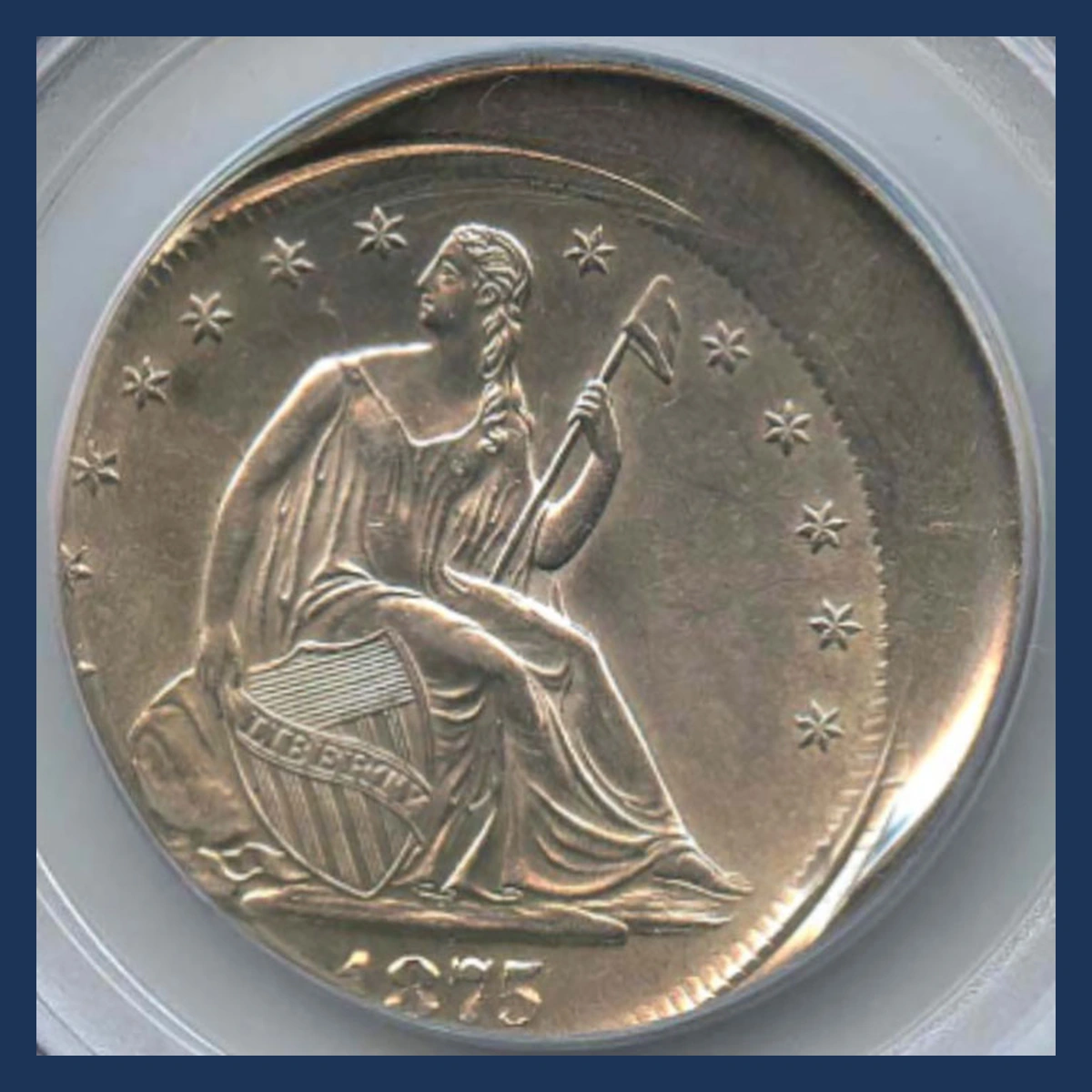
A wide blank crescent stands beside the shifted picture on a known 1875-S half dollar. PCGS graded it MS62, an unworn grade, and described the strike as 20% off-center.
Both faces received a design. One side was not left entirely blank.
The metal disc lay partly outside the stamping position. Only the area caught between the two steel tools received the pictures.
Another published 1875-S example is described as 15% off-center. These are much more than uneven rims: a broad untouched area appears opposite the design that missed the coin’s edge.
Estimated Value
Estimate $7,500–$25,000 for major 1875-S off-center halves in nearly unworn to unworn condition. The date and mint must remain identifiable.
The dealer’s MS62 example is marked sold, but its sale amount is not published. A different 1875-S coin, a twenty-cent piece, realized $16,800 in 2022.
That coin was graded NGC MS63 and struck 25% off-center. Its price helps compare major errors, but it is not a half-dollar sale.
How to Identify
An off-center strike moves metal; it does not cut a crescent away. A scale should show weight consistent with the original 12.50 grams, allowing for wear.
Record the outline with calipers when safely accessible. The normal diameter is about 30.6 millimeters, but the shape and shifted picture matter more than width alone.
Use a 10× magnifier to check the surviving 1875 date and S. Inspect the edge for cutting, seams, or signs of later flattening.
The known MS62 has pictures on both faces, shifted together. Turn the coin over and match the blank crescent on each face with the design missing beyond the opposite edge.
Conclusion
The smallest clues on an 1875 half dollar can be a raised line or an extra piece of a number. Start with the date and mintmark, then turn the coin sideways to check its edge.
Estimated prices stretch from $100 for modest worn examples to $25,000 for a major off-center coin. Match the visible feature and the amount of wear before comparing prices.