1942 Half Dollar Error List with Pictures

A 1942 half dollar with Liberty’s head missing sold for $16,200 in 2018. It was struck on the smaller silver disc meant for a quarter.
This 1942 Walking Liberty half dollar error list covers estimated values from $60 to $25,000. Some mistakes are obvious, while others hide in a tiny letter or date digit.
Read on to see what to look for and how each error affects value.
1. 1942 Walking Liberty Half Dollar Rim Clip Error (Estimated Up to $400)
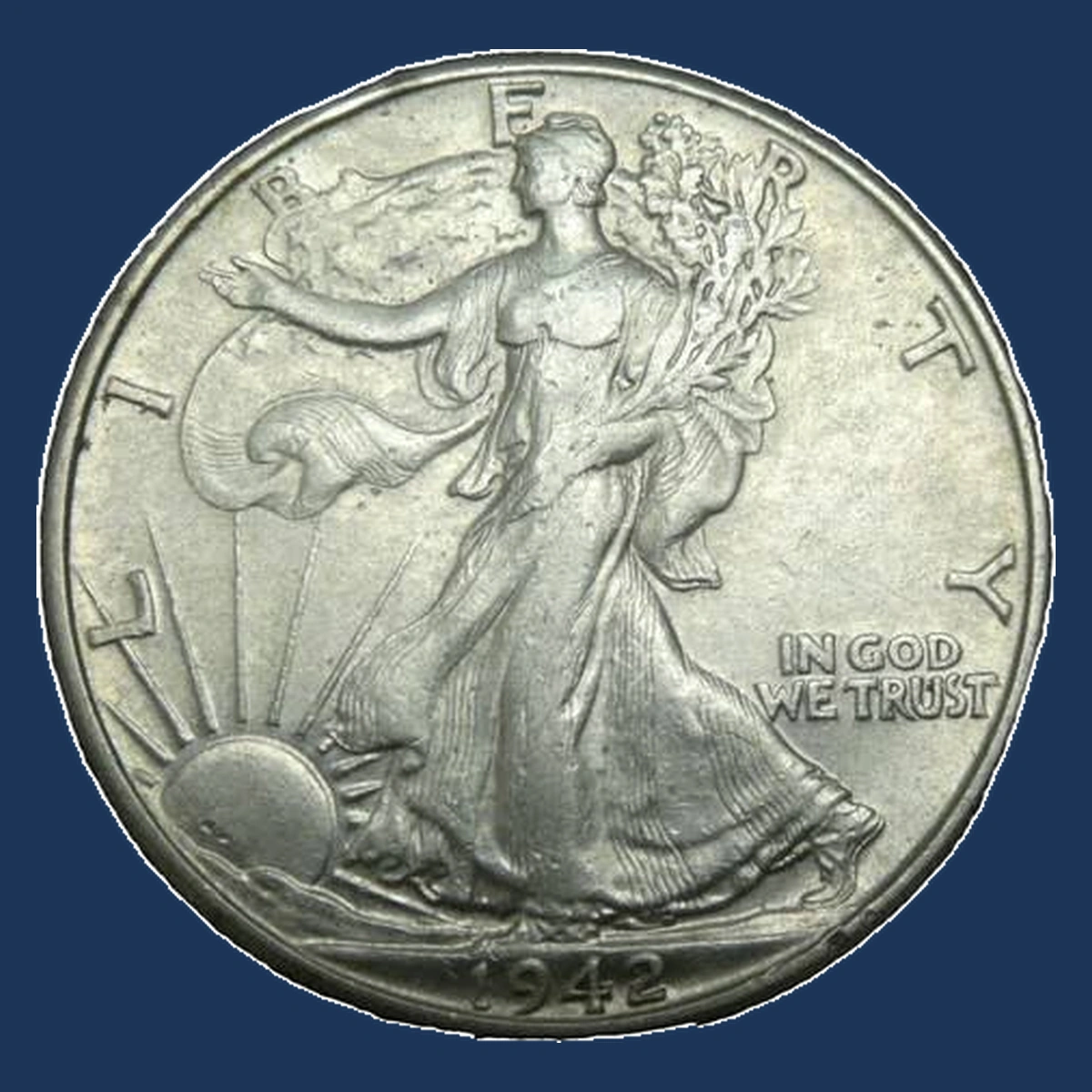
A small gap interrupts the round edge of this 1942-S half dollar. An example graded MS62 by ANACS shows the error on an unworn coin with visible marks.
The missing piece was never part of the finished coin. Its blank, the round metal disc used to make it, already had a gap before the design was stamped.
Metal then spread around that gap during the strike. This can leave weak lettering nearby or a weak rim directly across from it, unlike a piece cut away later.
Estimated Value
A 1942-S example graded ANACS MS62 sold for $81.90 including the buyer’s fee at Pristine Auction on May 19, 2025. The winning bid alone was $70.
Allow an estimated $60–$400 for worn through ordinary unworn examples. A larger missing piece or a cleaner surface can raise the price.
These figures cover the whole coin. They are not amounts to add to its normal value.
How to Identify
Find the small S on the back first. It means San Francisco made the coin; the shape of the gap cannot tell you its mint.
Inspect the gap with a 10× magnifier. Look for smooth transitions into the rim and lettering that weakens near the missing metal.
Now turn the coin sideways and check the grooves around its edge. Fresh saw marks, sharp burrs, or metal pushed outward can suggest later cutting.
Use a scale to compare its weight with the normal 12.50 g. Calipers should show about 30.6 mm across an undamaged part; a small clip may barely change the weight.
For a quick first check, look for original design fading into the gap rather than being sharply sliced off.
2. 1942 Walking Liberty Half Dollar Recessed Surface Defect (Estimated Up to $600)
A streaked hollow crosses the lower front of one 1942 half dollar. The same coin also has a doubled design from being struck twice.
The hollow may have formed in either of two ways. A thin layer of metal could have peeled away, leaving a shallow gap called a lamination.
Alternatively, material trapped over the coin could have been pressed into its surface. That is called a strike-through.
Heritage described both possibilities for this example. Its shape alone does not settle which happened, so the surface needs a closer examination.
Estimated Value
An estimated $75–$600 covers a confirmed mint-made hollow on a worn or ordinary unworn 1942 half dollar. Size and visibility influence the price.
The coin shown here sold for $417.13 in June 2017. That price includes its double strike and cannot be assigned to the hollow alone.
For comparison, Northeast Numismatics offered an unworn 1947 half with a peeling metal layer for $275. That was an asking price, not a sale.
How to Identify
Tilt the coin under a lamp so light runs across the hollow. A flaky edge suggests a separating metal layer, while a pressed-in pattern may point to trapped material.
Use a magnifier to follow the boundary. Do not scrape the surface or lift a loose flap to see underneath.
Check whether any split reaches the grooves around the edge. Weigh the coin on a scale and measure it with calipers against 12.50 g and 30.6 mm.
A missing layer can lower the weight. A mark pressed into the metal may leave its weight unchanged.
The doubled date is a separate feature. Start with the hollow’s boundary: a lifted seam or a clear pressed texture gives the best early clue to its cause.
3. 1942 Walking Liberty Half Dollar Repunched D Mintmark (Estimated Up to $2,000)
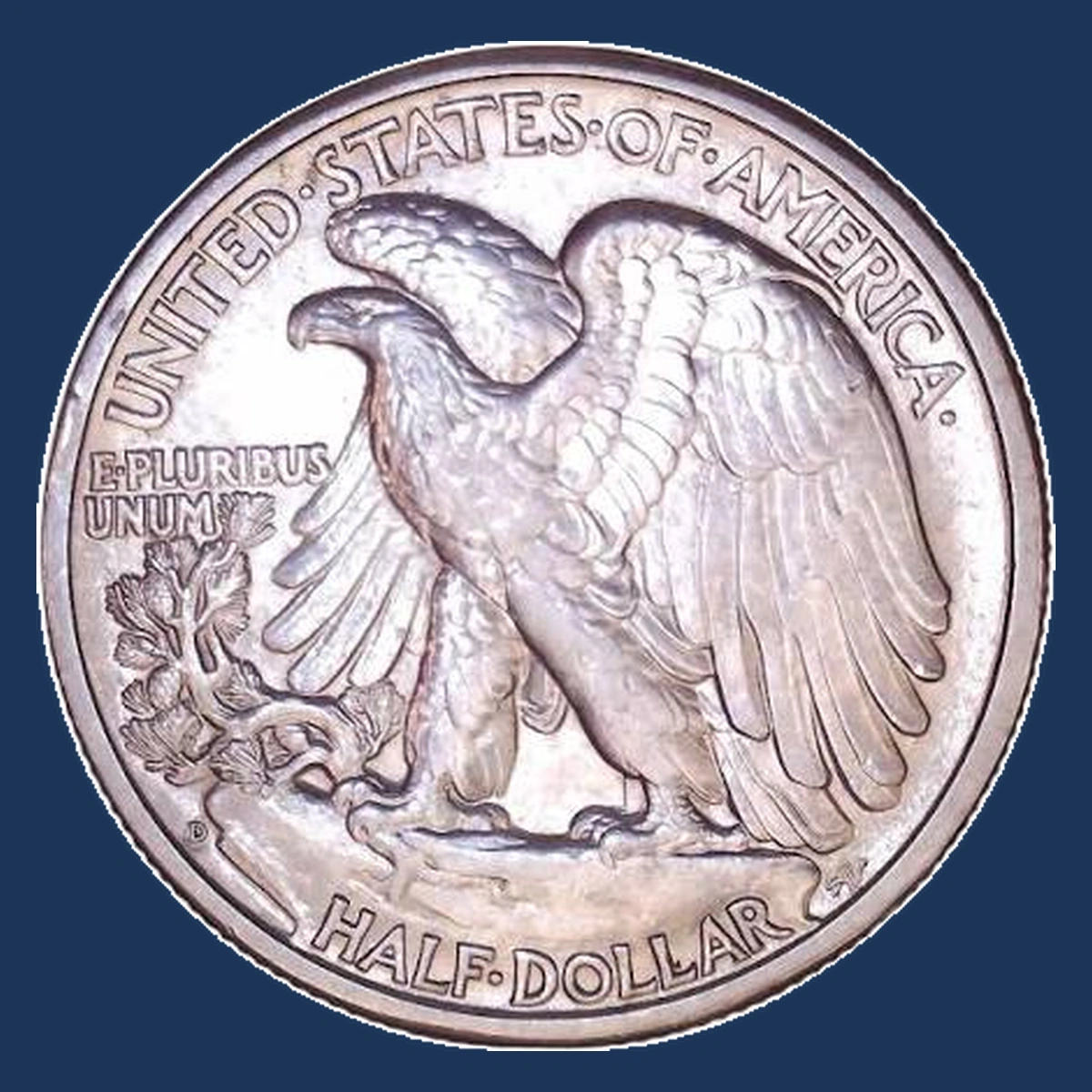
An extra curve beside the small D can reveal a repunched mintmark. Some 1942-D examples show part of a second D below the main letter, while others have a tilted outline.
At the time, workers punched the mintmark by hand into a die, the steel tool that stamps coins. A second attempt did not always cover the first completely.
The leftover shape then appeared on coins made with that tool. The downward and tilted versions come from different tools, so do not expect both patterns on one coin.
Estimated Value
Estimated values range from $75–$2,000 for worn through attractive unworn examples. Clear extra outlines and a match to a known variety help support a higher price.
A 1939-D/D graded PCGS MS64+ sold for $1,292.50 at Kagin’s in September 2017. That was an unworn coin with relatively few marks.
It provides a different-year comparison for the same kind of mistake. It is not a recorded sale of a 1942-D coin.
How to Identify
Keep the back upright and examine the D with a 10× magnifier. Compare its extra outline with one of the Wexler photographs.
For the first downward version, look for a thin raised line linking F in OF, the nearby dot, and the first A in AMERICA. This helps distinguish it from other doubled-looking mintmarks.
A flat shelf beside the D may come from movement during striking. It does not prove the letter was punched twice.
On a loose coin, check about 12.50 g with a scale and 30.6 mm with calipers. Inspect the edge grooves for damage too.
Matching the extra D outline to one pictured variety is the quickest place to begin.
4. 1942 Walking Liberty Half Dollar Doubled Die Obverse (Estimated Up to $2,500)
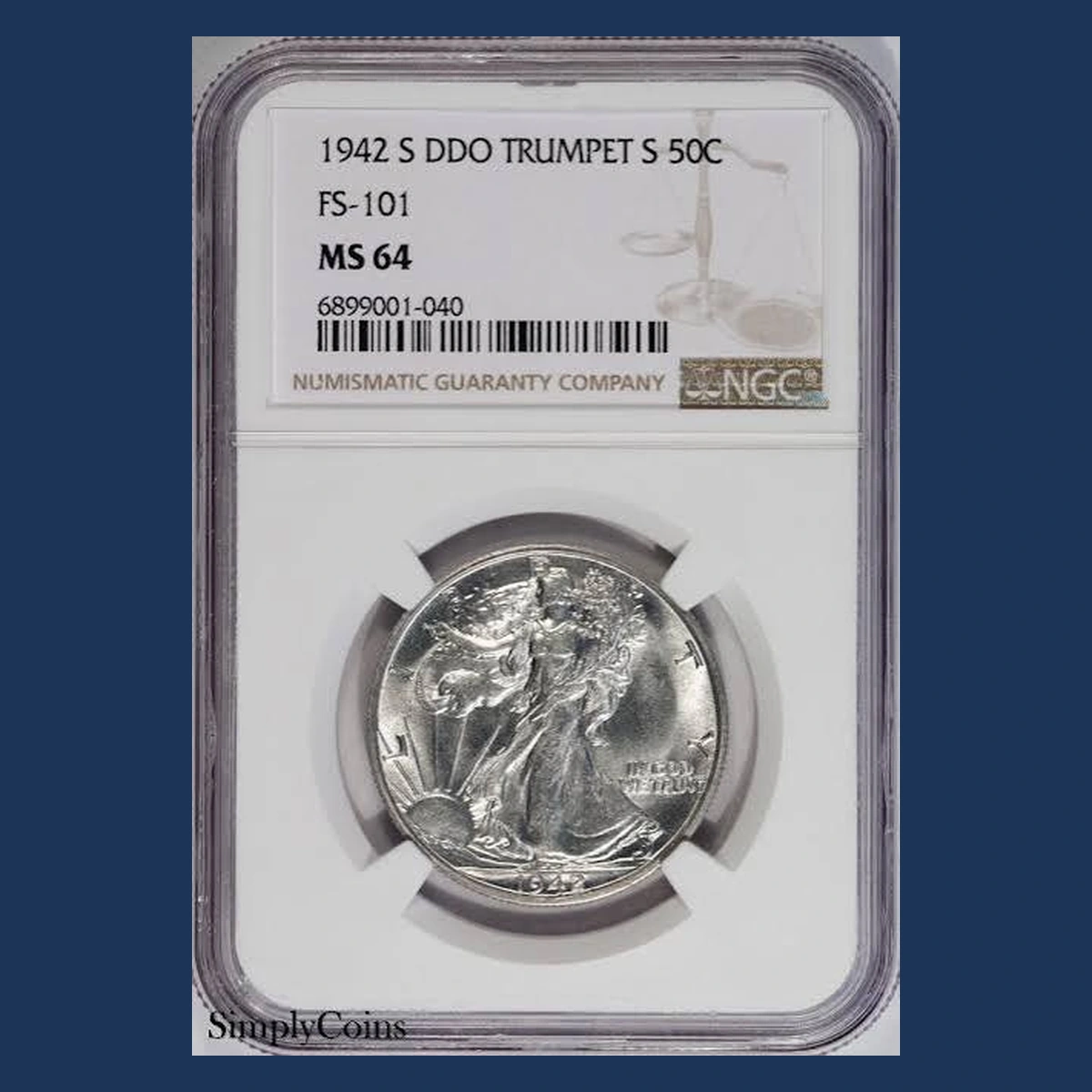
Look closely at IN GOD WE TRUST and the date on a Philadelphia 1942 half dollar. Extra edges in these areas can indicate a doubled front design.
This begins before the coin is struck. The design was transferred unevenly onto the steel stamping tool, leaving some details doubled.
Coins made with that tool received the same repeated pattern. They did not need to be struck twice.
That matters when examining the date. Another known 1942 error was struck twice and has traces below its date, but it belongs to a different category.
Estimated Value
Allow an estimated $70–$2,500 for worn through well-preserved unworn examples with clear, matching doubling. The year guide lists about $70 for a Fine example, meaning a coin with substantial wear.
A different-year 1939-D FS-101 doubled-front half sold for $2,160 at Stack’s Bowers in April 2025. It was graded NGC MS67+, a very well-preserved unworn coin.
That sale helps explain the upper estimate. It does not establish a 1942 sale price.
How to Identify
Compare your coin with an ordinary 1942 Philadelphia half under a 5× or 10× magnifier. Choose a coin with similar wear so worn-down letters do not confuse the comparison.
Examine IN GOD WE TRUST, then the date. Rounded extra edges can support true doubling; a thin, flat shelf may result from movement during the strike.
Check the grooves around the edge for filing or other changes. A scale and calipers should give roughly 12.50 g and 30.6 mm.
Traces far below the date may instead come from a second strike. Do not identify the error from one digit alone.
The fastest useful test is a matching doubled pattern in both the motto and date.
5. 1942 Walking Liberty Half Dollar Proof Missing AW Initials (Estimated Up to $3,000)
Two tiny letters, AW, normally identify designer Adolph Weinman near the eagle’s tail. Some 1942 proofs are known without these initials.
A proof is a specially made collector coin, usually with sharp details and reflective flat surfaces. Missing initials stand out when nearby details remain clear.
The small letters could disappear during work on the steel stamping tool. Their absence is different from letters worn away through use or removed by rubbing.
AW is not a mintmark. Philadelphia made the 1942 proofs, and those coins normally have no mintmark at all.
Estimated Value
Attractive certified examples have an estimated value of $500–$3,000. Much of that amount comes from the proof coin’s condition, rather than an automatic large premium for missing initials.
A 1941 No AW proof graded NGC PR67 sold for $690 at Heritage on March 26, 2025. Another, graded PR67+, brought $780 that July.
Both were highly preserved proofs from the previous year. They offer comparisons, not recorded transactions for this 1942 variety.
How to Identify
First confirm that the coin is a proof. Look for sharp detail and reflective flat areas, rather than assuming any shiny coin was specially made.
A loose example should weigh about 12.50 g on a scale and measure 30.6 mm with calipers. Check that its edge grooves have not been filed or altered.
Use a magnifier near the eagle’s tail and compare the spot with a proof that clearly shows AW. Tilt it under light to find rubbing, scratches, or material covering the letters.
Do not clean the area. A rubbed patch can remove initials without creating this variety.
Sharp nearby details around a smooth, untouched space where AW should be give the quickest useful check.
6. 1942 Walking Liberty Half Dollar Doubled Die Reverse (Estimated Up to $6,000)
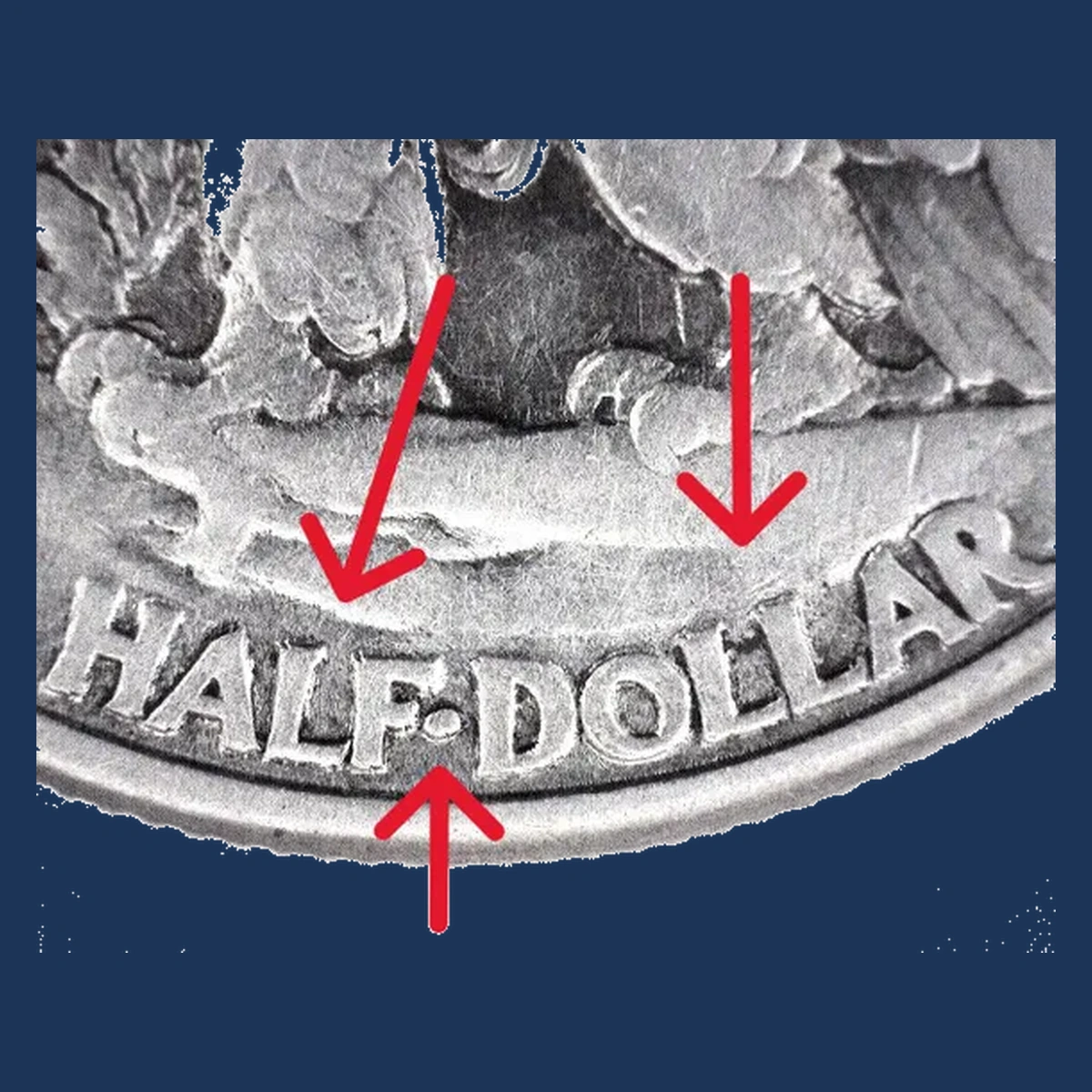
The words HALF DOLLAR can show repeated edges on this reported 1942 variety. Other places to examine include UNITED STATES OF AMERICA, the eagle’s tail feathers, and the pine branch.
These details were doubled on the steel tool used to stamp the back. That made the same pattern repeat on coins produced with it.
Random dents do not repeat in this way. Nor does one flattened letter establish that the whole tool had a doubled design.
This entry concerns ordinary Philadelphia coins. It does not identify the same variety on Denver, San Francisco, or proof examples.
Estimated Value
Estimated values run from $75–$6,000, covering worn examples through unusually well-preserved unworn coins. The condition and strength of the doubled pattern help narrow that broad range.
The 1942 price guide lists $550 at MS65 and about $5,980 at MS67. Both grades describe unworn coins; MS67 allows fewer marks.
Those numbers are guide estimates rather than completed sales. They should not be read as guaranteed offers for every doubled-looking half dollar.
How to Identify
Check the date and mintmark area before studying the letters. This Philadelphia variety should have no mintmark, with the area fully present and undamaged.
Read HALF DOLLAR under a magnifier, then move to UNITED STATES OF AMERICA. Look for rounded extra outlines or small splits where letter strokes meet.
Inspect the eagle’s tail and pine branch too. A flat ledge beside one letter is less useful than a repeated pattern across several details.
Confirm the normal size with calipers and weight with a scale: about 30.6 mm and 12.50 g. Look around the grooved edge for damage.
A clear match in several letters and nearby eagle details is the quickest way to separate this variety from an isolated mark.
7. 1942 Walking Liberty Half Dollar Double Strike Error (Estimated Up to $15,000)
One 1942 half shows only a slight overlap between two designs. Another carries a second impression far off center, making the mistake much easier to see.
Both coins were struck again after their first designs had formed. How far each coin moved determined where the second impression landed.
A metal ring normally keeps a coin in place during striking. Staying inside that ring can leave a close overlap instead of a large shift.
The more dramatic example also has later scratches on its front. Those scratches lower its appeal but do not erase the mint error.
Estimated Value
The closely overlapping PCGS XF45 example sold for $417.13 in June 2017. XF45 indicates moderate wear with much detail remaining.
The second example, with its later impression off center, brought $8,400 in December 2022. NGC called it unworn but noted scratches instead of assigning a normal numerical grade.
An estimated $400–$15,000 covers these differing appearances. An undated S-mint double strike sold for $11,400 in August 2025, but its year cannot be called 1942.
How to Identify
On the close-overlap example, use a magnifier below the date to find traces of the earlier digits. STATES also repeats outward on the back.
Its back has a thin raised edge from roughly seven to eleven o’clock. The shallow hollow on the front is a separate feature, not proof of a second strike.
For the larger shift, follow both impressions across the coin. Parts of one design should pass under or overlap the other.
A scale should read near 12.50 g, although calipers may show spreading beyond 30.6 mm. Check how the strike affected the edge grooves.
Two overlapping designs that fit the same movement offer the fastest confirmation.
8. 1942 Walking Liberty Half Dollar Silver Quarter Planchet Error (Estimated Up to $25,000)
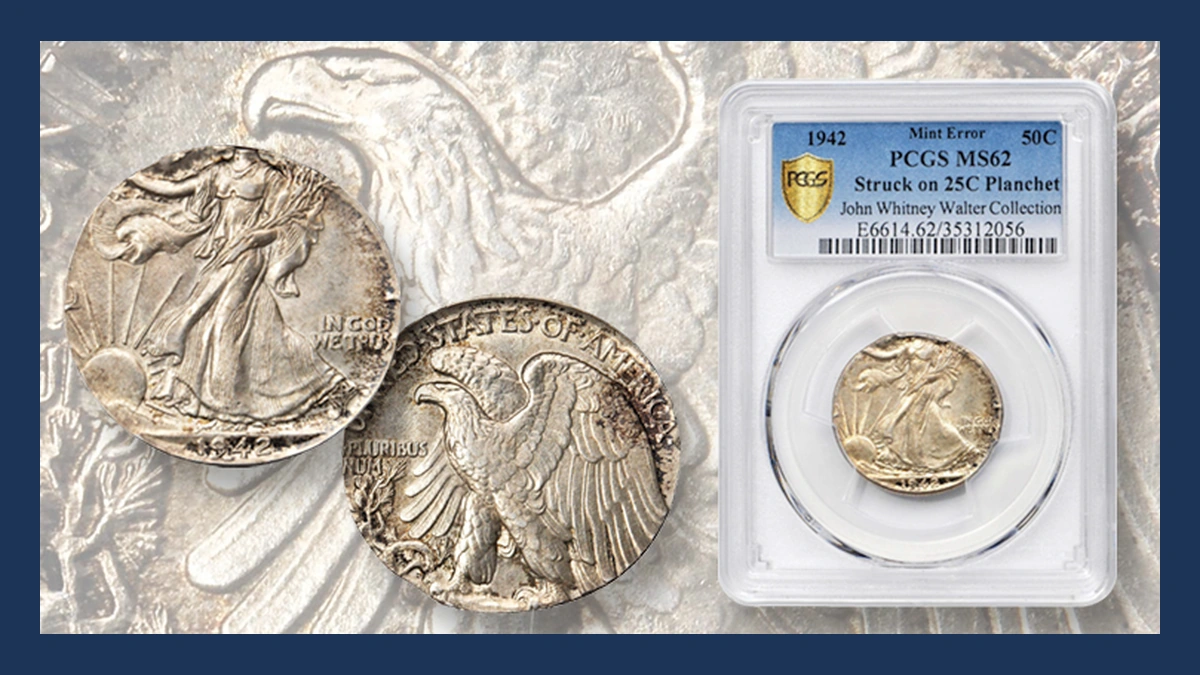
Liberty’s head and outstretched hand are missing from the Headless Walker. Part of the eagle’s wing is missing too, because the metal was too small to hold the full design.
A silver disc meant for a quarter had entered the half-dollar press. PCGS describes this example as MS62, meaning unworn with noticeable marks, and records its weight as 6.22 grams.
All four date digits survived. The mintmark area did not.
Its missing mintmark therefore cannot identify Philadelphia. Any of the three mints making half dollars that year remains possible.
Estimated Value
The PCGS account of the Headless Walker records a $16,200 sale at Stack’s Bowers in 2018. The working estimate for this error is $10,000–$25,000.
Condition, a readable date, and the amount of surviving design affect the value. These figures cover the whole coin.
An undated Walking Liberty half on a silver quarter disc brought $15,000 at Heritage in May 2022. Its missing date makes it a series comparison, not another confirmed 1942 sale.
How to Identify
Start with a scale. A normal half dollar weighs 12.50 g, while the silver quarter disc was made to weigh 6.25 g.
Use calipers to compare the size too. The usual diameters are 30.6 mm for the half and about 24.3 mm for the quarter, before any spreading during striking.
With a magnifier, follow the design where it reaches the edge. Look for natural metal flow and compare the edge grooves with a confirmed example.
Filing a normal half smaller leaves cut surfaces rather than an original undersized strike. Keep the complete date and missing mintmark area separate when identifying it.
Near-quarter weight together with a naturally cut-off half-dollar design gives the quickest strong clue.
Conclusion
The 1942 errors here range from a small missing rim section to a half-dollar design squeezed onto a quarter’s silver disc. Estimated values span $60–$25,000, with condition and the size of the mistake making a large difference.
Check the date, both sides, and the edge before naming an error. When one coin has several mistakes, compare prices for the whole coin instead of adding separate premiums together.