1854 Half Dollar Error List with Pictures

A faint eagle can remain underneath a missing silver layer. On another 1854 half dollar, the whole eagle may look normal until you flip the coin and notice its tilt.
This guide to 1854 half dollar errors covers six categories with estimates from $75 to $1,000. An ordinary 1854-O graded NGC AU55 sold for $720 in December 2025, a condition comparison rather than an error sale.
Read on to compare the shapes, surfaces, and angles that separate these features.
1. 1854 Liberty Seated Half Dollar Reported Multiple Die Clashes (Estimated Up to $400)
Several extra lines led a seller to suggest that an 1854 half dollar showed repeated clashes. That is a reported interpretation, not a confirmed mint assignment or a second-strike claim.
A die is the steel tool that stamps a coin. When the two tools hit without a blank between them, one can pick up part of the opposite design.
Later coins may show those unwanted shapes. More than one contact can leave separate, slightly shifted sets.
The repeated shapes are what matter. Several scratches scattered over the smooth background would not prove that the tools clashed more than once.
Estimated Value
Use an estimated $150–$400 for a circulated candidate with identifiable clash marks. Ordinary 1854-O PCGS XF40 coins sold for $169 and $186 at Heritage in March 2025.
XF40 describes light circulation wear. These New Orleans sales compare general condition, while the seller’s clash report does not establish its coin’s mint.
The upper estimate allows for clear transferred design. It is not a recorded sale or an automatic premium for a claim of multiple clashes.
How to Identify
Compare a suspected trace with the shape that would face it on the opposite design. A 10× magnifier should reveal enough detail to test that relationship, rather than simply show an extra line.
For multiple clashes, find another shifted copy of the same transferred shape; unrelated scratches and crack lines cannot establish repetition. Keep both faces and the mintmark area visible in the photographs.
A scale and calipers check about 12.44 grams before wear and 30.6 millimeters, with a ridged edge. The essential first test is repeated, recognizable pieces of the opposite design in positions that make sense for contact between the tools.
2. 1854 Liberty Seated Half Dollar Crumbled Reverse Die (Estimated Up to $600)
Irregular raised areas appear on a collector’s 1854-O described as having a crumbled back die. Its ANACS EF45 Cleaned label separates the lightly worn coin’s cleaning problem from the original tool damage.
Pieces breaking from the stamping tool leave recesses that silver can fill. The resulting patches stand above the normal design.
They differ from the narrow ridges left by small cracks. Their boundaries need comparison with the actual reference coin.
The collector’s text does not locate every defect. A complete back photograph is needed before assigning a patch to a wing, letter, or rim.
Estimated Value
Estimate $150–$600 for a circulated example with recognizable raised back defects. Cleaning affects the comparison, while original surfaces and clear features can strengthen it.
A normal 1854-O PCGS XF45 sold for $228 in March 2025. An ANACS VF35 Details Cleaned example brought $114 in April 2026.
Those are ordinary-coin condition references. They do not supply a sale price for the collector’s crumbled-die example, so the range remains an estimate.
How to Identify
Use the collector’s whole back image to locate the raised patches against the eagle and letters. A close-up alone can hide whether rough material belongs to the stamped design.
A 10× magnifier helps distinguish silver from solder, glue, or surface deposits. The patches should be continuous with the coin’s metal rather than sitting on top as foreign material.
Check the O and arrows beside the date. A scale and calipers compare the coin with about 12.44 grams before wear and 30.6 millimeters, with a ridged edge.
Matching the original raised defects and surrounding surface to the reference gives the quickest useful distinction from material added later.
3. 1854 Liberty Seated Half Dollar Repunched Date (Estimated Up to $700)
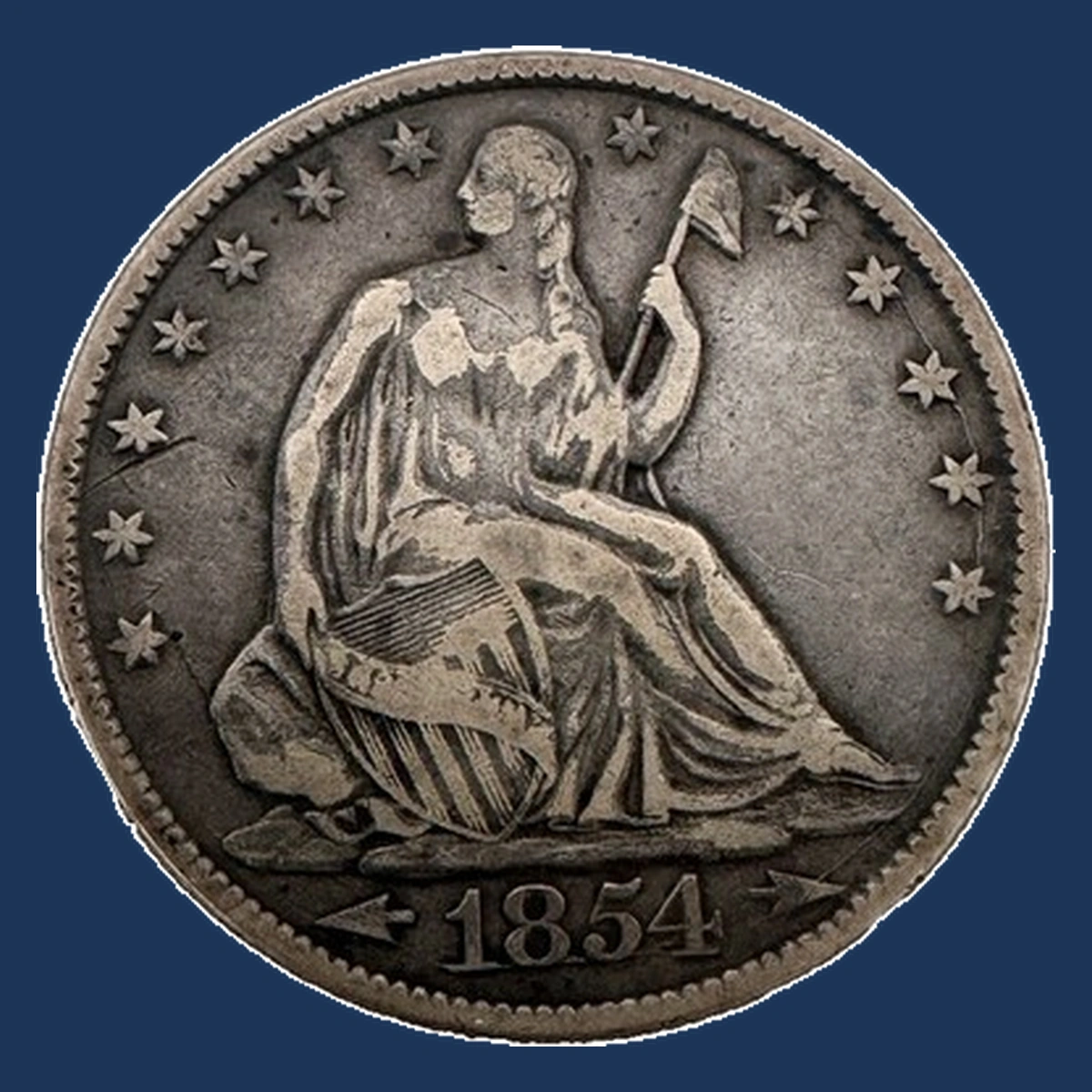
Extra numeral detail appears in the date on Paul Kluth’s published 1854-O. The same coin has missing metal on the back, but the date feature has a different cause.
Kluth describes the date as recut or repunched. That means an earlier impression or later reworking left additional detail in the stamping tool.
It does not mean the year was changed to 1854 from another date. Nor does it establish doubling across the whole front design.
The source gives no exact direction for an extra stroke. Compare its photographed digits instead of borrowing marks from the different 1855/4 overdate.
Estimated Value
An identified circulated example with visible date repunching has an estimated range of $175–$700. Ordinary 1854-O comparisons include $228 for PCGS XF45 in March 2025 and $342 for PCGS AU50 in January 2026.
Those grades cover light wear, with AU50 retaining more detail. No sale is assigned to Kluth’s published example.
Its date detail and back lamination share one coin. The range does not add two fixed premiums simply because both features are present.
How to Identify
Include both arrows when photographing the date. Their shapes and nearby marks should not be confused with remnants of an earlier numeral impression.
Trace the suspected extra stroke with a 10× magnifier and compare the reference date. A rounded numeral shape differs from a flat ledge or a cut into the surface.
Confirm the O on the same coin’s back. Its usual specifications are 12.44 grams before wear and about 30.6 millimeters, checked with a scale and calipers, with a ridged edge.
Keep the whole date beside the close-up. A matching secondary numeral feature in the same position is the direct first check for the reported repunching.
4. 1854 Liberty Seated Half Dollar Detached Lamination (Estimated Up to $750)
The eagle remains faintly visible where a surface layer is missing on this 1854-O. Paul Kluth described the coin in the February 2010 E-Gobrecht.
The loss reaches the eagle’s head, upper right wing, and parts of the lettering. Stronger design remains outside the affected area.
This is detached lamination: a layer separated within the metal blank and came away. Surviving faint design underneath does not mean the surface is still intact.
The loss is local. It should not be described as the whole coin splitting in half, which would be a different claim.
Estimated Value
Use an estimated $200–$750 for a circulated coin with a substantial original detached layer. Clear surrounding design and an easily recognized boundary improve the comparison.
Ordinary 1854-O XF45 and AU50 results at $228 and $342 show the coin’s value before considering the defect. Neither is a sale of Kluth’s example.
The upper allowance estimates a pronounced mint-made flaw. It should not be applied to a rough patch caused by later scraping or corrosion.
How to Identify
Does faint eagle detail continue across the lower, exposed surface? Compare that area with the stronger design outside the missing sheet.
Use a 10× magnifier and a low lamp to inspect the boundary. A natural layer edge differs from cutting lines or a gouged base left by later scraping.
A scale may show metal loss from the original 12.44 grams, though wear affects weight too. Measure an intact direction with calipers against 30.6 millimeters and inspect the remaining edge ridges.
Leave loose or exposed metal alone.
The most useful match combines faint underlying design with the layered boundary at the eagle and nearby letters shown in the published example.
5. 1854 Liberty Seated Half Dollar Rotated Reverse (Estimated Up to $800)
The eagle can lean when an upright Liberty is flipped top to bottom. This shows that the front and back stamping tools were not lined up at the normal angle.
One reported 1854-O in Good 6 was described as about thirty degrees clockwise. Its owner had no measuring device, so that angle is approximate.
A separate About Uncirculated coin was reported at forty-five degrees clockwise. These are two examples, not one angle shared by all coins of the date.
Both faces can otherwise show complete, centered designs. Rotation concerns their relationship after the flip, rather than missing or doubled design.
Estimated Value
Estimate $75–$800 across circulated examples, from heavily worn Good coins through lightly worn AU pieces. Condition explains much of the difference between the two reports.
Ordinary 1854-O auction records include $342 for PCGS AU50 in January 2026 and $720 for NGC AU55 in December 2025.
Those sales compare preservation. They are not transactions for the reported rotated coins, and they do not establish a price for each degree of tilt.
How to Identify
Confirm the 1854 date arrows and O with a 10× magnifier before measuring the rotation. The ridged-edge coin normally weighs 12.44 grams and measures 30.6 millimeters with a scale and calipers.
Set Liberty upright in a support that prevents sliding. Flip the coin top to bottom without twisting it sideways.
The eagle should normally finish upright. Measure its tilt with a protractor or an angle guide over the picture, keeping one fixed orientation reference.
Repeat the movement to check that the coin itself did not turn in the support. A repeatable clockwise offset is the useful confirmation; separately straightened pictures cannot prove rotation.
6. 1854 Liberty Seated Half Dollar Die Cracks (Estimated Up to $1,000)
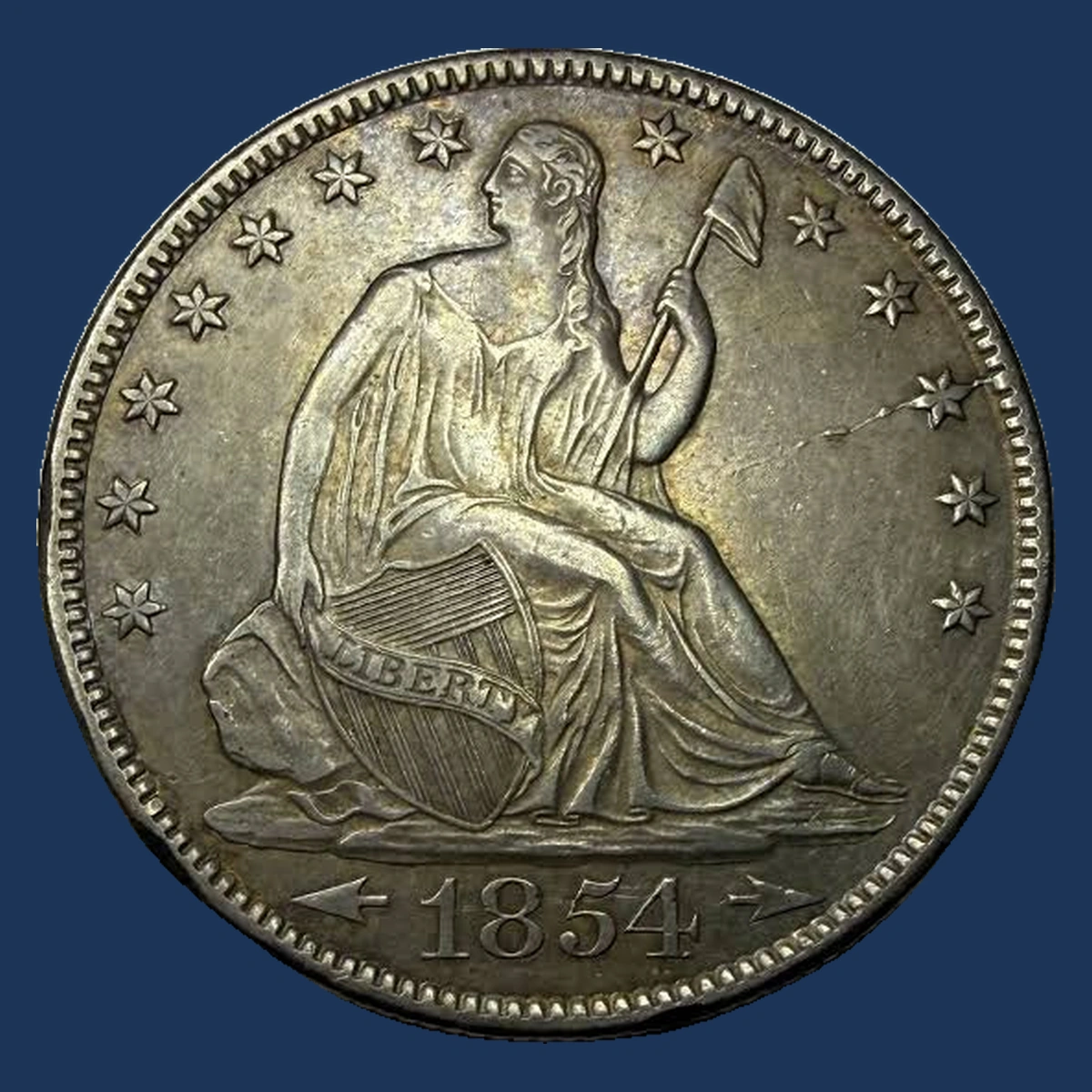
One raised line travels from the rim across the pointed rock and nearby arrow to the bottoms of 1 and 8. A second links stars two through five on the front.
The owner’s registry description records both paths on a Philadelphia PCGS AU58+ coin. They are separate from the New Orleans back defects described earlier.
The lines formed when silver entered cracks in the stamping tool. A scratch made after striking instead cuts into the finished coin.
Follow the actual paths. A line crossing a different arrow or another group of stars needs its own comparison.
Estimated Value
An estimated $200–$1,000 covers circulated Philadelphia examples with visible cracks. A well-preserved AU coin belongs toward the stronger end, but the registry gives no purchase price for its AU58+ example.
The ordinary New Orleans AU55 sale at $720 in December 2025 offers a different-mint condition comparison. It is not a transaction for this Philadelphia coin.
The two crack paths help identify the example. They are not separate fees to add to its value.
How to Identify
Start at the rim and trace the line across the rock tip and arrow to the bottoms of 18. Then examine stars two through five as a separate route.
A 10× magnifier and light from opposite sides should show a raised ridge. A scratch with dragged metal or a rough corrosion channel needs a different explanation.
Keep a full back photograph to confirm that there is no mintmark. A scale and calipers check about 12.44 grams and 30.6 millimeters, allowing for wear, with a ridged edge.
A continuous raised match along the documented rock-arrow-date path is the first feature to establish before comparing the second line.
Conclusion
Estimated values range from $75 to $1,000 for the examples and conditions described. Raised lines, extra date strokes, a missing silver layer, and a tilted back each need a different view.
The arrows beside 1854 belong to the normal design. Check the unusual feature separately, preserve its connection to the correct mint and coin, and keep ordinary auction comparisons distinct from sales of an actual error example.