1807 Draped Bust Half Dollar Error List with Pictures

A nearly unworn 1807 Draped Bust half dollar with fine raised crack lines sold for $1,900 before buyer’s fees in September 2026. The price covered the whole coin, not just those lines.
This guide to 1807 Draped Bust half dollar errors covers five features, with worn-coin estimates of $200–$6,000. Some are subtle: a slightly tilted eagle or weak hair does not automatically add a large premium.
Read on to check the right-facing portrait, lettered edge, and the individual clues on this design.
1. 1807 Draped Bust Half Dollar Sunken-Die Weakness (Estimated Up to $1,200)
Liberty’s lower curls can look worn even when nearby details are stronger. On one illustrated 1807 coin, NGC researcher David Lange explained that weakness as a problem with the stamping tool.
That steel tool is called a die. If it was not hardened properly, part could sink during use, leaving a deeper space that silver did not fully fill.
The result was weak detail at the lower curls and the matching area on the back. Collectors call this a sunken die.
The explanation concerns that example. Worn hair on another coin may have a different cause.
Estimated Value
An estimated $200–$1,200 covers worn examples with this localized weakness. Surviving detail and surface condition matter more than the mere presence of a soft patch.
For context, a PCGS VG8 1807 Draped Bust half sold for $384 at Heritage in April 2025. That was a heavily worn coin, not Lange’s example; cleaning or damage can lower value, while stronger detail outside the weak area can support a better overall condition assessment.
How to Identify
The NGC forum example provides a useful side-by-side check of the lower curls and corresponding back area. Look at both, rather than judging one soft patch alone.
For a safely accessible coin, a digital scale and calipers can check the original 13.48 grams and roughly 32.5-millimeter width. Inspect the lettering around the edge too.
Use a 10× magnifier to examine the weak area’s surface. Scraping leaves fine lines, and deliberate smoothing can create an unnatural hollow; ordinary wear also affects other exposed high points.
Matching weak areas on the two sides, beside better-formed detail and without removed metal, fit the illustrated sunken-die explanation. That pattern is more useful than weak curls by themselves.
2. 1807 Draped Bust Half Dollar Slight Die Rotation (Estimated Up to $2,500)
A small tilt can disappear when a seller straightens each photograph. One owner reported that the back of an NGC-encased 1807 Draped Bust half sat about 10–15 degrees out of alignment.
The report did not state a clockwise or counterclockwise direction. It describes a modest rotation between the designs, not a dramatic turn of the eagle.
The angle must be checked while flipping the coin in a consistent way. A coin sitting diagonally inside its case proves nothing about the relationship between its sides.
An NGC case also does not mean the grading service separately confirmed the reported rotation.
Estimated Value
An estimated $300–$2,500 covers ordinary worn examples with a small tilt of this scale. The range mainly reflects the coin’s condition, not an extra charge for a few degrees of rotation.
Same-date comparisons include a VG8 at $384 in April 2025 and an AU50 at $1,900 before fees in September 2026. Neither sale belongs to the owner’s reported coin; they show the broader market from heavily worn to almost unworn.
How to Identify
Use Liberty’s portrait to set the front upright, then flip top to bottom without a sideways twist. The eagle should normally appear upright after that movement.
A paper angle guide held outside the case can help measure a small tilt. Repeat the flip because a slight hand movement can imitate ten degrees.
Confirm the right-facing Draped Bust portrait and lettered edge, rather than confusing it with the other 1807 half-dollar design. Check accessible coins with a digital scale and calipers against about 13.48 grams and 32.5 millimeters; do not open a sealed case for this.
A repeatable tilt between the designs is the evidence to look for. The angle of the coin within its holder is a separate matter.
3. 1807 Draped Bust Half Dollar Slight Off-Center Strike (Estimated Up to $2,500)
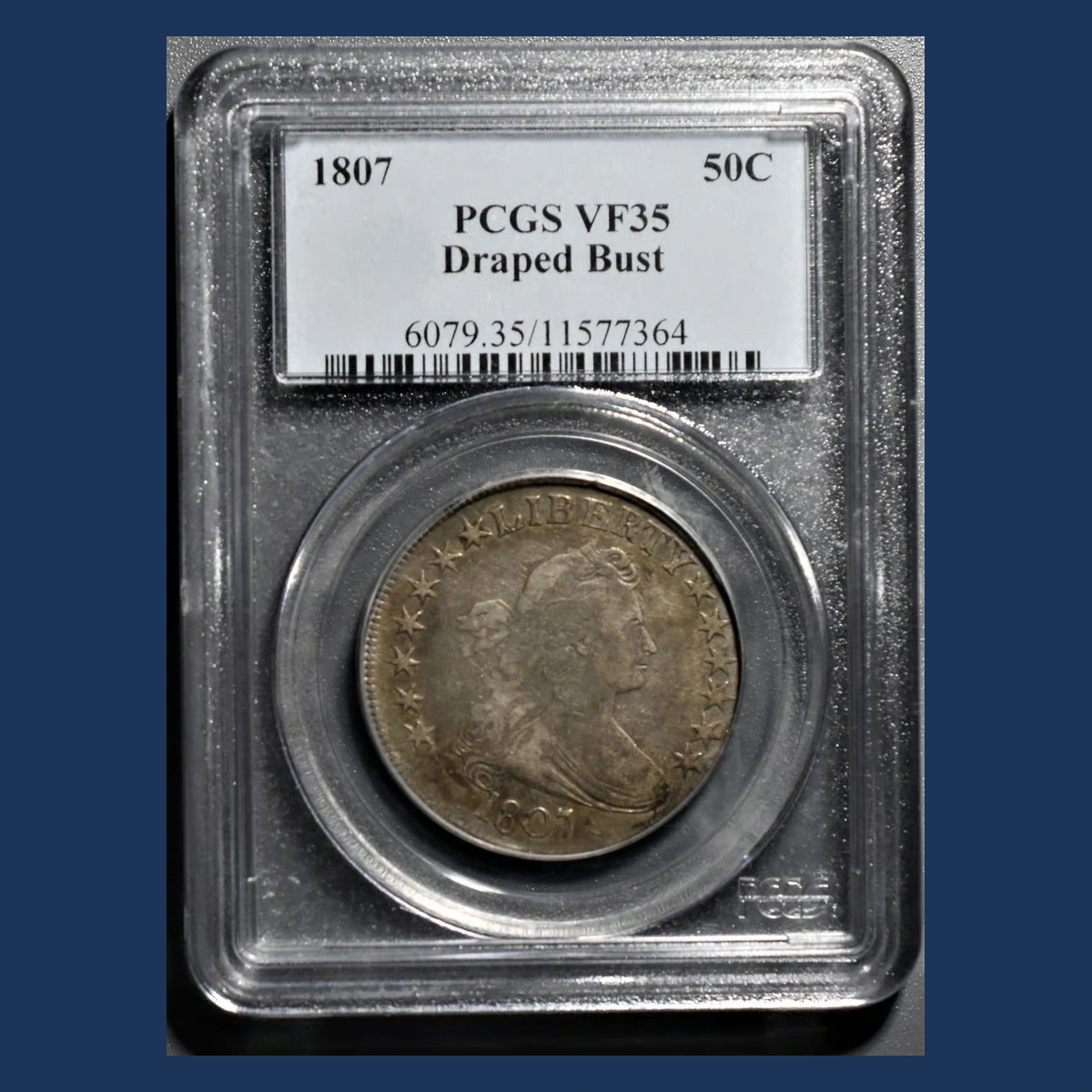
The design sits only slightly to one side. In an illustrated discussion, specialist Nysoto estimated the shift on an 1807 Draped Bust half at about 3–4% off center.
He considered that too small to add an error premium. It should not be described like a dramatic strike with a large part of the design missing.
A blank is the metal disc before stamping. Its position beneath the dies affects where the design lands.
Both sides and the complete edge belong in the comparison. A tight crop or one misaligned tool can make the shift seem greater than it is.
Estimated Value
The estimated $300–$2,500 range concerns ordinary worn examples with this modest shift. The original specialist comment specifically says it adds no error premium.
An almost unworn AU50 sold at CNG for $1,900 before fees in September 2026, offering a same-date condition comparison. That was not the forum coin, and prices for early halves with major missing-design areas should not be applied to a three-percent shift.
How to Identify
Hold the camera directly above the coin and include its entire outline. An angled photograph or uneven crop can make the design look farther off center.
Check the date and lettered edge. A digital scale and calipers can compare an accessible coin with the original 13.48 grams and about 32.5 millimeters.
Then compare the design’s position on both sides. If only one is displaced, one stamping tool may have been misaligned rather than the whole blank being off center.
Use a 10× magnifier at the border to check for filing or missing detail. A small, consistent shift in full photographs of both sides supports the limited feature described here; it should remain small in the explanation too.
4. 1807 Draped Bust Half Dollar Die Cracks (Estimated Up to $3,000)
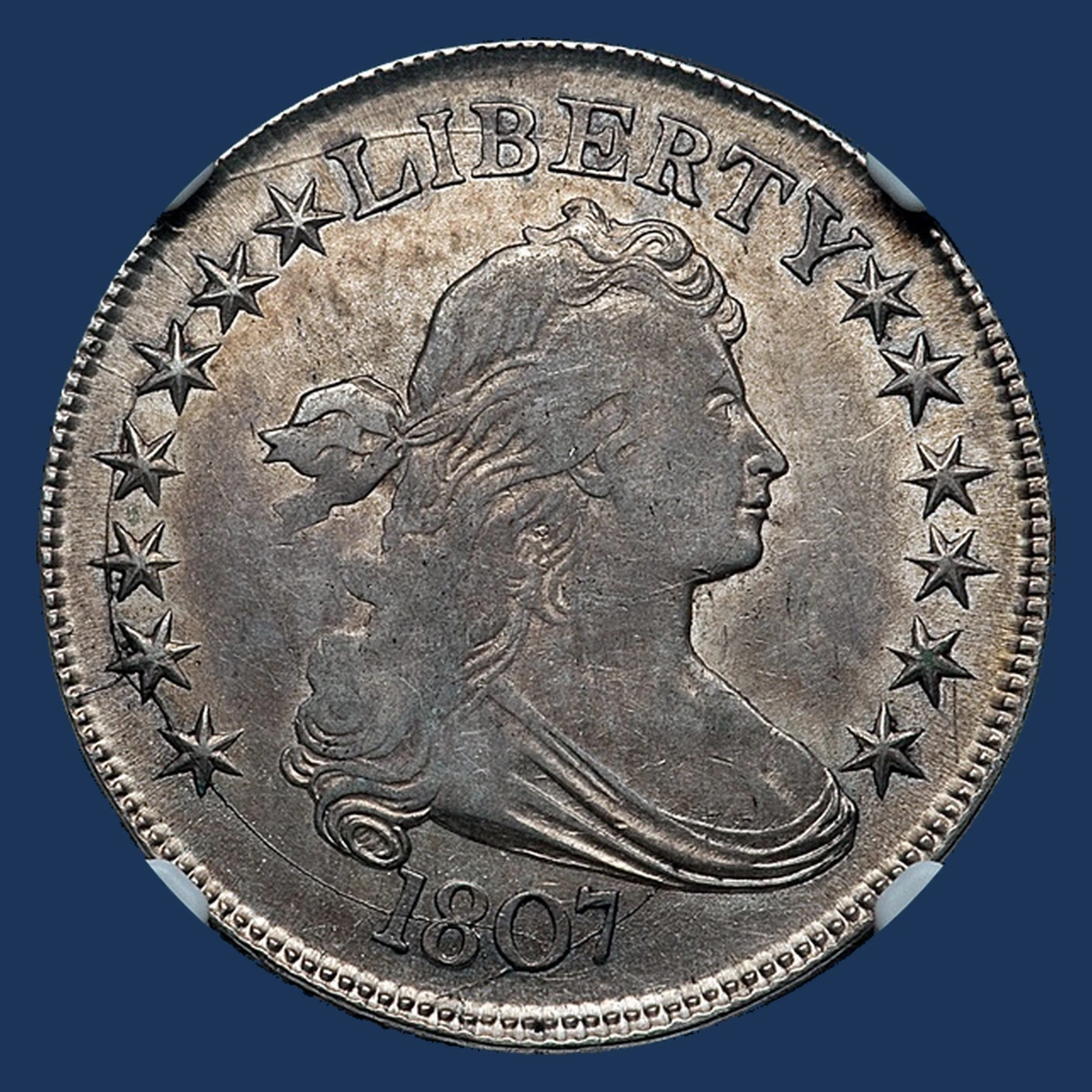
Fine raised lines circle the stars and lettering on CNG’s AU50 example. On the back, one runs from ED in UNITED toward the wingtip, and another from the last S in STATES toward the clouds.
Silver filled cracks in the stamping tools and reproduced them as ridges. The coin itself was not split along those routes.
A separate cataloged unworn example has a different front crack near the seventh star and LIBERTY. Its path belongs to that coin.
Compare each pattern separately. Combining lines from two examples would create a description that neither coin necessarily matches.
Estimated Value
CNG sold the PCGS AU50 example for $1,900 before buyer’s fees in September 2026. An estimated $350–$3,000 covers worn coins with visible crack lines.
This is a whole-coin price, including its date, condition, and appeal. An attractive, almost unworn coin with fine cracks can be worth more than a heavily worn piece with bold ones; the line’s size alone does not set the value.
How to Identify
Confirm the right-facing portrait, eagle with a shield, and lettered edge first. A digital scale and calipers can check accessible coins against about 13.48 grams and 32.5 millimeters.
Under a 10× magnifier, follow each line while changing the light direction. A raised ridge behaves differently from a scratch, especially where it crosses lettering.
For the CNG example, compare the UNITED-to-wing and STATES-to-cloud lines with the front’s surrounding cracks. Other examples need photographs of their own patterns.
The most useful distinction is a continuous raised line following a known route. A groove cut into the surface, even in roughly the same area, does not show a cracked die.
5. 1807 Draped Bust Half Dollar Die Clash (Estimated Up to $6,000)
A piece of the opposite design can appear where it does not belong. If the dies hit each other with no blank between them, one can leave its shape on the other.
Later coins then pick up those extra traces. This is called a die clash, and it does not require another coin to touch the finished surface.
Legend’s Regency XIII catalog describes strong clashes on both sides of an 1807 graded NGC MS64, an unworn coin. It does not give a complete map of their locations.
Clashes and cracks can occur together. Their shapes come from different causes.
Estimated Value
For worn examples with visible clashes, use an estimated $500–$6,000. An 1803 Draped Bust half with clashing and cracks, graded PCGS AU53, sold for $5,500 before fees in January 2008.
That older, different-year sale supplies a comparison, not a price for Legend’s 1807 MS64. The range concerns circulated coins; the much finer unworn catalog example needs its own price comparisons, with condition and original surfaces taken into account.
How to Identify
Place enlarged photographs of the two sides together. Try to explain an extra shape as part of the opposite design, allowing for how the stamping tools faced each other.
A 10× magnifier helps distinguish transferred shapes from scratches and raised cracks. Parallel lines made while adjusting a blank’s weight are another feature, not proof of a clash.
Inspect without rubbing or polishing the surface. Check the lettered edge and, when safely accessible, use a digital scale and calipers against approximately 13.48 grams and 32.5 millimeters.
A recognizable fragment of the other side, formed with the original design, is the strongest first clue. Random lines without that relationship do not establish clashing.
Conclusion
A slight shift, a tilted back, and weak curls are easy to overstate in a photograph. Begin with the complete Draped Bust design, then compare the specific feature rather than another half-dollar type from 1807.
Estimated worn-coin values run from $200 to $6,000. The $1,900 crack example sold before fees, while small rotation and off-centering need not add much at all; condition remains part of every comparison.