1818 Half Dollar Error List with Pictures

Read the edge as well as the date on an 1818 half dollar. Repeated words can reveal one error, while a hidden 7 beneath the last 8 identifies an overdate.
An 1818/7 Large 8 in MS64 sold for $19,388 at Heritage in August 2016. The 1818 half dollar errors below have estimated ranges from $120 to $25,000 across different conditions.
Follow the edge, cap, stars, and date to see what each feature means before choosing its price comparison.
1. 1818 Capped Bust Half Dollar Doubled Edge Lettering Error (Estimated Up to $700)
Whole letters can overlap around the edge even when Liberty and the eagle look normal. The inscription was added before the faces were struck, in a separate lettering operation.
A repeated or slipping pass through that equipment could create another set of letters. The extra sequence is more useful than one doubled stroke inside a character.
GreatCollections listed an O-114a in NGC XF40 with doubled edge lettering. A collector also reports an O-107.
These are different coins showing the same broad error. One thick or doubled stroke could instead come from the lettering tool itself.
Estimated Value
Estimate $150–$700 for a circulated 1818 with readable repeated lettering. Better-preserved examples with moderate to light wear support the upper comparison.
The XF40 listing identifies a coin but gives no usable sale amount here. A cleaned 1834 with doubled edge lettering sold for $220 at Heritage in July 2026, graded ANACS Fine Details.
That later, damaged example is a lower benchmark. It should not set a ceiling for an attractive 1818 with stronger edge repetition.
How to Identify
Photograph the full edge in overlapping sections while turning the coin in one direction. A close-up of one letter can hide how a second sequence fits into the inscription.
Use a 10× magnifier to follow extra characters into neighboring words. Their depth and surface should be consistent with original lettering, rather than newly cut additions.
The Philadelphia coin has no mintmark and normally measures about 32.5 millimeters. A scale checks the original 13.48 grams, allowing for wear, and calipers measure size.
Inspect both faces separately. Two overlapping sequences of complete letters give a clearer first answer than a doubled stroke within one character.
2. 1818 Capped Bust Half Dollar Partially Inverted Edge Lettering Error (Estimated Up to $1,000)
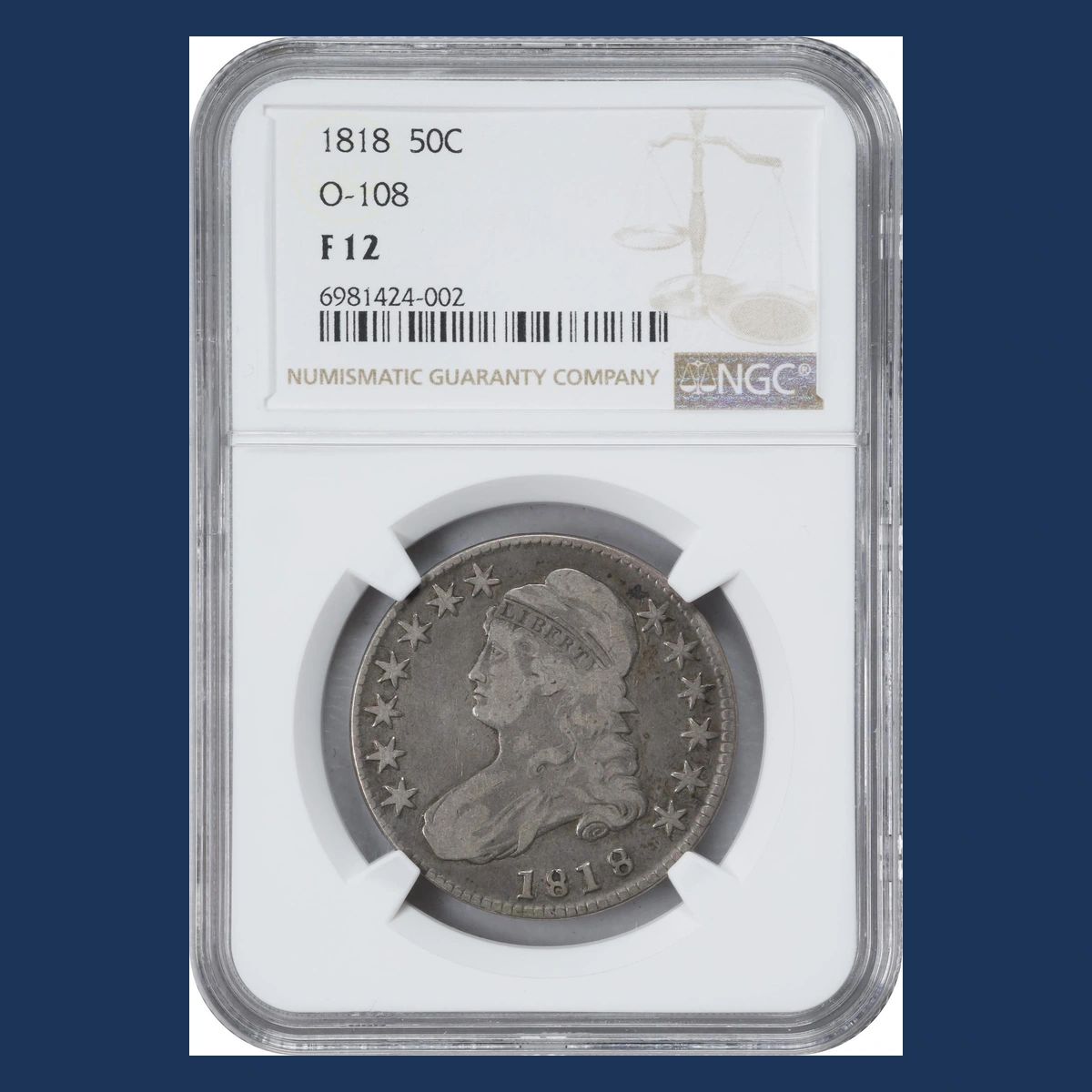
The edge words face opposite ways on the reported 1818 O-108. FIFTY CENTS OR has one orientation, while HALF A DOLLAR is upside down relative to it.
That differs from normal edge lettering that runs uniformly in either direction relative to Liberty. The mismatch is within the inscription itself.
The collector’s account explains it as an inverted lettering bar. One part of the edge tool was positioned the other way up.
Photographs must preserve the sequence. Reversing one image can imitate the same effect, so the claim depends on how both word groups sit on one continuous edge.
Estimated Value
A clearly identified mixed-direction edge has an estimated range of $300–$1,000 in moderately to lightly worn condition. This is not a recorded sale of the reported O-108.
The cleaned Fine Details 1834 doubled-edge sale at $220 in July 2026 gives a recent edge-error comparison. Its mechanism differs from an inverted segment.
The higher allowance assumes readable opposing word groups, original surfaces, and independent identification. Crowded or damaged lettering alone does not support the same comparison.
How to Identify
Keep the front facing upward throughout the examination. Read FIFTY CENTS OR, then continue straight into HALF A DOLLAR without flipping the coin.
The two groups must face opposite ways. All the words being upside down relative to Liberty is an ordinary orientation.
Use a 10× magnifier to distinguish surviving letter bottoms from dents. A scale and calipers check about 13.48 grams before wear and 32.5 millimeters; confirm both unmarked Philadelphia faces.
Record one continuous edge video so no photograph needs reversing. Seeing the two opposing word groups in that uninterrupted sequence is the most efficient check against a misleading assembled image.
3. 1818 Capped Bust Half Dollar Die Crack Error (Estimated Up to $1,200)
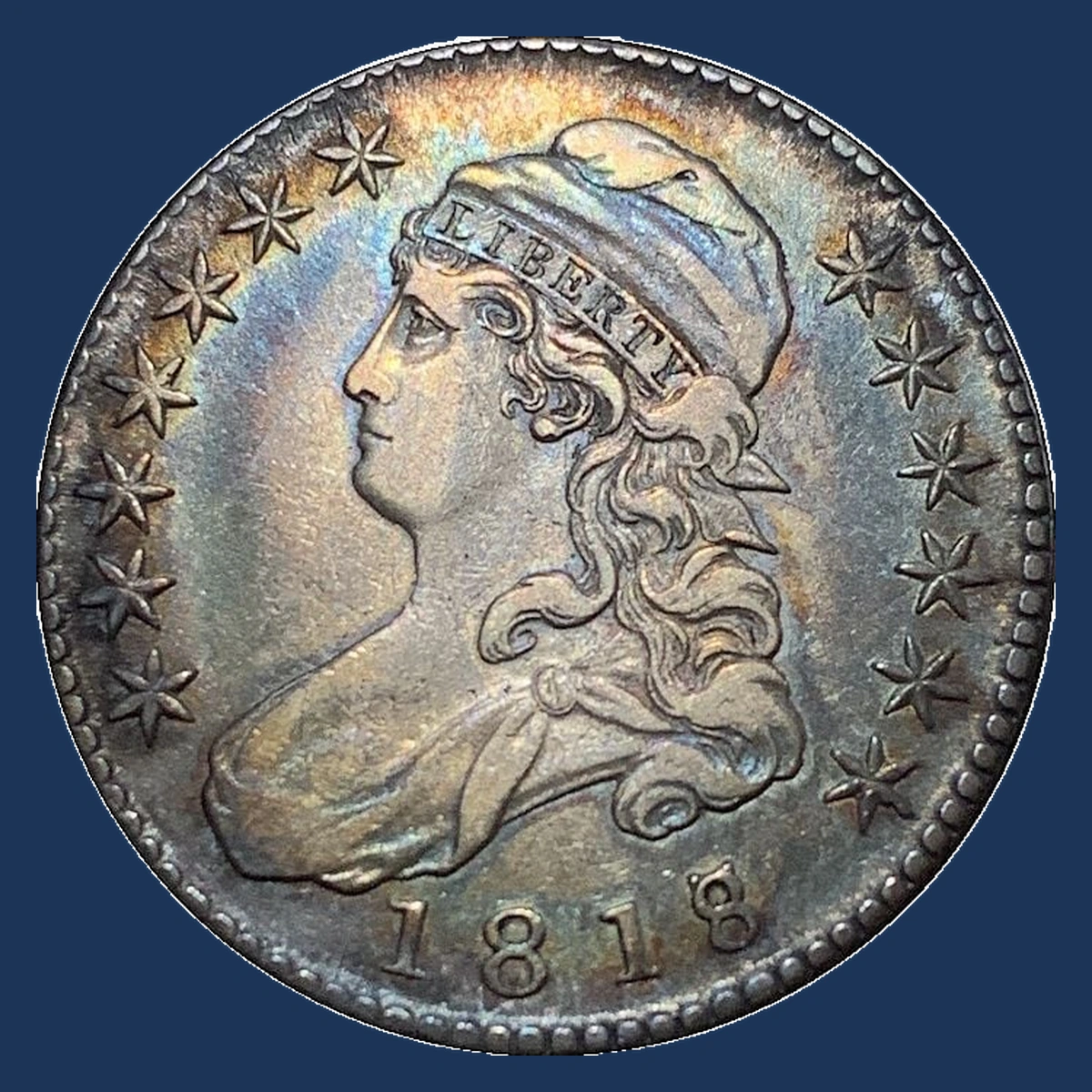
Raised lines connect parts of the date, curls, and stars on the 1818 O-112. The described route reaches the cap and upper-left border as well.
Specific points include the bottom of the first 8, the final 18, lower curls, and star 11. Other sections cross upper stars and the cap.
These lines came from cracks in the die, the steel stamping tool. Silver entered the openings and formed ridges on the coin.
Wear can hide part of a path. That differs from a scratch cut into the surface or a split through the coin’s own metal, which needs another explanation.
Estimated Value
Estimate $120–$1,200 for circulated 1818 examples with readable cracks and attractive surfaces. Lightly worn AU coins with stronger crack development sit toward the top.
An 1826 O-104 graded PCGS AU58 with cracks on both faces sold for $1,020 including fees in August 2025. It was offered by Early Cents Auctions.
That later Capped Bust supports the upper comparison. Its grade and crack paths should not be assigned to an 1818 merely because both coins show raised lines.
How to Identify
Use the O-112 description to compare where lines meet the date, curls, and stars. Number the stars from the lower left before tracing the reported intersections.
Under a 10× magnifier, move low light from side to side. A raised ridge changes its highlight and shadow differently from a recessed scratch.
Confirm the lettered edge and lack of a mintmark. A scale and calipers should show about 13.48 grams before wear and 32.5 millimeters.
Do not connect unrelated marks into one imaginary crack. Matching several clearly visible raised date-to-curl and star junctions is the useful first check for this documented pattern.
4. 1818 Capped Bust Half Dollar Slight Off-Center Strike Error (Estimated Up to $1,500)
The collector’s O-104a appears slightly off-center and also has small traces near Liberty’s cap. The centering question must be judged from both complete faces, not from those interior marks alone.
An off-center strike places the design out of its intended position on the blank. Early half dollars can complicate the comparison because ordinary outlines and borders vary.
The report supplies no direction or percentage. The shift should remain described as slight.
A large blank crescent on another coin is a different level of error. The cap traces may concern repeated striking, but they do not measure this coin’s off-centering.
Estimated Value
Estimate $300–$1,500 for a circulated 1818 with clear slight off-centering and good surfaces. That range reflects the subtle reported shift, rather than a spectacular missing-design error.
For contrast, an 1811 NGC Fine 12 struck twenty-five percent off-center sold for $11,162.50 in 2016. Its much larger displacement explains why the comparison differs.
The O-104a’s cap traces belong to the same coin. Any second-strike evidence must be considered within its total value, not added as a separate fixed premium.
How to Identify
Take straight-on photographs showing the entire blank. Compare each design’s center with the metal outline, keeping both faces in a known orientation.
A wide border on only one face can result from a misaligned tool. Early open-collar production, without a tight ring defining the edge, also allows normal shape variation.
Inspect the lettered edge through a 10× magnifier for filing or impact damage. A scale and calipers compare the coin with 13.48 grams before wear and about 32.5 millimeters.
Confirm 1818 and the lack of a mintmark. Matching displacement on both complete faces is the immediate test; the cap-area tracks answer a separate question.
5. 1818 Capped Bust Half Dollar Reported Double-Strike Dentil Tracks (Estimated Up to $3,000)
A short arc of border-tooth shapes can remain inside the design after a second strike. Those small teeth are called dentils and normally sit near the rim.
The collector’s 1818 O-104a reportedly has subtle tracks near the cap, along with slight off-centering. The report gives neither a complete second portrait nor a measured turn.
A moved coin or tool can leave only small parts of an earlier impression visible. A full duplicate design is not required.
The surviving sequence still needs checking. Parallel scratches, clash marks, and the normal outer dentils have different causes.
Estimated Value
Estimate $600–$3,000 for a circulated example whose subtle tracks convincingly show another strike. A related 1824 front double strike graded PCGS VF20 sold for $2,880 at Heritage in January 2022.
That is a different-year comparison, not a sale of the reported 1818. The clarity of the surviving pattern matters greatly.
The O-104a’s slight off-centering and dentil tracks are features of one coin. Their two ranges should not be added as independent premiums.
How to Identify
Begin near the cap and compare the tracks with the normal border teeth. Through a 10× magnifier, check their spacing and curve rather than searching immediately for another portrait.
Low side light helps separate original impressions from new cuts or surface contact marks. Look for supporting remnants elsewhere, but do not require equal doubling on the back.
Check the 1818 date, unmarked Philadelphia identity, and complete edge inscription. Record weight and size with a scale and calipers against 13.48 grams and about 32.5 millimeters.
The first feature to resolve is a short row of tooth shapes with the expected spacing and an original struck surface.
6. 1818 Capped Bust Half Dollar 1818/7 Overdate (Estimated Up to $22,000)
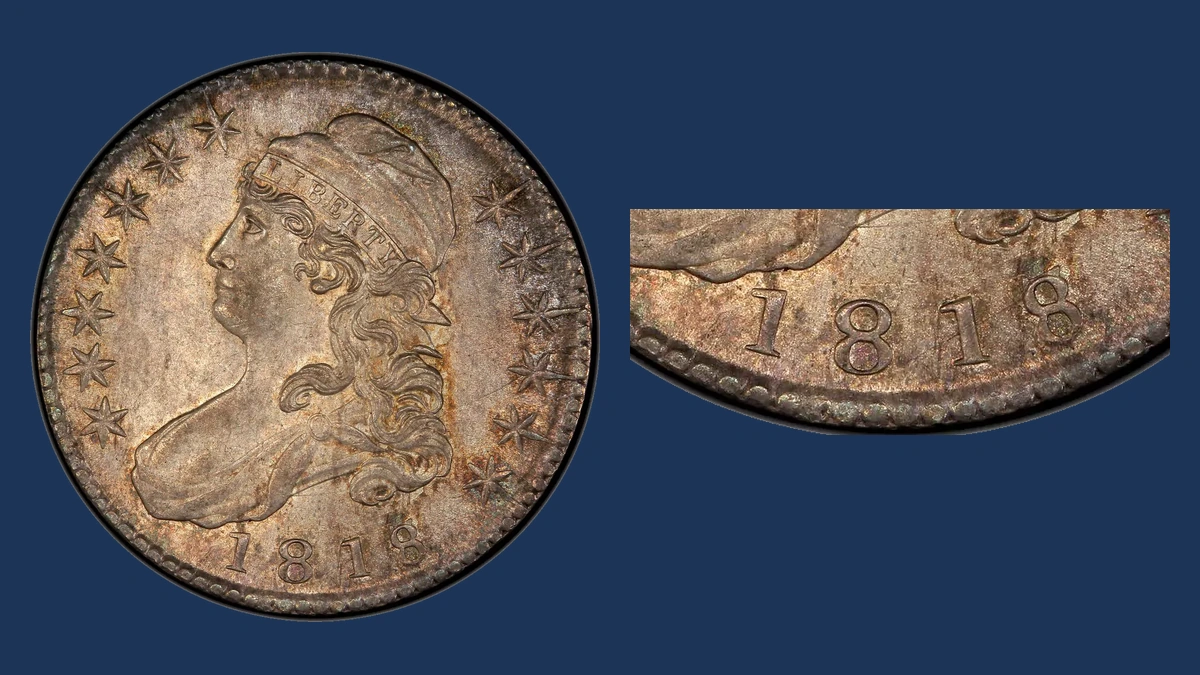
Two different eights answer two different questions on an 1818/7. The last 8 contains traces of the earlier 7, while Small 8 and Large 8 describe the first 8 in the date.
An 1817-dated front stamping tool was changed for use in 1818. Later coins copied the surviving old digit beneath the new one.
That is an overdate, not a second strike on each coin. The earlier digit was already part of the tool.
Compare the middle connection of the first 8 to choose the version. Small 8 has a slanted script-style connection, while Large 8 has a flatter one.
Estimated Value
Circulated overdates have an estimated $250–$2,000 range from moderate to slight wear. An NGC AU53 Large 8 brought $1,320 at Stack’s Bowers in April 2025.
Higher-quality unworn coins occupy a separate estimated $6,000–$22,000 range. PCGS records $19,388 for Large 8 MS64 at Heritage in August 2016.
Keep the version and condition with each price. A worn coin should not inherit the unworn result merely because both dates show traces of a 7.
How to Identify
Use a 10× magnifier on the last 8 first. Compare its old-digit traces with a known overdate, rather than treating a scratch or thick outline as proof of a 7.
Now move to the first 8. Its middle connection distinguishes Small 8 from Large 8; inspecting the wrong digit can produce the wrong variety name.
Confirm 50 C. on the back because the 1818/5 quarter is a different coin. The lettered-edge half normally weighs 13.48 grams and measures about 32.5 millimeters with a scale and calipers.
The last digit establishes 8 over 7, and the first 8 then gives the quickest major-version distinction.
7. 1818 Capped Bust Half Dollar Natural Planchet Flaw (Estimated Up to $25,000)
A tiny irregularity sits immediately right of star 4 on the front of this exceptional overdate. Stack’s Bowers notes it as a natural planchet flaw on lot 4092 in March 2021.
The coin was an 1818/7 Large 8 graded NGC MS64+. The small mark helps identify that particular example.
Planchet flaw means a problem in the original metal blank. The catalog does not describe peeling or a loose layer, so lamination would be a narrower claim than its evidence supports.
The surrounding coin remains impressive. This is a small identifying feature rather than a major visual error dominating the piece.
Estimated Value
Estimate $12,000–$25,000 for a high-quality unworn 1818/7 comparable to the cataloged MS64+. The $19,388 Large 8 MS64 sale from August 2016 provides a nearby condition and variety reference.
It is not the sale price of lot 4092. The range values the whole overdate with its small natural flaw.
A similar tiny defect on a moderately to lightly worn coin would instead compare around $250–$1,000. Preservation carries far more value than the blemish itself.
How to Identify
Count upward from the lower-left front star to star 4. Inspect immediately to its right, rather than choosing a mark at a guessed position near the rim.
Compare the area with lot 4092 in the March 2021 catalog. A 10× magnifier and low light reveal how the irregular surface meets surrounding struck metal.
Gouges or corrosion can create different boundaries. Record both faces, the Large 8 overdate, and lettered edge, with a scale and calipers against 13.48 grams and about 32.5 millimeters.
Matching the position beside star 4 together with compatible surface texture is the most direct first identification check.
Conclusion
Estimated values span $120–$25,000 for the examples and conditions covered. Edge words reveal repetition or an inverted segment, while the date, cap, and stars answer different questions about the tools and strikes.
The O-104a’s two reported striking features belong to one coin, so their ranges should not be added. For the high-grade overdate with a tiny metal flaw, the coin’s preservation and variety remain the main price factors.