1856 Half Dollar Error List with Pictures

A missing fold beneath Liberty’s elbow helps identify an 1856-S that sold for $3,162.50 in August 2011. Other 1856 Liberty Seated Half Dollar errors add detail instead, from jagged rim patches to shield lines in Liberty’s clothing.
Estimated values for the seven features below range from $125 to $5,000. The prices apply to the stated grades and examples.
Check the mintmark first, then follow the visible clues to distinguish a worn design from a damaged tool or separating metal.
1. 1856 Liberty Seated Half Dollar Clamshell Lamination Error (Estimated Up to $600)
A partly attached flap gives the reported Philadelphia coin a clamshell-like opening. The metal has separated along an internal weakness while one part remains connected.
Collectors call this lamination. The blank used for an 1856 half was 90% silver alloy, not the bonded outer layers found on modern clad halves.
The split therefore formed within the original alloy. It should not be explained as a modern outer layer coming unglued.
The year account describes a circulated coin but gives no certified grade or exact location. Its actual flap and connection need examination before a more specific claim can be made.
Estimated Value
Estimate $150–$600 for a circulated example with an original attached flap. The year guide recorded a $399.99 asking price for the reported piece.
That was a seller’s offer, not a completed auction result. It provides a midpoint reference for the estimate.
The flap’s extent and the coin’s overall condition matter. A small peel and a large clamshell opening should not receive the same value simply because both involve separated metal.
How to Identify
Do not flex or lift the flap. Its surviving connection can break and is part of the evidence.
Under a 10× magnifier, inspect the layer boundary and the attached end. Look for a natural split rather than a tool cut or metal pried open afterward.
A scale checks against the original 12.44 grams, though an attached flap may cause little weight loss. Measure about 30.6 millimeters across intact edges with calipers and inspect the edge ridges for cutting.
Rough corrosion is different from a single separating sheet. A natural layer opening with an undisturbed connection is the clearest immediate clue to this clamshell form.
2. 1856 Liberty Seated Half Dollar Die Clash Error (Estimated Up to $1,000)
Shield lines do not belong in Liberty’s clothing. On documented Philadelphia examples, marks near the knee and skirt copy parts of the shield from the back.
They came from a die clash. Dies are the steel tools that stamp the two faces; without a blank between them, contact can leave one design on the opposite tool.
Later coins then copy the unwanted traces. The area to the skirt’s right is part of the reported comparison.
Some sawtooth-cud examples have this clash too. Contact between tools causes the transferred design, while missing pieces of tool steel cause the raised rim patches.
Estimated Value
For circulated Philadelphia coins with readable shield traces, estimate $125–$1,000. The clarity of the marks matters alongside wear and surface condition.
A same-year historical comparison is Heritage’s ANACS MS63 reverse strike-through, sold for $632.50 in July 2003. Its description also noted light clashing.
That price includes the unworn coin and its other feature. It does not isolate a clash premium or provide a current fixed value for every 1856 with transferred shield lines.
How to Identify
Compare the extra clothing lines with the shield on the back. A 10× magnifier and aligned photographs help show whether their spacing and shapes fit that opposite design.
Philadelphia has no mintmark below the eagle. Check the normal 12.44-gram weight before wear and 30.6-millimeter diameter with a scale and calipers, along with the ridged edge.
Scratches cut into the surface without needing to follow any shield feature. A later impression from another finished coin can also disturb surrounding metal.
The focused first check is shield-derived lines in the documented knee-and-skirt area, rather than a mark that merely looks like another fold.
3. 1856-O Liberty Seated Half Dollar Doubled Die Obverse Error (Estimated Up to $1,800)
PCGS recognizes an 1856-O doubled front as WB-19. That gives collectors a particular variety to compare, rather than treating any thick date as an error.
Obverse means the front. A doubled die already has repeated design in the stamping tool before coins are made.
Later coins copy those shapes. A tool slipping during one strike can instead leave a flat ledge beside the design.
This year also has repunched dates, where the date punch left an earlier outline. Those numeral marks need separate checking and do not alone prove that the coin matches the cataloged WB-19 doubled front.
Estimated Value
Estimate $150–$1,800 for properly identified circulated examples. Attractive coins with only light wear fit the stronger end of the comparison.
PCGS recognizes WB-19 but lists no auction record on its page. A different-year comparison is an 1871-S doubled front with an incomplete S, graded PCGS MS65, sold for $7,200 in May 2025.
That exceptional unworn coin is a higher-grade reference only. Its result is not a sale or valuation of the 1856-O variety.
How to Identify
Find the O below the eagle first. A Philadelphia coin cannot become this New Orleans variety because its date looks similar.
Compare the front with a certified WB-19 image through a 10× magnifier. The available catalog text does not name one exact letter, so use the actual photographed repeated contours.
A scale and calipers check the original 12.44 grams and about 30.6 millimeters, with a normal ridged edge. Those dimensions identify the basic coin, not the doubling.
Look for rounded extra design instead of flat ledges or altered cuts. A direct match to the WB-19 reference is the efficient first confirmation.
4. 1856 Liberty Seated Half Dollar Sawtooth Cud Error (Estimated Up to $2,000)
Two jagged raised shapes sit outside the first and second stars at the lower-left rim. They give the Philadelphia sawtooth-cud variety its name.
Cracks around stars one through three help locate the affected area. A cud forms when part of a stamping tool breaks away at its edge.
Silver fills the resulting space during striking, leaving an irregular raised patch. It adds metal above the intended surface rather than removing a piece of the coin.
That differs from a clip or a rim dent. A later blow can bend the outline, but the surrounding metal should tell a different story.
Estimated Value
Estimate $150–$2,000 from circulated examples through modest unworn coins with identifiable sawtooth detail. Clear projections and undamaged surfaces support the higher comparison.
An 1848 WB-13 rim cud in MS61 had a published result of $1,700 in Heritage’s January 2025 sale. It offers a related Seated-half reference.
The date and cud location differ. That result is not a transaction for the 1856 sawtooth variety, and minor worn projections need a different condition assessment.
How to Identify
Count stars upward from the lower left and inspect the rim outside the first two. A 10× magnifier should show the raised tooth-like patches joining the struck border.
Look for the supporting cracks in the surrounding star area. Then inspect the complete ridged edge for dents, bending, or flattened metal that could imitate the outline.
A scale checks the original 12.44 grams with allowance for wear. Calipers should find about 30.6 millimeters across intact areas, rather than a generally squeezed or expanded coin.
A clip removes metal while a cud adds a raised shape. The matching pair outside stars 1 and 2 is the direct recognition point.
5. 1856 Liberty Seated Half Dollar Repunched Date Error (Estimated Up to $2,000)
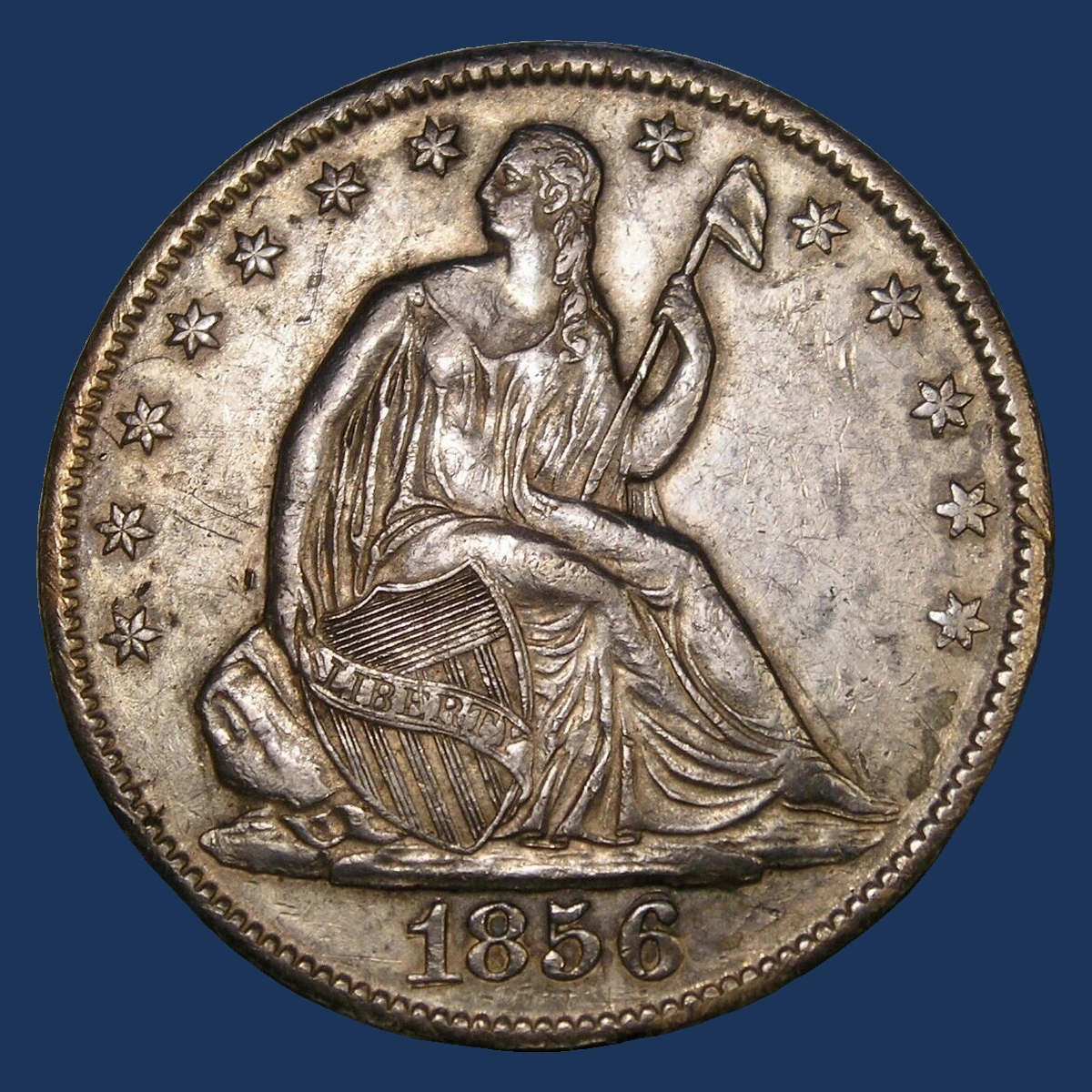
Extra strokes may appear beside the 1, the 6, or the last two digits together. Philadelphia and New Orleans each have cataloged repunched-date examples.
The date punch entered the stamping tool more than once in slightly different positions. Part of an earlier numeral outline survived beside the final shape.
Check the mintmark before choosing a reference. An O below the eagle identifies New Orleans, while Philadelphia has none.
The O does not make this a repunched-mintmark error. The repeated detail is in the front date.
Estimated Value
Estimate $150–$2,000 across representative circulated and lower unworn examples. Compare the mint and condition before judging the strength of the extra date detail.
A Philadelphia WB-6 Repunched 1 graded XF40 sold for $372 at Heritage in May 2022. An 1856-O repunched date in PCGS MS63 brought $1,320 at Stack’s Bowers in November 2019.
Both are whole-coin prices. Exceptionally well-preserved specimens can exceed this working range, while heavier wear belongs nearer its lower end.
How to Identify
Photograph the date straight on with all four digits visible. Use a 10× magnifier to follow any extra curve, upright, or small end stroke beside a numeral.
Match its shape with the correct mint’s example. Do not assume every 1856 date was punched twice in the same direction.
The normal coin has a ridged edge and weighs 12.44 grams before wear. A scale and calipers check that weight and a diameter around 30.6 millimeters.
A scratch usually fails to form a recognizable digit shape, while striking movement can leave flat ledges. A matching earlier numeral outline is the quickest useful confirmation.
6. 1856 Liberty Seated Half Dollar Reverse Struck-Through Error (Estimated Up to $2,500)
An unusual area behind the eagle’s head appears on Heritage’s cataloged 1856 Philadelphia example. The title calls it a reverse strike-through, while the description calls it a mint-made metal flaw.
A strike-through normally happens when material lies between the stamping tool and blank, interrupting the design. Here, no specific substance is identified.
The catalog also notes light clashing on the same ANACS MS63 coin. Those transferred lines are separate from the interrupted area behind the head.
Use the visible location to compare the example. The wording supports the listed classification without proving whether grease, cloth, or another material caused it.
Estimated Value
The coin sold for $632.50 at Heritage on July 30, 2003. That is a direct historical 1856 result, not a recent transaction.
A current working estimate is $500–$2,500 for comparable attractive examples. Grade and the visibility of the unusual back area affect the range.
MS63 means the reference coin was unworn. A small flaw on a worn piece should not automatically receive the high end of this comparison.
How to Identify
Locate the area behind the eagle’s head in the Heritage record. Compare its outline through a 10× magnifier with the coin in front of you.
A later gouge can push metal beside a cut. An interruption formed during striking should relate naturally to the surrounding design instead.
Check a loose coin with a scale and calipers against 12.44 grams and about 30.6 millimeters. The ridged edge should be inspected for later work; a depression need not remove metal or make the coin light.
Keep accompanying clash lines separate. Matching the original interruption behind the head is the quickest check for this example.
7. 1856-S Liberty Seated Half Dollar No Drapery Die-Polishing Error (Estimated Up to $5,000)
A fold should hang beneath Liberty’s left elbow on an 1856 half dollar. On the recognized San Francisco No Drapery variety, that shallow detail is absent.
Polishing the stamping tool removed the recess that formed the fold. Later coins therefore came out without it.
This is a changed tool, not a return to the separate 1839 No Drapery design. The year and mint still matter.
A worn elbow alone cannot prove the variety. General circulation wear smooths many exposed parts, while this identification requires the specific lost fold to match the known example amid enough surviving nearby detail.
Estimated Value
Estimate $500–$5,000 across identifiable circulated examples. The scarce San Francisco coin already carries significant value before its missing fold is considered.
A PCGS AU55 No Drapery example sold for $3,162.50 at Stack’s Bowers in August 2011. AU55 indicates only light wear.
The catalog noted surface problems on the back. Those problems make originality important when choosing another comparison, and the older result is not a fixed price for every similarly graded coin.
How to Identify
Compare the area beneath the left elbow with normal drapery and a known No Drapery example. Use a 10× magnifier to judge the missing fold alongside nearby retained detail.
Confirm the S below the eagle. A Philadelphia coin or a generally worn portrait needs a different comparison.
With a scale and calipers, check the normal 12.44 grams before wear and roughly 30.6-millimeter diameter. Inspect the ridged edge and nearby surfaces for alteration.
Scraping can remove a fold but leaves disturbed texture or cut boundaries, so do not clean the area. The absent fold matching the recognized San Francisco pattern is the quickest specific identification check.
Conclusion
The estimated ranges run from $125 to $5,000 for these 1856 examples. A separating layer, transferred shield lines, repeated date, jagged rim patch, and missing fold leave different clues.
Keep Philadelphia, New Orleans, and San Francisco comparisons separate. When a coin has more than one feature, such as a clash and a strike-through, its price still covers one complete coin rather than two independent error premiums.