1962 Half Dollar Error List with Pictures

A 1962-D Franklin half dollar struck twice sold for $11,400 in November 2022. Its second picture sits far off center, overlapping the first.
Smaller 1962 Franklin half dollar errors can be much more affordable, with estimated ranges across this guide running from $40–$13,000. Some add tiny raised details; others change the coin’s shape or metal.
Start with the mouth and mint letter, then follow the seven types below to compare the larger mistakes.
1. 1962 Franklin Half Dollar Bugs Bunny Die Clash (Estimated Up to $175)
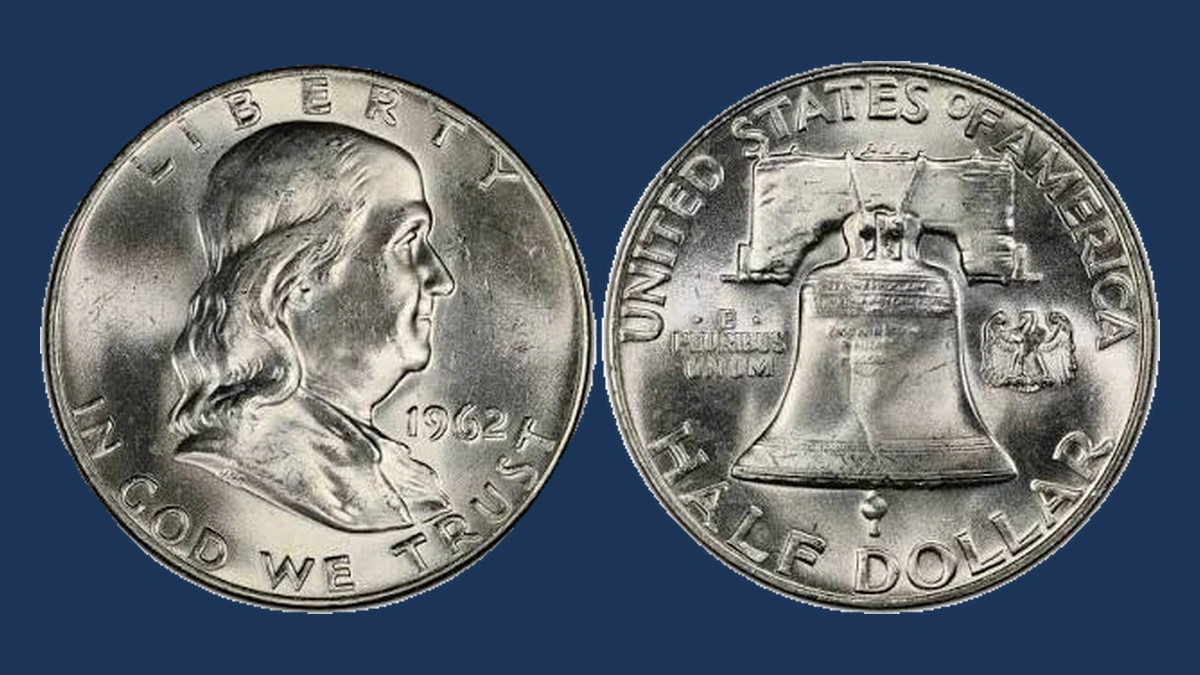
Franklin appears to have protruding teeth on this variety. The extra shape actually comes from part of the eagle’s wing on the other face.
It formed after the dies, the steel tools that stamp coins, hit each other without a blank between them. Later coins received the unwanted wing trace near Franklin’s mouth.
Collectors call the effect Bugs Bunny. It belongs to the Philadelphia issue made for everyday use, which has no mint letter.
The teeth are not an added object or a changed portrait. Other faint clash marks may appear with them on the same coin.
Estimated Value
The year guide records two MS63 examples in sold listings at $50 and $95 in July 2026. MS63 means unworn with visible marks.
An estimated $40–$175 covers worn through attractive unworn examples with a clear mouth feature. Strong preservation and an easy match to the variety support the upper end.
These are modest whole-coin values. A faint mark or unclear photograph does not justify the same price as a well-defined Bugs Bunny example.
How to Identify
Look at Franklin’s mouth under a 10× magnifier, keeping the nearby profile in view. Find where the tooth-like projection joins the surface.
An attached speck may show a seam, while a gouge cuts into the metal. A genuine clash trace is part of the struck picture.
Compare with a recognized example from the PCGS year listing. A sharp mark near the lip does not establish the nickname by itself.
This Philadelphia coin has no mint letter above the bell. Inspect the edge grooves and use a scale and calipers when safely accessible against 12.50 grams and 30.6 mm.
Match the raised tooth-like shape at the mouth, rather than simply finding any extra mark there.
2. 1962-D Franklin Half Dollar Repunched Mintmark (Estimated Up to $200)
The small D above the bell was punched separately into the stamping tool. If the punch moved before a later blow, a piece of the earlier D could remain.
Coins made with that tool would then show both impressions. Collectors call this a repunched mintmark.
NGC lists a D/D variety for 1962. The extra detail belongs at the mint letter on the back, rather than in the date on the front.
No single direction is assigned here to the old punch. Look for a separate raised stroke, not just a D that appears unusually thick.
Estimated Value
An estimated $50–$200 suits recognizable repunched D examples from worn to unworn condition. Clear extra strokes and attractive surfaces help support the upper end.
The 1962 price guide places an unworn example near $120. That is a guide estimate, not a named auction result.
The surrounding range allows for wear and the strength of the extra impression. A large photograph of a barely visible mark does not by itself add value.
How to Identify
Find D above the Liberty Bell and move the light around it. A 10× magnifier should help separate a real raised stroke from a bright reflection.
Trace the suspected old D independently of the final letter. It should form part of a recognizable second impression rather than a random bump.
Compare the complete shape with the NGC D/D example. A flat shelf or metal pushed up by an impact can imitate doubling.
Check the date, edge grooves, and normal dimensions. Use a scale and calipers when safely accessible against 12.50 grams and 30.6 mm.
The key is a separately placed piece of D, not thickness around the whole letter.
3. 1962 Franklin Half Dollar Curved Clip (Estimated Up to $250)
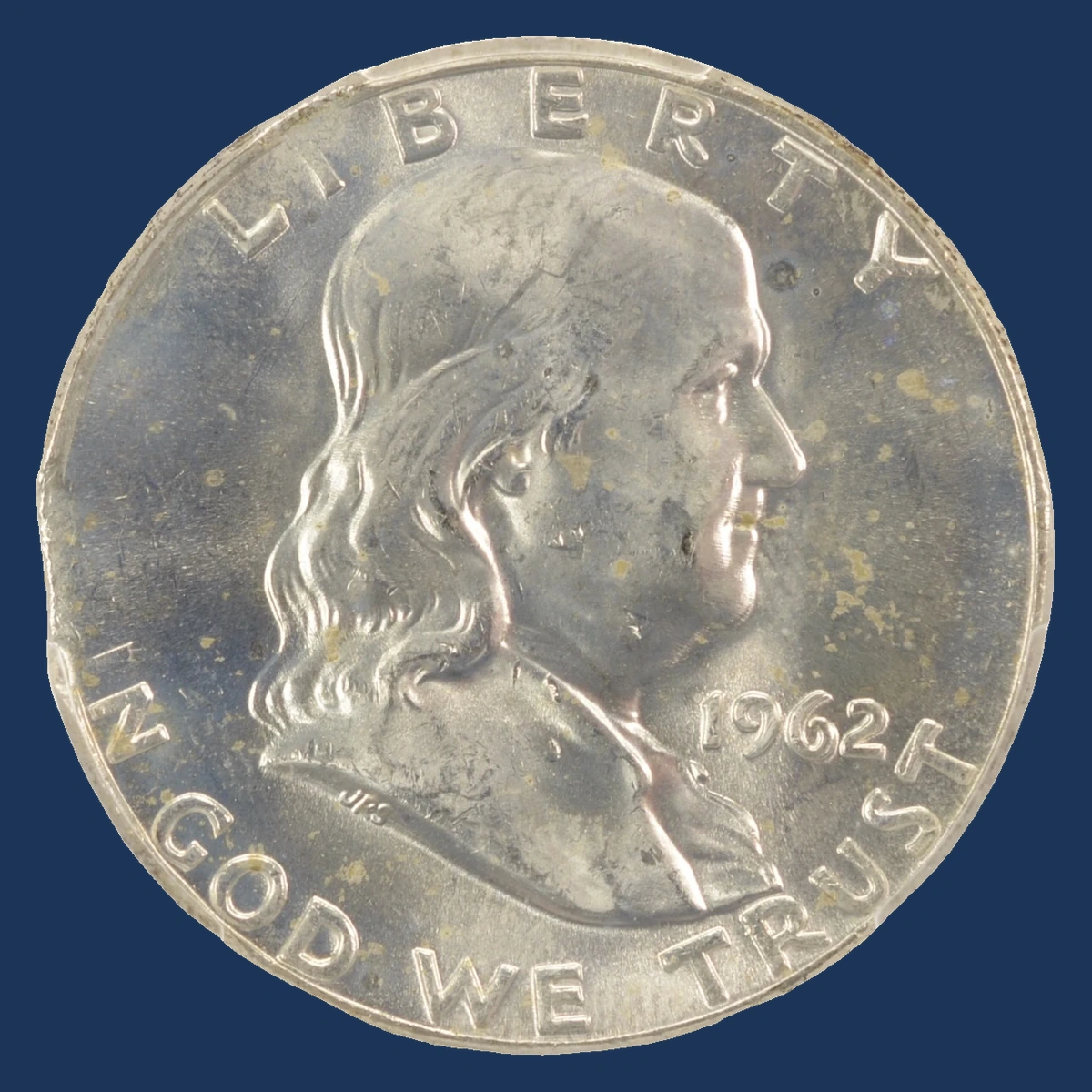
A curved clip removes part of the coin’s original blank. It begins when the punch overlaps a hole left by an earlier blank.
The incomplete piece can still reach the press. Its remaining metal then flows around the gap as the pictures are struck.
CoinValueApp describes a 1962 example with a fifteen-percent clip and an MS64 grade. That grade means unworn with some marks.
The account does not establish its mint letter. It should stay separate from the smaller Denver clip used for the price comparison, rather than borrowing that coin’s mint, grade, or sale amount.
Estimated Value
A 1962-D with a four-percent clip sold for $84 in March 2011. Its MS61 grade describes an unworn coin with noticeable marks.
That historical sale is not the price of the reported fifteen-percent MS64 example. The coins differ in clip size and preservation.
Estimate $75–$250 for genuine curved clips. A larger, clearer missing segment and better surfaces can support a higher figure, but the two descriptions must remain separate comparisons.
How to Identify
Follow the curve from one intact part of the rim to the other. Under a 10× magnifier, inspect how the design fades or changes as it approaches the gap.
Check the opposite rim for weakness that may have formed because the blank was incomplete. That supporting sign is useful when present.
A cutter can also make a smooth crescent. Saw marks, sharp burrs, or cuts through completed edge grooves suggest later damage.
On safely accessible coins, compare the remaining weight with 12.50 grams using a scale. Calipers across intact areas should fit the ordinary 30.6 mm format.
Keep the date visible, then check that the struck metal beside the gap shows it existed before the picture was added.
4. 1962 Franklin Half Dollar Proof Doubled Die Obverse (Estimated Up to $350)
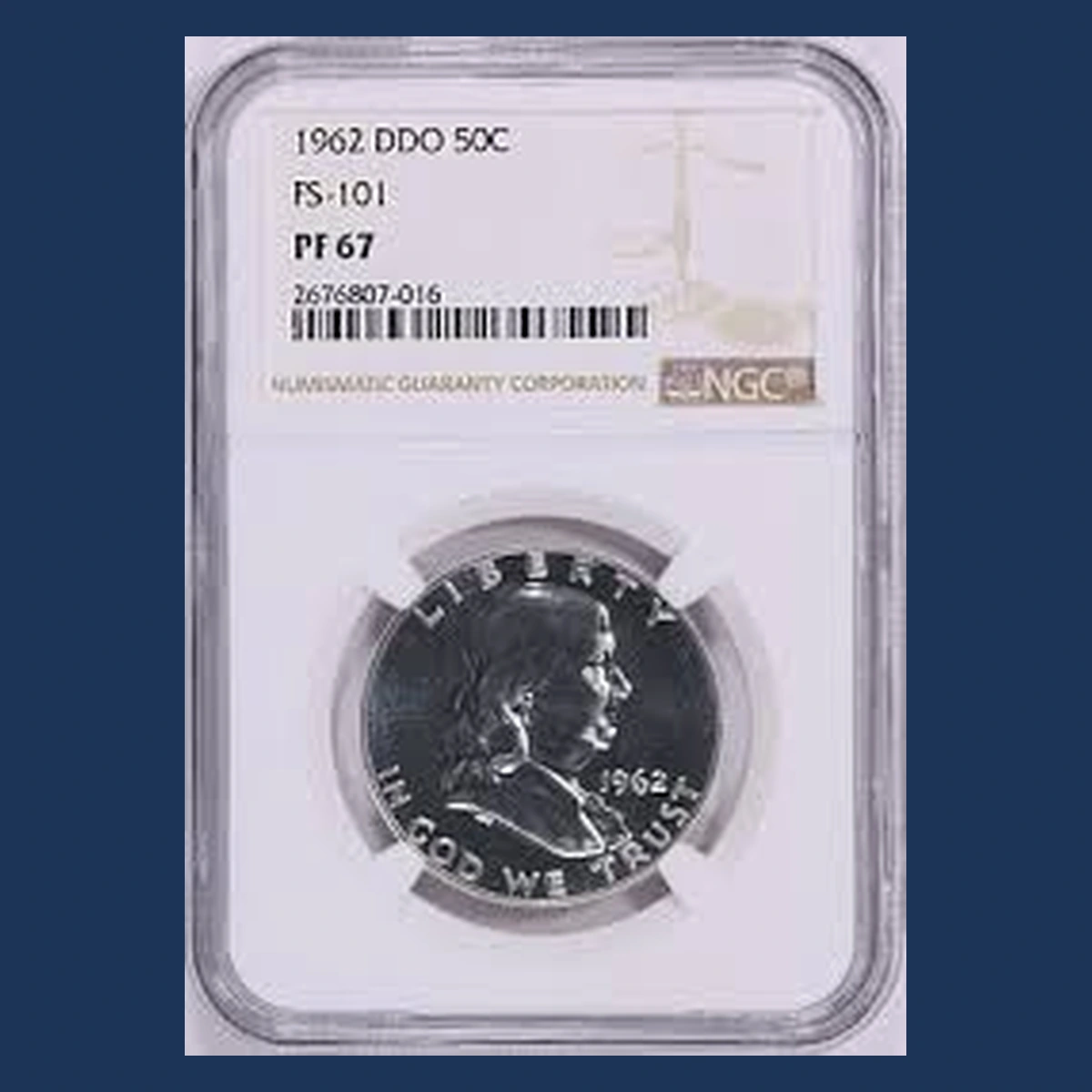
A Proof is a specially made collector coin, often with mirror-like flat areas. That shine can make extra lettering easier to inspect, but shine itself is not the error.
The 1962 Proof variety called FS-101 has doubled detail on the front. Its stamping tool carried the extra outlines before it made the coin.
Compare the letters and date with an ordinary Proof and a verified FS-101. Reflections can otherwise make a single outline appear doubled.
This variety belongs to Philadelphia Proofs. A worn Denver half does not become the same variety simply because an edge near its date looks repeated.
Estimated Value
Recorded FS-101 Proof sales include $69 for PR64 in April 2026 and $159 for PR67 in July 2026. The numbers describe condition, with PR67 better preserved.
Estimate $60–$350 for comparable identified Proofs. Surface quality and grade help place a coin within that range.
The GreatCollections variety archive includes several Proof grades. An exceptionally clear contrast between the portrait and mirror-like areas needs its own comparison rather than an automatic added amount.
How to Identify
Confirm that the coin is a Proof and has no D above the bell. Bright polish on an ordinary coin is not enough to establish the collector finish.
Move the light across the front while using a 10× magnifier on the date and letters. A real repeated outline should remain visible when glare changes.
Compare rounded extra detail with a verified FS-101 photograph. Flat shelves can come from movement during striking, while fine scratches cross the surface without forming another letter.
Normal measurements remain 12.50 grams and 30.6 mm, with edge grooves. Use a scale and calipers only when safely accessible, avoiding contact with delicate flat areas.
Match several date or letter contours, rather than relying on one shiny close-up.
5. 1962 Franklin Half Dollar Off-Center Strike (Estimated Up to $500)
When a blank enters the press out of position, the picture and the coin no longer share a center. Part of the blank stays bare while some intended design misses it.
The 1962 guide reports off-center Franklin halves with readable dates. It does not identify one certified coin for every percentage discussed.
A single displaced strike differs from the Denver double strike later in this list. That coin first received a normal picture, then moved before another blow.
Look at the metal beside the shifted design. Bare blank surface and an older struck picture tell different stories.
Estimated Value
The year guide places modest ten-to-twenty-percent shifts in lower ranges and pronounced readable-date examples around $300–$500. These are estimates rather than confirmed sales for each percentage.
An overall estimated range of $50–$500 allows for wear, amount of shift, and surviving date. Those factors need to be considered together.
A Franklin half missing its entire date cannot be identified as 1962 merely because it resembles another pictured error.
How to Identify
Find the date before measuring the shift. Without readable 1962 digits, the coin cannot support this year-specific comparison.
Compare both faces while tracking the same area. One uneven picture with a centered opposite face may come from a misaligned tool instead.
A 10× magnifier helps show where struck detail meets untouched metal. Grinding away a border leaves different surfaces and does not create matching incomplete pictures.
Use a scale and calipers when safely accessible against 12.50 grams and the normal 30.6 mm diameter. The outline may be distorted, and edge grooves may be incomplete.
The useful combination is a readable 1962 date and the same displaced blank affecting both pictures beside a genuinely bare area.
6. 1962-D Franklin Half Dollar on a Nickel Planchet (Estimated Up to $6,000)
A five-cent blank is too small to hold the whole Franklin half-dollar picture. Outer letters can fall beyond its edge when half-dollar tools strike it.
Recorded 1962-D examples include an MS64 coin weighing about 5.1 grams and an MS67 coin weighing about 5.0 grams. These are separate coins with the same basic mistake.
The metal changes too. A nickel blank is copper-nickel rather than the half dollar’s usual ninety-percent silver alloy.
Weight alone cannot prove the error. Size, metal, and the surviving Denver design must all agree that the press received the wrong blank.
Estimated Value
The MS67 example sold for $4,312.50 in January 2009. That grade describes exceptionally well-preserved unworn condition.
An estimated $3,000–$6,000 suits authenticated examples in comparable unworn condition. This is a same-year nickel-blank comparison, not a price borrowed from another denomination’s error.
Keep the MS64 and MS67 coins separate when comparing marks and surviving design. Their historical descriptions do not mean either exact coin has recently sold at the endpoints of the estimated range.
How to Identify
Start with a scale when the coin is safely accessible. About 5.0–5.1 grams fits the recorded examples and is far below the normal 12.50 grams.
Calipers should show a smaller body than the ordinary 30.6 mm half dollar, allowing for spreading during the strike. Inspect the edge under a 10× magnifier for filing or cutting.
The picture should run naturally beyond the available metal. Record any remaining edge grooves rather than expecting a complete normal edge.
A specialist can test copper-nickel against the usual silver alloy. Compare the published MS67 example while preserving the date and D identification.
A small five-gram body with naturally missing outer design is the useful combination, rather than low weight alone.
7. 1962-D Franklin Half Dollar Double Strike (Estimated Up to $13,000)
The edge grooves help explain this coin’s story. Its first strike happened inside the retaining ring, making an ordinary half dollar with a complete grooved edge.
The coin then moved and received another blow. That second strike was about seventy percent off center toward two o’clock.
The new partial picture overlaps a design already on the metal. It does not simply sit beside a blank crescent.
The auction example was graded MS60, meaning unworn but with many marks. Its overlapping pictures and surviving edge make the order of the two strikes unusually clear to follow.
Estimated Value
The documented double strike sold for $11,400 on November 21, 2022. It provides the strongest direct error-sale comparison in this list.
Estimate $9,000–$13,000 for an authenticated piece of similar condition with equally clear overlapping strikes. The readable Denver identity and obvious second picture help explain its appeal.
That range does not apply to a faint doubled nose, a doubled-die Proof, or an off-center coin struck only once. Those features have different causes.
How to Identify
Find the ordinary first picture, then follow the extra impression toward two o’clock. The second design should overlap existing details in one consistent direction.
Inspect the complete edge grooves with a 10× magnifier. They support the catalog’s description of a normal first strike inside the retaining ring.
Check for seams or crushed areas that could reveal later manipulation. Two isolated flat shelves beside letters do not reproduce an overlapping second picture.
A safely accessible coin should weigh near the ordinary 12.50 grams on a scale. Calipers record its altered outline against the usual 30.6 mm; the second strike moves metal without necessarily removing it.
The visible match is a normal first picture crossed by the strongly displaced second strike toward two o’clock.
Conclusion
A mouth projection and an overlapping second strike can share the 1962 date but have very different causes and prices. The estimated $40–$13,000 span reflects those differences, along with condition.
Begin with the mint letter and finish. Philadelphia Proofs, everyday silver coins, and Denver pieces struck on nickel blanks need their own comparisons; use the weight, edge, and visible design together when checking the larger errors.