1976 Dollar Coin Error List with Pictures

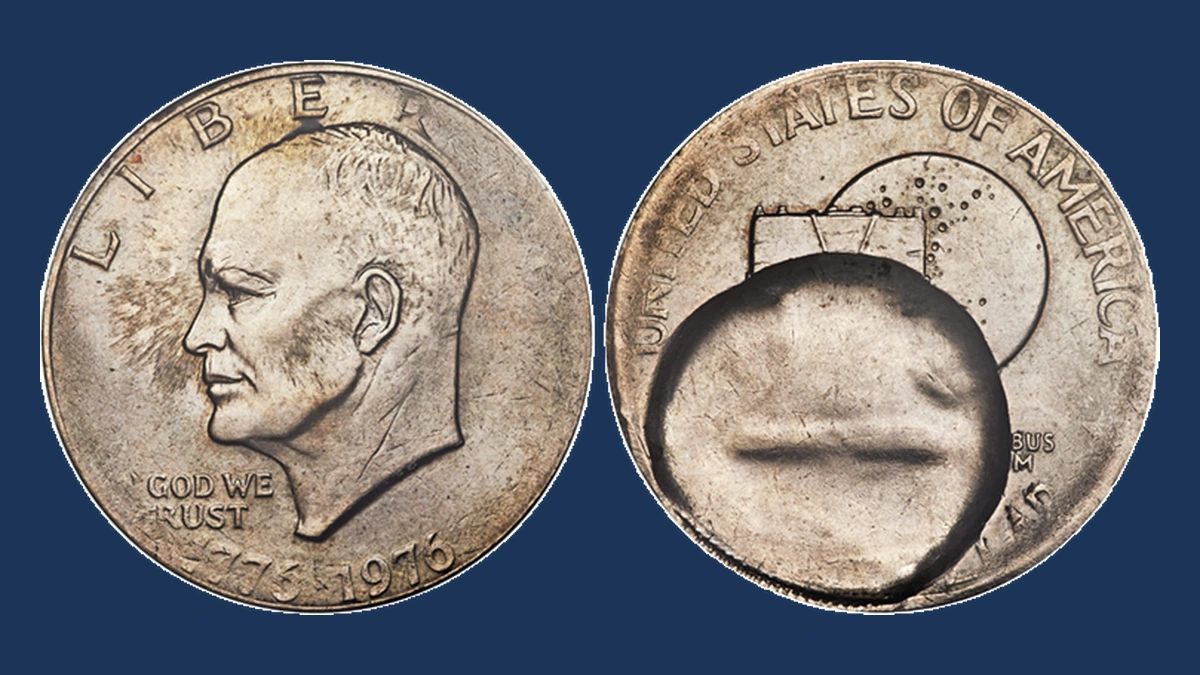
The Liberty Bell belongs on a Bicentennial dollar. Washington’s portrait underneath it does not: a dollar struck over a finished Bicentennial quarter brought $28,200 in January 2014.
This guide to 1976 Eisenhower dollar errors covers estimated values from $20 to $75,000. A separate No S silver Proof rarity carries an estimated $850,000 to $1.2 million, rather than an ordinary error price.
Read on to check the lettering, metal, and overlapping pictures on your coin.
1. 1976 Eisenhower Dollar Peg Leg Lettering
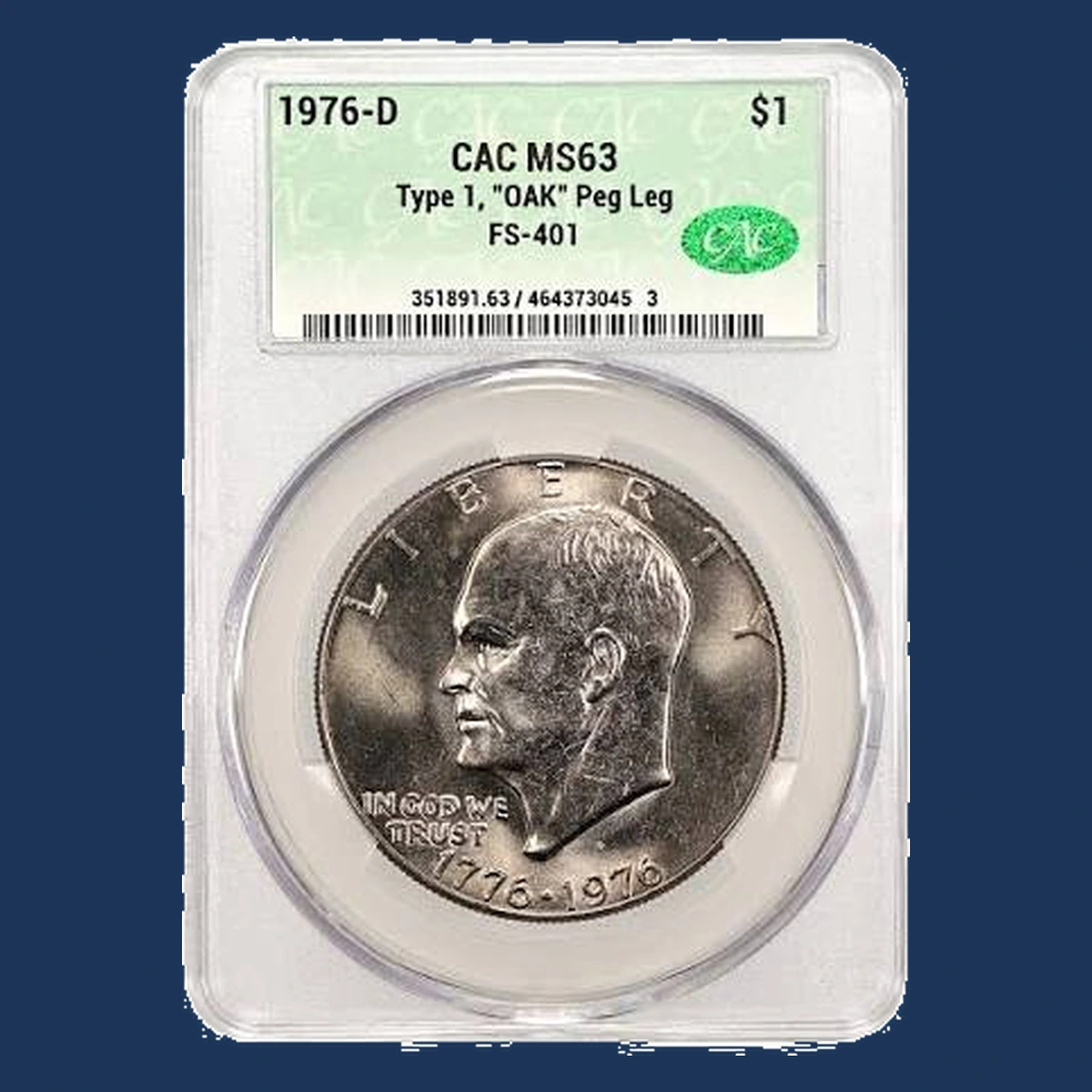
The R in LIBERTY can lose part of its familiar foot or lower shape. Collectors call these changed letter shapes Peg Leg varieties.
The Ike Group lists a Denver Type 1 version nicknamed Off at the Knees and a separate Denver Type 2 version. Type 1 has thick lettering on the back; Type 2 has thinner lettering.
These are changes in the tool-made letter shape, rather than proof of a second strike. Each version needs comparison with its own normal lettering, since the two designs do not start out identical.
Estimated Value
An estimated $20 to $300 covers correctly identified examples of these reported Peg Leg varieties. Worn coins with a barely readable R belong near the lower end.
An unworn coin with a clear missing foot or shortened lower section is more attractive. The condition of the whole dollar still matters, so clean surfaces and strong surrounding letters support the higher end of this estimated range.
How to Identify
Read the lettering around the Liberty Bell before looking at the R on the front. The broad letters identify Type 1, while the finer letters identify Type 2.
Choose a normal Denver dollar of that same type for comparison. Magnify the lower part of the R and trace where its upright, foot, and sloping leg meet.
Wear usually softens other nearby letters too. A Peg Leg match depends on the particular missing or changed portion of the R against otherwise readable lettering.
Photograph that letter straight above and from a low lighting angle. Keep the Type 1 and Type 2 comparisons separate, rather than matching any shortened R to the same nickname.
2. 1976 Eisenhower Dollar Repunched D Mintmark
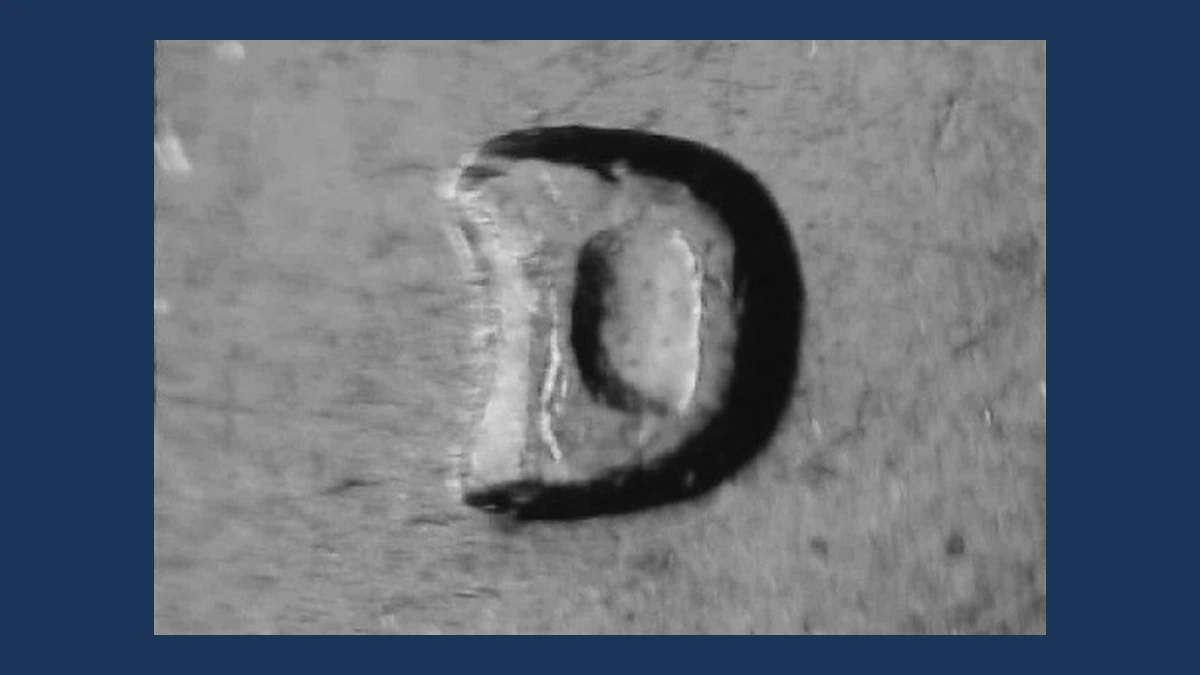
The small D below Eisenhower’s portrait can carry traces of a second D. The letter was punched into the stamping tool more than once, with a slight change in angle.
This is a repunched mintmark, or RPM. Wexler lists a Denver Type 1 example with extra detail at the ends of the D.
Fine lines near the 19 in 1976 and a small mark beside the O in OF help identify that particular tool. Those marks support the mintmark match; they are not additional errors that each need a separate price.
Estimated Value
Estimate $25 to $350 for a properly matched repunched D. Subtle examples with wear or heavy marks generally belong in the lower part of the range.
A crisp D with visible extra ends is easier to display and can bring more. Strong photographs and a reliable identification matter because a flat shelf beside a normal D can look similar without being a second punch.
How to Identify
Turn the dollar over before enlarging the mintmark: this repunch belongs to a thick-letter Type 1 Denver coin. A Type 2 dollar with an odd D needs a different comparison.
Under a 10× magnifier, trace the D’s main outline and then its upper and lower ends. A second punch made at an angle should leave related extra details, rather than just one broad, flat shelf.
Check the fine lines near 19 in the date and the small mark below and right of the O in OF. Those supporting marks strengthen a match to the right letter shape, but an ordinary D beside a random scratch does not qualify.
3. 1976 Eisenhower Dollar Runny Nose Die Variety
A small abnormal feature near Eisenhower’s nose gives this variety its memorable nickname. The Ike Group lists Runny Nose for the Denver Type 1 Bicentennial dollar.
The name directs attention to the nose and the area below it. It does not, by itself, explain whether every line or bump found there has the same cause.
A die is the steel tool that stamps a coin. A matching tool-made feature should repeat in the same place on other examples, unlike an accidental scratch picked up after the coin entered circulation.
Estimated Value
Use an estimated $20 to $400 for an authenticated match to the listed variety. A small feature on a worn dollar would normally fall toward the lower end.
Clear shape and an attractive, unworn surface can support a stronger price. The nickname alone adds nothing: the nose feature must match the recognized variety rather than a random mark, stain, or scrape in roughly the same area.
How to Identify
Look first for a D below the portrait and thick Type 1 lettering on the back. Then compare the nose area with photographs of the listed Denver variety.
Move a lamp from side to side while viewing through a magnifier. Note whether the feature rises above the surface or cuts into it, and follow its exact connection with the nose.
A scratch can have a raised edge, so height alone is not enough. Compare the full shape, starting point, and nearby portrait details rather than matching one bright line.
Do not combine several unrelated marks into an imagined flowing shape. One repeatable feature that matches the reference coin is more useful than a dramatic nickname.
4. 1976 Eisenhower Dollar Doubled Dies
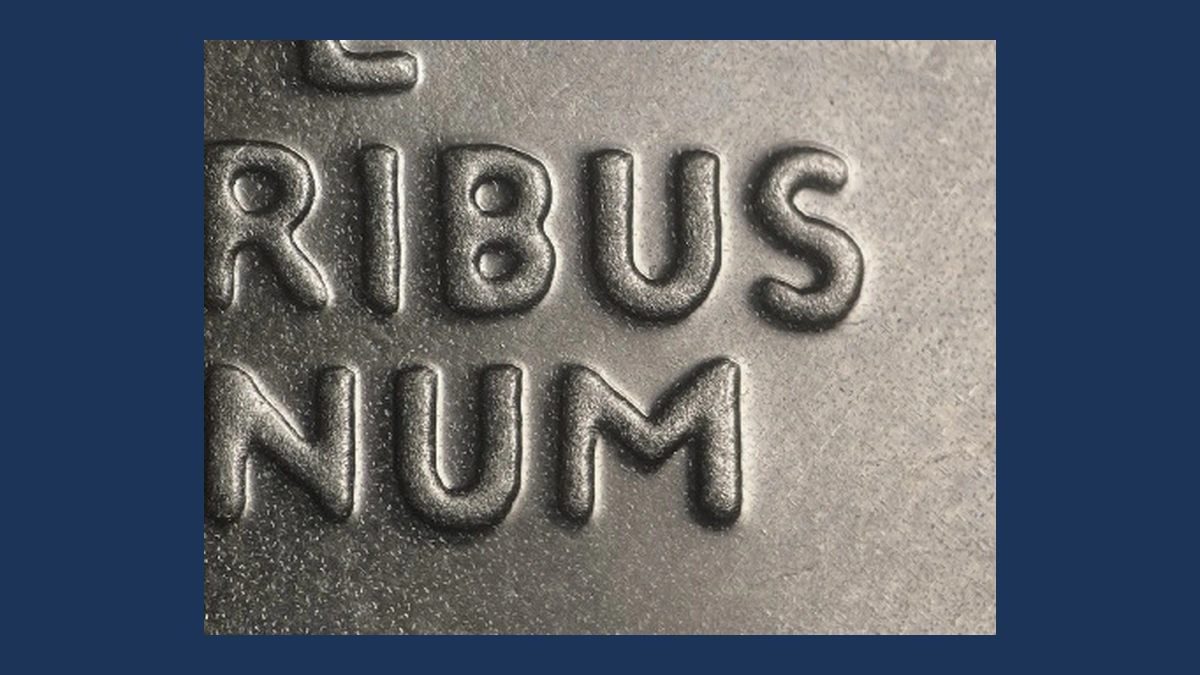
Two raised outlines in a letter can originate in the stamping tool itself. When the design entered that tool with a slight shift, coins struck from it inherited the doubled shape.
Wexler’s Denver listing describes close doubling in the dates and LIBERTY. A separate S Proof listing describes doubling in the back lettering and right star.
Proofs are collector coins made with specially prepared tools and blanks. Common date doubling shared by many Bicentennial dollars does not automatically match either of these more specific varieties.
Estimated Value
The estimated range is $20 to $500 for the listed varieties, depending on strength, condition, and correct identification. Ordinary shared date doubling adds little or no special premium by itself.
The Denver front and S Proof back need separate comparisons. A clear, unworn example with the right extra letter edges belongs higher than a heavily marked coin whose supposed doubling disappears under better lighting.
How to Identify
Begin with the words, rather than the date alone. On the Denver example, examine LIBERTY and both parts of the dual date for the same close separation.
On the S Proof, inspect DOLLAR, AMERICA, E PLURIBUS UNUM, and the right star. Follow the raised edges inward toward the center of the coin.
A 10× magnifier should show shape, not merely a thick blur. Flat shelves that shave part of a letter away usually indicate movement during the strike.
For the Denver match, a fine line through the lower E and another through the O of OF provide supporting checks. Keep the S Proof’s different letter marks with that separate coin.
5. 1976 Eisenhower Dollar Peeling Surface Metal
A thin flap or shallow torn area can interrupt the portrait side of a dollar. This kind of metal separation is called a lamination.
It begins when part of the metal does not hold together properly. The weak area can peel or break away, leaving an irregular boundary through the stamped design.
A Type 1 example from the Don Bonser collection was graded MS63 by ANACS, meaning unworn with noticeable marks. Its problem is a local front separation, rather than the complete loss of the outer layer from one whole face.
Estimated Value
The ANACS MS63 Type 1 front-lamination example sold for $37 in August 2021. It shows that an unusual surface need not cost thousands of dollars.
The estimated range is $25 to $750, with larger, clearly visible peels generally bringing more than tiny rough patches. Remaining original surface and readable design help, while corrosion, cleaning, or a flap broken off through handling can reduce the price.
How to Identify
Leave any loose flap alone. Pulling it up to inspect underneath can destroy the relationship between the metal and the design.
Use angled light to follow the torn boundary across the portrait side. Look for thin separated metal and any remaining stamped detail on the surface beside it.
Compare that texture with corrosion, which often leaves scattered pits, and scraping, which tends to leave directional marks. A natural metal separation can cut irregularly across details without flattening the entire surrounding area.
Photograph the edge of the peel from the side as well as above. The location must match the actual coin being examined; a front-lamination label does not identify a specific cheek or forehead defect.
6. 1976 Eisenhower Dollar Partial Collar Strike
A step around the edge can reveal that only part of the blank sat inside the collar. The collar is the ring that holds the coin’s diameter and forms its edge grooves during striking.
Metal held by the ring keeps the intended shape, while the unrestrained part spreads. This creates a change in the edge profile rather than a completely uniform edge.
A Type 2 example graded MS65 by NGC shows this error. Its auction description does not assign a particular tilted direction or percentage of the edge to the mistake.
Estimated Value
The NGC MS65 Type 2 dollar brought $104 in March 2026. A strong step that photographs clearly can have more appeal than a faint irregularity along the edge.
Allow an estimated $50 to $800 for ordinary partial-collar examples. Buyers also consider the condition of both faces, while added striking mistakes can change the value of the whole coin rather than supplying fixed extra fees.
How to Identify
View the edge at eye level and turn the dollar through a full circle. Look for the point where a restrained, grooved section meets metal that spread farther outward.
A loose normal dollar measures about 38.1 millimeters across. Calipers can help document the expanded part, but an edge profile photograph usually explains the error more clearly than one width reading.
Inspect the transition for fresh filing or dents. A tool-made step should relate to the original grooves and struck faces, rather than cutting through them as later damage.
Keep the coin upright as you photograph several sections of the edge. One dark line seen from above can be a shadow instead of a physical change in thickness.
7. 1976 Eisenhower Dollar Clipped Blanks
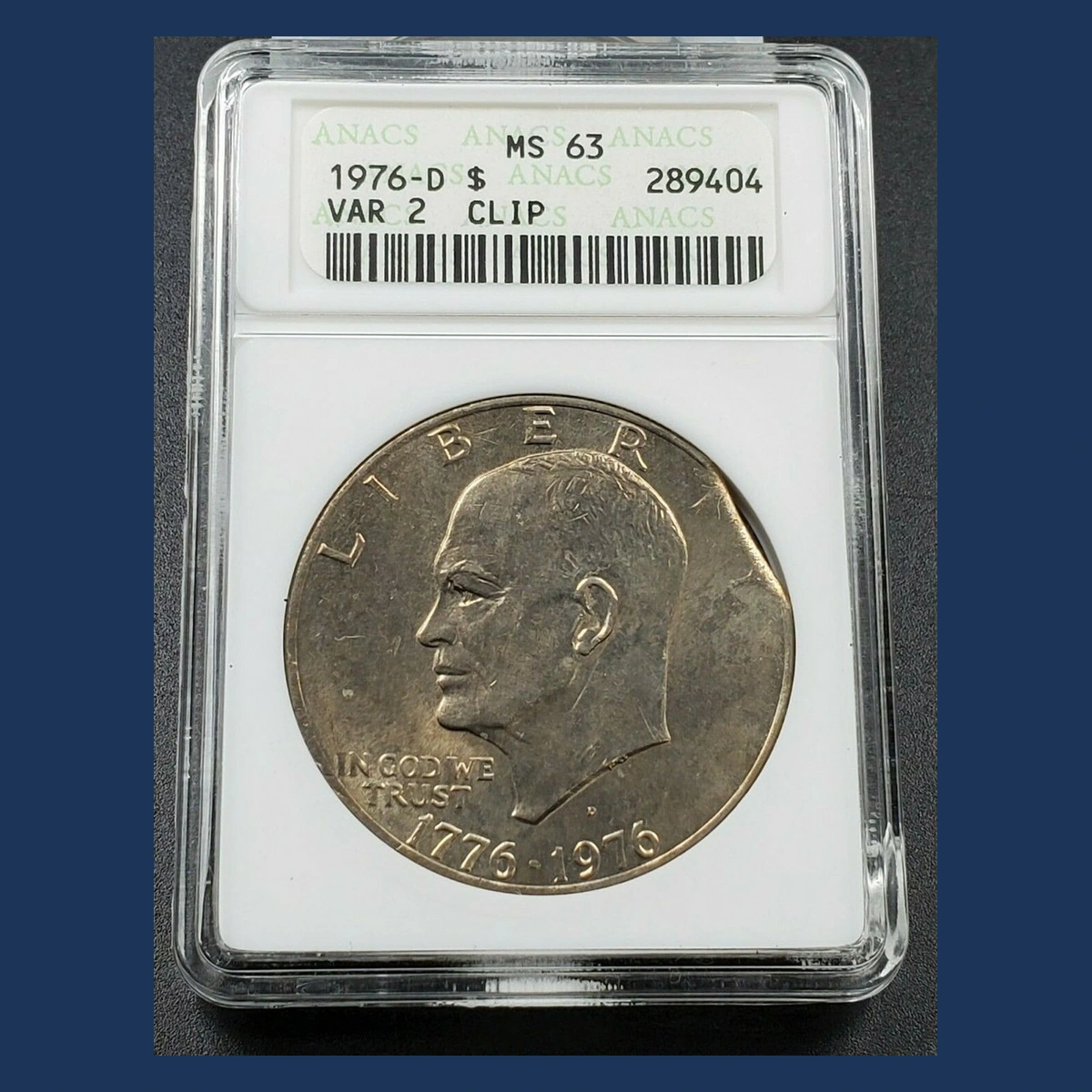
Bicentennial dollars exist with curved bites, two missing sections, and a straight missing edge. These shapes start when incomplete blanks are cut from the metal strip.
The examples include ordinary single and double clips from Philadelphia and Denver. A museum-listed Denver dollar has a large straight clip.
One Denver Type 2 coin combines two curved clips with an off-center strike. Its gaps lie around 6 and 8 o’clock, while the design shifted toward 1 o’clock; the missing metal and displaced design describe different features on that same coin.
Estimated Value
Estimated values range from $25 to $2,000, with size, surface quality, and added striking features affecting the price. A Denver Type 2 dollar with two small clips sold for $44.85 in April 2001.
The larger two-clip coin also struck off center brought $920 in June 2012. That was the price of the complete coin, rather than separate amounts for each missing piece and the shifted design.
How to Identify
For the Denver combination coin, mark the two missing sections at 6 and 8 o’clock on a photograph. Separately mark the design’s shift toward 1 o’clock.
This keeps missing metal from being mistaken for part of the off-center percentage.
Examine the cut surfaces with a magnifier, looking for fresh saw marks, squeezed edges, or other evidence of later damage. Follow each gap toward the nearby rim and letters.
A genuine clip can weaken the approaching rim or stretch nearby details, with another weak spot sometimes appearing opposite the gap.
For a straight clip, compare its boundary with a properly identified straight-edge example. A straight missing section and a curved bite should not be matched solely because their estimated sizes happen to agree.
8. 1976 Eisenhower Dollar Struck-Through Material
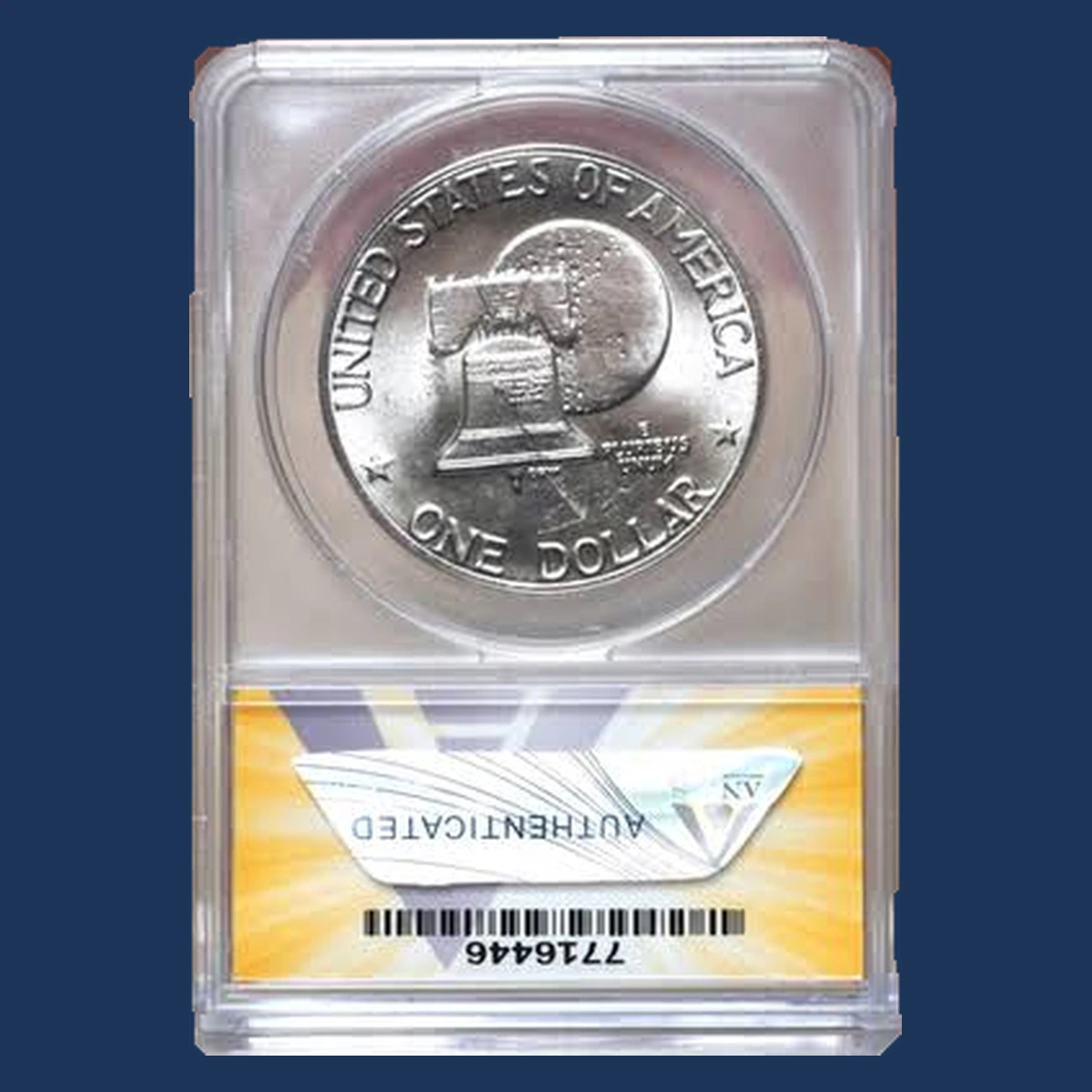
Material caught between a stamping tool and a blank can interrupt the dollar’s design. Sometimes the material stays attached; sometimes it falls away and leaves only its impression.
A silver 1976-S dollar retains tape to the right of the Liberty Bell. A separate Type 2 dollar has a narrow curved impression beneath the bell, with traces of grooves left by the object.
Other examples include a silver S coin affected on the back and a Type 1 coin affected on both faces. Their descriptions do not identify the obstructing material.
Estimated Value
A piece of original tape still embedded in the coin creates a very different display from a shallow, empty depression. Clear retained material can therefore draw stronger collector interest.
The estimated range is $50 to $2,500, from modest impressions to dramatic retained-material examples. The tape-bearing silver dollar needs its own comparison, while the other silver back-only coin must not inherit its price merely because both errors affect the same face.
How to Identify
On the tape example, inspect the boundary where the material meets the coin without lifting or pulling it. The surrounding struck surface should show how the tape was pressed into place.
The grooved-impression coin offers a different test. Look beneath the Liberty Bell for a slender recessed arc and the small repeated grooves within it.
For an example without retained material, move a lamp across the interrupted design. Check whether nearby details remain sharp while the affected patch records the obstacle.
The ordinary silver S coin weighs about 24.59 grams, unlike a 22.68-gram copper-nickel dollar. That distinction identifies the underlying coin but does not, by itself, prove a struck-through error.
9. 1976 Eisenhower Dollar Missing Front Outer Layer
A copper-colored portrait side can result when one outer layer is missing. Normal copper-nickel Eisenhower dollars have a copper center covered by silver-colored metal on both faces.
The documented Type 2 example has the loss on the front, while its back retains the normal outer surface. PCGS graded that coin MS64.
This is a structural loss of metal, not simply brown color on an intact surface. It also differs from a small peeling patch, because the recorded error involves the front’s outer layer rather than a limited surface flake.
Estimated Value
The PCGS MS64 Type 2 dollar sold for $1,057.50 in January 2017. Its copper front and normal back make the missing layer easy to appreciate.
Estimate $500 to $3,000 for authenticated examples with substantial front-layer loss. An attractive copper face with a clear design has stronger appeal than a scratched example; cleaning can reduce the price even when the original error remains present.
How to Identify
Compare the portrait side with the Liberty Bell side under the same light. The recorded arrangement is copper in front and a normal silver-colored surface on the back.
Now inspect the edge for the relationship between the remaining outer layer and exposed center. Color that simply crosses both layers may be a stain or applied coating.
For a loose candidate, record its weight against the normal copper-nickel standard of 22.68 grams. The documented coin’s measured weight was not published, so use the scale as a physical check rather than an exact matching number.
Look closely for grinding lines and damaged letter edges. A missing layer should not be diagnosed solely from a brown face or a low weight.
10. 1976 Eisenhower Dollar Off-Center Strike
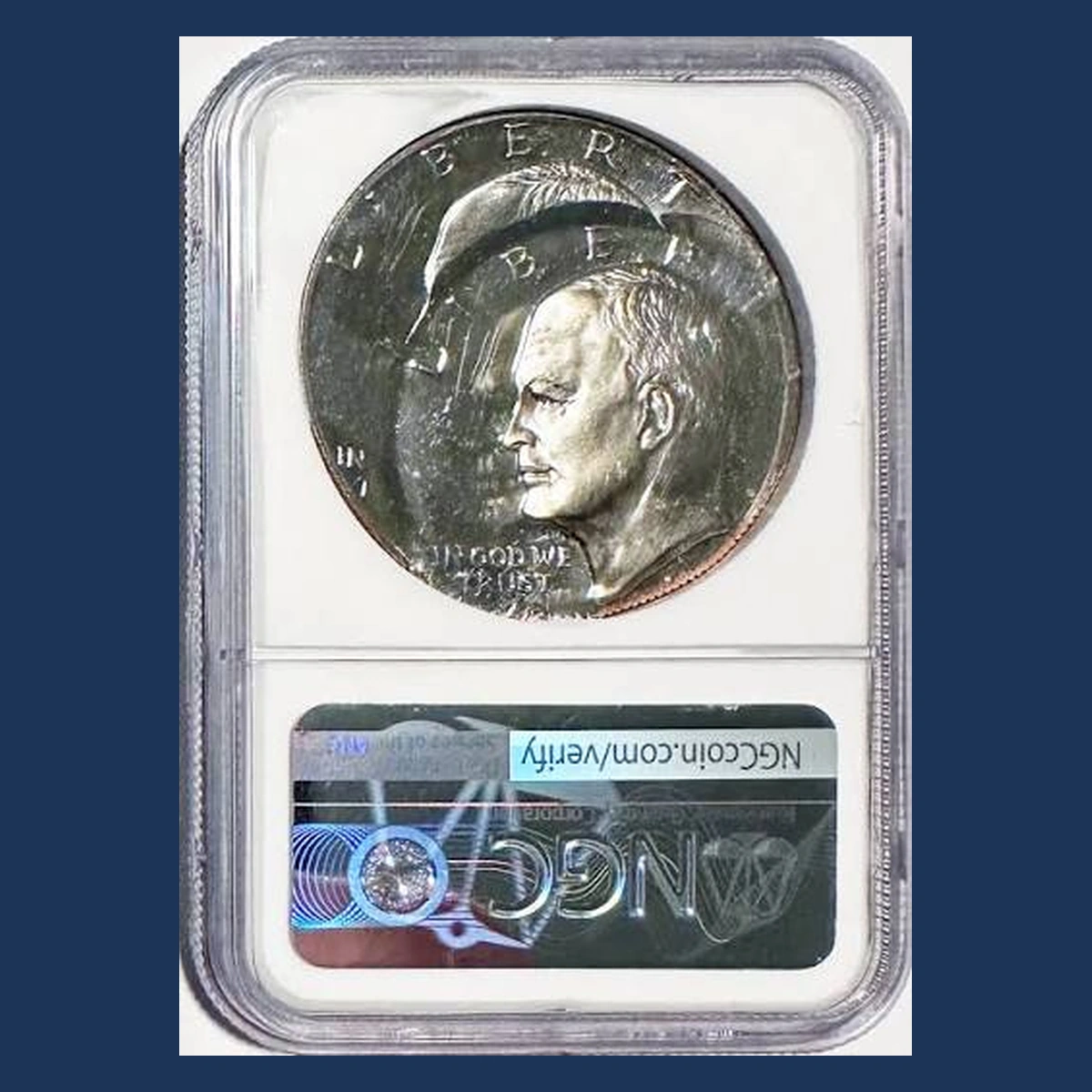
A blank crescent with missing lettering at the opposite edge reveals a coin struck away from the center. The blank did not sit fully between the two stamping tools.
A Type 2 dollar graded MS63 by ANACS was struck about 5% off center toward the top. Some upper letters in LIBERTY and UNITED STATES OF AMERICA ran beyond the metal.
A separate Type 1 example is described as 75% off center. Its much smaller surviving design must not be used to illustrate the nearly complete picture on the milder Type 2 coin.
Estimated Value
An estimated $150 to $5,000 covers modest shifts through dramatic examples with readable identifying details. The 5% off-center Type 2 dollar sold for $224.25 in May 2003.
A large shift with a surviving date can command much more than a slight displacement. The remaining portrait and Liberty Bell also affect display appeal, while heavy damage or an unreadable identity can hold back an otherwise dramatic piece.
How to Identify
Hold the dollar with the portrait upright and trace the outer letters. On the 5% example, the missing letter tops should agree with an upward shift, rather than random weakness.
Turn the coin over and inspect the corresponding cutoff and blank area. A displaced tool affecting only one face calls for a different explanation from the whole blank sitting off center.
For a heavily displaced coin, identify the Liberty Bell and surviving lettering before deciding the date and type. The Bicentennial back design can establish the issue even when the front date falls outside the blank.
Check the untouched metal for scraping or flattening. Its original surface should connect naturally with the struck area, without signs of a manufactured blank crescent.
11. 1976 Eisenhower Dollar Indent from an Extra Blank
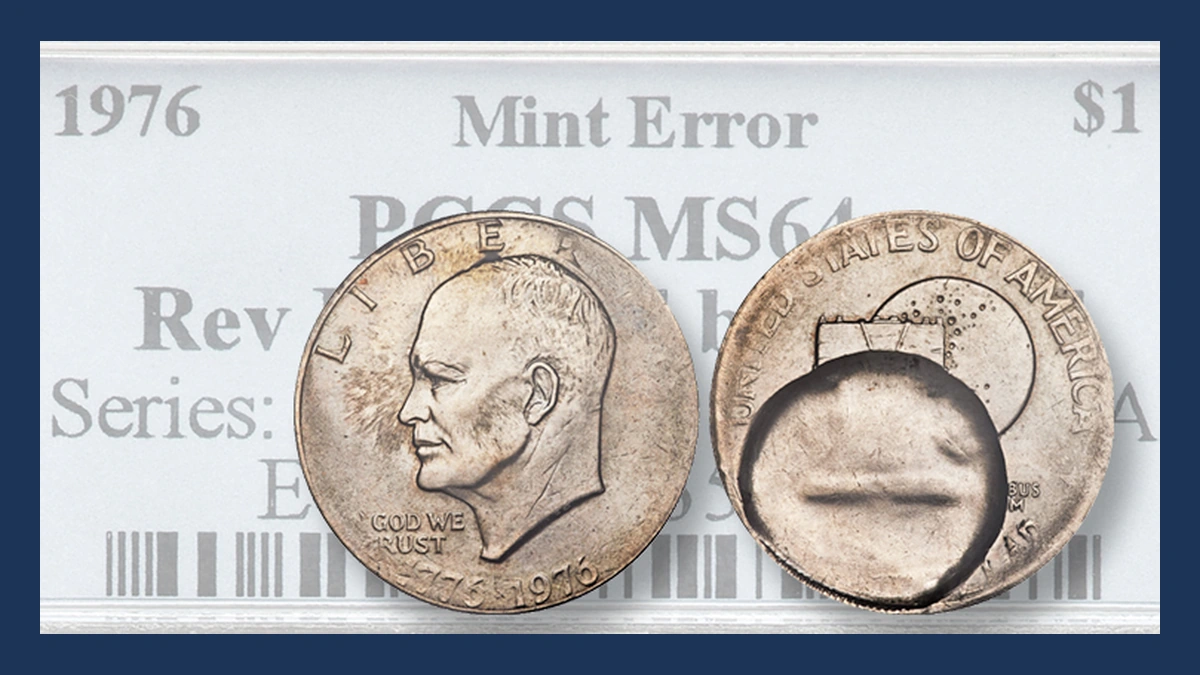
A round depression cutting across the Liberty Bell can come from a second blank entering the press. In this example, a quarter-sized blank lay between the dollar and the back stamping tool.
The extra piece pressed into the dollar and blocked part of its design. The resulting arc covers the lower-left bell area and much of ONE DOLLAR.
The dollar itself remained a dollar blank; it was not struck on a quarter blank. The obstructing quarter blank was absent from the auction, leaving the recessed shape as the evidence of contact.
Estimated Value
An estimated $800 to $5,000 fits substantial indents of this kind. The PCGS MS64 Type 2 example sold for $1,997.50 in January 2017, after a reported $3,220 sale in 2008.
The shape, size, and position of the depression influence its appeal. A broad indent crossing the main picture is easier to appreciate than a tiny edge impression, provided the remaining dollar surfaces are attractive.
How to Identify
Follow the curved boundary on the lower-left back. Notice how the Liberty Bell and ONE DOLLAR stop or weaken where the extra blank blocked them.
The recessed area should have the curved shape expected from another round blank. It need not contain a second coin design, because the interfering object was an unused blank.
Check the front and the remaining edge for their relationship with the depression. Much of this example’s border is weak, apart from the area opposite the indent.
A dollar actually struck on a quarter blank would be smaller and much lighter throughout. Here, the large dollar body remains, with an extra object having pressed into one section during the strike.
12. 1976 Eisenhower Dollar Mirror-Image Impressions
Backward lettering pressed into the surface can form when a struck coin gets between a blank and a stamping tool. The struck coin transfers a recessed, mirror-image copy of its own design.
This is called a brockage. Recorded Bicentennial examples include a small Philadelphia impression and a Type 2 coin combining a front impression with a stepped edge.
A Denver Type 1 coin has a mirror impression on the back and is also about 5% off center. Its weak date and clipped letter tops belong to that particular combination, not every brockage.
Estimated Value
Estimate $500 to $8,000 for these mirror-image errors. A small partial impression generally belongs lower than a large, readable mirror design on an attractive dollar.
Added off-center striking or a partial collar can make a coin more interesting, but the total price still belongs to one coin. Strong reversed lettering, a clear date, and well-preserved surfaces offer more value than a vague depression with little recognizable design.
How to Identify
Read a suspect letter in reverse, using a mirrored photograph if necessary. A genuine brockage should make sense as part of the opposite design, rather than as random dents.
Check the depth with low angled light: the transferred picture is pressed into the coin. A normal overlapping second strike generally leaves raised design instead.
On the Type 2 combination, examine the edge for a partial-collar step separately from the front mirror image. On the Denver Type 1 example, check the back image and the upper lettering lost through the off-center strike.
Coins squeezed together after minting can also leave backward marks. The surrounding metal and original strike need expert inspection before a valuable example is accepted.
13. 1976 Eisenhower Dollar Struck on Scrap Metal
A bow-tie-shaped piece of scrap can receive a dollar design if it reaches the press. It starts with an irregular outline instead of the round shape of a normal blank.
The ANA museum’s Berry collection records a Philadelphia Bicentennial example struck twice on scrap. Its front is described as uniface, meaning it lacks the normal front design.
The repeated design and unusual metal shape belong to the same object. A cut-up ordinary dollar would not automatically reproduce the way original striking pressure formed design along the scrap’s irregular edges.
Estimated Value
For an authenticated scrap strike of this complexity, use an estimated $5,000 to $30,000. This is a comparison-based range for an unusual multiple-strike object, not an auction result for the museum piece.
Clear surviving Bicentennial details and a visibly original scrap outline increase appeal. The extent of the second strike, metal condition, and the ability to trace the piece’s history can also influence the price substantially.
How to Identify
Begin with photographs of the complete object, including every edge. Its irregular outline is central to the identification, so a close-up of one bit of lettering is not enough.
Locate the Liberty Bell or other recognizable Bicentennial details and map the separate impressions. Keep the side lacking the normal front design distinct from a worn portrait side.
Inspect where the stamped detail meets the irregular metal boundary. Fresh cuts through an otherwise ordinary dollar design suggest a coin altered after striking.
A scale and calipers can document the object, but it has no standard dollar weight or round diameter to match. Compare its full shape and strike pattern with the museum example rather than an ordinary blank.
14. 1976 Eisenhower Dollar Struck on the Wrong Blank
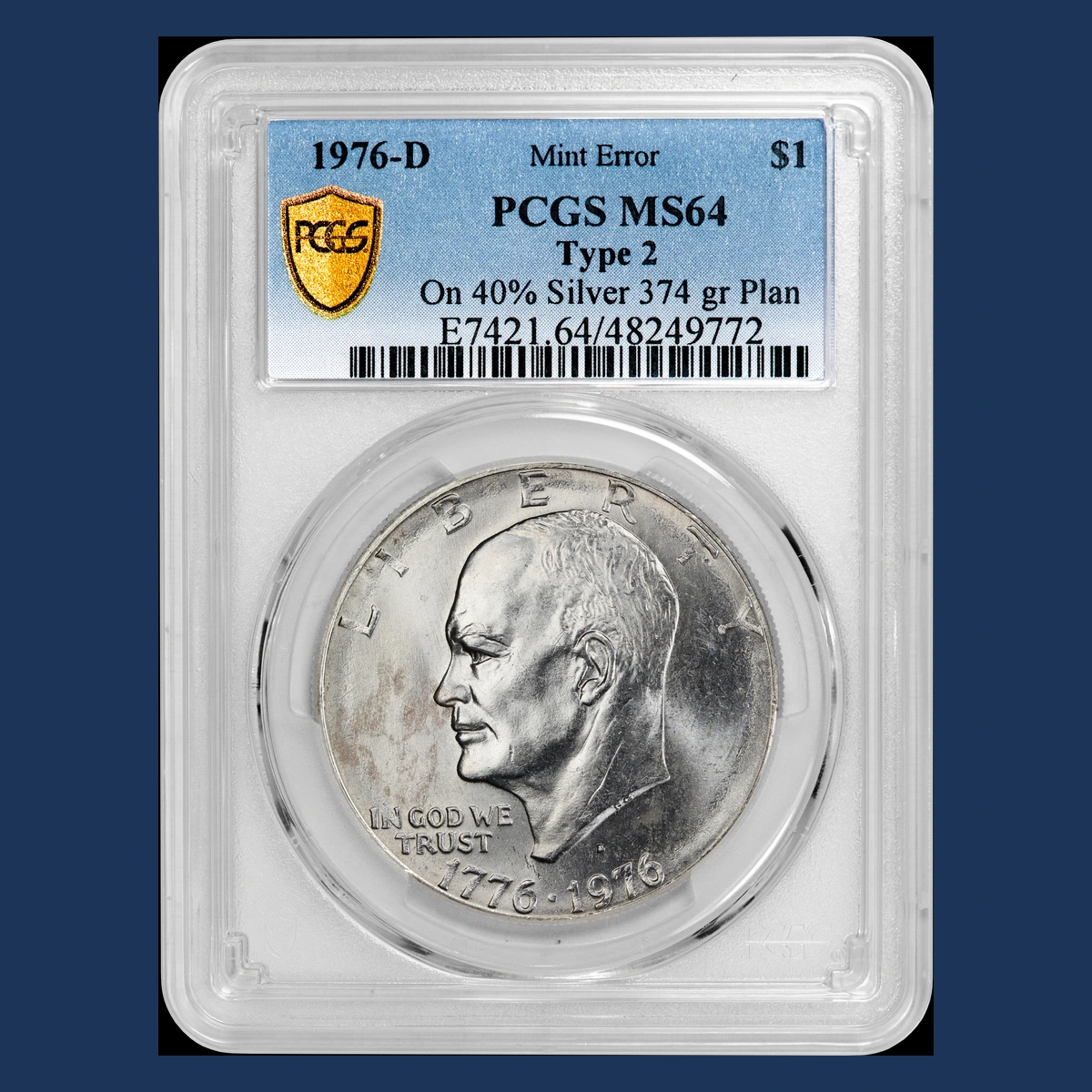
A wrong blank can change the dollar’s metal, size, or both. Denver Type 2 dollars are reported on 40% silver blanks normally intended for collector issues.
Others received the design on smaller half-dollar, quarter, or dime blanks. The tiny dime examples include a back-only strike and a separate twice-struck coin weighing 2.3 grams.
These are different objects. A normal S silver dollar is not a wrong-metal error, while a small piece with no readable mint letter cannot automatically be assigned to Philadelphia merely because its mintmark is absent.
Estimated Value
Estimated ranges are $5,000 to $35,000 for Denver silver, $5,000 to $15,000 for half-dollar blanks, and $4,000 to $20,000 for quarter or dime blanks.
A quarter-blank example brought $8,050 in September 2011; a back-only dime-blank example brought $8,050 in March 2007. A half-dollar-blank piece was offered at $11,500 in 2013, which was an asking price rather than a confirmed sale.
How to Identify
For a loose coin, record the weight before comparing its pictures. Normal copper-nickel dollars weigh 22.68 grams; the 40% silver version weighs 24.59 grams, both around 38.1 millimeters wide.
A Denver silver candidate needs a clear D, Type 2 lettering, and a professional metal-composition check. Edge color alone cannot establish the silver alloy.
Smaller blank standards are 11.34 grams for a clad half dollar, 5.67 for a quarter, and 2.27 for a dime. Striking can spread these blanks beyond their original widths.
On the back-only dime example, use the Liberty Bell design to establish the Bicentennial issue. The separate 2.3-gram example must also show two impressions.
Look for remnants of a different coin’s earlier design. Their presence would move the diagnosis from an unused wrong blank to an overstruck finished coin.
15. 1976 Eisenhower Dollar Struck over Another Finished Coin
A smaller coin can carry two different denominations when it is struck again by dollar tools. Surviving pieces of its first design remain beneath Eisenhower or the Liberty Bell.
The Bicentennial records include a dollar struck about 50% off center over a finished 1976 cent. A Denver dollar was also struck over a 1975-D nickel.
Another example uses a finished Bicentennial quarter, leaving Washington or drummer details beneath the dollar design. That quarter-based coin appeared in several auctions, but repeated sales do not turn it into several separate error specimens.
Estimated Value
The dollar over a Bicentennial quarter brought $28,200 in January 2014 and $27,025 that August. The nickel-based example was offered at $35,000, an asking price.
An estimated $5,000 to $40,000 covers the group, depending on the underlying coin and condition. Clear remnants of both denominations are especially appealing because a buyer can understand the mistake from the coin itself, rather than relying only on a holder label.
How to Identify
Pick out one feature that cannot belong to the dollar: Lincoln’s portrait, Jefferson’s design, or part of the Bicentennial drummer. Then search for another matching feature from that same smaller coin.
Trace where the dollar design crosses it. Both designs should belong to the same piece of metal, with the later impression interrupting the earlier one.
For the cent example, check the separate blank area left by the roughly 50% off-center dollar strike. For the nickel example, distinguish the underlying 1975-D identity from the later Denver dollar.
The quarter’s dual date alone proves little because both coins use it. Washington and drummer details provide a much stronger way to recognize the earlier quarter design.
16. 1976 Eisenhower Dollar Multiple and Flipover Strikes
Some Bicentennial dollars escaped the press only after receiving extra blows. A coin could shift, turn over, or spread during the repeated strikes.
Examples include a flipped Type 2 coin, Denver strikes with displacement or a weak first blow, and a silver S triple strike. The silver triple strike also spread beyond its normal border.
A Type 2 coin combines a 95% displaced second strike with a front obstruction at 5:30. A separate S Type 1 copper-nickel Proof has an off-center second strike; it should not be confused with the ordinary silver example.
Estimated Value
Ordinary examples have an estimated range of $600 to $8,000, while dramatic Proof errors can reach an estimated $25,000 to $75,000. The latter is a comparison range, not a sale of the listed Proof.
The Denver 90% second-strike example sold for $990 in August 2021. The flipped Type 2 brought $2,530 in 2004, and the silver triple-struck dollar brought $4,465 in April 2017.
How to Identify
On the flipped Type 2 coin, look beside and below the Liberty Bell for traces of Eisenhower’s portrait. On the front, bell or moon details survive below the chin, with motto lettering below LIBERTY’s L.
A shifted strike needs a different check. Map a second raised picture against the first, rather than expecting designs from opposite faces.
The Denver 90% example and the Type 2 95% example are separate coins. The latter also has an interrupted front area at 5:30; its obstructing material was not identified.
For a weak-first-strike example, search for faint earlier detail beneath a stronger picture. On Proofs, normal repeated blows in the same position do not constitute an error; visible displacement or another abnormal striking feature is required.
17. 1976 Eisenhower Dollar Special No S Silver Proof
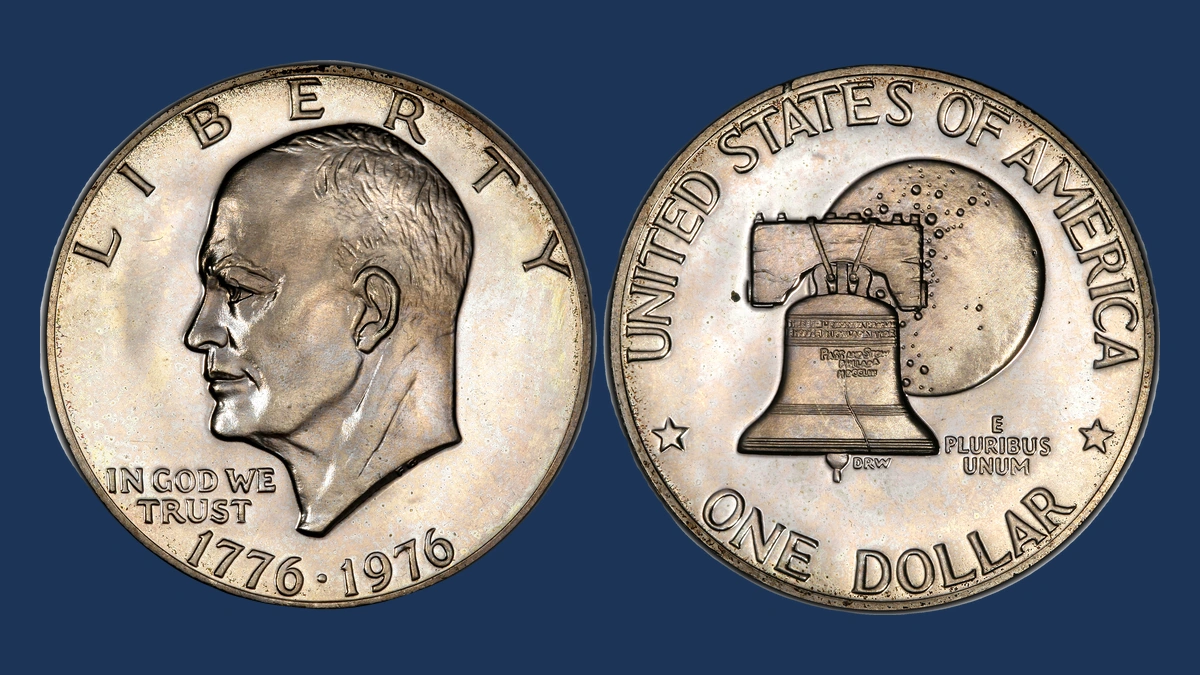
The unusual No S coin combines three features: a Proof finish, a silver composition, and thin Type 2 lettering. Its portrait side has no mintmark.
PCGS identifies this famous example as a special non-error coin. Its existence does not establish that a worker simply forgot to punch an S into an ordinary production tool.
The distinction matters because Philadelphia made millions of normal dollars without a mint letter. A shiny, no-mintmark dollar from change is not the same combination as this specially made silver Proof with its documented history and certification.
Estimated Value
An estimated $850,000 to $1.2 million reflects published valuations for this special rarity, rather than a confirmed public auction result. The PCGS guide now lists $1 million for the PR66 example.
That Proof grade describes a well-preserved collector striking. This exceptional estimate applies to the documented silver Type 2 coin, not to ordinary Philadelphia dollars with no mintmark or to polished circulation coins.
How to Identify
Start with the complete certified coin and its history, not a magnified picture of an empty mintmark spot. Millions of ordinary Philadelphia dollars already have that empty area.
Compare the thin Type 2 back lettering and the specially made Proof surfaces with the documented example. A polished circulation coin can become shiny, but polishing does not create the original finish of a Proof.
A professional examination must also establish silver composition and check the portrait’s mintmark area for alteration. Only the combined finish, silver metal, correct design, and matching physical identity can connect a candidate with this special rarity and its exceptional valuation.
Conclusion
Thick and thin back lettering are normal designs, and an S can belong to several collector versions. Identify the underlying dollar before judging an odd letter, missing layer, or second picture.
The estimated error range runs from $20 to $75,000. The separate No S silver Proof has an estimated $850,000 to $1.2 million valuation, which applies to that special documented rarity rather than ordinary dollars without mintmarks.