1972 Quarter Error List with Pictures

Two readable years can share one quarter. An unusual 1972 example was struck over a finished 1964 silver quarter; its January 2026 auction listing reports $8,500.
This 1972 quarter error list also includes smaller blanks, missing metal, and mistakes on specially made Proof coins. Estimated error values range from $5–$40,000.
Ordinary circulation coins and collector Proofs need different comparisons. Start with the visible design and finish before choosing a price.
1. 1972 Washington Quarter Rotated Designs
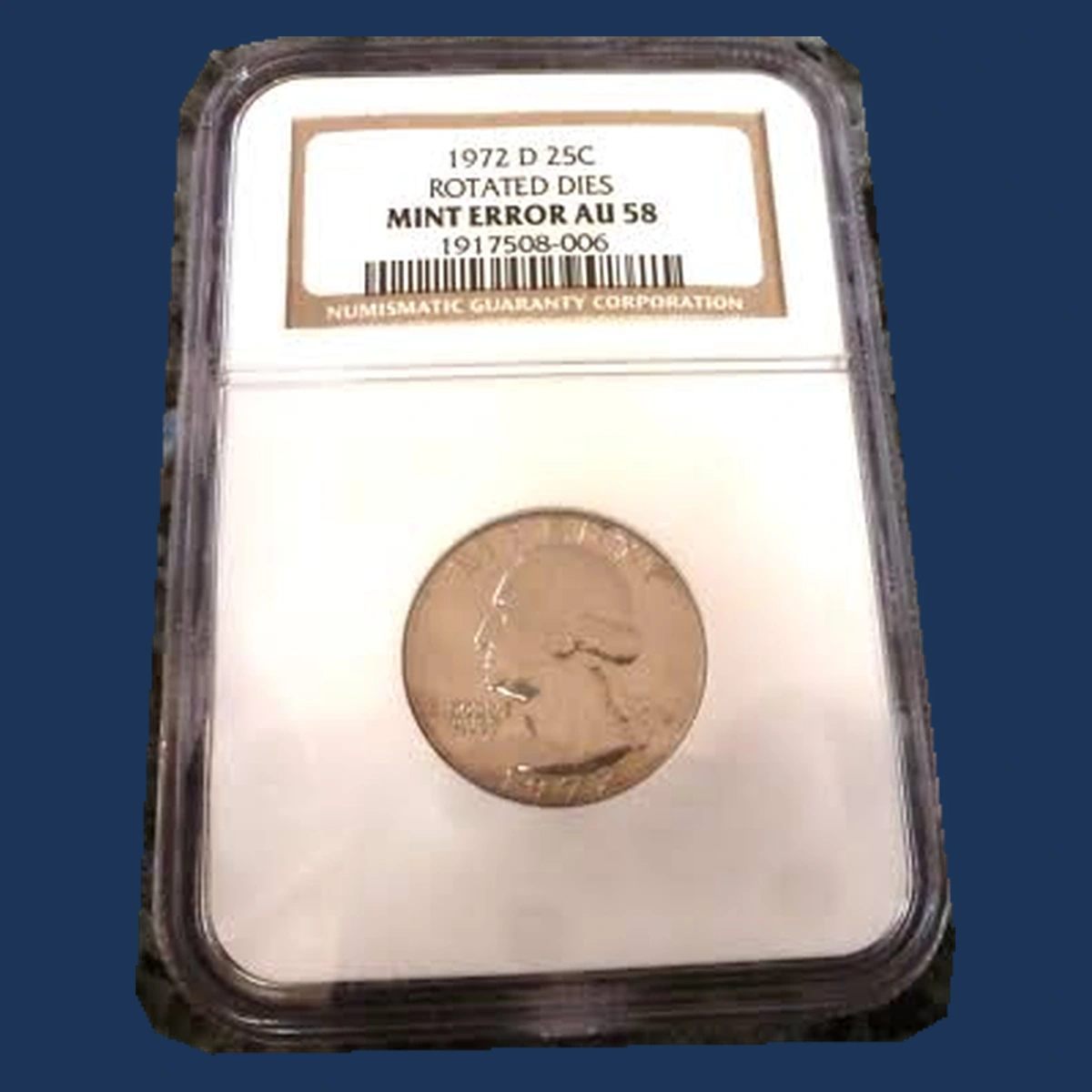
The eagle should stand upright after an upright Washington portrait is flipped from top to bottom. A rotated stamping tool changes that relationship between the two faces.
A Denver example appears in an auction listing with an ANACS AU58 grade. That means the coin has slight wear.
The listing gives no angle for the rotation. A candidate’s actual tilt can be measured by comparing the two faces along a fixed turning axis.
This type keeps one intended design on each face. It differs from a coin that turned between two strikes and received overlapping pictures.
Estimated Value
A large, repeatable tilt is easier to display than a small alignment difference. For an authenticated 1972-D rotation, the estimated range is $20–$300.
The reported AU58 example has slight wear, which matters when comparing it with an unworn coin. A strong rotation with clean, readable designs generally has more appeal than one obscured by damage, heavy wear, or photographs that do not clearly show both faces.
How to Identify
Practice with a normal quarter first: hold Washington upright over a vertical line, then flip the coin from top to bottom. The eagle should finish upright if you have not twisted the coin sideways.
Repeat the same movement with the candidate and photograph both positions without changing the camera angle. A repeatable tilt can be measured with a protractor over the image, but a coin moving inside its holder can mislead.
Keep the readable 1972 date and D visible in the photographs. This test compares the two faces; it does not measure the movement between two overlapping strikes on a single face of a Proof.
2. 1972 Washington Quarter Doubled Designs on Ordinary and Proof Quarters
Some repeated detail starts in a stamping tool before any coin is struck. That doubled tool can pass the same feature to many quarters.
Ordinary 1972 front and back doubling is reported, but common inherited master-design repetition also affects these years. That widespread background is not automatically a rare variety.
San Francisco Proofs have specific cataloged patterns. Three front varieties thicken the motto and date to different degrees, while another repeats parts of the back.
A Proof is a collector coin made with specially prepared tools. Its catalog details should not be assigned to an ordinary Philadelphia or Denver quarter.
Estimated Value
Estimate $5–$250 for identified ordinary doubled-tool varieties and $20–$500 for the cataloged Proof patterns. Strong, clearly matched detail and original surfaces support more interest.
Common master-design repetition alone does not add an error premium. In particular, thick back lettering shared across multiple years and mints should not receive a rare-variety price merely because it looks doubled.
The ranges require a match to the actual working-tool pattern. Flat shelves from movement during striking need a separate assessment.
How to Identify
Identify the finish and mint before magnifying a letter. On ordinary coins, compare the lower back lettering with the common inward repetition inherited from the master design.
For Proof front varieties, examine IN GOD WE TRUST and every date digit. DDO-001 has slight thickness with tool lines inside the back wings; DDO-002 has moderate thickness and a frosted S.
DDO-003 shows stronger thickness and needs its own catalog photograph. Do not combine those supporting features into one imaginary coin.
For Proof DDR-001, compare both branch stems, QUARTER DOLLAR, lower-left leaves, wing tips, and RICA in AMERICA. A consistent match across several details is more useful than one thick letter, especially when common master-design repetition is also present.
3. 1972 Washington Quarter Repunched Mintmarks
A mint letter can retain part of an earlier impression when its punch is entered into the tool again. The resulting overlapping shapes are called a repunched mintmark.
Four San Francisco Proof patterns are cataloged for 1972. One has a counterclockwise-turned earlier S, two have northward remnants, and one has eastward remnants.
The two northward examples are different catalog patterns despite their shared direction. Each needs its own matching image.
A Denver D-over-D is also reported without a confirmed direction or catalog number. It should not inherit the S varieties’ directions or identifying features.
Estimated Value
A clear extra curve can be more attractive than a thick letter that requires lengthy explanation. Well-preserved Proof surfaces also help the small mintmark stand out.
Estimate $10–$500 for genuine repunched mintmarks, with minor or worn remnants toward the lower end. Compare the complete letter pattern, finish, and condition; a filled center or flat shelf from striking movement does not deserve the same variety premium.
How to Identify
Find the mint letter beside the lower-right part of Washington’s hair. Photograph the whole letter before enlarging its outer edges and inner curves.
For an S Proof, a second outline turned counterclockwise points toward the RPM-001 comparison. Extra detail above the letter instead calls for separate comparisons with RPM-002 and RPM-003, both of which point north.
An extra outline to the right is the starting clue for RPM-004.
On a Denver coin, trace an earlier D without using any of those S catalog numbers. Its direction has not been established by the general report.
A second punch should leave parts of a recognizable letter. Dirt inside the center or a flat shelf beside the main letter cannot establish that shape.
4. 1972 Washington Quarter Die Cracks and Rim Cuds
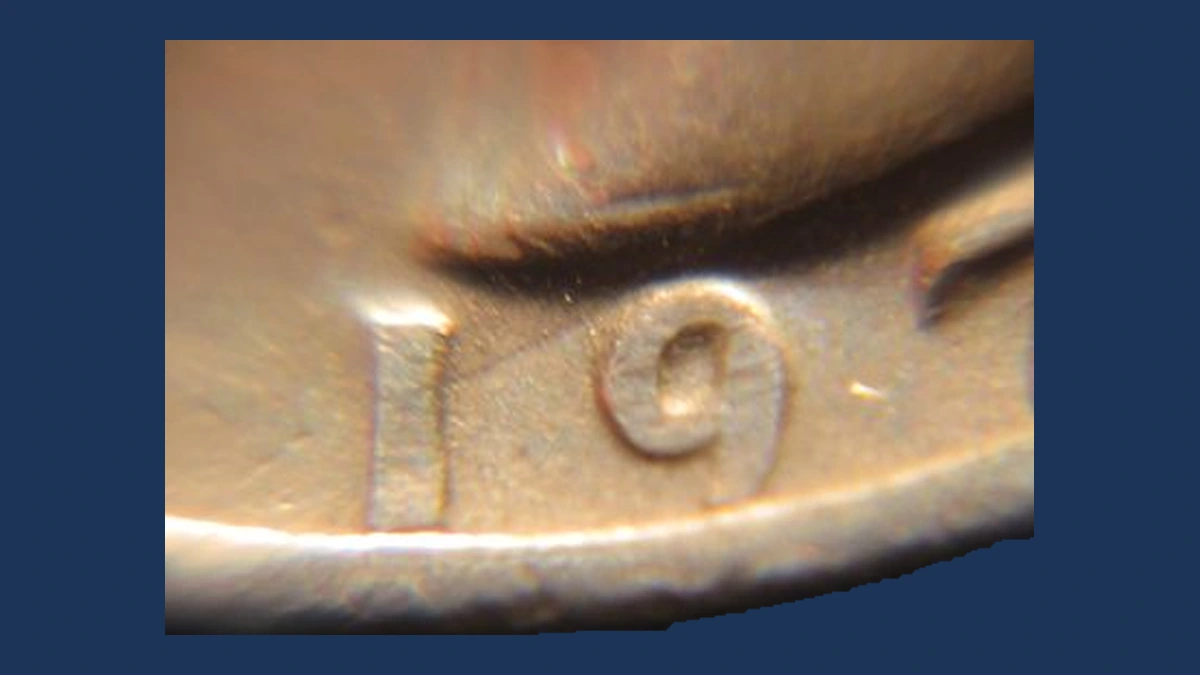
A line standing above the quarter can record a crack in the steel tool that struck it. Metal entered that crack and formed a raised ridge.
When a larger piece of the tool breaks away, more metal can rise into the empty space. A raised patch reaching the rim is called a cud.
The 1972 reports list these appearances without an exact mint, catalog number, or clock position. They describe a type to examine rather than one fully mapped specimen.
A cut or impact at the rim can imitate parts of the appearance. The surrounding original surface helps distinguish them.
Estimated Value
Thin raised lines often bring only a small premium, while a large patch replacing part of the picture is easier to appreciate. The estimated range for authenticated ordinary 1972 examples is $5–$500.
This estimate draws on similar modern-quarter tool breaks. Size alone does not set the price: clear original surfaces and readable surrounding details help, while corrosion and rim damage can make a striking feature less desirable.
How to Identify
First decide whether the feature is a raised line or a larger raised patch. Low light from opposite sides helps distinguish solid raised metal from the bright lips around a sunken scratch.
Follow a line through the neighboring letters and open areas, photographing its whole route rather than one bright segment. For a larger patch, trace its connection to the rim; an isolated lump inside the design is not automatically a cud.
Finish with side views of the edge and a photograph of the opposite face. A later impact can push metal into a raised shape, but it also damages the original border or surrounding design in ways a cracked stamping tool does not.
5. 1972 Washington Quarter Broadstrike
A quarter can spread beyond its intended outline if the surrounding collar fails to contain its metal. The collar is the ring that normally controls width and forms edge grooves.
The expanded strike is called a broadstrike when the complete design remains on the coin. Its border can be wider on one side than the other.
A general 1972 report lists this type without an individually identified mint or measured diameter. Each candidate needs its own design and edge examined.
The three-clip Denver broadstrike discussed next is a specific combined error. Its clipped shape should not define every ordinary broadstrike.
Estimated Value
Estimate $25–$800 for an authenticated ordinary 1972 broadstrike, using similar modern-quarter errors as comparisons. Strong outward spread with a complete design makes the mistake easy to see.
A small, uneven border generally brings less than dramatic expansion on an attractive coin. Original lettering and surface quality matter too, since a quarter widened by later hammering can lose the clear detail that collectors seek in an actual broadstrike.
How to Identify
Check LIBERTY and the back’s outer lettering before measuring the coin. The intended design should remain on the metal even if the border spreads unevenly.
Measure a loose candidate across several directions and compare with the usual 24.3-millimeter width. A single wide reading does not explain how the shape formed.
Inspect the edge beside the expanded area for original metal flow rather than grinding. Then look for crushed raised details from later pressure.
If an unstruck crescent lies beside design that falls beyond the blank, consider an off-center strike instead. Keep a separate record for any clipped section so missing metal is not confused with outward spreading.
6. 1972 Washington Quarter Curved Clips and a Triple-Clip Broadstrike
Metal missing before striking can leave one curved gap or several gaps around a quarter. The design then forms beside the incomplete parts of the blank.
A Denver example is reported with a twenty-five-percent curved clip and a 4.7-gram weight. It has an AU58 assessment, indicating slight wear.
Another Denver coin was broadstruck and carries three clips totaling twenty-two percent. PCGS graded that separate specimen MS63, meaning unworn with visible marks.
The three gaps belong to the same broadstruck coin. Their positions need to be read from that specimen, while the separate single clip has its own shape and weight.
Estimated Value
An estimated $10–$1,000 covers genuine 1972 clips and the more distinctive broadstruck combinations. Size, shape, and preservation influence the useful comparison.
The twenty-five-percent and twenty-two-percent figures describe different coins. The actual 4.7-gram weight belongs to the single curved-clip report, not automatically to the triple-clip example.
A broadstrike plus missing sections remains one physical coin. Its value should be compared with similar combined errors, without simply adding full prices for a clip and an unrestricted strike.
How to Identify
Inspect the rim where each gap begins and ends, using photographs of both faces. The design and border can weaken or stretch as metal moves beside an incomplete blank.
On the three-clip example, map all three missing sections before examining the expanded outline. Their total percentage does not tell you their individual sizes or clock positions.
Compare the inner gap surfaces for saw marks, filing, or sharp burrs that suggest later cutting. A weak rim opposite a clip can help, but is not required to be obvious.
The single curved-clip specimen’s weight is supporting evidence only. Later removal also reduces weight, so the natural gap boundaries must agree with the original struck design.
7. 1972 Washington Quarter Missing Back Clad Layer
The eagle face can look copper-colored if its pale outer layer is missing. A normal clad quarter has two outer layers bonded around a copper center.
A report lists a 1972-D back-layer-loss example weighing 4.67 grams. The other face and edge are important comparisons for its altered structure.
The description alone does not establish whether separation happened before or after striking. Original details on the exposed metal can help a specialist resolve that timing.
A brown surface caused by toning does not necessarily involve missing metal. Scraping or chemical damage can also expose copper after the coin leaves the Mint.
Estimated Value
An estimated $50–$1,200 applies to an authenticated 1972-D quarter missing its back layer. A clearly exposed copper face with original design has more appeal than a heavily scratched patch.
The reported example weighs 4.67 grams, compared with 5.67 grams for a normal quarter. That difference supports further examination, but the condition and origin of the exposed surface matter more to value than a low scale reading alone.
How to Identify
For a loose candidate, weigh the whole coin before studying its color. The reported example is 4.67 grams, while a normal quarter is about 5.67 grams.
A low reading shows missing metal, but not when or how it disappeared.
Compare the eagle face with the portrait side under the same neutral light. Then follow the copper-colored area into the edge to see which layers remain.
Under magnification, look at the design on the exposed copper and the boundary of the loss. Scratches cutting through finished details may show later removal, while other surface relationships can help establish separation during production.
Leave loose material untouched and keep it with the coin. The original boundary and design give a specialist more useful evidence than color alone.
8. 1972 Washington Quarter Struck Through Reeding or Cloth
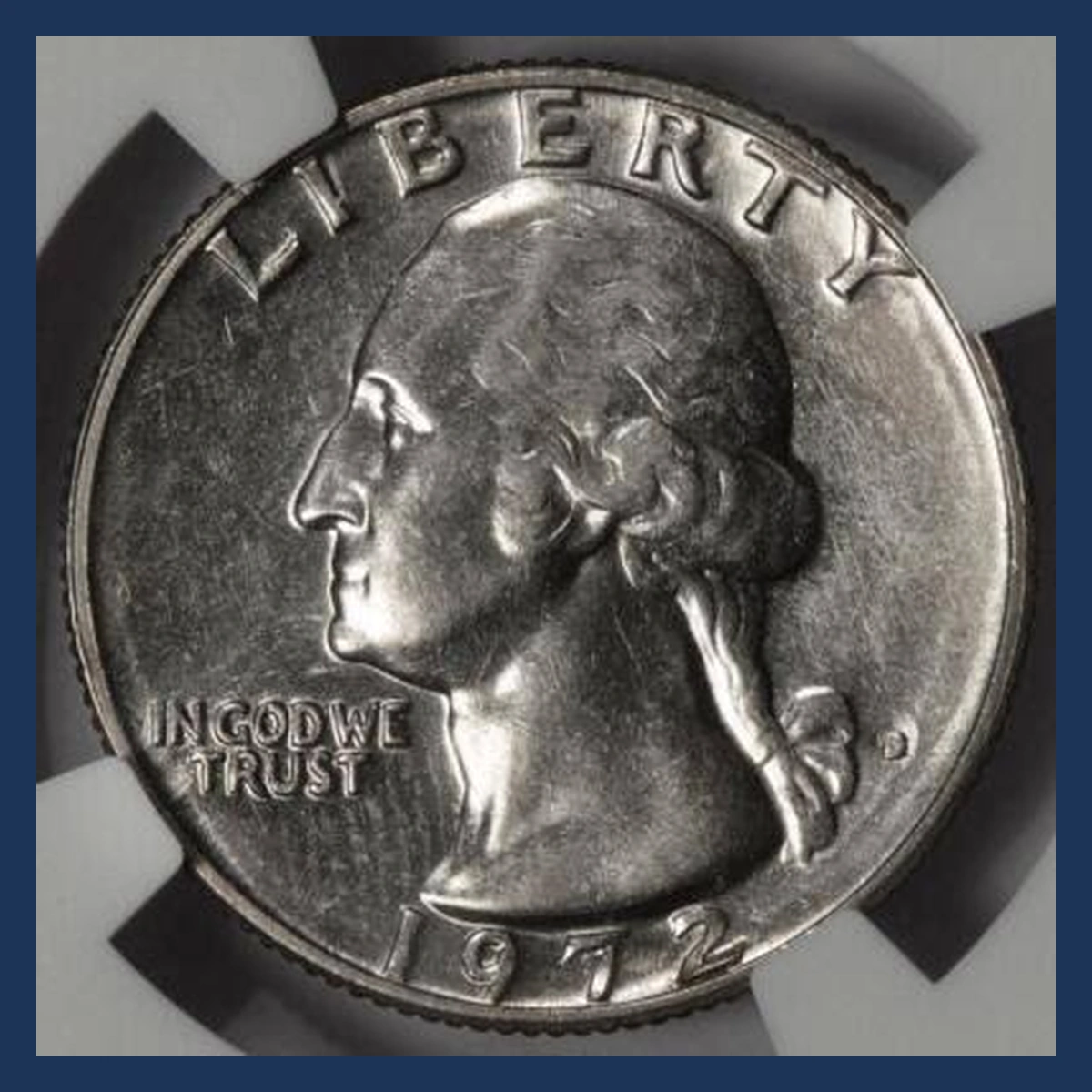
Regular grooves impressed into the eagle side distinguish a Denver quarter graded NGC MS62. Its catalog description identifies a strike through reeding, meaning a grooved surface was between the tool and coin.
The object that supplied those grooves is not specifically identified. It should not automatically be called the edge of another quarter.
A separate Philadelphia report describes cloth impressed into the front of an NGC MS65 coin. A weave pattern would explain that description more directly than general weakness.
The two impressions belong to different faces and specimens. Neither should inherit the other’s location or material.
Estimated Value
The Denver MS62 grooved-impression example has appeared with a $999.97 asking price. An offer at that amount does not establish what a buyer actually paid.
An estimated $25–$2,000 covers these struck-through types. Repeated texture that clearly interrupts the design is more appealing than a vague hollow.
Compare the separate Philadelphia cloth example by its own weave pattern, size, and condition. The Denver coin’s asking price does not establish what that different cloth impression is worth.
How to Identify
For the Denver example, trace the regular recessed grooves across the back and into the normal eagle design. Photograph where the texture starts and stops.
Compare that boundary with a later scrape, which may cut through already formed detail or push up metal beside a groove. The original struck surface should explain the interruption.
For the Philadelphia report, inspect the front for an actual crossing weave pattern. A plain hollow cannot establish cloth on its own.
Use both full-face images and low-angle close-ups without cleaning the affected area. Keep the two specimens separate, and do not assign a material or exact location merely because another year’s error looks similar.
9. 1972 Washington Quarter Off-Center Strike
Part of the design can miss the metal when a blank sits too far from the center of the press. The opposite part of that blank remains unstamped.
The 1972 reports include ordinary Philadelphia and Denver examples. They do not establish one photographed coin’s direction or a percentage that applies to the whole group.
Both faces matter because the blank receives their designs together. One displaced face with a centered opposite design instead suggests a misaligned stamping tool.
This mistake also differs from a broadstrike, where spreading metal still carries the complete intended design.
Estimated Value
A large shift becomes especially appealing when the date survives. Clear mint details and attractive untouched metal also help buyers understand an off-center coin at a glance.
For authenticated ordinary 1972 examples, estimate $25–$2,500 using similar modern-quarter errors. Small displacements and worn surfaces sit nearer the lower end, while dramatic original strikes can bring more; a trimmed rim does not become valuable merely because it has lost some lettering.
How to Identify
Find the plain crescent and the place where letters or artwork stop at the edge. Photograph those areas on both faces before assigning an error name.
Check whether both designs moved in a matching way relative to the blank. A shift confined to one face calls for a different explanation.
Then examine the outer edge for filing, cuts, or metal pushed up by a later hit. A normal quarter can lose design through damage without ever being struck off center.
Keep the remaining year and any mint letter in the photographs. The general report gives no fixed direction or percentage, so describe the visible displacement of this particular coin.
10. 1972 Washington Quarter Double-Struck Proof
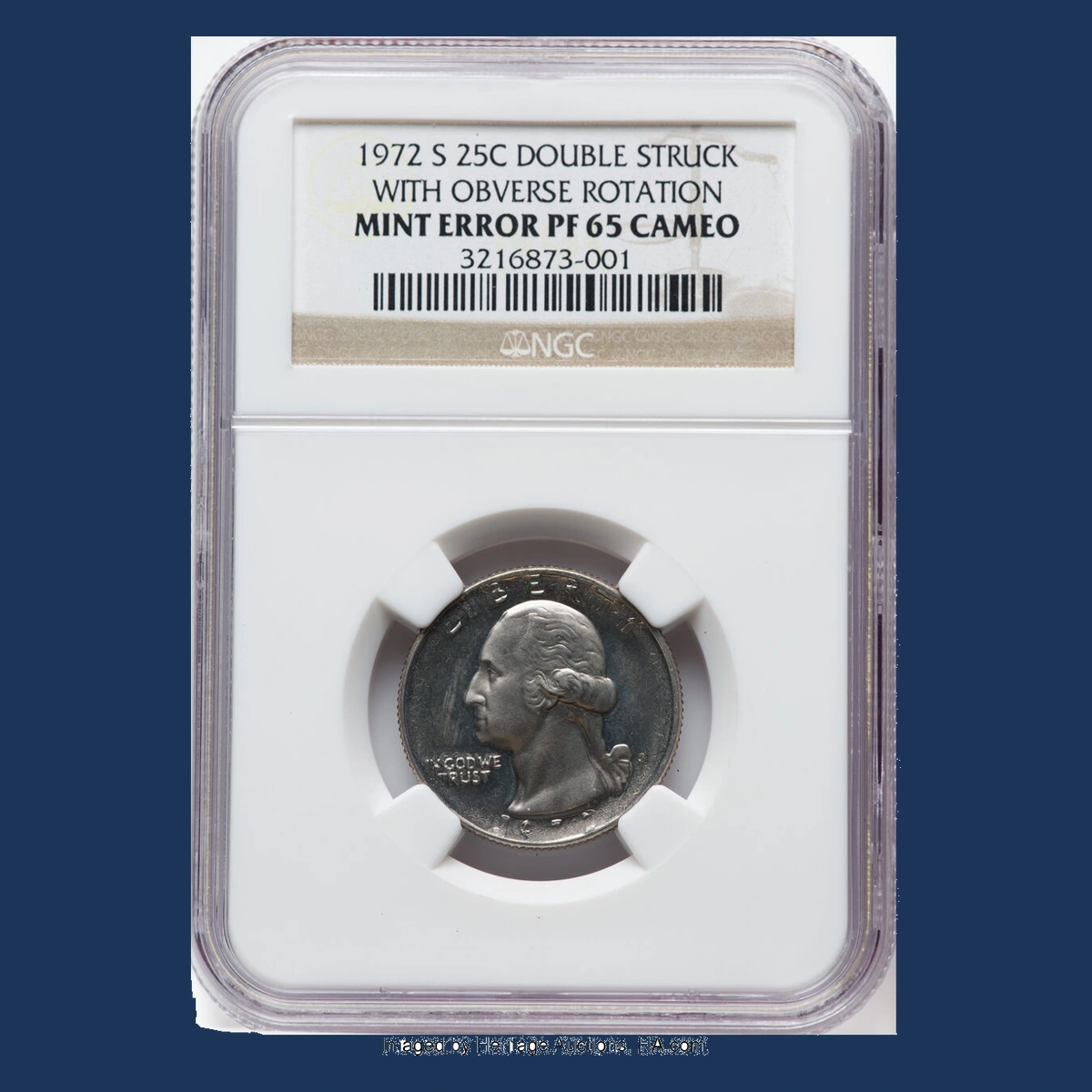
Proof coins normally receive careful striking to sharpen their detail. Repeated blows alone are not an error when the design stays in its intended position.
On the reported 1972-S mistakes, a design shifted between blows and left overlapping images. One example has a rotated front design and an NGC PR65 Cameo grade.
A different PCGS PR66 Proof was described with thirty-five degrees of movement between strikes inside the collar. The collar is the surrounding ring that controls the coin’s width.
That measured angle belongs to the second example. It should not be assigned to every doubled or double-struck Proof.
Estimated Value
A 2010 Mint Error News report records $805 for a PR65 Cameo example. A separate PR66 coin was advertised at $2,350, which was an asking price.
The estimated range is $300–$3,500. A widely separated second picture and clean reflective surfaces usually make a stronger display than slight overlapping detail.
Scratches can limit appeal even when the extra strike is genuine. Compare both the size of the displacement and the state of the surrounding shiny fields.
How to Identify
Look for a second placement of the portrait, date, or inscription across a broad area. A small repeated edge beside a letter is not enough to show a separate blow.
Follow several matching details to see whether they turn around the same center. Then inspect the rim for the collar’s boundary around the overlapping designs.
The thirty-five-degree example needs its own photographs and identity. Compare the rotated-front PR65 Cameo coin separately rather than building one set of features from both descriptions.
Finally, distinguish overlapping designs on one face from a tilted relationship between the two faces. Turning an ordinary rotated-design coin over does not reveal a second stamped portrait.
11. 1972 Washington Quarter Struck on Smaller Coin Blanks
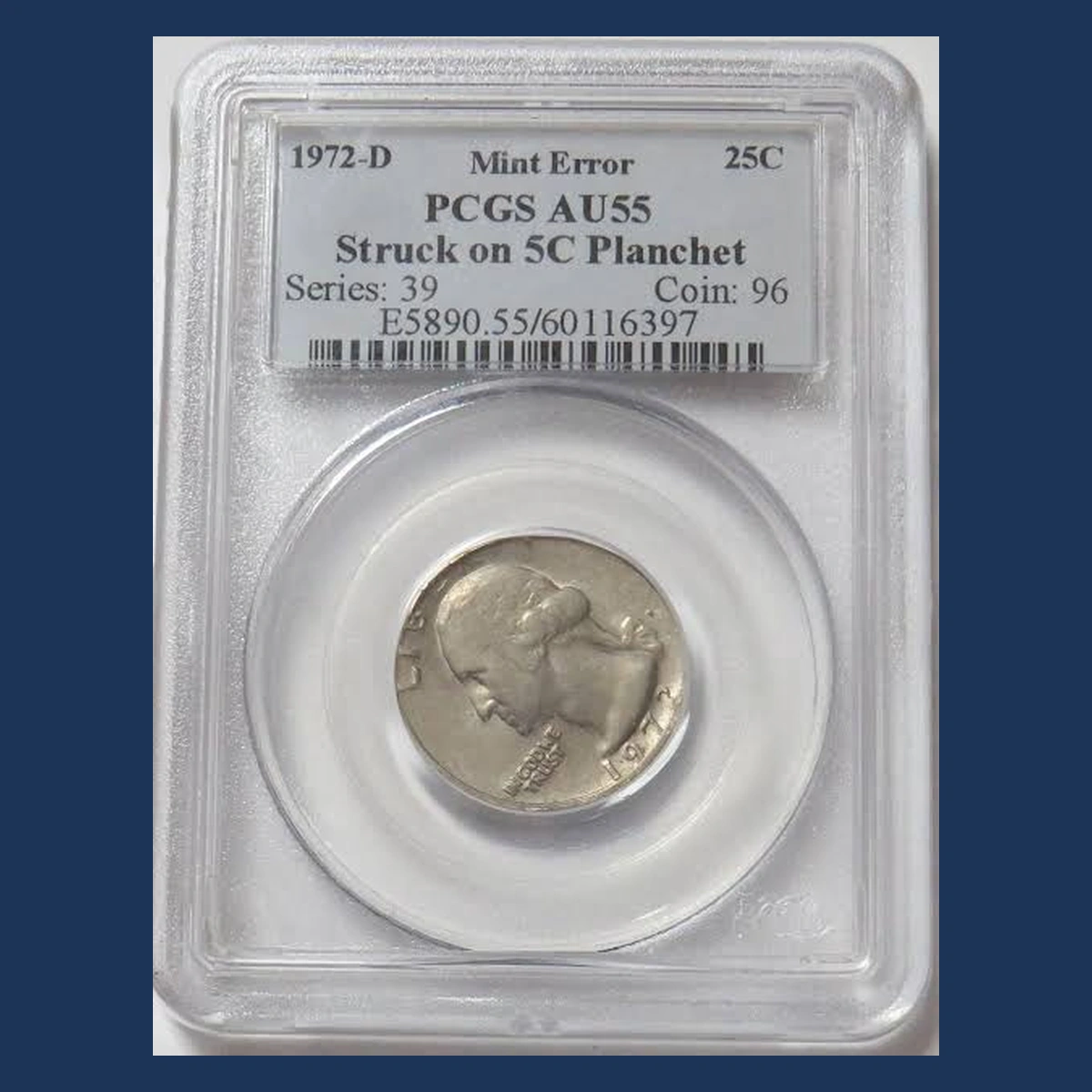
A blank intended for another coin can receive a quarter’s design. Its size, metal, and weight then differ from a quarter, often leaving outer lettering off the edge.
Denver examples include nickel, cent, and Philippine five-sentimo blanks. One cent-blank coin also retains a thin metal fragment on the back; the fragment’s composition has not been established.
A San Francisco Proof on a cent blank received two strikes as well. It is a combined wrong-blank and double-strike error, not two separately priced coins.
These blanks were unstamped before receiving the quarter design. Finished coins struck again belong in the final section.
Estimated Value
Estimate $150–$5,000 for ordinary smaller-blank errors and $2,000–$10,000 for the double-struck Proof on a cent blank. Unusual combinations and strong detail can increase collector interest.
A Denver nickel-blank quarter graded PCGS AU58 sold for $172.50 in May 2005. That older worn example provides context without setting a ceiling for better-preserved coins.
The three-point-one-gram Proof is a separate specimen. Its special finish and additional strike require comparisons beyond an ordinary Denver wrong-blank coin.
How to Identify
Compare the metal color and the amount of outer lettering that fits. Weigh a loose coin and measure its width without forcing it out of a sealed holder.
The reported Denver cent blank weighs 3.1 grams. A Philippine blank example weighs 2.4 grams, while a different Philippine-blank coin carries a PCGS MS62 grade.
Keep those identities separate from the cent-blank specimen with a retained back fragment. Do not remove the attached material or identify its metal from color alone.
On the 3.1-gram Proof, look for the readable date and S, repeated UNITED, and collar contact near four o’clock. LIBERTY lies beyond its edge; those details distinguish this specific combined error.
12. 1972 Washington Quarter Philippine Blank Bonded to the Front
A smaller brass blank became embedded in the front of a quarter blank during striking. Together they formed the reported eight-gram 1972-D composite coin.
The smaller piece was identified as a Philippine five-sentimo blank. It lay between the quarter blank and the front stamping tool, leaving the two pieces joined.
This is different from a quarter design struck only on a foreign blank. The composite contains both the quarter and the added piece.
The coin received an NGC MS62 grade, indicating no circulation wear but visible surface marks. Its auction description also identifies a later test scratch on the back.
Estimated Value
The composite sold for $4,560 at Heritage in December 2022. Estimate $2,500–$10,000 for a comparable authenticated combination.
Its value reflects the unusual joined pieces and their visible relationship. A loose foreign blank placed beside a quarter does not recreate the same error.
The eight-gram weight applies to the combined object, not to a normal Philippine blank. Any later scratches or attempts to separate the metal affect the whole coin’s condition.
How to Identify
The two pieces should remain joined: do not pull the smaller brass piece away to inspect underneath. Use side photographs to study its boundary near nine o’clock on the portrait side.
Turn to the back and locate the weak area near AMERICA. The original catalog describes a groove left unstruck there, helping connect the added front metal with the back’s incomplete design.
The thin test marks near three o’clock on the back are later damage, not features made by the striking press. For a loose example, the recorded eight-gram total belongs to the joined object; it must not be compared as though it were a single 2.4-gram foreign blank.
13. 1972 Washington Quarter Proof Reverse Die Cap
A coin can remain attached to a stamping tool and receive further blows as more blanks enter the press. Continued pressure may draw its metal outward into a cup.
The reported 1972-S Proof became a cap on the reverse tool, the tool carrying the eagle design. ANACS graded the example PF65.
Its shape records repeated striking, but the available description does not establish how many blows it received. Later listings do not create new error types.
This cupped object differs from the flatter Proofs with rotated overlapping images. Both the attached face and the developing side walls matter.
Estimated Value
A deep, intact cup with recognizable quarter designs is easier to appreciate than a shallow or damaged cap. Its projecting walls also make careful preservation particularly important.
Estimate $2,000–$15,000 using comparable dramatic Proof errors, rather than a claimed recent sale of this PF65 example. Broken, bent, or scraped walls can reduce interest, while an original shape and attractive remaining surfaces help a buyer understand the repeated striking.
How to Identify
A side view is more useful than a close-up of the shiny face at the start. Look for metal drawn into walls around the face that remained on the stamping tool.
Now follow the quarter’s original design into those stretched areas on photographs of both sides. A simple later fold bends the whole coin along a line instead of forming a cup through repeated striking pressure.
The documented example stayed on the back tool, which carried the eagle. Keep that relationship clear while checking the walls for later bending, cracks, or scraping; several visible ridges do not reveal an exact number of strikes.
14. 1972 Washington Quarter Struck over Finished Coins
An already stamped coin can receive another coin’s design. Surviving pieces of the older design reveal the host underneath the newer quarter image.
A 1972-S Proof was double-struck over a Roosevelt dime, while another Proof was struck over a 1953 Italian ten-lire coin. The dime’s own year is not established.
A different 1972 quarter was struck over a finished 1964 silver quarter. This example carries two quarter designs rather than two different denominations.
These objects therefore need separate identities despite sharing the same basic sequence. The unusual choice of host does not by itself establish how it entered the press.
Estimated Value
Estimate $2,000–$40,000 across these authenticated finished-coin overstrikes. The host, special Proof finish, remaining older design, and surface condition make major differences.
The January 2026 listing for the 1964-quarter overstrike reports $8,500. The listing does not specify the fee basis, so it is not labeled here as a hammer or fee-inclusive amount.
The Proof dime and Italian-coin examples require their own comparisons. Their values should not be added to the price of the ordinary quarter-over-quarter specimen.
How to Identify
Find letters or numbers that cannot belong to a Washington quarter, then trace enough of the older design to identify its source. Photograph them together with the 1972 design.
On the dime-host Proof, old NITED STA appears near four-thirty, with repeated GOD TRUST and a visible 72 and S. The old dime’s year must not be inferred from the quarter date.
The Italian host is a 1953 aluminum ten-lire coin. Match its surviving design without borrowing locations from the dime example.
For the silver quarter host, compare the surviving 1964 date near 1972 and the two overlapping quarter designs. A silver blank alone cannot explain visible remnants of an earlier date.
Conclusion
A repeated outline, a second strike, and an older coin beneath the quarter design need different explanations. The estimated error ranges here span $5–$40,000.
Compare Proofs with Proofs and ordinary coins with ordinary coins. Preserve any attached metal, and inspect both faces before applying a price.
Broad lettering alone may come from a common master design, while a true second strike leaves a separate picture.