2020 Dime Error List with Pictures

Look at the metal before the nickname. A copper-colored patch needs different checks from the mouth bump collectors call “Drooling Roosevelt.”
For price context, a 2018-P dime missing its front outer layer sold for $384 in July 2021. The 2020 dime errors discussed here have an estimated range of $5–$600.
Seven groups cover raised bumps, faint designs, extra leaf detail, and more. Work through the visible clues below to decide which check fits your coin.
1. 2020 Roosevelt Dime Weak Strike (Estimated Up to $200)
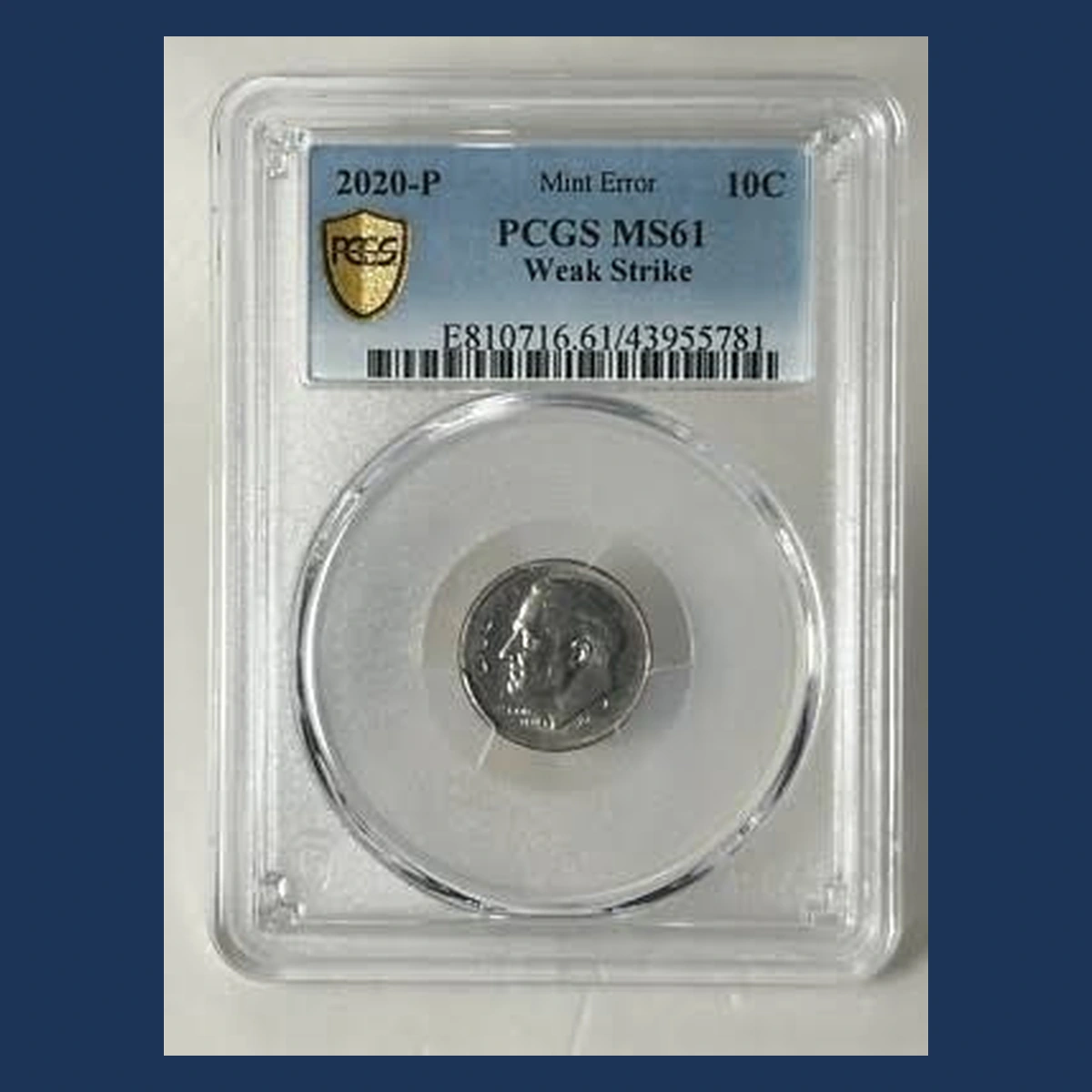
A dime can leave the press with very shallow lettering and a faint portrait. The design was never pressed fully into the metal.
This is a weak strike. It differs from a normally made coin whose raised details were worn away later.
The 2020 type is sometimes called a die-adjustment strike, suggesting that the press was being set up. Appearance alone cannot establish that particular factory step.
Look at the whole coin. Weak central details and faint outer letters on both faces are more useful than one missing letter on an otherwise sharp dime.
Estimated Value
Use an estimated $30–$200 for genuine, clearly visible weak strikes. A readable date and undamaged surfaces help a buyer understand the error.
A dateless Roosevelt dime with a weak strike and scratches sold for $114 at Heritage in October 2022. PCGS described that different coin as having almost-uncirculated details.
Its damage and missing date limit the comparison. The estimate does not give every faint 2020 dime the same value.
How to Identify
Compare a normal 2020 dime beside the candidate. Look for shallow design across both faces, rather than wear confined mainly to the highest points.
A 10× magnifier can reveal fine scratches, rubbing, or a rough surface left by chemicals. Those signs may explain why the detail looks faint.
Use a scale and calipers to compare with 2.268 g and 17.91 mm. Ordinary 2020 dimes have clad metal, meaning bonded outer layers around a copper center.
Inspect the grooves around the edge for filing or squeezing. A genuine weak strike need not lose metal.
Check for shallow but undamaged detail on both faces, with the date still tying the coin to 2020.
2. 2020 Roosevelt Dime Die Cracks, Chips, and Cuds (Estimated Up to $300)
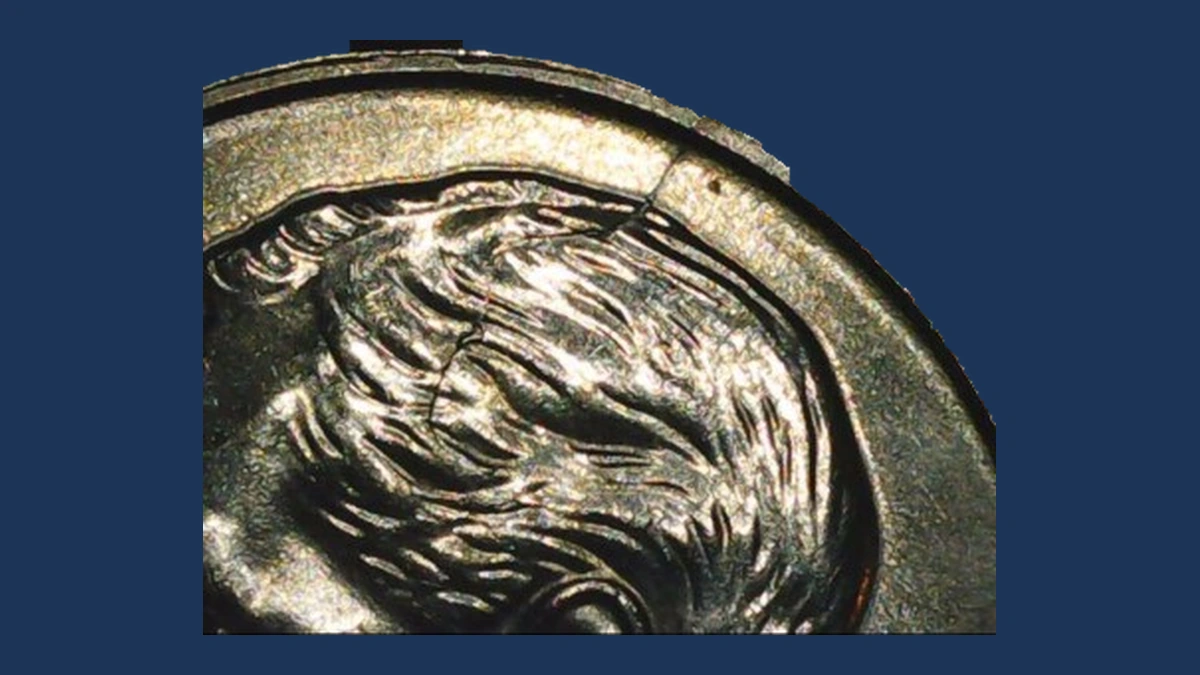
A small bump near Roosevelt’s mouth can make him appear to drool. On reported 2020-P examples, raised metal near the mouth, chin, or below the nose comes from a chipped die.
A die is the steel tool that stamps the coin. A small missing piece lets metal rise into the gap, making a die chip.
Cracks in the tool instead leave raised lines, including reported Denver examples. A larger break reaching the rim makes a blob called a cud.
An internal portrait bump is not a cud unless it connects to the rim.
Estimated Value
Estimate $5–$300 across small chips, cracks, and larger rim breaks. Tiny portrait bumps generally sit near the lower end.
A strong, easily seen cud can attract more interest than a thin line. This is an estimate for genuine errors, not a claim of a specific 2020 auction result.
The “Drooling Roosevelt” nickname does not set a fixed price. Size, condition, and how clearly the metal defect shows all affect demand.
How to Identify
Find where the raised metal begins and ends. With a 10× magnifier, follow a line across the surface or trace the outline of a bump.
Near the portrait, inspect the mouth, chin, and area below the nose. Dirt can stick in these places, while a hit may push up metal beside a dent.
A rim-connected blob should join the coin’s border naturally. Look at both faces and the edge grooves for damage explaining its shape.
A scale and calipers provide basic checks against 2.268 g and 17.91 mm. Tool damage alone does not require a different disc.
Check whether the feature is raised metal joined to the coin, rather than a scratch, deposit, or dent’s raised lip.
3. 2020 Roosevelt Dime Doubled Die (Estimated Up to $300)
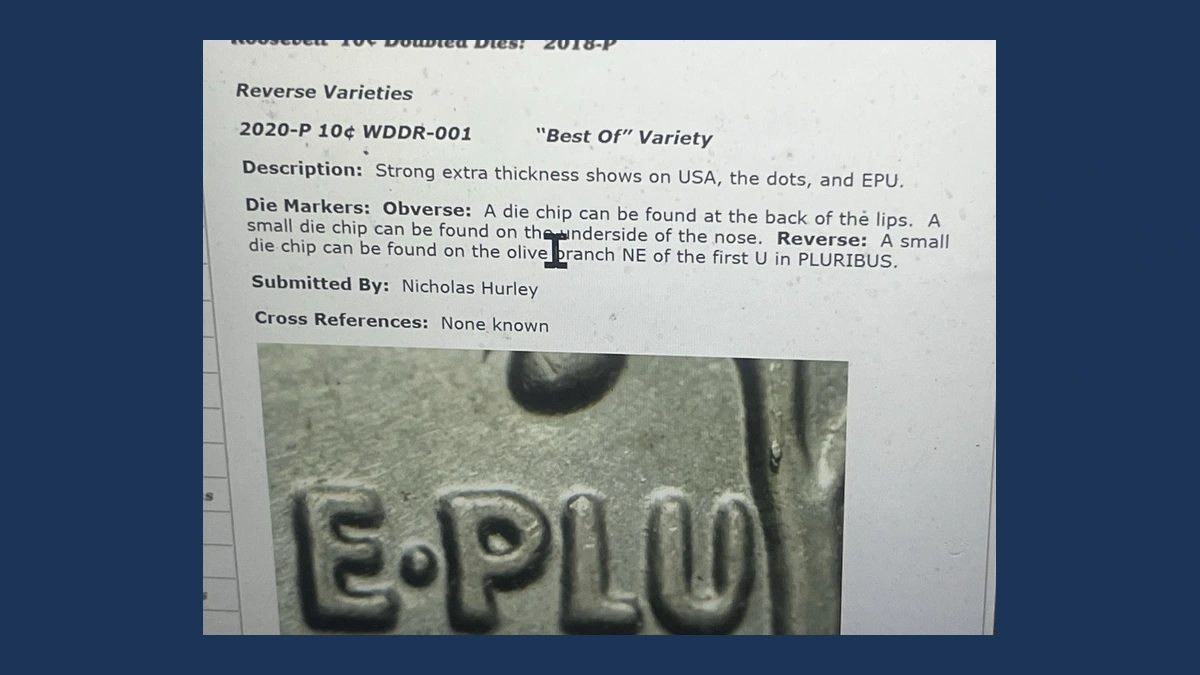
An extra edge on an olive leaf can be more useful than a generally thick-looking letter. On 2020-P dimes, the area above RIB in E PLURIBUS UNUM deserves attention.
A doubled die has repeated detail built into the stamping tool. Coins made with it can repeat that same extra shape.
Other back-design descriptions involve thicker lettering. These features must be compared separately, rather than treated as one universal pattern.
A Denver front-doubling claim also exists, but the Philadelphia back pattern cannot confirm it. Inspect the correct face and mint before naming a variety.
Estimated Value
An estimated $20–$300 applies to genuine doubled dies with recognizable extra detail. Small features usually bring less than strong, well-documented doubling.
This range is an editorial estimate rather than a recorded 2020 sale. A claimed Denver front variety needs its own match before it receives a doubled-die premium.
Flat shelves caused by movement during stamping usually add little. Clear photographs of the actual extra stroke matter more than a doubled-looking overall appearance.
How to Identify
Begin with the P or D mintmark on the front. For a Philadelphia coin, turn it over and find the olive leaf above RIB.
Inspect the leaf’s right edge with a 10× magnifier. Compare it with Wexler’s pictured 2020-P details, keeping other lettering patterns separate.
If examining a Denver front, use a matching front-side example instead. A low flat shelf can come from movement during stamping.
Check the edge grooves and compare scale and caliper readings with 2.268 g and 17.91 mm. Small portrait chips do not prove doubling.
Match the extra stroke’s exact shape and location to the same mint and face, rather than relying on thick letters.
4. 2020 Roosevelt Dime Struck Through a Capped Die (Estimated Up to $350)
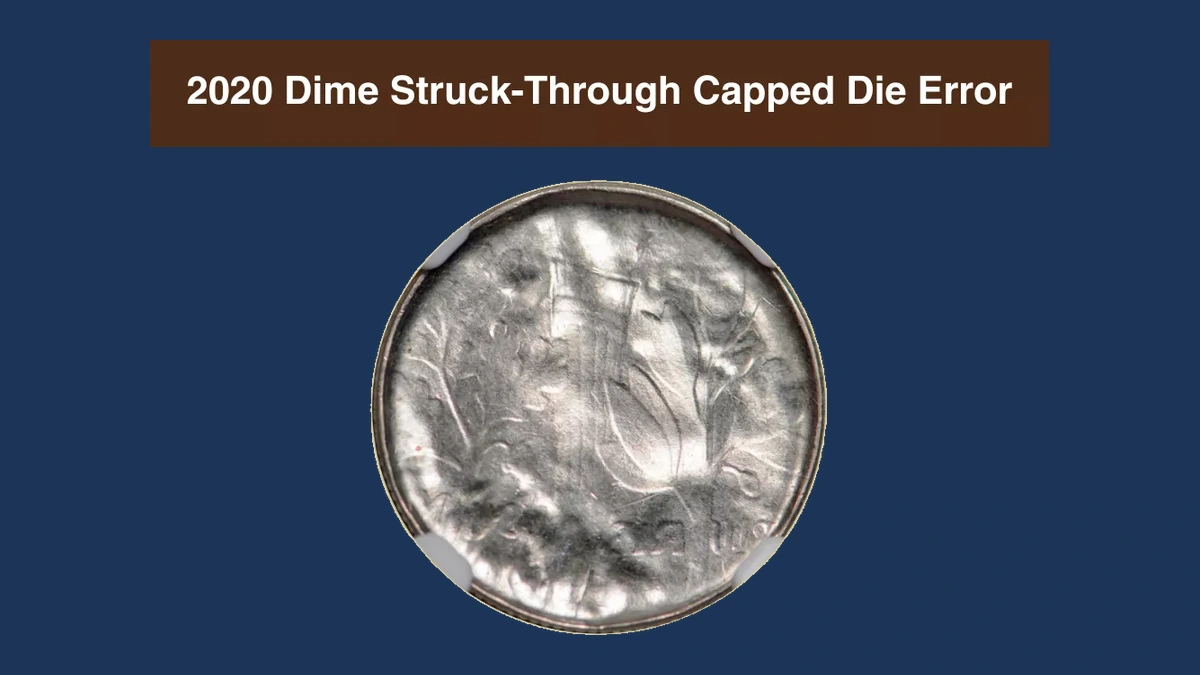
One face may look blurred or partly hidden while the other carries a much clearer design. A previously struck coin can stick to a stamping tool and block its contact with the next disc.
The stuck coin acts like a cap. A coin made beneath it is described as struck through a capped die.
The appearance changes as the cap becomes thinner and spreads. Some coins show backward, sunken traces, while others show faint or distorted detail.
The reported 2020 example should not be expected to have a complete backward design merely because of its error name.
Estimated Value
An estimated $40–$350 covers modest through stronger examples with a clear capped-die effect. Sharp remaining detail and attractive surfaces can increase interest.
A 1997-P dime struck through a late-stage cap sold for $49 at Heritage in October 2022. ANACS graded that different-year coin MS60, meaning unworn but noticeably marked.
This sale supports the affordable end of the estimate. A vague, damaged face alone does not establish the error.
How to Identify
Compare the two faces before examining a single faint letter. One may show a much clearer design than the side blocked by the stuck coin.
Under a 10× magnifier, look for distorted outlines or backward, sunken traces. Their absence does not rule out a later-stage cap that had become very thin.
Check the edge grooves and the weak face for grinding, hammering, or scraping. Later damage can erase one side without involving the coin press.
Record scale and caliper measurements against the ordinary 2.268 g and 17.91 mm. Keep the whole coin available for comparison.
Compare the blocked face with a confirmed capped-die strike showing the same kind of distortion, not just similar weakness.
5. 2020 Roosevelt Dime Broadstrike (Estimated Up to $400)
The dime may look too wide, with extra metal beyond its normal border. A broadstrike happens when the collar fails to hold the disc during stamping.
The collar is a ring that limits the coin’s width and forms its edge grooves. Without it, the metal can spread outward.
A broadstrike keeps the design on the coin, although the border may be uneven. This distinguishes it from a strike that loses design beyond the edge.
The amount of spreading varies. Compare the actual 2020 coin with a normal dime rather than expecting one fixed error diameter.
Estimated Value
Use an estimated $50–$400 for genuine 2020 broadstrikes. Bold spreading and well-preserved designs generally make an example more appealing.
A 2000-P dime that was broadstruck and stamped several times brought $159 in September 2025. NGC graded it MS65, an unworn grade.
That coin combines more than one error and has a different date. Its sale helps inform the range, but it is not a price quote for a simple 2020 broadstrike.
How to Identify
Use calipers in several directions, comparing the results with the normal 17.91 mm diameter. A broadstrike can have an uneven outline rather than a perfect circle.
Look around both designs with a 10× magnifier. Confirm that the important outer letters remain on the metal, even where they are weak.
An intact ordinary disc should stay near 2.268 g on a scale. Inspect the edge for absent or incomplete grooves where the ring failed to contain it.
Hammering can also widen a dime, but often flattens the portrait and letters. Check for those crushed surfaces.
Find complete designs within an expanded outline, with natural outward spreading rather than damage flattening the coin.
6. 2020 Roosevelt Dime Off-Center Strike (Estimated Up to $500)
A narrow plain crescent can mark a small off-center strike. The 2020-P report describes an offset of about five percent.
The disc sat partly outside the stamping tools, so part of the design missed it. Both faces should reflect the same misplaced disc.
At such a small offset, an uneven border can be easy to misread. A tool shifted on just one side can also make that side look off center.
The comparison therefore needs both faces. A clear 2020 date and P mintmark help identify the reported type without guessing from the outline alone.
Estimated Value
Estimated values are $30–$500 for genuine, readable-date 2020 off-center dimes. The reported small offset belongs toward the modest end unless other features add interest.
A 1977 dime struck ten percent off center sold for $109 in June 2026. NGC graded that different-year comparison MS64 Full Bands, with clearly separated torch bands.
Larger, attractive offsets can bring more. The estimate is not a fixed price for each percentage of missing design.
How to Identify
Find 2020 and the P mintmark first when comparing the reported example. Then inspect the border closest to the missing design with a 10× magnifier.
Turn the coin over and check the same area on the back. One shifted face opposite a centered face instead suggests a misplaced stamping tool.
The plain arc should still contain metal. A cutout or gap has a different explanation.
Compare a scale reading with 2.268 g and caliper measurements with 17.91 mm, allowing for an uneven outline. Check the edge grooves for cutting or filing.
Trace matching plain arcs on both faces to show that the disc, rather than only one tool, was out of position.
7. 2020 Roosevelt Dime Missing Clad Layer (Estimated Up to $600)
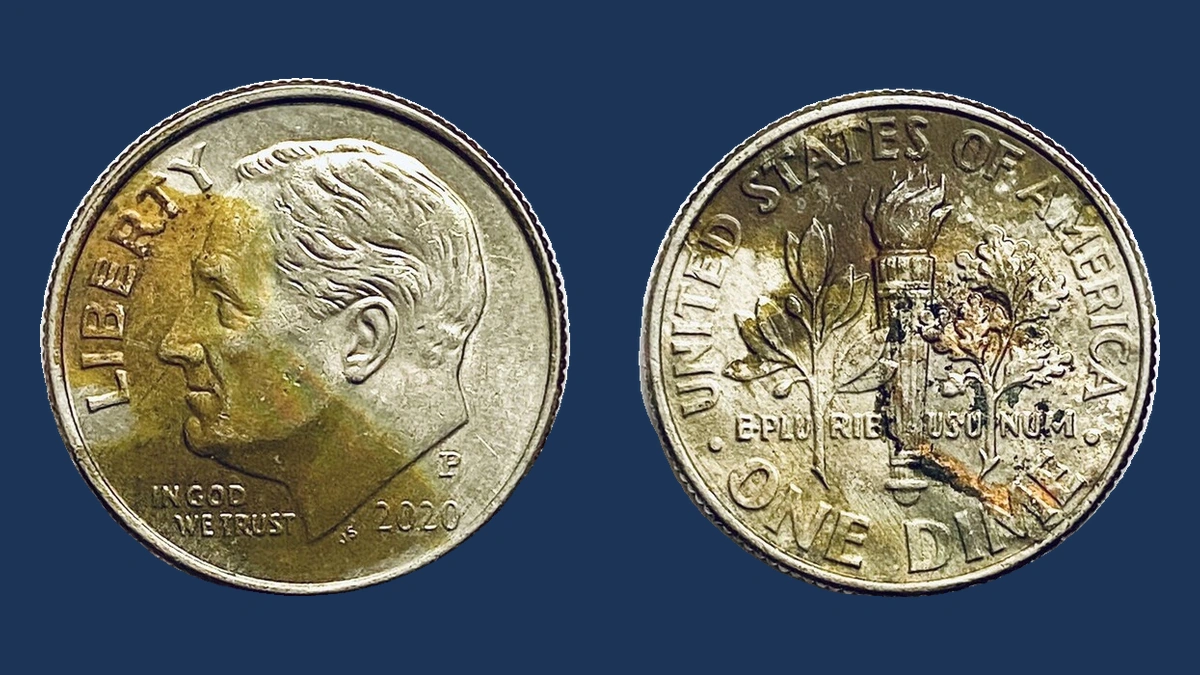
A copper-colored patch or face may expose the center of an ordinary dime. Its pale outer metal is normally bonded to that copper center.
When an outer layer is missing, the coin’s appearance and weight can change. A partial loss leaves a boundary within the face, while a complete loss exposes more metal.
This applies to ordinary clad dimes. The specially made 2020 silver proofs use .999 silver and should not be judged as missing-layer clad coins.
Stains, heat, and chemicals can also change color. Check the metal structure before assigning an error premium.
Estimated Value
An estimated $50–$600 covers genuine partial through complete missing-layer errors in collectible condition. A large, clear exposed area can attract more interest.
A 2018-P dime missing its front layer sold for $384 in July 2021, graded PCGS MS64. A 2019-P example with eighty percent missing brought $139 in September 2024.
Those are different years and different conditions. Their sales help guide the estimate, without making every brown 2020 dime valuable.
How to Identify
Confirm that the coin is an ordinary clad dime before weighing it. A silver collector proof has a different metal composition and is not this error.
Use a 10× magnifier to inspect the pale-to-copper boundary, or the edge if a whole face is exposed. Look for scratches and rough areas caused by chemical attack.
A scale may show less than the standard 2.268 g. The amount lost depends on how much layer is absent, while acid damage can also lower weight.
Compare caliper readings with 17.91 mm and inspect the remaining edge grooves. Examine both faces.
Look for an actual missing layer and naturally stamped detail in the exposed area, rather than color alone.
Conclusion
On a 2020 dime, a bump adds metal to the design while a missing layer removes it. A shifted or faint design calls for a different comparison again.
The estimated $5–$600 range covers those very different mistakes. Begin with the feature you can see, check both faces and the edge, and use confirmed examples before paying for an error label.