2010 Dime Error List with Pictures

A 2010-P dime missing its front outer layer sold for $131.38 in June 2019, according to PCGS auction records. Its copper-colored face offers a much stronger clue than a tiny mark spotted at random.
This 2010 dime error list covers estimated values from $5 to $1,500. The upper estimates include errors on Proofs, specially made collector coins, with guide reports kept separate from the recorded sale.
Use the visible differences below to decide which kind of unusual dime you have.
1. 2010 Roosevelt Dime Broadstrike with a Spread Border
The design may fit entirely on the coin while the surrounding border spreads unusually far outward. This is a broadstrike: the ring around the blank failed to contain the metal during striking.
That ring, called the collar, normally controls width and forms the edge grooves. Without proper support, metal can spread and leave part of the edge smooth.
The 2010 reports include a Denver circulation example. A broad border is different from a missing section of design, so a wide coin should not automatically be called an off-center strike.
Estimated Value
An estimated $15–$250 covers modest through clearly expanded broadstrikes. A complete design and an attractive, undamaged border matter more than a small increase in width alone.
The year guide’s general modern-dime range is $15–$200. A stronger example can bring more, but its shape and surfaces should explain that difference; a high seller figure alone does not.
Compare the actual amount of spreading before paying for a more dramatic error.
How to Identify
Place a normal dime beside the suspected broadstrike and compare the border around the letters. The design should remain complete, even when the surrounding metal has spread unevenly.
Use a 10× magnifier to examine the outer edge for battered grooves or repeated rubbing. A coin tumbled in machinery can develop a thick rounded edge after minting.
Only then measure the outline with calipers against the usual 17.91 millimeters. A scale should place an ordinary clad dime near 2.268 grams because spreading does not remove its metal.
Look at both faces for squeezed or flattened lettering from later pressure. An original expanded border surrounding a complete, normally stamped design supports the broadstrike explanation.
2. 2010 Roosevelt Dime Off-Center Strike with an Unstruck Crescent
A curved area of untouched metal can occupy one side of the dime while the design runs beyond the opposite edge. The blank was not centered beneath the stamping tools when the coin was struck.
The year guide includes this error but does not identify a particular mint or measured 2010 specimen. Its percentages describe possible appearances, rather than one specific coin.
The date may survive or disappear depending on the shift. Both faces need examination, since a narrow border on only one side can result from a misplaced stamping tool instead.
Estimated Value
For a small genuine offset, estimate $5–$30; a more dramatic example with a readable date may reach $50–$300. These ranges use comparable modern clad dimes.
A complete 2010 date makes the coin easier to collect by year. Greater displacement is not automatically better if it leaves too little design to recognize.
The year guide supplies general ranges rather than a named 2010 auction sale. Flattening, clipping, or a merely uneven rim should not receive the same premium.
How to Identify
Compare the two faces without cropping the photographs. The unstruck crescent should line up with corresponding design loss, rather than appear as an uneven border on just one face.
Read whatever remains of the date and mintmark under a magnifier. Do not supply missing digits from a seller’s guess.
The blank crescent should retain an original surface. Grinding may leave parallel scratches or a flat area that cuts through the normal struck detail.
Weigh a loose circulation example with a scale against 2.268 grams, then use calipers to record its outline against 17.91 millimeters. Striking can stretch the shape without cutting away metal.
Matching blank areas and interrupted designs on both faces provide the clearest visible check.
3. 2010 Roosevelt Dime Wire-Shaped Struck-Through Impression
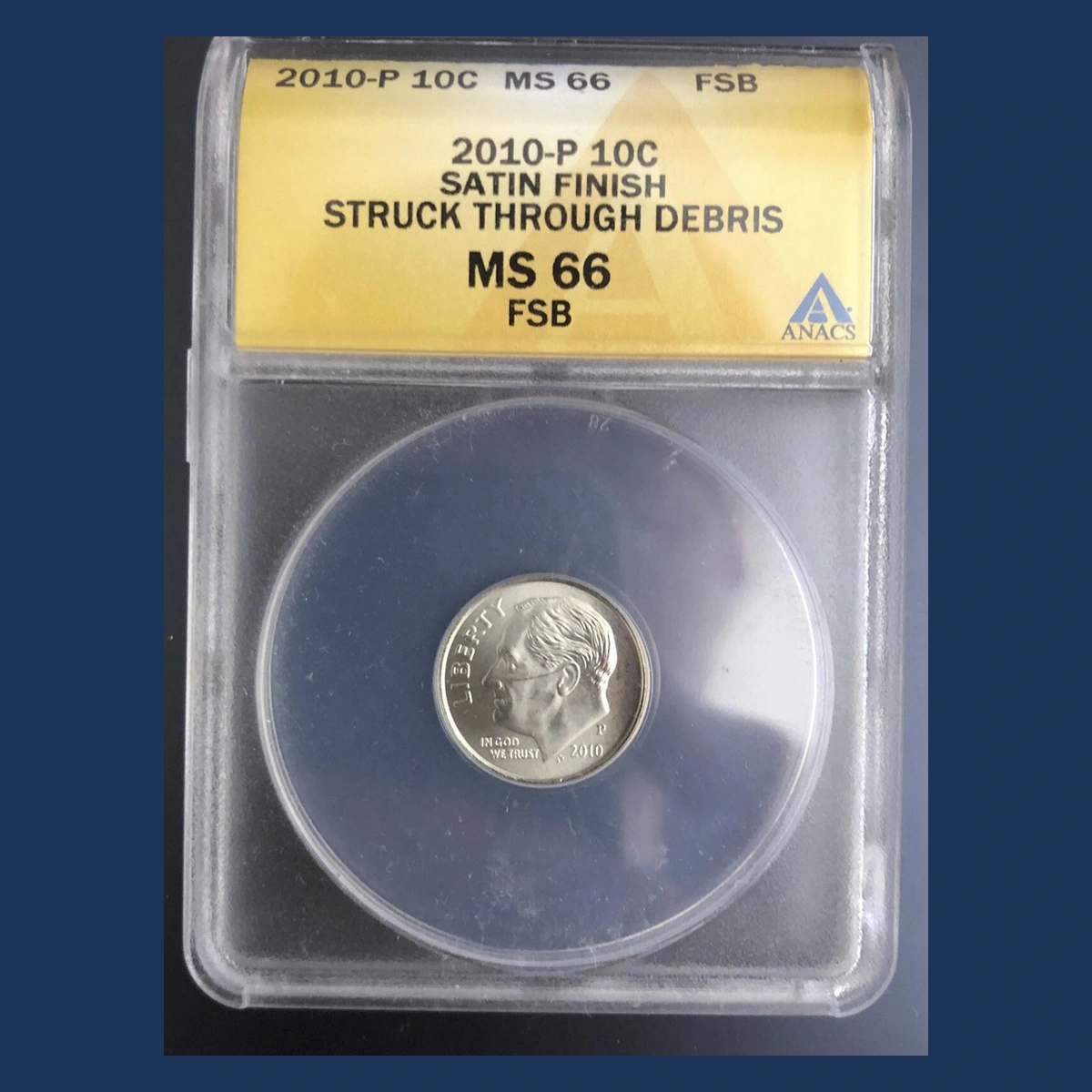
A narrow impression can cross the surface where a wire lay between the blank and a stamping tool. The wire blocked the design and left its shape behind when the coin was struck.
A dealer reports a 2010-P circulation dime graded ANACS MS64 with this error. MS64 means it has no circulation wear but still shows some marks.
The description does not establish that the wire remains embedded in the coin. A wire-shaped hollow and a retained piece of wire are different visible results, and neither should be confused with an ordinary later scratch.
Estimated Value
The dealer’s 2010-P listing asks $325 or best offer for the ANACS MS64 piece. That is an asking price, not a completed transaction.
Estimate $100–$350 for a clear wire-shaped impression on an attractive example. Length, depth, and the amount of interrupted design affect its appeal.
The higher prices sometimes quoted for retained objects should not be added unless material actually remains in the coin and is identified as part of the original strike.
How to Identify
For the reported certified example, read the holder’s error description and compare it with the coin inside. Leave the holder sealed.
Under a 10× magnifier, follow the narrow hollow through the surrounding design. Look for detail blocked by the object rather than a fresh groove slicing through a fully formed letter.
Photograph any apparently retained material without pulling at it. A hollow line does not prove that the wire is still present, and later attached material can be misleading.
A loose circulation dime normally weighs 2.268 grams and measures 17.91 millimeters, checked with a scale and calipers. The most useful visible evidence is an original impressed channel that interrupts the strike, not merely a long scratch.
4. 2010 Roosevelt Dime Opposite-Side Design from a Die Clash
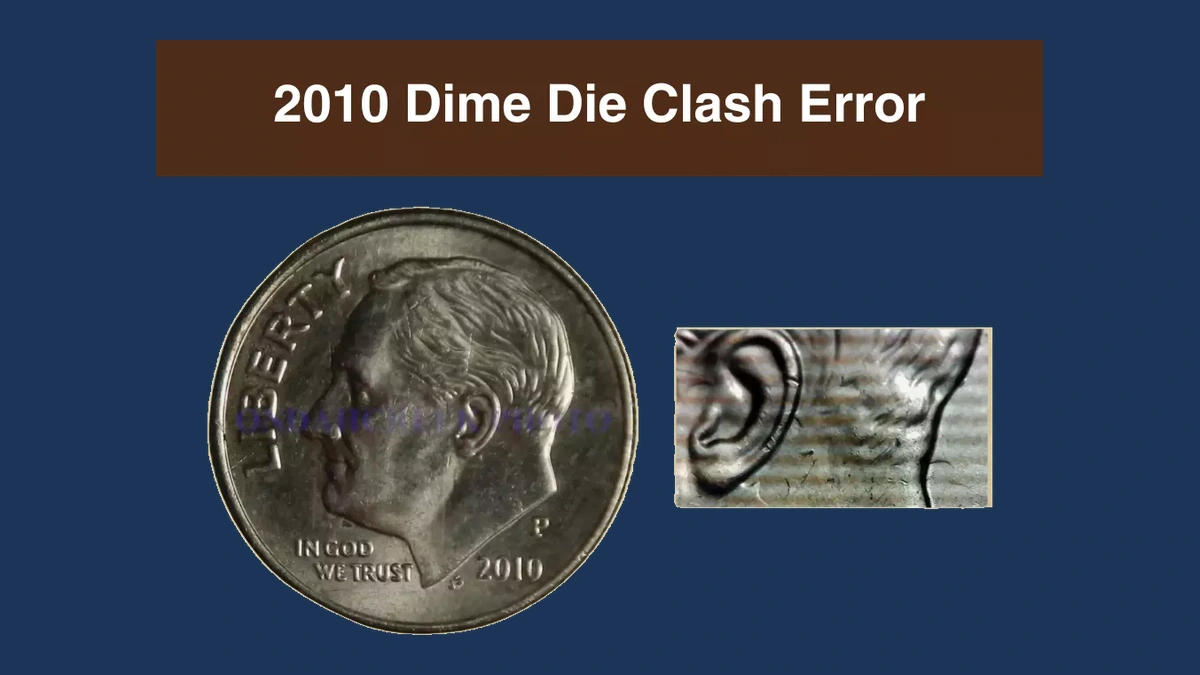
An unexpected outline can resemble part of the design that belongs on the other face. A die clash happens when the two stamping tools meet without a blank between them and mark each other.
Coins struck afterward can carry faint transferred traces beside their regular designs. The year guide reports a 2010-P example, but it does not establish a precise map of its extra outlines.
A suggested torch or portrait position is therefore only a place to investigate. Scratches and unrelated lines need to match a real part of the opposite design before they support a clash.
Estimated Value
Estimate $5–$30 for slight but identifiable traces and $50–$500 for a much clearer example. A recognizable transferred shape is more persuasive than a collection of faint random lines.
The year guide reports a $490 eBay result in 2020 for a 2010-P coin described as MS60, meaning unworn with many marks. It remains a secondary report.
Compare the strength and completeness of the extra outline rather than assuming every clash reaches that reported price.
How to Identify
Try to trace the unexpected shape in a photograph before enlarging it. Compare its curve or outline with the actual design on the other face, keeping both photographs at the same scale.
Under a 10× magnifier, follow the trace as you move the lamp and check for scratches crossing it. Also look for damage caused by another finished coin being pressed against the dime.
For a loose P circulation coin, check 2.268 grams with a scale and 17.91 millimeters with calipers. Neither measurement proves a clash; the useful match is a recognizable part of the opposite design within the faint extra outline.
5. 2010 Roosevelt Dime Discoloration from Improper Annealing
A dark or unusually colored surface is reported on a 2010-D dime as improper annealing. Annealing is the controlled heating that softens coin blanks before striking.
A problem during that step can change the surface, but the finished dime may still contain its normal metal. This differs from losing an outer layer and exposing the copper core beneath.
Color and rotating shine are useful observations, not proof of the heating history. Staining, chemicals, and heat applied after minting can also change a dime, so the whole surface needs to be examined.
Estimated Value
Use an estimated $25–$800 for an identified mint heating error, with minor appearances toward the bottom. Strong original color on a well-preserved coin provides a more useful upper-end comparison.
The year guide reports a $760 online-auction result in 2019 for a 2010-D graded MS63, meaning unworn with visible marks. That figure is a guide report, not an original auction record presented here.
Ordinary environmental staining carries no equivalent premium simply because the shade looks dramatic.
How to Identify
Check the coin’s edge before deciding that unusual color came from heating. A missing outer layer or obvious peeling points toward a different metal problem.
A scale and calipers help compare a loose D circulation coin with 2.268 grams and 17.91 millimeters. A normal weight does not prove improper annealing, but substantial missing metal needs another explanation.
Examine the surface with a 10× magnifier under neutral light. Note whether the color covers intact design or accompanies corrosion pits, a coating, or rubbed patches.
Turn the coin slowly to observe its shine without cleaning it. Original-looking shine can survive several kinds of color change, so it is not a stand-alone test.
Have the intact surface and edge examined together before calling the discoloration a mint heating error.
6. 2010 Roosevelt Dime Doubled Design from a Stamping Tool
A genuine doubled design can give a letter or small feature an extra rounded edge. The steel stamping tool carries that doubled pattern, so more than one coin may repeat it.
The 2010 guide reports a Philadelphia example without a precise pattern that identifies its tool. It lists lettering, the date, and reverse details as places to examine, not as confirmed features of one coin.
A flattened ledge from movement during striking is different. Slight thickness, wear, and reflected light can also suggest two outlines even when the tool’s original design was not doubled.
Estimated Value
An estimated $25–$850 spans minor identifiable doubling through a strong, professionally identified example. Most slight thickening should not be compared directly with the upper end.
The year guide reports $835 at GreatCollections in 2022 for a 2010-P described as MS64, an unworn coin with some marks. The named auction record and precise doubled pattern are not established here.
Pay for a match to an actual doubled design, rather than for a label attached to a flat striking shelf.
How to Identify
Take a sharp photograph of the apparent second outline and compare it with a normal dime under the same light. A 10× magnifier should show whether it is rounded metal, a flat striking ledge, or just a reflection.
Check the P near the date, then use a scale and calipers on a loose coin for 2.268 grams and 17.91 millimeters. Those ordinary clad measurements establish the coin type but say nothing about the cause of its extra outline.
The year report does not identify one precise doubled pattern, so a claimed match needs clear images of an established example. Concentrate on repeated rounded separation in that actual pattern, rather than hunting for unrelated thick letters across both faces.
7. 2010 Roosevelt Dime Incomplete Blank or Clipped Planchet
A missing piece of the outline can originate before the dime receives its design. Planchet means the prepared metal blank, and a clipped planchet begins with part of that blank absent.
A curved gap can form when the blank-cutting punch overlaps an earlier hole in the metal strip. Other incomplete shapes need their own edge evidence rather than being forced into the curved-clip description.
The 2010 year guide includes clips without identifying a particular mint, shape, or size. Its general percentage examples should not be mistaken for measurements of a known 2010 coin.
Estimated Value
Small genuine clips can be estimated at $10–$40, with larger examples around $50–$250. A very large, clearly original clip with a readable date may reach $300–$1,000 by comparison with modern clad dime errors.
These are appearance-based estimates rather than recorded prices for specific 2010 specimens. A larger gap needs stronger evidence that metal was missing before striking.
Wear, corrosion, and a later cut can make the edge less convincing even when the missing section looks dramatic.
How to Identify
Inspect the missing section at an angle with a 10× magnifier. Look for original metal flow around the gap instead of file marks, sharp cutting burrs, or a newly exposed sheared surface.
Then examine the rim directly opposite the gap. It may be weak because the incomplete blank did not form a normal rim, although this clue is not equally strong on every clip.
Weigh the coin on a scale: missing metal should lower the ordinary 2.268-gram weight. With calipers, compare the unaffected span with the normal 17.91-millimeter diameter.
A light coin alone proves nothing about when metal was removed. The edge, nearby stamped detail, and any opposite-rim weakness need to agree with a gap present before striking.
8. 2010 Roosevelt Dime Missing Front or Partial Reverse Outer Layer
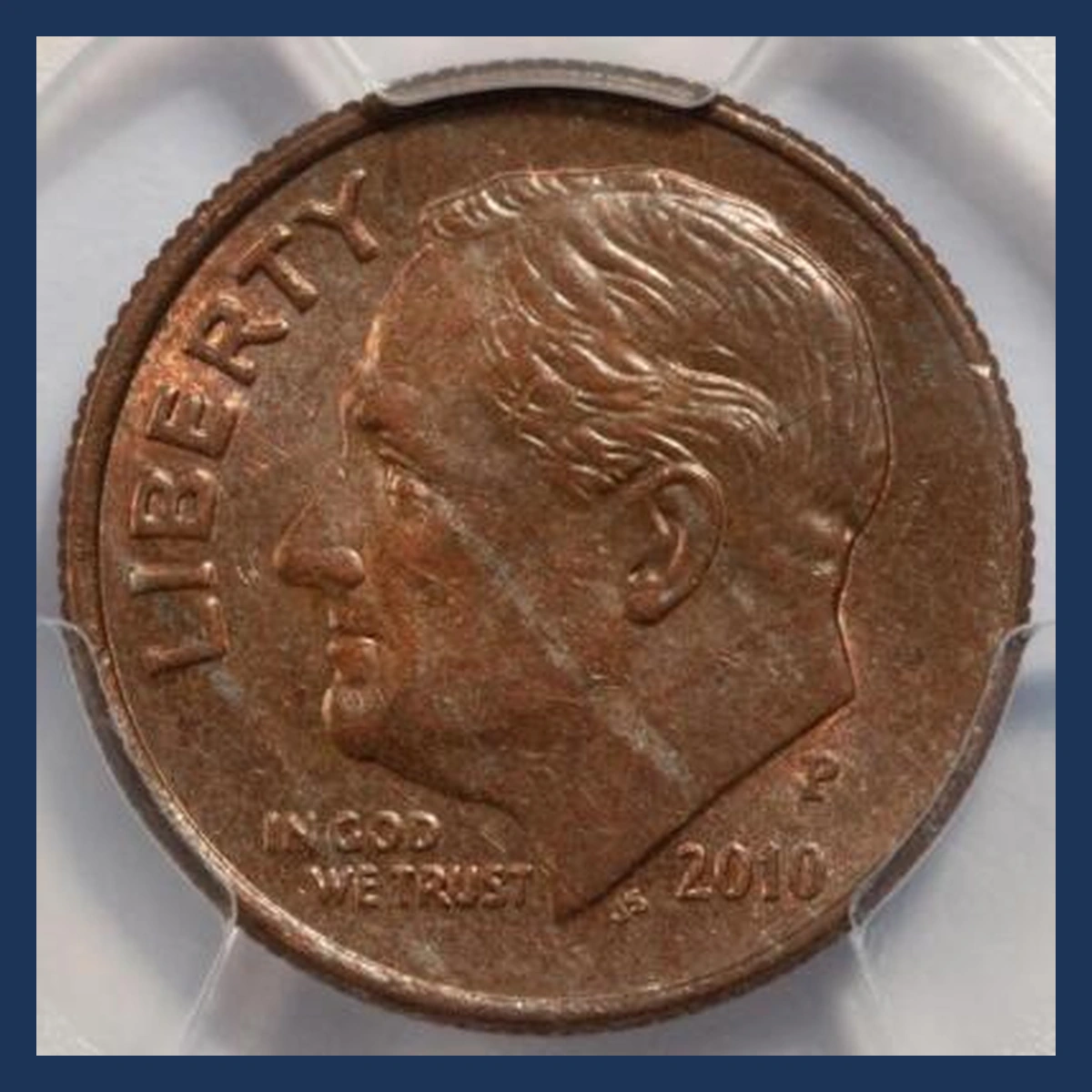
A copper-colored face can reveal the core beneath a missing silver-colored outer layer. On a partly affected face, copper and the remaining outer metal meet along a visible boundary.
PCGS records a 2010-P dime missing the front layer, with an auction title describing NGC MS65 FT. MS65 means unworn with relatively few marks; FT refers to sharply defined torch details.
The year guide separately reports a 2010-D missing part of its reverse layer. These are two different coins and affected faces, so one example’s shape or amount of loss cannot identify the other.
Estimated Value
PCGS records $131.38 for the front-layer 2010-P in June 2019. This is an actual recorded result, unlike the year guide’s separate $1,320 report for a Denver partial-reverse example.
Estimate $100–$1,400, with the affected area, condition, and strength of identification determining where a coin fits. A small stained patch is not comparable to missing metal.
The Philadelphia sale also shows why a four-figure guide report should not become the automatic price for every missing-layer dime.
How to Identify
Compare the two faces first. The Philadelphia report concerns the front, while the Denver report concerns only part of the reverse.
At the boundary of a suspected missing area, use a 10× magnifier to follow the remaining outer layer. Stripped or ground metal may show disturbed lettering and unnatural surface texture.
A precise scale should show a loss from the normal clad weight of 2.268 grams. Use calipers for the usual 17.91-millimeter width, but do not invent a fixed error weight for every amount of loss.
A normal 2010-S silver Proof weighs 2.50 grams and belongs to a different issue. On a clad candidate, require exposed copper, absent outer metal, and preserved original struck detail together.
9. 2010 Roosevelt Dime Cracks, Chips, and Rim Cuds
Raised lines and extra lumps can come from different-sized breaks in the stamping tools. A narrow crack leaves a ridge; a small missing piece of steel allows a lump to form on the coin.
A cud is a larger raised area connected to the rim where part of the tool’s edge broke away. The normal design disappears within that missing section.
The 2010 reports include clad S Proofs with interior chips and a separate rim-cud example. Proofs are specially made collector coins, and these reports should not be extended to the silver Proof issue.
Estimated Value
Estimate $5–$150 for fine through prominent cracks, while the reported clad Proof breaks support a broader $100–$1,500 comparison range. The small-crack range should not be replaced by a Proof-level price.
The year guide reports $1,010 for a two-sided chip example and $1,450 for a separate rim cud. These remain secondary auction reports.
Compare the size, location, and collector finish of the actual coin, without adding separate premiums for every bump.
How to Identify
Look for a connection to the rim before calling a raised patch a cud. An isolated interior lump is a chip, while a narrow ridge is a crack.
Under a 10× magnifier, check that the raised metal belongs to the surface. Glue, solder, and metal pushed up beside a gouge can create misleading bumps.
For an S example, distinguish the clad collector Proof from the normal silver version. A loose clad Proof weighs 2.268 grams; the silver Proof weighs 2.50 grams, and both measure 17.91 millimeters.
Use a scale and calipers only on loose coins, leaving graded pieces sealed. A cud can also cause weakness on the opposite face.
The rim connection and missing design inside a raised patch separate a cud from an ordinary interior chip.
Conclusion
Estimated 2010 dime error values run from $5 to $1,500, but the particular coin matters more than the highest guide figure. The recorded $131.38 Philadelphia missing-layer sale is a useful reminder that similar error names can cover very different coins.
Check whether your dime has missing metal, added raised detail, or a shifted design. Keep circulation coins, satin-finish coins with softly textured surfaces, clad Proofs, and silver Proofs separate when comparing prices.