1925 Nickel Error List with Pictures

A Buffalo nickel can carry the right design on the wrong metal. One 1925 example struck on a silver dime blank sold for $4,800 in January 2018.
This 1925 Buffalo Nickel error list also explains missing feathers, an absent designer’s initial, and extra mintmark curves. Estimated values span $2–$10,000, including ordinary circulated coins with a common doubled design that adds no special premium.
Read on to compare the visible features before deciding which description fits your coin.
1. 1925 Buffalo Nickel Common Doubling beside the Braid and Ribbon
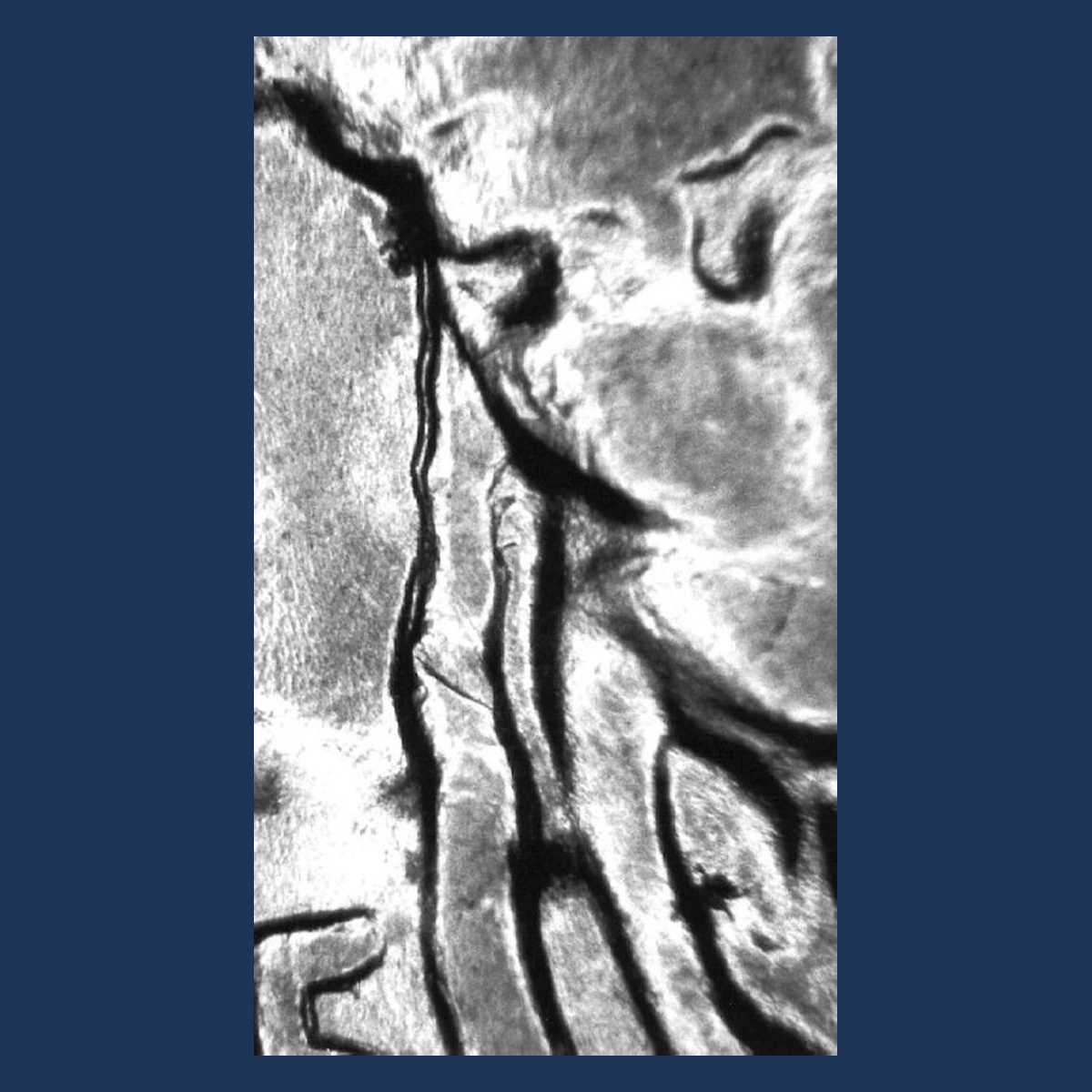
A small repeated outline beside the braid does not always identify a rare coin. For 1925, this feature began in the master tool used to make later stamping tools.
Wexler describes extra detail along the left of the lower braid and ribbon. The same starting design served Philadelphia, Denver, and San Francisco.
That makes it a shared feature of the date, rather than three separate scarce varieties. Wear and later polishing of the tools can change how clearly it appears.
It is included here to help avoid an expensive misidentification.
Estimated Value
Allow an ordinary circulated-coin estimate of $2–$100 across the three mints and differing amounts of wear. This range is for the whole nickel, not an added doubling premium.
Wexler’s shared-master explanation gives no reason to charge extra merely for this repeated braid outline. Attractive unworn coins need separate grading and can exceed this circulated range.
The mint and condition remain the important price factors when this common feature is the only unusual detail.
How to Identify
The mintmark below FIVE CENTS may be D or S; Philadelphia normally has neither. For a loose coin, check the normal 5 grams and 21.21 millimeters with a scale and calipers, including the plain edge.
Now compare the lower braid and ribbon with another 1925 nickel under a 10× magnifier. Look along their left edges rather than searching for an unrelated doubled date.
The shared outline can become faint through wear or changes to the stamping tool, without creating a new rare variety. Photograph the braid and ribbon together so the extra detail remains connected to the common design instead of appearing as an isolated thick line.
2. 1925 Buffalo Nickel Filled Upper Opening in the S Mintmark
The upper opening inside an S can look filled with metal. In the documented 1925-S pattern, Wexler attributes that shape to damage in the letter punch.
The punch was the small tool used to put S into the larger stamping tool. Its damaged shape then appeared on coins made with that tool.
This is not an extra S impression by itself. A filled opening and overlapping letters answer different questions about the mintmark.
Dirt or a later surface deposit can also close a small opening, so the shape must be examined closely.
Estimated Value
For a correctly matched damaged-punch S, use a modest estimated $20–$150 for worn through lightly worn examples. Much of that total can come from the underlying San Francisco nickel itself.
A well-preserved S that clearly shows the filled upper opening is easier to compare than one flattened by wear. The estimate does not assume a scarce repunched mintmark.
An attached deposit or a random dent should not receive a premium for this specific tool-made shape.
How to Identify
Find S below FIVE CENTS and examine its upper opening with a 10× magnifier. Side lighting can reveal whether the filling belongs to the raised letter or sits on top.
Keep any suspected deposit undisturbed. Scraping would damage the very boundary needed for examination.
For a loose nickel, use a scale and calipers against 5 grams and 21.21 millimeters and inspect the plain edge. These checks do not explain the filled opening.
Compare the whole S with the damaged-punch illustration, including the upper and lower curves. Then look outside the letter for separate earlier strokes.
A filled opening alone supports a different comparison from overlapping S outlines. Do not turn the one feature into a repunched-mintmark claim without those extra strokes.
3. 1925 Buffalo Nickel Missing Designer’s F
The small F below the date stands for designer James Earle Fraser. It is different from the S mintmark found on the back.
A collector’s gallery shows a 1925-S described as a No F variety, graded AU55. That grade indicates light wear, not a freshly made coin.
The missing initial needs to be considered alongside the surrounding detail. Heavy wear, weakly formed lettering, or later smoothing can also make a tiny F disappear.
A blank spot alone therefore does not explain what happened. Compare the original surface and the rest of the design.
Estimated Value
Estimate $40–$250 for a clearly matched No F example in worn to lightly worn condition. The San Francisco date, preserved surfaces, and strength of identification influence the total.
This is a comparison-based estimate for a minor missing-detail variety, not a quoted sale for the collector’s AU55 coin. Ordinary wear that erases the initial does not add the same premium.
A readable date and sharp neighboring details make the missing feature easier to demonstrate to another collector.
How to Identify
Locate the normal F position immediately below the date using an ordinary Buffalo nickel. Then compare that small area on the candidate under a 10× magnifier.
Look at the neighboring date and portrait detail too. Broad flattening across these features makes simple wear a stronger explanation than one selectively missing initial.
Confirm the S below FIVE CENTS on the back.
For a loose intact example, check about 5 grams on a scale and 21.21 millimeters with calipers, including the plain edge. These measurements cannot identify No F by themselves.
Texture changes, fine scraping, or an unnatural hollow below the date can reveal later removal rather than an original missing design.
4. 1925 Buffalo Nickel Peeling Metal on a San Francisco Coin
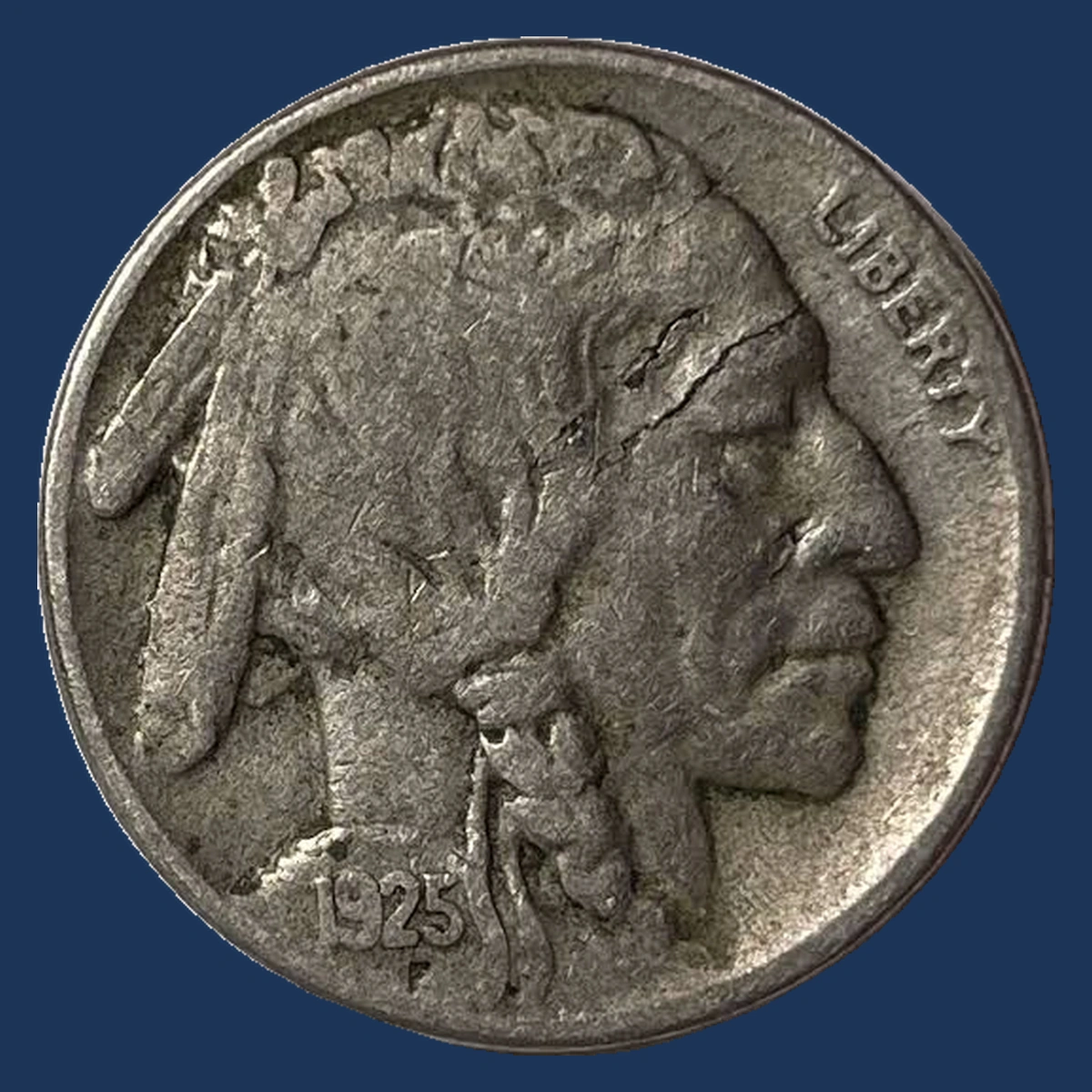
A thin layer can lift from a nickel’s surface if the original metal contains a weak seam. Collectors call this a lamination error.
The 1925 year guide reports a San Francisco example without locating the affected patch. Its description does not establish whether the layer separated before or after the coin received its design.
A normal Buffalo nickel is a copper-nickel mixture throughout, not a copper core with a silver coating. A lifted layer is therefore a break within the alloy.
Scraped metal and corrosion can imitate parts of this appearance.
Estimated Value
An estimated $20–$400 covers genuine 1925-S surface separations from small flaws to bold, clearly original peeling. Size, location, and the condition of the underlying nickel affect the total.
For context, a different-year 1929-S with an attached back flap graded MS64 sold for $149.50 in April 2010. That coin was unworn and had a specific retained layer.
Do not transfer its grade or flap position to the 1925 report. A preserved original connection can help explain the defect.
How to Identify
Leave any attached flap in place and photograph the opening from a shallow angle. Look for the point where the layer still joins the coin, rather than lifting it to see underneath.
A 10× magnifier helps compare rough inner metal with fresh scraping or corrosion. Determine the affected face from the actual coin; the year report does not name one.
Confirm 1925 and S, then inspect the plain edge. For a loose piece, a scale checks against 5 grams, while calipers compare intact spans with 21.21 millimeters.
Missing metal may lower the weight, but a still-attached layer can leave it nearly unchanged.
5. 1925 Buffalo Nickel Back Design Turned About 35 Degrees
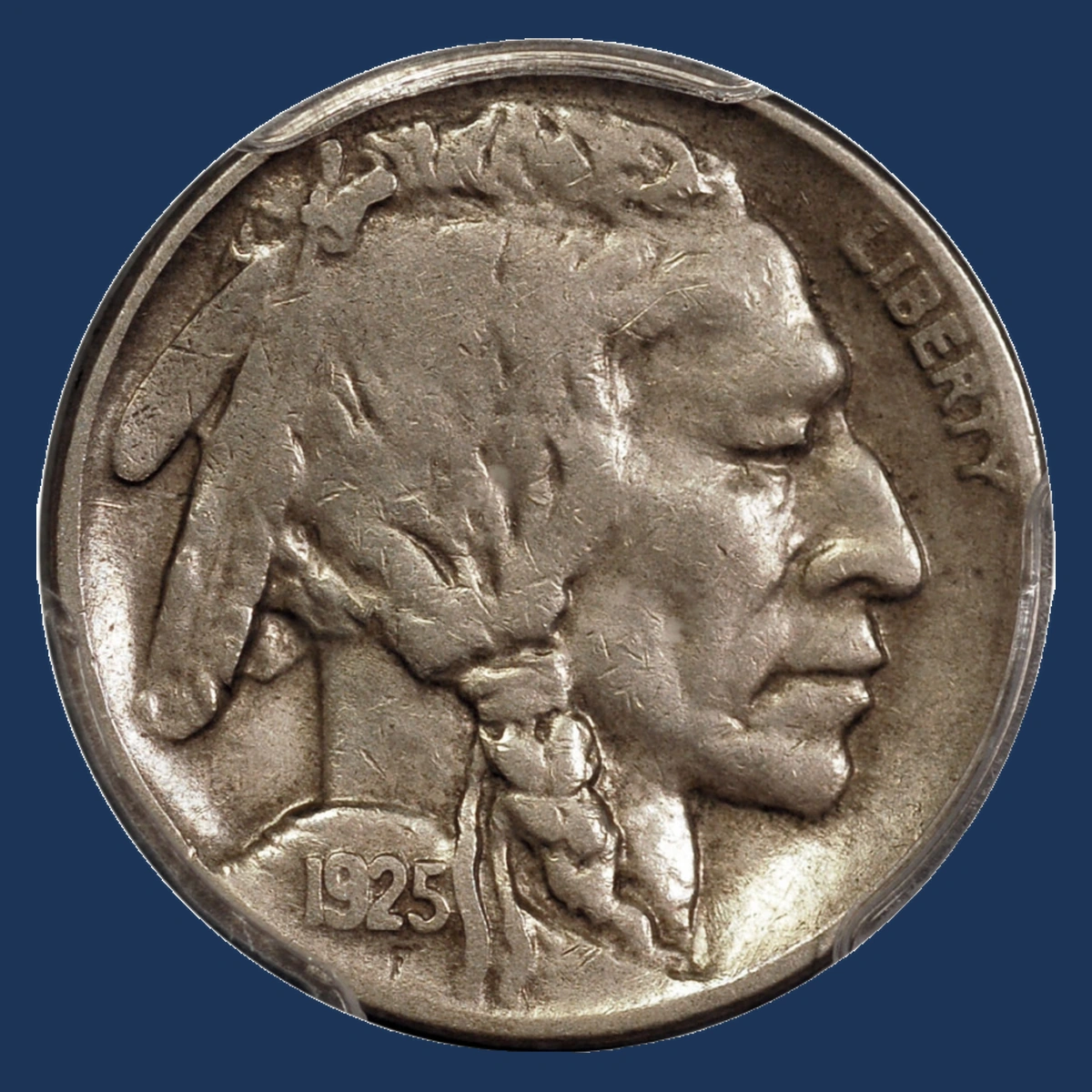
The buffalo may finish tilted after the portrait is turned over from top to bottom. This can happen when the two stamping tools are turned incorrectly relative to each other.
A 1925-D year report describes a turn of about 35 degrees. It does not specify a clockwise or counterclockwise direction.
The error concerns the relationship between the two faces. It does not require a second portrait or repeated letters on either side.
Two photographs rotated independently can create the same apparent effect. A continuous flip of the actual coin is the useful demonstration.
Estimated Value
For a genuine rotation around the reported size, estimate $30–$500 across worn to attractive lightly worn coins. A clearly demonstrated angle supports a better comparison than separately positioned photographs.
The range is an estimate for the whole Denver nickel, not a recorded sale of the year-guide example. The condition of the date and main designs still matters.
Small alignment differences attract less attention than large turns. Do not increase a price because the coin merely sits crookedly in its holder.
How to Identify
Hold the portrait upright and keep the camera fixed while flipping the coin from top to bottom. The buffalo should normally finish upright too.
Check the D below FIVE CENTS through a magnifier, then repeat the flip. Record the angle only if it recurs rather than changing with your grip.
For a loose nickel, a scale and calipers check about 5 grams and 21.21 millimeters, and the edge should be plain. These measurements identify the normal format but cannot establish rotation.
The year report gives about 35 degrees without a direction. Keep the complete flipping motion in the recording so the viewer can see the actual tilt, instead of rotating separate photographs to reproduce a claimed angle.
6. 1925 Buffalo Nickel Missing Section of the Blank
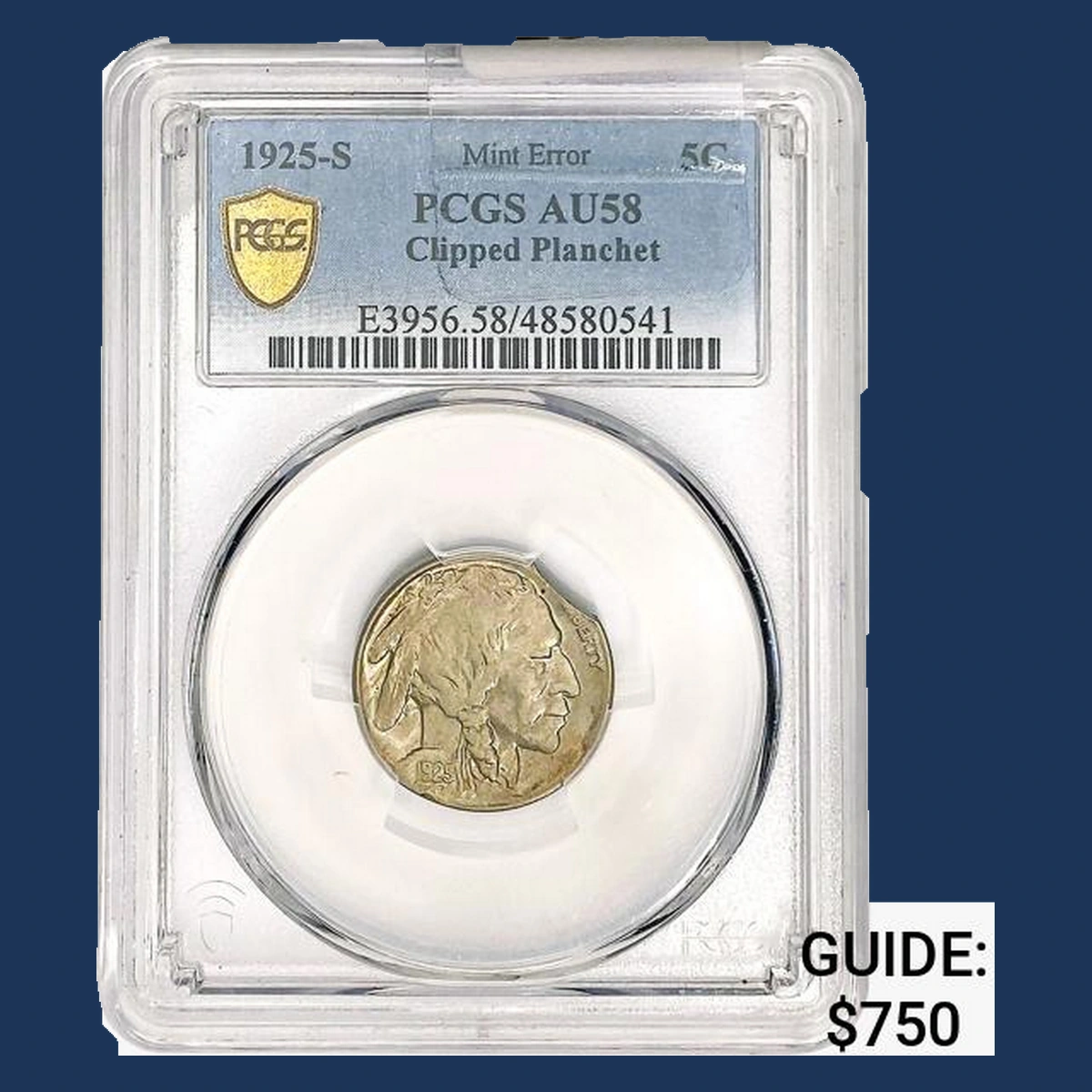
The round outline is incomplete because some metal was already missing before striking. The blank is the disk prepared to receive the coin’s design.
Gold Standard Auctions listed a 1925-S clipped-blank nickel graded PCGS AU58. This indicates only slight circulation wear.
The listing title does not establish the gap’s shape, clock position, or percentage. Those details need to be read from the coin itself.
A curved gap can come from overlapping blank-cutting holes, while a straight shortage can start at the strip’s edge. A later cut through a finished nickel is different.
Estimated Value
Use an estimated $150–$600 for a genuine 1925 clipped blank, consistent with the year guide’s broad comparison. A clear original gap and attractive surfaces can support the stronger end.
The PCGS AU58 listing establishes a particular San Francisco example but does not supply a sale price here. Its missing proportion should not be invented to place it within the range.
Price the entire coin, considering the date and mint alongside the gap. Removed or filed metal does not qualify.
How to Identify
Weigh a loose coin against 5 grams and measure intact widths with calipers against 21.21 millimeters. Missing weight can support a shortage but cannot tell whether it happened before or after striking.
Under a 10× magnifier, follow the plain edge into each end of the gap. Look for design formed around an original shortage, then check the opposite rim for possible weakness.
Inspect the exposed boundary for later filing or cutting without treating roughness or smoothness alone as proof. Photograph the date, S, and gap together; the listing does not give a position or percentage, so establish those details from the actual coin.
7. 1925 Buffalo Nickel Repunched S Mintmark
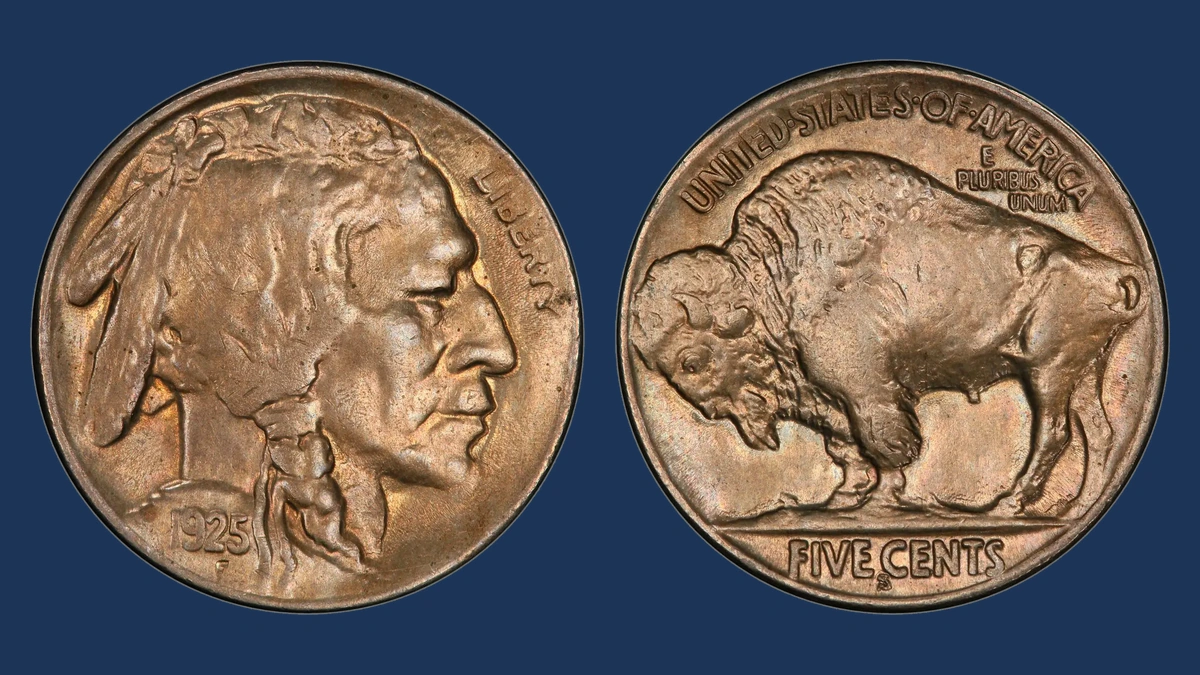
An extra curved stroke beside S can show that the mintmark was punched more than once into the stamping tool. A slight shift between punches created overlapping letter positions.
Wexler lists five 1925-S patterns. The first three have remnants mainly to the right, while another shows them toward the upper right.
The fifth includes upper-right and leftward remnants from three punches. These are separate tools, not features that must all appear on one coin.
The first pattern also carries the catalog name FS-501. A filled upper opening alone belongs to the damaged-punch comparison above.
Estimated Value
Allow an estimated $50–$1,200 for matched repunched S coins, from worn pieces to attractive unworn examples. A distinct earlier curve is more appealing than a faint feature hidden by damage.
The original San Francisco nickel’s grade contributes to the total, so the entire amount should not be called an error premium. FS-501 and less familiar patterns need their own matching photographs.
Count the coin once even when several earlier punch strokes survive. Three punches do not produce three independent prices.
How to Identify
Find S below FIVE CENTS and follow its upper and lower curves with a 10× magnifier. Compare the extra strokes with a specific photograph rather than choosing a variety from direction alone.
For a loose nickel, a scale and calipers check the normal 5 grams and 21.21 millimeters. Inspect the plain edge before concentrating on small tool marks.
For the second pattern, check the fine line extending below the middle of AMERICA’s M. The fourth instead has a horizontal line inside UNITED’s D.
These marks belong to different tools. Use them with the corresponding S outline, and reject a match that relies on a dent or flat ledge instead of an earlier curved letter stroke.
8. 1925 Buffalo Nickel Design Shifted toward the Lower Edge
A crescent of unused metal remains when the blank sits partly outside the stamping tools. On the opposite side, some intended design falls beyond the metal.
A collector’s gallery describes a 1925 nickel shifted about 15% toward the bottom and lower right. Its AU58 grade indicates slight wear.
The gallery lists the coin under Philadelphia, but a missing mintmark must be assessed carefully on an off-center piece. If the mark’s expected position missed the metal, absence cannot establish its mint.
An uneven border on only one face instead suggests a shifted tool.
Estimated Value
Estimated values of $100–$1,200 cover moderate through stronger readable-date off-center 1925 nickels. The year guide places modest shifts around 10–20% near $100–$300.
The collector’s 15% example gives a visual comparison, not a recorded selling price. Larger errors can attract more attention when the date survives and the surfaces remain attractive.
Do not value a coin from its percentage alone. Wear, cleaning, and lost identifying detail can lower interest even when the displacement is obvious.
How to Identify
Locate 1925 before estimating the shift. Then inspect the expected mintmark position below FIVE CENTS, keeping the mint unidentified if that area never received a design.
Use a 10× magnifier at the boundary between stamped detail and unused metal. Check both faces so the same misplaced disk explains the design loss.
Compare the collector’s downward and lower-right shift with the candidate’s actual direction. Do not rotate a photograph simply to make the two look alike.
An intact loose blank may still weigh near 5 grams on a scale. Calipers record its changed outline against 21.21 millimeters, while the plain edge should show no later cutting or pressing.
9. 1925 Buffalo Nickel Repeated Strike within the Collar
Unexpected motto letters appear above the portrait on a nickel cataloged as double struck within the collar. The collar is the ring that normally holds the coin’s edge during striking.
Jim’s Coins describes strong movement between impressions and extra detail beneath the buffalo. NGC assigned VG08, indicating heavy wear.
The catalog writes the year in parentheses as (1925), so that date is an attribution rather than a clearly readable four-digit claim. Its mint is not specified.
This is a repeated striking accident on one coin, unlike small doubling already present in a stamping tool.
Estimated Value
For an authenticated, identifiable repeated-strike Buffalo nickel of this type, estimate $800–$3,500. Clear overlapping designs support the higher end, while heavy wear can make the sequence harder to read.
The historical Jim’s Coins catalog gives a $1,700 minimum bid for the piece attributed to 1925. A minimum bid is an auction starting requirement, not evidence of a completed sale.
The date attribution and surviving details must accompany any price comparison. Do not present the year as fully visible.
How to Identify
Begin by separating the two sets of designs in enlarged photographs. Under a 10× magnifier, follow the reported motto remnants above the portrait and the additional detail beneath the buffalo.
Check whether those fragments fit a real earlier strike. A few flat shelves beside letters do not establish the same event.
Keep the attributed date in parentheses unless the actual coin supplies clearer evidence. The source does not establish a mint or exact movement angle.
For a loose intact coin, compare 5 grams and 21.21 millimeters with a scale and calipers. Inspect the plain edge and original surfaces for later squeezing, which can add misleading impressions from other coins.
10. 1925 Buffalo Nickel Two-Feather Design
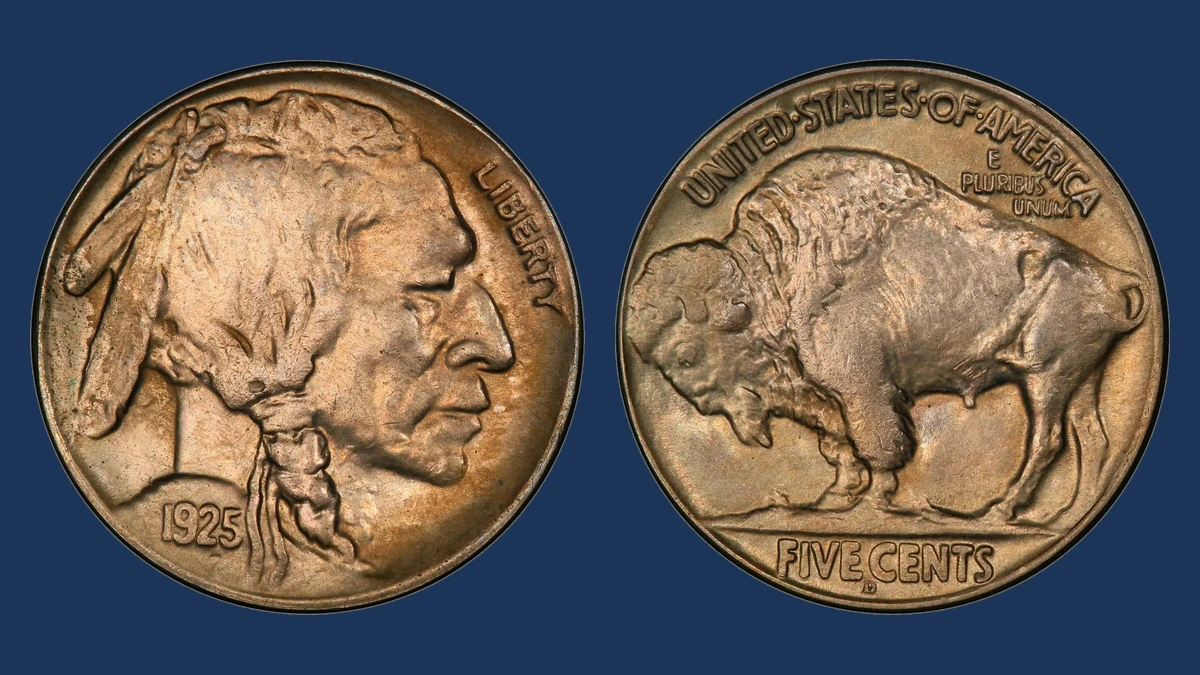
The small third feather behind the portrait may nearly disappear, leaving the two larger feathers easy to see. Both Denver and San Francisco have cataloged 1925 two-feather varieties.
They are separate mint issues even though each uses FS-401 as its catalog name. One Denver MS63 example retains a tiny isolated feather remnant, detached from the hair and neck.
That remnant does not automatically exclude the variety. Its precise pattern matters more than an absolute rule that no trace may survive.
Wear and weak striking can also hide fine detail, so count carefully before assigning the name.
Estimated Value
Estimate $50–$5,000 across correctly matched circulated and attractive unworn two-feather coins. Mint, grade, and how clearly the defining pattern survives can make a large difference.
PCGS records a San Francisco MS64 result of about $4,406 at Heritage in April 2014. That historical price concerns an unworn S example, not the collector’s Denver MS63.
A heavily worn coin lacking several nearby details should not automatically receive the same variety premium.
How to Identify
Choose a normal 1925 nickel as a comparison and find where the small third feather should meet the area behind the portrait. Use a 10× magnifier to distinguish an isolated remnant from connected feather detail.
Next confirm D or S on the back. A Denver photograph cannot supply every exact marker for a San Francisco example.
Check nearby hair and the two large feathers for general wear.
A loose piece should be near 5 grams and 21.21 millimeters on a scale and calipers, with a plain edge. These normal readings do not prove the variety.
Inspect the missing-feather area for scraping or altered texture before matching the complete pattern.
11. 1925 Buffalo Nickel Design Struck on a Dime or Cent Blank
A smaller disk prepared for a dime or cent cannot hold the full nickel design. Its metal also differs from the normal copper-nickel mixture.
The silver-dime-blank AU50 coin has a full date, but the mintmark area lies beyond the metal. A bar-shaped blocked-strike mark crosses the buffalo’s head on that same coin.
A separate Denver cent-blank example weighs 3.09 grams. It has light wear, cleaning lines, and green surface corrosion near the buffalo’s chin and chest.
Other cent-blank pieces appear in a specialist census. Their individual grades and histories should remain separate.
Estimated Value
Estimate $3,000–$10,000 for the silver-dime-blank type and $2,000–$8,000 for cent-blank examples. These are whole-coin ranges, with condition and reliable identification affecting the result.
The silver-blank AU50 coin brought $4,800 on January 5, 2018. The cleaned Denver cent-blank coin sold for $3,737.50 on September 18, 2008, also at Heritage.
Those historical sales concern different metals and individual specimens. The silver coin’s additional blocked-strike mark is included in its sale price.
How to Identify
A scale provides the first useful comparison: normal nickels weigh 5 grams, contemporary cent blanks about 3.11 grams, and silver dime blanks 2.5 grams. The Denver specimen’s recorded measurement is 3.09 grams.
The silver coin’s actual weight is not supplied here.
With calipers, compare starting widths of 19.05 millimeters for a cent and 17.91 for a dime, against the nickel’s 21.21. Striking can spread a smaller blank.
Inspect cropped letters and the edge through a 10× magnifier for trimming or added coating. The metal itself must match the proposed blank.
Keep the mint unidentified when its expected mark position lies beyond the surviving disk.
Conclusion
The estimated $2–$10,000 span covers very different 1925 nickels, including a common design feature with no extra error value. The silver-dime-blank coin’s $4,800 sale is a specific historical result.
Check the date and mint, then concentrate on the actual change: a missing feather, an extra letter, a shifted design, or different metal. Preserve peeling layers and original surfaces so the evidence remains available for a closer examination.