1905 Dime Error List with Pictures

A tiny O helped one 1905 dime bring $12,650 in January 2005. The unworn MS65 Micro O used a smaller mintmark punch intended for quarters.
The 1905 dime errors below have estimated values of $30–$15,000 across the conditions discussed. Another Micro O graded MS63 sold for $6,405 in May 2026.
Read on to compare missing metal, shifted designs, a foreign coin disc, and that unusually small mintmark.
1. 1905 Barber Dime Clipped Planchet (Estimated Up to $400)
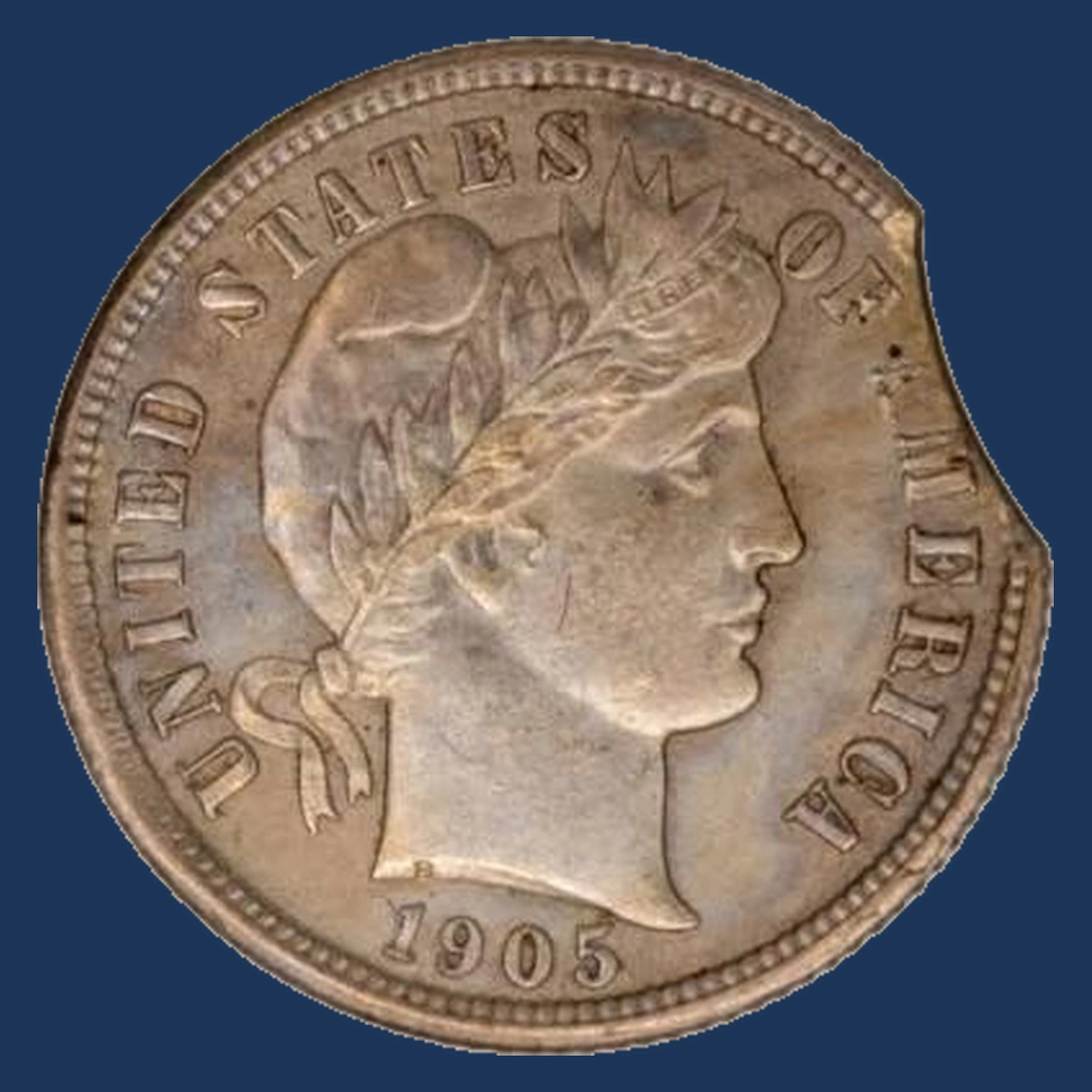
A curved bite can begin before the coin has a design. The cutting punch overlaps a hole already made in the metal strip, leaving an incomplete disc.
The disc, called a blank, can still receive the dime’s design in the press. Striking around the missing part affects nearby details and the rim.
Clips appear in the published 1905 list, but it does not identify one mint, position, or certified example. Each actual coin needs its own examination.
The bite’s shape alone is not enough. A later cut can imitate the outline without reproducing the mint-made boundary.
Estimated Value
Modest genuine clips on circulated 1905 dimes have an estimated value of $30–$400. The date, mint, condition, and size of the missing section affect the comparison.
An undated silver dime disc with a clip sold for $59 in March 2025. Graded PCGS MS60, that piece had not received a coin design.
It is a lower-priced comparison for clipped metal, not a 1905 Barber sale. Its unstruck state limits how directly the price can be applied.
How to Identify
Inspect where the rim and design meet the gap with a 10× magnifier. Look for natural striking rather than fresh cutting, filing, or a sharp displaced lip.
The opposite rim may be weak because the missing edge interrupted an earlier rim-forming step. This clue is helpful but not a strict pass-or-fail test, especially with wear.
A scale should show a sensible reduction from the original 2.50 grams. Use calipers across intact spans against roughly 17.9 millimeters and examine the surviving edge grooves.
Natural boundaries beside the missing metal, supported by appropriate weight loss and rim behavior, distinguish a struck incomplete disc from a finished dime cut afterward.
2. 1905-S Barber Dime Repunched Mintmark (Estimated Up to $750)
Extra outlines appear at the upper and lower ends of the S in the reported 1905-S variety. They suggest that the mintmark punch entered the steel stamping tool more than once.
Parts of the earlier S remained beside the final letter. The tool could repeat those same lines on the coins it made.
Collectors call this S/S, or a repunched mintmark. It differs from a low, flat shelf left when a tool moves during striking.
The New Orleans small O has a separate cause. Its size does not make it the same type of repeated-letter error.
Estimated Value
Clearly identified S/S coins have an estimated value of $50–$750 from circulated through lightly worn condition. The San Francisco dime’s basic value is included in that range.
A different 1899-O O/O graded AU Details sold for $115 in May 2023. That Heritage comparison had damage as well as light wear.
It helps compare the broader mintmark-variety market, not price the 1905-S directly. Clear extra outlines are more useful than a doubled-looking shadow.
How to Identify
Place a normal 1905-S picture beside the suspected example at equal size. Compare the S ends so the letter’s normal curves are not mistaken for extra ones.
Use a 10× magnifier and change the light direction. Look for raised pieces of another S rather than nicks or metal pushed up by damage.
For an unsealed coin, compare a scale reading with 2.50 grams and calipers with roughly 17.9 millimeters. Inspect the grooves around its edge; those checks establish the normal silver dime, not the repunching.
Matching extra curves at both the upper and lower ends of the S provides the direct test for this reported variety.
3. 1905 Barber Dime Broadstrike (Estimated Up to $800)
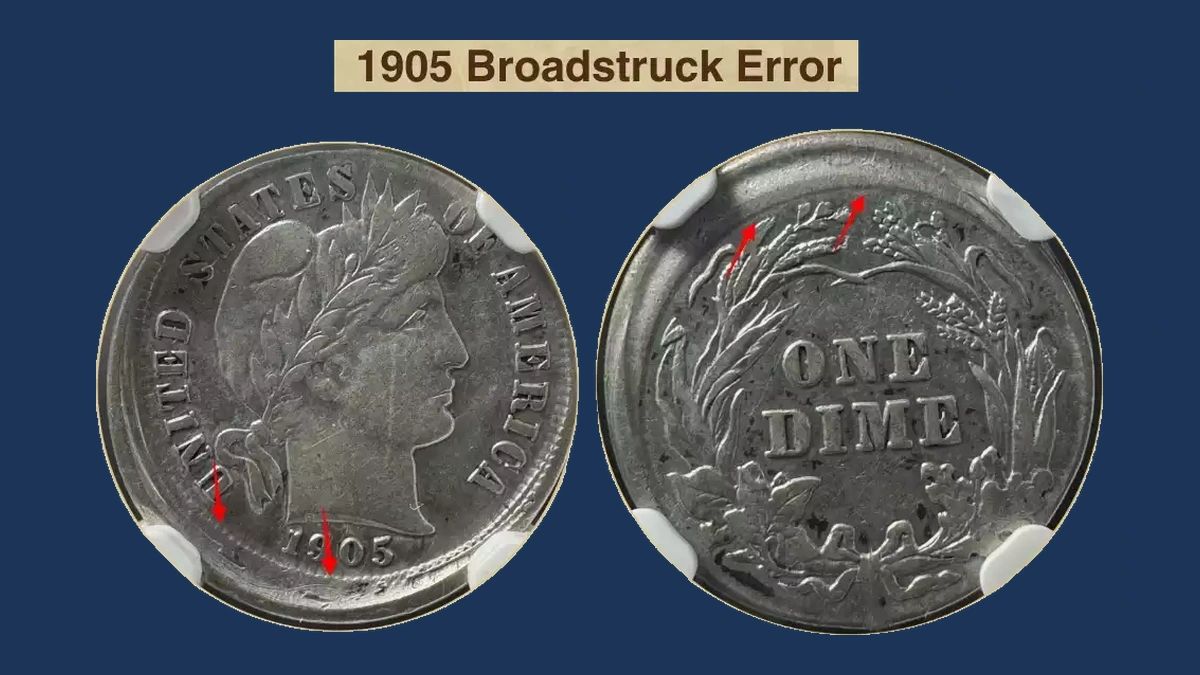
Extra space around a complete design can mean the dime spread wider during striking. The collar, a ring that normally limits its width, failed to restrain the silver.
The metal moved beyond the usual edge while receiving the design. This is called a broadstrike.
The published 1905 guide includes this type without identifying every example’s mint or grade. The main clue is a complete design on an expanded disc.
The collar also forms the edge grooves. Its failure should make sense of both the unusual edge and the wider border, rather than just one smooth spot.
Estimated Value
The guide gives about $400 for an AU58 Barber broadstrike and $575 for an MS65 example. These are series comparisons without a specific 1905 transaction attached.
An estimated $75–$800 covers worn coins through attractive examples in lower unworn grades. Clear expansion can improve collector interest.
The price depends on original striking, not width alone. A coin flattened later may also be wider, but crushed details do not receive the same error premium.
How to Identify
Look at the edge from the side before judging the wide border. A fully unrestrained strike does not form the normal complete set of edge grooves.
With a 10× magnifier, follow every outer inscription. The design should remain present rather than run off the metal.
Measure the width with calipers against 17.9 millimeters. A scale should still show approximately the original 2.50 grams, allowing for wear, because expansion does not remove the silver.
Check Liberty and the wreath for hammering or crushed details. Complete, naturally struck designs on expanded metal support a broadstrike, while flattened designs and pressure marks suggest later damage.
4. 1905 Barber Dime Off-Center Strike (Estimated Up to $1,500)
Blank metal remains beside the design when the dime disc sits partly outside the stamping tools. The design shifts toward the other edge, where some intended detail falls beyond the metal.
This is an off-center strike. Both faces record the misplaced disc even though their missing details look different.
The 1905 list gives no one percentage or direction for all examples. A surviving readable date lets a collector identify the year.
A wider coin with a complete design is different. Off-centering requires actual design loss at the boundary, not simply a wide or uneven rim.
Estimated Value
An 1899 Philadelphia dime graded NGC VF25 and struck ten percent off center reportedly sold for $312 in June 2023. It provides a different-year comparison for a circulated Barber error.
Readable-date 1905 examples have an estimated value of $200–$1,500, spanning modest worn shifts through attractive lower unworn grades. More displacement can make the error striking to look at.
Condition and surviving identity still matter. A high percentage alone does not determine value.
How to Identify
Read and photograph the date before estimating the offset. Do not supply a missing digit by assumption; check the back mintmark if that area survives.
Compare both designs with the same physical outline. A centered back paired with a shifted front can indicate one displaced tool instead.
Inspect the untouched margin and edge with a 10× magnifier for grinding or reshaping. A scale comparison begins with 2.50 grams, and calipers can record the changed outline against 17.9 millimeters.
A normal off-center strike keeps its metal. Matching displaced designs on both faces beside original blank surface establish more than an uneven rim on one side.
5. 1905 Barber Dime on a Costa Rica Five-Cent Planchet (Estimated Up to $10,000)
The Barber design runs off the edge of a much smaller foreign disc on the illustrated NGC XF40 example. Its label identifies a Costa Rica five-cent disc beneath the American design.
The related auction description records a weight of one gram. That is far below a normal dime’s weight.
Parts of the outer lettering could not fit, and the thin disc did not fill all the stamping-tool details. Some design therefore appears weak.
This is not simply a worn, lightweight dime. Its identity depends on the documented foreign disc, original edges, surviving design, and measurements together.
Estimated Value
The illustrated XF40 form has a specialist estimate of $2,000–$10,000. Mint Error News lists it as unsold at the 2010 Central States auction.
A different 1972-S Kennedy Proof on a nickel disc sold for $3,720 in June 2023. That provides broad context for unusual wrong-disc errors.
Its denomination, metal, and special collector finish differ from this dime. The comparison does not establish a matched Barber price or turn the unsold offering into a sale.
How to Identify
Weigh the coin against the reported one gram, rather than treating any lightweight dime as a match. A normal Barber dime starts at 2.50 grams.
Use calipers to record width and thickness, then compare the whole piece with the NGC XF40 in Mint Error News. A 10× magnifier should show the design naturally ending at the small original boundary.
Inspect the edge for filing. The normal 17.9-millimeter grooved-edge dime is a baseline, not the required size of this foreign disc.
Matching the certified coin’s measurements, original edge, and truncated design supports the Costa Rica identification; small size alone cannot identify the country.
6. 1905-O Barber Dime Micro O Mintmark (Estimated Up to $15,000)
A small rounded O sits farther below the ribbon knot than the normal dime mintmark. PCGS explains that workers used an O punch intended for Barber quarters.
The larger quarter design had little space for its mintmark, so its O punch was smaller. On the dime it produced this unusual size mismatch.
The Micro O has thick sides surrounding a small oval opening. Its outside outline is compact and rounded.
Wear or dirt can make an opening look smaller, but cannot establish the whole variety. The letter’s shape and spacing must agree with the recognized Micro O.
Estimated Value
An MS65 Micro O sold for $12,650 in January 2005. A separate FS-501 example graded MS63 brought $6,405 in May 2026.
Clearly identified circulated coins have an estimated value of $500–$3,000. Desirable unworn examples fall around $3,000–$15,000.
The two sales show why condition matters even for such a small feature. Keep each grade with its result rather than assuming any Micro O has the older, exceptionally preserved coin’s value.
How to Identify
Compare the mintmarks at exactly the same enlargement. A normal O is taller and closer to the ribbon knot; the Micro O is compact, thick-sided, and farther from it.
Use a 10× magnifier with the PCGS pictures. Check the oval center and spacing from the small border teeth as well as the outside shape.
Inspect the edge grooves and compare scale and caliper readings with 2.50 grams and roughly 17.9 millimeters. Dirt or wear may obscure the center.
The compact rounded outline, thick sides, oval opening, and characteristic spacing must match together; apparent small size from one photograph is insufficient.
Conclusion
Estimated values of $30–$15,000 cover modest 1905 clips through premium Micro O coins in excellent condition. Match the grade and exact feature before applying any figure.
Compare the small O with a normal mintmark at equal size. For the foreign-disc dime, use its documented measurements and certified pictures.
For striking errors, keep complete views of both faces and the edge. Together they show whether metal was missing, spread outward, or missed the design.