1825 Dime Error List with Pictures

An 1825 JR-1 dime with a repeated A in STATES sold for $21,600 in February 2023, graded PCGS MS65+ CAC. Its exceptional preservation was a major part of that whole-coin price.
This 1825 Capped Bust dime error list also includes raised cracks, rim breaks, and a full backward portrait. Estimated values span $100–$25,000.
Read on to see where each feature appears and why one extra letter outline differs from a second portrait.
1. 1825 Capped Bust Dime Die Cracks and Cuds (Estimated Up to $6,000)
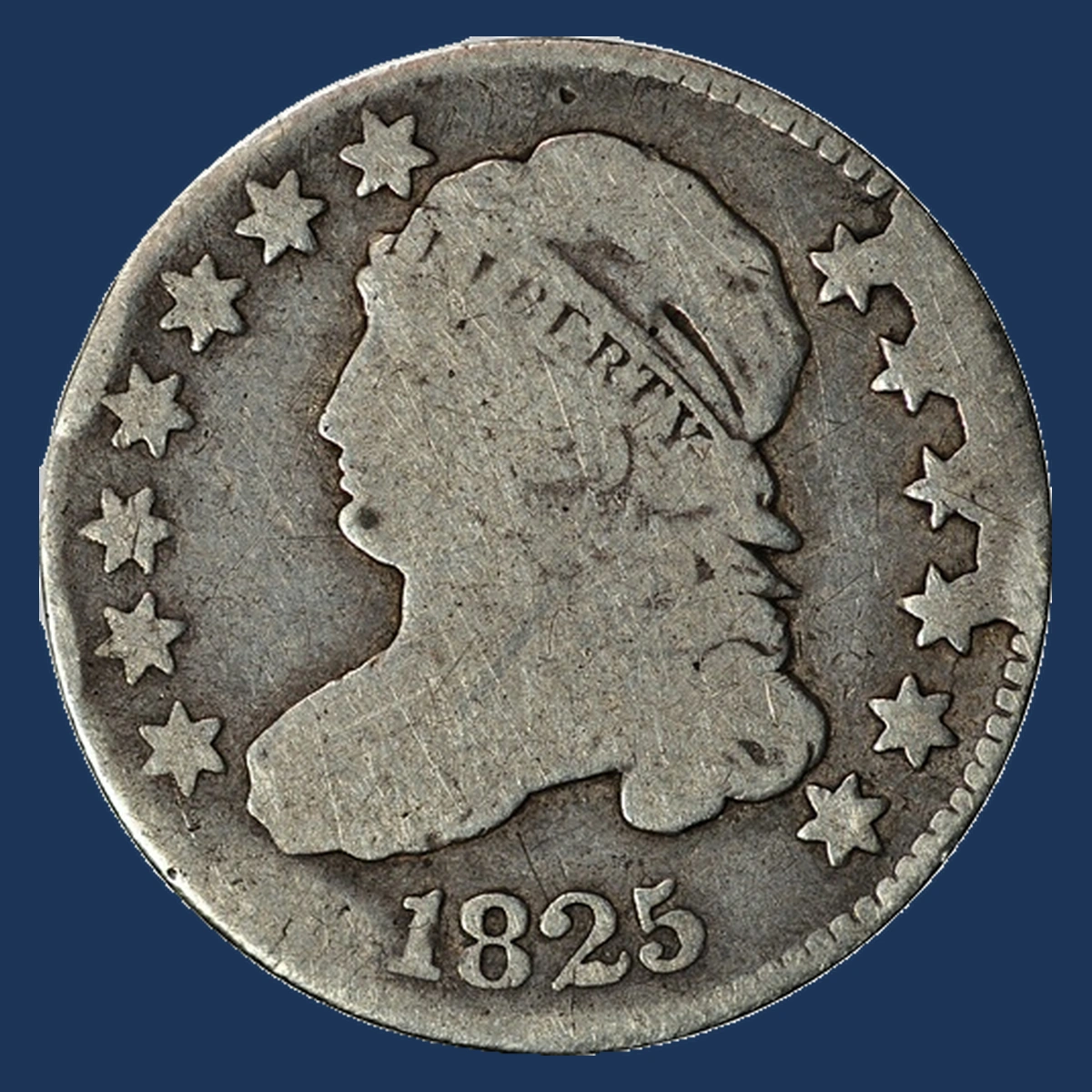
Raised patches called cuds can join the rim beside the front stars. Reported examples occur near stars 5–6 on JR-1, stars 3–4 on JR-3, and stars 8–11 on JR-4.
These patches form when the edge of a stamping tool breaks. A piece that stays in place may still leave some picture detail inside the affected area.
On the back, JR-4 and JR-5 can show a crack left of U, between the wing and border. JR-5 also has a line from the upper-right D toward the rim.
The JR numbers distinguish different varieties.
Estimated Value
Estimate $100–$6,000 for worn through lower-grade unworn examples with these cracks or rim breaks. A prominent raised patch may attract more interest than a fine line.
A JR-1 graded PCGS AU50 sold for $630 in April 2025. AU50 means light circulation wear, and that sale was not identified as a matching rim-break example.
Compare the actual break and the whole coin’s condition. The presence of any small crack does not justify one fixed extra payment.
How to Identify
Match the star positions to the correct variety before studying a raised rim patch. With a magnifier, look for its connection to the border and any picture detail remaining inside it.
A dent usually pushes down or crushes a finished edge. Weak detail by itself does not prove that part of the stamping tool fell away.
On the back, compare the U-area crack and the separate JR-5 line above D. Use photographs of 1825 examples rather than later-dated coins made with related tools.
Check about 2.70 grams on a scale, 19 mm with calipers, and the edge grooves. Start by matching the raised feature to the same star or letter position on the correct variety.
2. 1825 Capped Bust Dime Repunched A in STATES (Estimated Up to $25,000)
The A in STATES has an extra outline along its left side. A worker punched the letter into the stamping tool again, leaving part of the earlier shape visible.
The coin received that repeated shape during a normal strike. It did not need to be struck twice.
The letter appears on JR-1 and JR-3 because both varieties used the same back-side tool. Their front-side stars help tell them apart.
This is a local letter-punching feature, rather than proof that all the lettering or the entire back design is doubled.
Estimated Value
The JR-1 sale index lists a PCGS MS65+ CAC at $21,600 in February 2023. A PCGS AU50 brought $630 in April 2025.
Estimate $100–$25,000 from worn coins through exceptional unworn examples. MS65+ describes a much better-preserved coin than the lightly worn AU50.
Both sales value complete coins. The repeated A identifies the variety, but the high-grade price is not simply a payment for one extra letter outline.
How to Identify
Use a scale and calipers to check about 2.70 grams and 19 mm, allowing for wear. This is the earlier, larger Capped Bust dime.
Inspect the edge grooves, then bring a magnifier to the left side of A in STATES. Compare the extra rounded shape with the PCGS variety description.
A cut beside the A can look like another line but does not repeat the letter’s punched shape. Check how the raised outline follows the existing letter.
To separate JR-1 from JR-3, compare the eighth front star with the nearby border teeth. For a quick first match, find the second raised outline along the A’s left side.
3. 1825 Capped Bust Dime Full Obverse Brockage (Estimated Up to $25,000)
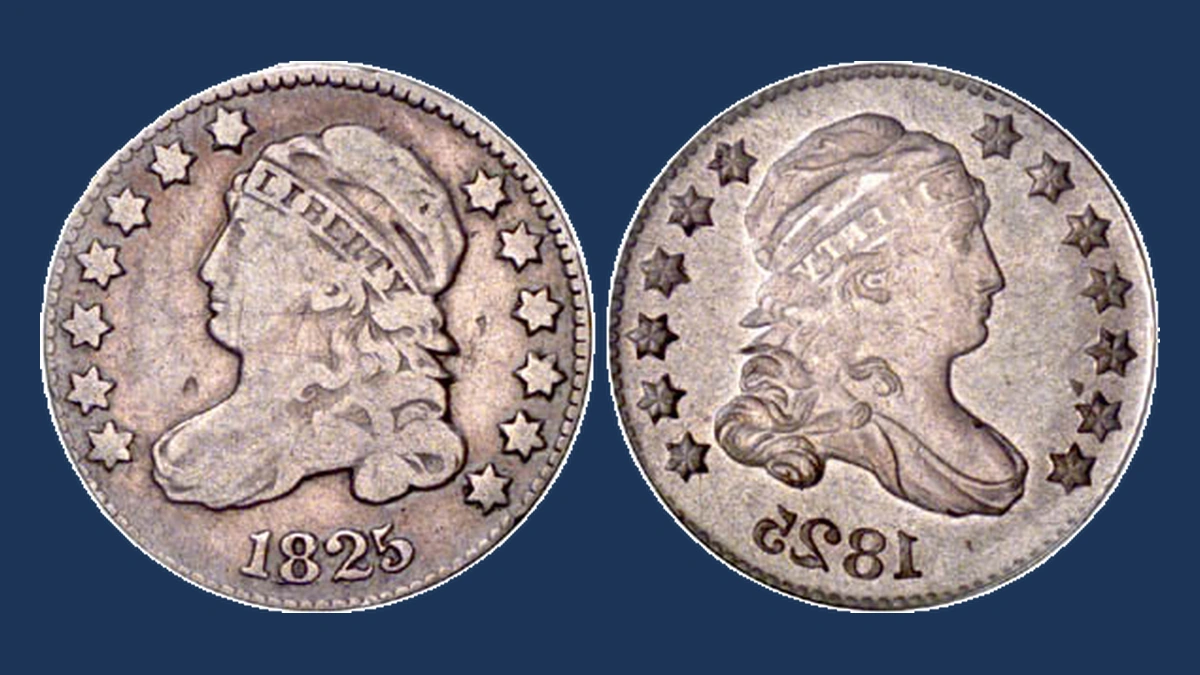
Liberty appears on both sides of this dime, but one portrait is backward and pressed below the surface. The expected eagle design is missing from that face.
This is a brockage. An already struck coin came between a fresh metal disc and a stamping tool, pressing its raised picture into the new coin.
The Logan collection example has a full front-design impression, with its normal portrait linked to the JR-2 variety.
It is much more than the faint extra lines from two bare tools colliding, and more than a reversed photograph.
Estimated Value
A genuine full front-design brockage has an estimated value of $8,000–$25,000. Clear dating, complete transferred detail, and original surfaces are important to the price.
This is a comparison-based estimate, not a recorded sale of the Logan coin. No grade is assigned to that example here.
A different 1827 back-design brockage graded NGC MS64 brought a $14,000 hammer price in January 2007. That older comparison excludes buyer fees and concerns another date and configuration.
How to Identify
Compare the two faces together. One should have a normal raised portrait; the other should repeat that portrait backward in a sunken impression.
Use a magnifier to check the reversed lettering and the impression’s depth. A flipped digital picture cannot show how the actual surface rises and falls.
Coins pressed together after minting can also leave marks. Inspect the complete design and edge for crushing, joins, or tool damage, using a confirmed brockage for comparison.
Weigh against about 2.70 grams and measure with calipers against 19 mm, allowing for striking distortion. Check the edge grooves, then start identification by matching a fully sunken, reversed portrait against the normal face.
Conclusion
These 1825 dimes span estimated whole-coin values of $100–$25,000. The repeated A points to how a tool was prepared, raised cracks show a damaged tool, and a backward portrait shows contact with an already struck coin.
Use the exact star, letter, or portrait position to make the comparison. Condition remains central to the price, especially when comparing a worn dime with the exceptional $21,600 JR-1 example.