2010 Quarter Error List with Pictures

Yosemite’s design landed on a nickel blank on one remarkable 2010 quarter. The resulting coin sold for $2,880 in April 2020.
This 2010 America the Beautiful Quarter error list covers estimated whole-coin values from $2–$6,000, including a separately identified five-ounce silver finish error. Continue below to compare ordinary pocket-change errors with the larger collector issue and learn what each physical clue can prove.
1. 2010 America the Beautiful Quarter Reported Feeder-Related Lines
Parallel lines on Washington’s side are reported on a Yosemite quarter. They have been linked to the machine part that feeds metal blanks into the press.
The cause needs to fit the surface. A feeder scratching the stamping tool can leave raised copies on later coins, while direct contact can create a recessed impression or scrape.
Those are different physical events, even when both are described as feeder marks. The report does not establish one exact line shape here.
Ordinary scratches after minting can also run parallel. Their presence alone is not evidence of a manufacturing error.
Estimated Value
A small genuine feeder-related feature on an ordinary clad quarter is estimated at $2–$40. Clad means the quarter is made from bonded layers of metal.
The line must be distinguishable from ordinary handling damage. A clear raised pattern with undisturbed nearby detail gives buyers more to assess than a faint scrape, especially when several coins share the same mark.
Lines caused by later scraping do not receive that error premium. An attractive unworn coin can still have ordinary handling scratches.
How to Identify
Decide whether the parallel lines are raised or recessed before choosing a cause. View them through a 10× magnifier while moving a light across Washington’s portrait.
Compare the lines with the surrounding design and check whether any impression interrupted the strike. A later scratch can simply cut across already finished details.
Inspect the grooved edge for related damage, then weigh and measure a loose ordinary clad coin. Its normal readings are about 5.67 grams on a scale and 24.26 millimeters with calipers.
A repeated raised pattern on other examples can support a scratched-tool explanation. An isolated groove needs direct evidence of minting contact rather than its parallel shape alone.
2. 2010 America the Beautiful Quarter One Misaligned Tool
Washington or the park scene can sit too close to one edge while the opposite face remains centered. That pattern can come from one stamping tool being misplaced.
The coin itself may still be held normally in the press. It differs from an entire blank entering off center and shifting both designs together.
A Denver example is reported for 2010, without an established affected face or park here. Those details need to come from the actual coin.
A severe one-tool shift can affect outer design elements. It should not be defined only as a complete design with an uneven border.
Estimated Value
Estimate $2–$75 for a genuine one-tool misalignment on an ordinary clad quarter. Very small border differences tend to bring little premium, while more obvious examples can attract interest.
The amount of visible displacement matters more than the word “error.” Clear outer lettering and intact edges help show the shift, while rim dents can make it harder to judge.
A coin photographed at an angle may merely look uneven. A clear comparison of both faces is needed before applying the estimate.
How to Identify
Place the coin flat and photograph each face with the camera directly above it. Compare the distance between the design and the rim around both Washington and the park scene.
Use a 10× magnifier to check which details, if any, are cut off. A matching shift on both faces calls for an off-center check instead.
Weigh an ordinary loose clad piece against 5.67 grams on a scale and measure it against 24.26 millimeters with calipers. Inspect the edge grooves for crushing that could explain an uneven outline; one centered face paired with one displaced face provides the first useful sign of a misplaced tool.
3. 2010 America the Beautiful Quarter Raised Cracks, Chips, and Rim Breaks
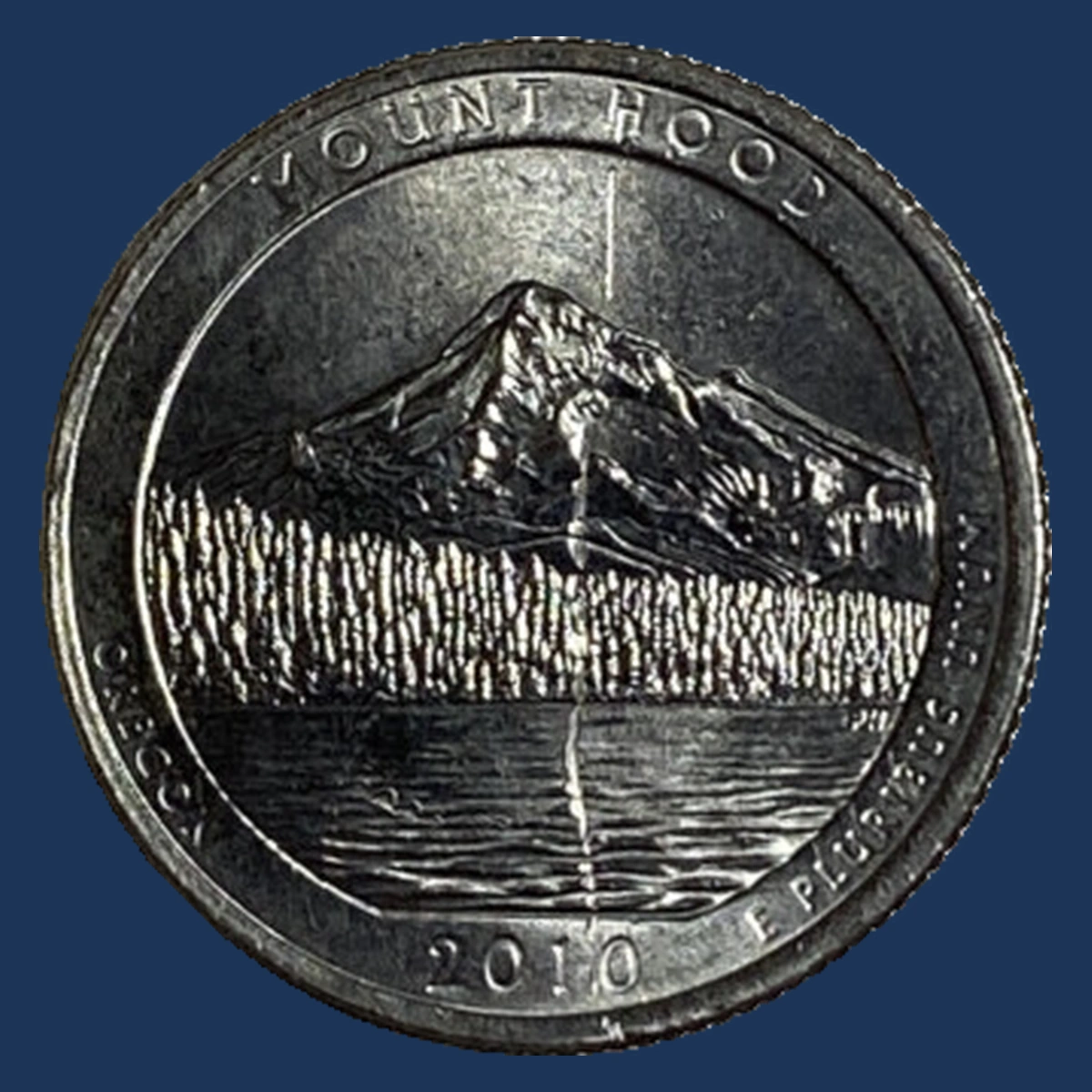
A raised line can trace a crack in the steel stamping tool. A chipped-out piece can instead leave a lump of extra metal on the coin.
Hot Springs reports include a Denver mark near Washington’s mouth and a separate Philadelphia rim-connected break. Yellowstone has a Philadelphia front-crack report, while Yosemite has a front-side chip report.
Mount Hood also has tool-damage reports. Grand Canyon cracks and a Yosemite rim cud remain types to check rather than firmly established examples here.
An interior chip is not automatically a cud. The larger break called a cud must connect to the coin’s rim.
Estimated Value
For ordinary clad quarters, estimate $2–$30 for small cracks or chips and roughly $30–$200 for stronger rim breaks. Visibility and condition affect the price.
A different-year 1970-D nickel with two cuds sold for $63 in October 2022. That result provides perspective rather than a fixed price for a Hot Springs break.
The higher range requires a genuine larger feature. A source mentioning a possible cud does not turn every small raised dot into a valuable rim break.
How to Identify
Compare a normal coin of the same park with the candidate. The Hot Springs mouth crack and Philadelphia rim break belong to separate examples, while a Yosemite chip does not prove a cud.
Use a scale and calipers on an ordinary loose clad coin against 5.67 grams and 24.26 millimeters. A damaged tool can add a raised feature without removing any coin metal.
Now direct light across the mark and examine it with a 10× magnifier. A raised ridge differs from a scratch cut into the face.
For a larger patch, follow it to the grooved edge. Crushing there can push metal upward and mimic a broken-tool feature.
A naturally struck patch replacing design and meeting the rim supports a cud.
4. 2010 America the Beautiful Quarter Weak or Missing Detail from Blockage
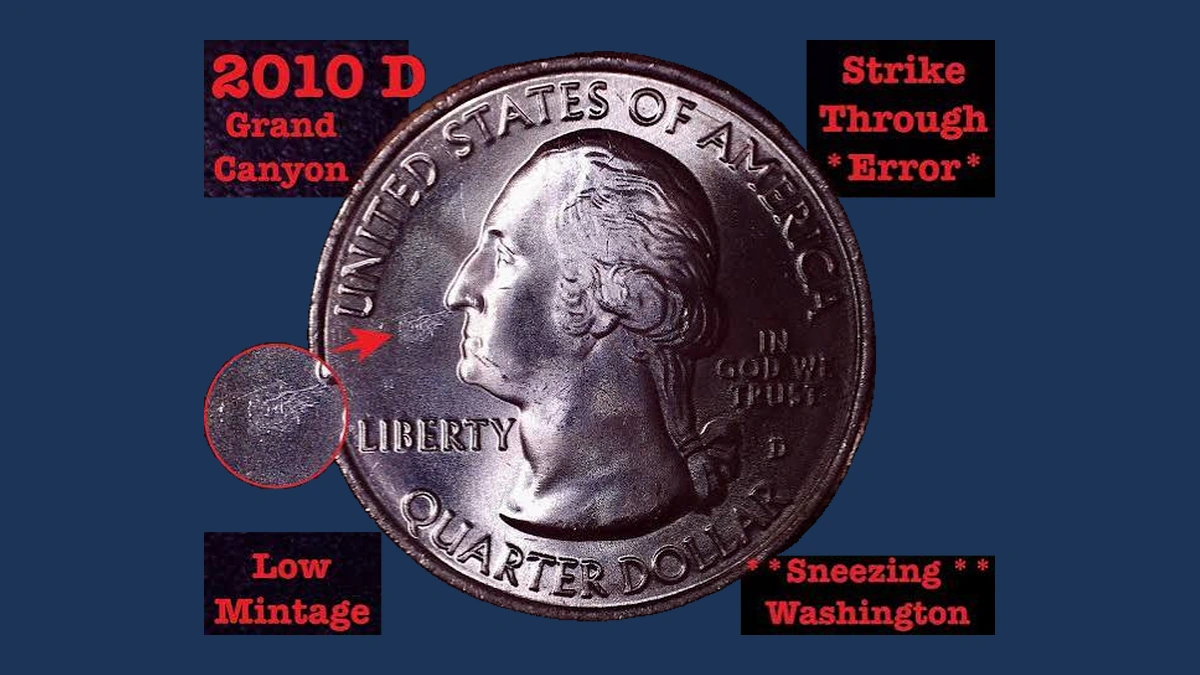
A letter or part of the portrait can fade away when material blocks the stamping tool. Grease is one possible cause, but a weak feature alone does not identify the material.
Mount Hood and Yellowstone reports include a missing E in WE. A Yosemite report concerns weak detail on Washington’s portrait, while Hot Springs has a separate blocked-strike report.
Grand Canyon remains a possible example without a securely established specimen here. Its location should not be borrowed from another park.
Wear can also remove lettering. A missing E does not automatically establish a doubled design or a special missing-letter variety.
Estimated Value
Genuine minor blocked-detail errors on ordinary clad coins are estimated at $5–$50. Larger, clearer affected areas can fall around $50–$250.
For comparison, a 1986-P nickel struck through material sold for $204 in June 2023. Its impression does not establish the shape or material involved in a 2010 quarter.
A missing E needs its own surface check. General wear or a scraped letter should not receive the same premium merely because the word looks unusual.
How to Identify
On Mount Hood or Yellowstone, compare E with W and the rest of the motto under a 10× magnifier. A smooth weak letter surrounded by sharp detail calls for a different explanation from general wear.
For Yosemite, inspect Washington’s affected portrait area instead. Do not borrow the missing-letter location from another park.
A loose ordinary clad coin should measure about 24.26 millimeters with calipers and weigh near 5.67 grams on a scale. Weak detail does not require missing metal.
Check the opposite face and grooved edge for a blow that could have flattened the area. Smoothly unformed detail supports blockage more directly than a scraped or crushed letter.
5. 2010 America the Beautiful Quarter Doubled Front or Back Details
A repeated raised detail can come from a doubled image in the stamping tool. Each coin made with that tool may receive the same extra shape.
Yellowstone has a front-side doubling report around lettering such as LIBERTY or WE. Grand Canyon and Hot Springs have separate back-side reports involving their own designs or inscriptions.
The reports do not establish one shared pattern or a catalog match here. Flat mechanical doubling and worn tools can also create misleading thick or doubled edges.
The date appears on the back of these quarters. It is not a location for a front-side doubling claim.
Estimated Value
If genuine tool doubling is established, estimate $15–$300 for an ordinary clad example. A clear recognized pattern on an attractive coin can command more interest than vague thickening.
Each park and face needs its own match before applying a premium. Wear can merge small outlines, while clean surfaces and close-ups make them easier to judge.
Flat shelf-like doubling from movement during striking usually attracts little special value. A missing letter should not be priced as doubled detail.
How to Identify
Read the park name and choose the claimed face before comparing close-ups. Yellowstone front lettering cannot identify the separate Grand Canyon or Hot Springs back report.
A loose ordinary clad example should be about 5.67 grams and 24.26 millimeters on a scale and calipers, with grooves around the edge. Damage near the edge can distort nearby details.
Through a 10× magnifier, follow the repeated shape and compare it with the original design. Avoid accepting a flat shelf as a second rounded outline.
An identified example should reproduce the same local pattern. Matching raised detail provides a firmer starting point than a generic “DDO” or “DDR” label.
6. 2010 America the Beautiful Quarter Clipped Blanks
A section can be missing before the blank receives the quarter design. The machine cutting blanks may overlap a previous hole or reach an irregular strip edge.
Yellowstone and Hot Springs have clipped-blank reports. A Denver Mount Hood report describes a missing portion cutting into the lake scene.
The scene shows Lost Lake beneath Mount Hood. The clip’s position and missing percentage must be judged from the actual coin.
Grand Canyon clipping remains a type requiring a definite example. A curved opening or weakness opposite it can help identification, but neither feature alone proves the cut happened before minting.
Estimated Value
Estimate $20–$350 for a genuine clip on an ordinary clad quarter. Larger, clearer missing sections on attractive coins can bring more than small cuts on worn examples.
A 1999-D Pennsylvania quarter with overlapping curved clips sold for $74 in December 2024. Its two cuts are not a measurement or exact price match for the 2010 reports.
A natural boundary is essential to the estimate. Later cutting, filing, or missing metal from damage should not receive a mint-made clip premium.
How to Identify
With a 10× magnifier, inspect the cut boundary before looking for weakness opposite it. Saw grooves, filing, or crushed edges can explain a missing section after minting.
If the boundary looks natural, follow the surviving edge grooves toward it. Then examine the opposite rim for supporting weakness, remembering that this feature cannot authenticate a clip alone.
A scale will usually read below the ordinary clad standard of 5.67 grams when metal is missing. Calipers can compare an intact direction with the normal 24.26-millimeter diameter.
Read the park name and scene to confirm which design remains. On the Denver Mount Hood report, follow where the missing section interrupts Lost Lake and the surrounding struck details.
7. 2010 America the Beautiful Quarter Broadstrikes Outside the Ring
The design can remain complete while the coin’s border becomes wider than usual. The retaining ring failed to restrain the blank as the metal spread under pressure.
This error is called a broadstrike. The ring normally limits the coin’s size and gives its edge a grooved pattern.
Hot Springs and Mount Hood broadstrikes are reported. Grand Canyon remains a possible type without a firmly established example here.
The design may sit unevenly within the wider coin. It should still be distinguished from a strike that cuts off part of the picture, and from a quarter flattened after minting.
Estimated Value
A genuine broadstruck ordinary clad quarter is estimated at $40–$400. The width of the expansion and the survival of attractive, complete designs affect its value.
A different-year 1988-P dime with overlapping strikes and expansion sold for $80.50 in May 2005. It was a smaller coin with an additional striking event, so it is only a general comparison.
The 2010 park examples require their own assessment. A quarter widened by hammering should not receive the same mint-error range.
How to Identify
Compare both complete designs with a normal quarter before measuring the outline. A broadstrike should retain the main picture and lettering inside naturally expanded borders.
Calipers can measure the expansion in several directions against 24.26 millimeters. A scale should remain near the original clad weight of 5.67 grams if the full blank survives.
Use a 10× magnifier along the edge to check where the usual grooves are incomplete or absent. Examine the face for flattened lettering or impact marks.
Hammering can make a coin wider as well. Its damage should not be mistaken for the cleanly struck detail of an expanded mint-made coin.
Complete designs within freely spread borders provide the useful first distinction.
8. 2010 America the Beautiful Quarter Off-Center Strikes
Part of the blank can miss the stamping tools, leaving an untouched crescent beside an incomplete design. This happens when the coin is not correctly positioned for the strike.
Yellowstone, Hot Springs, and Mount Hood off-center examples are reported. Grand Canyon remains an unconfirmed possibility in the retained reports.
No common percentage, direction, or mintmark applies to all of them. The readable design must identify the actual park and year.
A single wide border on one face is not enough. Both faces should show how the same misplaced blank received the two designs.
Estimated Value
Genuine off-center ordinary clad quarters are estimated at $50–$500. Clearer shifts with readable dates and attractive surfaces tend to draw more interest.
A 1999-P Georgia quarter struck 40% off center sold for $192 in December 2024. That different-year MS66 example provides a comparison, not a shift percentage or sale for a 2010 park coin.
A small single-tool misalignment belongs in a lower price category. Correct identification comes before applying the more substantial off-center estimate.
How to Identify
Read the 2010 date and park name on the back, then compare the unstruck portions of both faces. They should reflect the same misplaced blank rather than a shift confined to one tool.
Inspect the boundary with a 10× magnifier, looking for a natural transition between untouched metal and stamped detail. Follow the edge grooves where the struck area ends.
For a loose ordinary clad coin, a scale should remain near 5.67 grams if the full blank survives. Calipers compare its shape with 24.26 millimeters, allowing for uneven spread; matching blank areas on both faces provide the practical first distinction from one uneven rim.
9. 2010 America the Beautiful Quarter Repeated Strikes
Two shifted sets of design details can remain when a coin receives another blow after moving in the press. A turn between blows can also change their relative angle.
Hot Springs, Mount Hood, and Yosemite have repeated-strike reports. Grand Canyon remains a possible example without definite matching evidence here.
The reports do not establish one shared strike count, direction, or offset percentage. Those details need to follow the actual overlapping impressions.
A doubled tool can repeat a small design feature without striking the coin twice. Mechanical shelves beside letters are also insufficient evidence of two separate blows.
Estimated Value
For a confirmed repeated strike on an ordinary clad quarter, estimate $100–$600. Clearly separated impressions and attractive condition support stronger prices.
A different-year 2001-P dime with a second strike 75% off center sold for $114 in October 2021. The 2010 reports do not inherit that dime’s percentage, grade, or exact sale value.
The estimate requires evidence of separate blows to the same coin. A vaguely doubled letter or an unexplained picture caption should not establish that premium.
How to Identify
Find the park and date within the surviving designs before accepting a repeated-strike label. The report does not supply a fixed direction or percentage to expect on every coin.
Under a 10× magnifier, identify one original design position and then the parts of a later impression. Their overlap should explain which details were flattened or replaced.
An ordinary loose clad quarter begins near 5.67 grams and 24.26 millimeters on a scale and calipers. More blows can change its outline without adding metal.
Compare the other face and the edge grooves with that proposed sequence. Corresponding naturally struck impressions on both sides are stronger evidence than one doubled letter or random surface marks.
10. 2010 America the Beautiful Quarter Missing or Poorly Bonded Outer Layers
A copper-colored patch or face can reveal a problem with the quarter’s layered construction. Ordinary coins have a copper center bonded between two copper-nickel outer layers.
Hot Springs and Mount Hood have reports of layer loss or poor bonding. Grand Canyon has a back-side outer-layer defect report, which does not automatically mean the entire face is missing.
The amount of exposed metal needs to be judged on each coin. Actual weights should not be borrowed between the examples.
Color alone can also come from staining or later treatment. Silver collector quarters have a different construction and need separate comparison.
Estimated Value
Estimate $30–$200 for a genuine localized layer defect on an ordinary clad quarter. A clearly missing complete outer layer can fall around $100–$700.
A 1999-D Connecticut quarter missing its back layer sold for $149 in December 2024. That different-year result concerns whole-layer loss, not every small bonding defect reported on a 2010 coin.
The higher estimate requires the corresponding physical evidence. Chemical stripping or discoloration after minting should not receive the same error premium.
How to Identify
Separate ordinary clad coins from the 90% silver collector versions first. A silver coin normally weighs 6.25 grams and has no copper core like the ordinary quarter.
For a loose clad candidate, use a scale against 5.67 grams and calipers against 24.26 millimeters. Record the reading rather than borrowing a reduced weight from another missing-layer coin.
Follow the affected surface to the grooved edge through a 10× magnifier. Look for a natural bond boundary and for evidence of stripping or scraping.
Grand Canyon’s reported back defect need not cover the whole face. Judge its extent separately.
A natural exposed-layer boundary consistent with the actual measured loss supports the error more strongly than unusual color alone.
11. 2010 America the Beautiful Quarter Recessed Mirror-Image Impression
A backwards, sunken copy of a design can appear when a struck coin blocks the next blank. The stuck coin acts as an unintended stamping surface.
Its raised picture presses a recessed mirror image into the new coin. Collectors call this a brockage.
A Yellowstone report describes its back design transferred onto the other face. The specific auction identity and extent of that impression are not established here.
This is different from faint marks caused by two bare tools clashing together. It is also different from a normal raised second design left by another strike.
Estimated Value
For a genuine Yellowstone brockage on an ordinary clad coin, estimate $200–$1,500. A strong readable mirror image on an attractive example supports the upper end.
Size and clarity of the recessed impression matter greatly. Readable backward letters or recognizable parts of Yellowstone’s scene make the error easier to explain than a faint, poorly preserved patch.
A faint clash mark should not receive the same range. The backwards, sunken design needs to be established before assigning the more substantial brockage premium.
How to Identify
Test two things first: is the unexpected design backwards, and does it sink into the surface? Side lighting and a 10× magnifier make those differences easier to see.
Compare its shapes with Yellowstone’s normal back design. A similar-looking stain or a few faint lines do not establish a transferred image.
Inspect the other face and grooved edge for damage from someone squeezing coins together after minting. An ordinary loose clad coin should start near 5.67 grams and 24.26 millimeters on a scale and calipers, though striking can spread its outline.
A naturally pressed, recessed mirror image is the defining feature. A raised normal-reading duplicate belongs to a different explanation.
12. 2010 America the Beautiful Quarter Yosemite Design on a Nickel Blank
The quarter design can run out of room when it lands on a smaller nickel blank. The metal also differs from the quarter’s normal bonded-layer construction.
A Philadelphia Yosemite example was struck on a five-cent blank and graded MS62 by PCGS, an unworn grade. It provides a confirmed example of the wrong-blank mechanism for 2010.
The intended nickel blank is a solid copper-nickel alloy. Its normal standard weight is 5 grams, but that figure is not an independently stated measurement of this particular coin.
The actual missing design and edge appearance must be read from the specimen itself.
Estimated Value
The Yosemite wrong-blank coin sold for $2,880 at Heritage on April 15, 2020. The result is also reproduced in Mint Error News’s auction report.
A reasonable estimated range for comparable genuine examples is $1,500–$4,000. Condition, surviving date and mintmark, and confidence in the blank identification affect the price.
This is the complete coin’s value, not a premium for a slightly underweight ordinary quarter. The correct metal and smaller blank must be established.
How to Identify
Compare the quarter design’s fit on the metal with a normal Yosemite coin. A nickel blank leaves less room, but the actual cut-off details must be established from the specimen.
Record a loose coin’s measurements using a scale and calipers. The normal quarter is 5.67 grams and 24.26 millimeters, while a nickel blank starts near 5 grams and 21.2 millimeters.
Those are standards, not measurements of this particular auction coin. Striking can spread the smaller blank.
Use a 10× magnifier on the edge to distinguish a solid alloy from a normal quarter’s layered copper core. A nickel blank need not show complete quarter-style grooves.
Match the smaller-blank design fit with the expected solid copper-nickel metal before accepting the identification.
13. 2010 America the Beautiful Quarter Five-Ounce Yellowstone Coin with an Unfinished Back
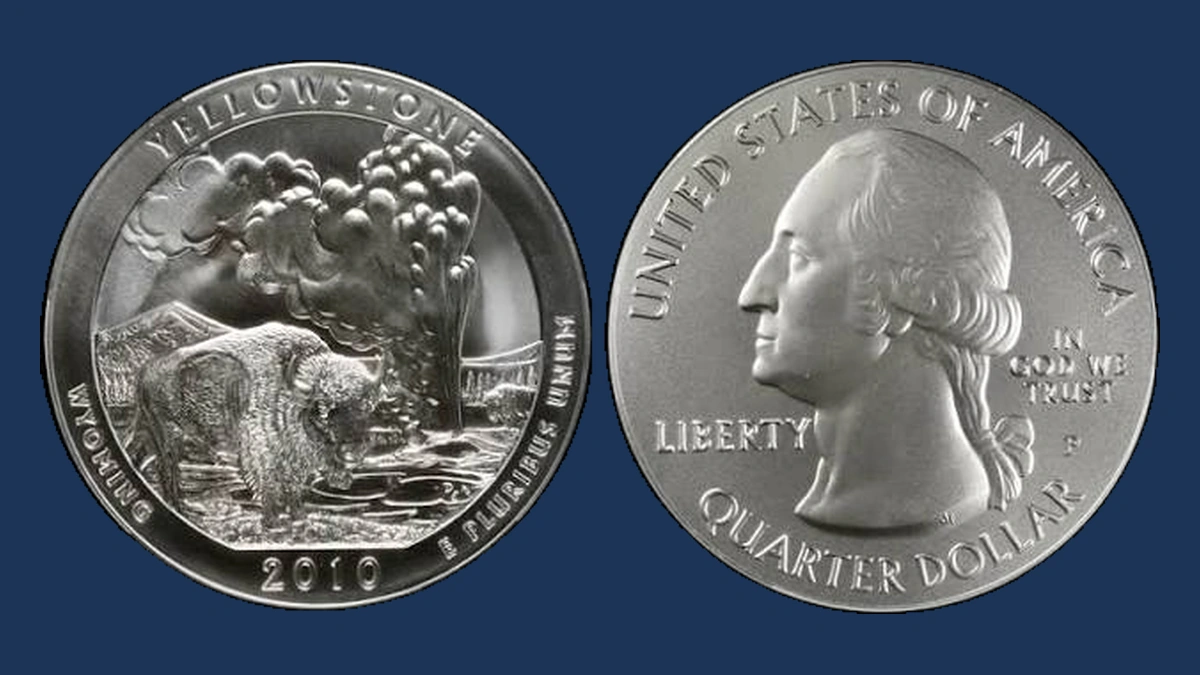
One large Yellowstone silver coin has a matte Washington side and a bright back. NGC identified it as a 2010-P five-ounce collector coin with an unfinished reverse.
These collector coins receive a surface treatment after striking that gives them a matte appearance. On this example, the treatment was applied to Washington’s side but missed the Yellowstone side.
NGC graded it Specimen 69, a grade for this specially made collector finish. The bright side still has its normal struck design.
This is the large five-ounce silver format, not an ordinary pocket-change quarter. A normal shiny bullion version is a separate product.
Estimated Value
Use an estimated $1,500–$6,000 for a properly authenticated example of this unusual five-ounce finishing error. The estimate includes the complete silver coin and the collector interest in its mismatched original surfaces.
The contrast between the original finishes is central to this estimated range. Scratches, spots, or cleaning reduce appeal, especially when they disturb the bright Yellowstone side.
A normal bright bullion coin or a lightly finished Grand Canyon collector coin should not automatically receive the same error valuation.
How to Identify
Check the format first: the five-ounce coin is about 76.2 millimeters across and contains roughly 155.5 grams of silver. Use calipers and a scale only on a safely accessible loose example, keeping certified coins sealed.
Its edge carries the silver-weight inscription rather than the small quarter’s normal grooves. Confirm the P mintmark and Yellowstone design before comparing finishes.
Under the same lighting, use a 10× magnifier to compare the matte Washington surface with the bright back. Polishing or cleaning can also change reflectivity, so the surface must remain original.
NGC’s reported example combines one treated face with one untreated face. That specific two-face contrast distinguishes it from a normally shiny bullion coin.
Conclusion
Estimated values run from $2–$6,000, but the wide range covers very different coins. Small tool marks on ordinary quarters should not be compared directly with a wrong-blank coin or the large silver finish error.
Start with the park, mintmark, and coin size, then examine the actual abnormal feature. Clear pictures of both faces and the edge help separate genuine minting mistakes from damage and unsupported labels.