1966 Quarter Error List with Pictures

Three displaced impressions can turn a round quarter into a map of repeated strikes. A 1966 example with strikes 70%, 75%, and 85% off center sold for $1,140 in July 2021.
This guide to 1966 quarter errors covers estimated values from $5 to $6,000, including unusual blanks and a matching two-coin pair. The missing mintmark is normal for this year.
Use the descriptions to choose the right comparison, then examine the design, edge, or matching impression that identifies it.
1. 1966 Washington Quarter Reported Doubled Dies
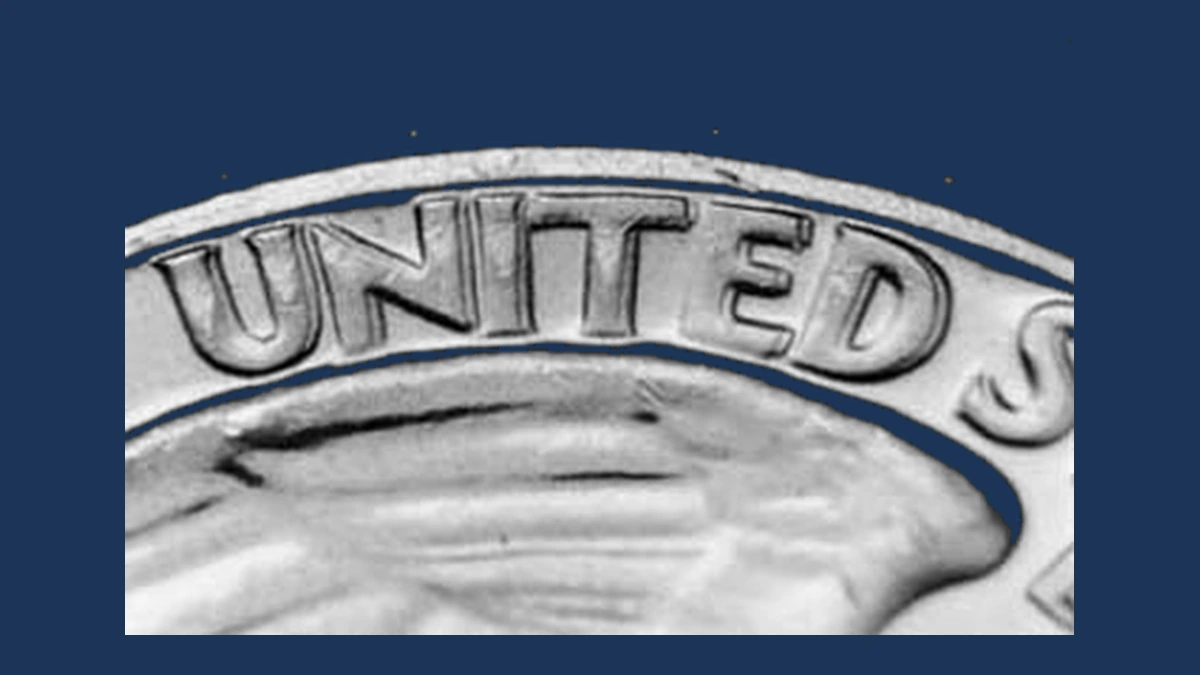
An extra outline in a letter may have been present on the stamping tool before the coin was made. Collectors call that a doubled die; a die is the steel tool carrying the design.
Reports for 1966 include both front and back examples. The back-side reports identify UNITED STATES OF AMERICA and QUARTER DOLLAR as areas to inspect.
These reports do not establish one specimen with doubling on both faces. The pattern and finish need to match the particular example, and flat shelves beside letters can have a different cause from a doubled tool.
Estimated Value
For a confirmed minor doubled die, estimate $10 to $300. Strong, separated detail that remains easy to photograph generally attracts more interest than slight thickening.
Wear can remove the small corners needed for a convincing match. Scratches, reflections, and flat strike-related shelves should not receive the same premium as a properly identified variety.
The range depends on visible strength and condition. A valuable ordinary or Special Mint Set coin does not automatically owe its price to doubled lettering.
How to Identify
Place a close photograph beside a normal coin of the same issue and finish. Compare the actual letter shapes before trying to name a variety.
On a back-side candidate, inspect the ends and corners of UNITED STATES OF AMERICA and QUARTER DOLLAR. Look for consistent extra outlines rather than a shadow that changes with the light.
For a front-side candidate, follow the reported doubled feature into neighboring details. A single flattened edge from a hit does not establish a repeated design on the tool.
Use photographs taken from directly above the surface to reduce reflections and distortion. A sound match should explain the visible pattern on that particular side, without borrowing a different example’s finish or opposite-face doubling.
2. 1966 Washington Quarter Reported Struck-Through Error
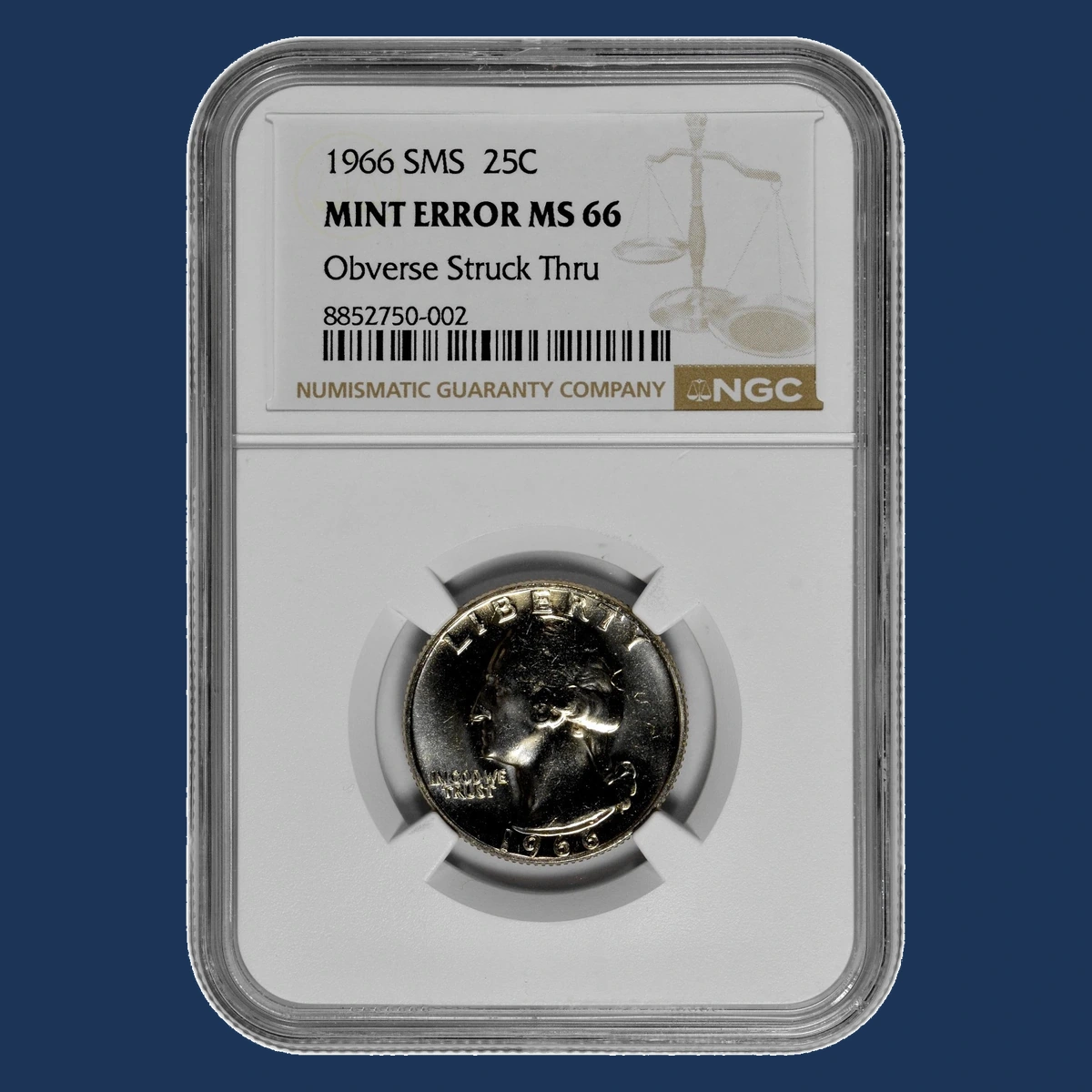
An unexpected hollow or weak patch can form when material gets between a blank and the stamping tool. The obstruction prevents the normal design from reaching that area.
This is called a struck-through error. Reports for 1966 include the category without fixing a specific material, location, or retained object for every example.
The shape of the interruption is therefore the starting point. Grease can soften or hide detail, while a more solid object can leave a recognizable impression; neither description should be applied merely because a worn coin has weak letters.
Estimated Value
An estimated $5 to $500 covers modest genuine interruptions through more visible impressions. A clearly shaped obstruction mark is usually easier to display than one faint missing letter.
For a different-year comparison, a 1979 quarter with impressions on both faces sold for $59 in September 2025. Its obstructing material was not identified.
An actual retained object would need separate evaluation. The general 1966 report does not establish one, so a seller’s object claim should be supported by the coin itself.
How to Identify
Inspect the boundary where the normal design meets the unusual area. Determine whether the feature is a depression, weak struck detail, or material lying on the finished surface.
Compare surrounding high points for wear. A locally blocked letter can disappear while neighboring detail remains strong, whereas circulation often affects several exposed areas together.
Look for scraping and impact marks that could explain a later interruption. Those may cut across existing detail instead of showing how an obstruction prevented it from forming.
If material remains attached, do not pry it out or clean around it. Photograph the whole face and the boundary before seeking an expert opinion; the visible shape alone may not identify the original substance.
3. 1966 Washington Quarter Uncentered Broadstrike
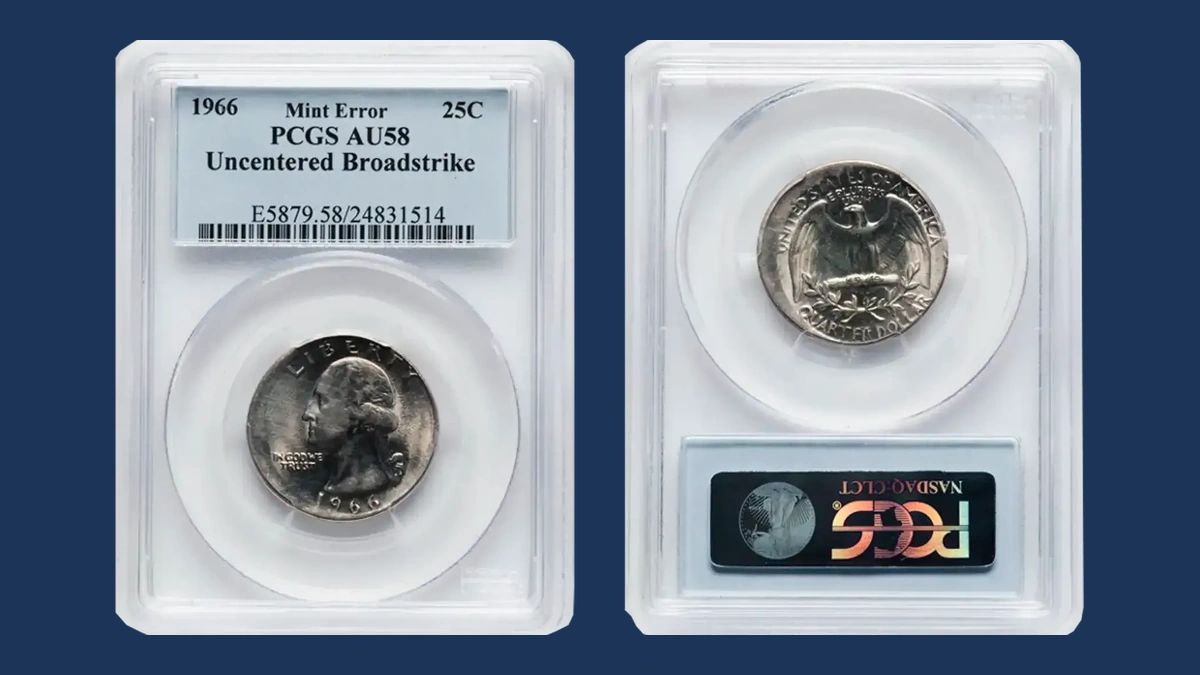
A broadstrike can be uneven without losing part of its design. The portrait may sit closer to one edge while an expanded border occupies the other side.
The collar, a ring that controls the blank’s width during striking, failed to hold the metal normally. The disk spread outside its intended outline as the design was stamped.
A recorded 1966 example is an uncentered broadstrike graded PCGS AU58, meaning slight circulation wear. Its wider, uneven outline differs from a simple off-center strike, which carries part of the intended design beyond the available metal.
Estimated Value
The AU58 uncentered broadstrike sold for $222 in June 2024. Comparable genuine examples have an estimated range of $50 to $500.
An attractive uneven border around a complete design makes the error easy to see. Wear and later damage can reduce that appeal, especially if the outer letters become hard to follow.
A wide appearance by itself does not establish value. A normal coin flattened after minting may look larger while lacking the original features of a broadstrike.
How to Identify
Walk around the outside lettering in the photograph and check that the complete design remains on the metal. The blank border can vary in width without turning the coin into an off-center strike.
Compare its diameter with a normal quarter at the same image scale. A loose example can be measured gently with calipers against the usual 24.3 millimeters.
Look along the expanded edge for original spreading and changes to the normal grooves. Then inspect the portrait and eagle for crushing that could have resulted from later pressure.
The recorded AU58 example provides a useful whole-coin comparison. Match the relationship of the intact design to the extra metal, not simply the width of one rim segment.
4. 1966 Washington Quarter Straight Clipped Blank
A straight portion of the blank is absent from this 1966 quarter. The design was struck after that metal was missing, rather than cut away from a finished coin.
The recorded example has a 20% straight clip and weighs 4.52 grams. PCGS graded it MS65, describing an unworn coin with relatively few marks.
The straight boundary and nearby struck details help explain the blank-making defect. A later saw cut can imitate the outline, so the exposed edge and the way the design approaches it matter more than the neatness of the missing section.
Estimated Value
The documented twenty-percent clip sold for $124 in June 2024. Estimate $25 to $500 for genuine comparable clipped quarters across different sizes and conditions.
A large, clear missing section can attract attention, but preserving a readable date remains important. An undamaged exposed edge also makes the mint-made origin easier to understand.
Heavy scratches or uncertain edge treatment can lower appeal. The 4.52-gram weight supports this specific example and should not become a price rule for every clipped coin.
How to Identify
Inspect the straight edge from the side before judging the front silhouette. Look for saw marks, filing, or a sharp later cut through already finished lettering.
Follow the rim and letters as they approach each end of the gap. Their original formation should fit metal that was missing before striking.
Check the opposite rim for a weak area, sometimes called the Blakesley effect. It can support a clip, but its absence alone is not a reliable reason to reject one.
For a loose candidate, compare its weight with the normal 5.67 grams. The known twenty-percent example weighs 4.52 grams; other gap sizes will not necessarily produce the same reading.
Keep the date in the full-coin photographs alongside the edge close-ups.
5. 1966 Washington Quarter Special Mint Set Partial Collar
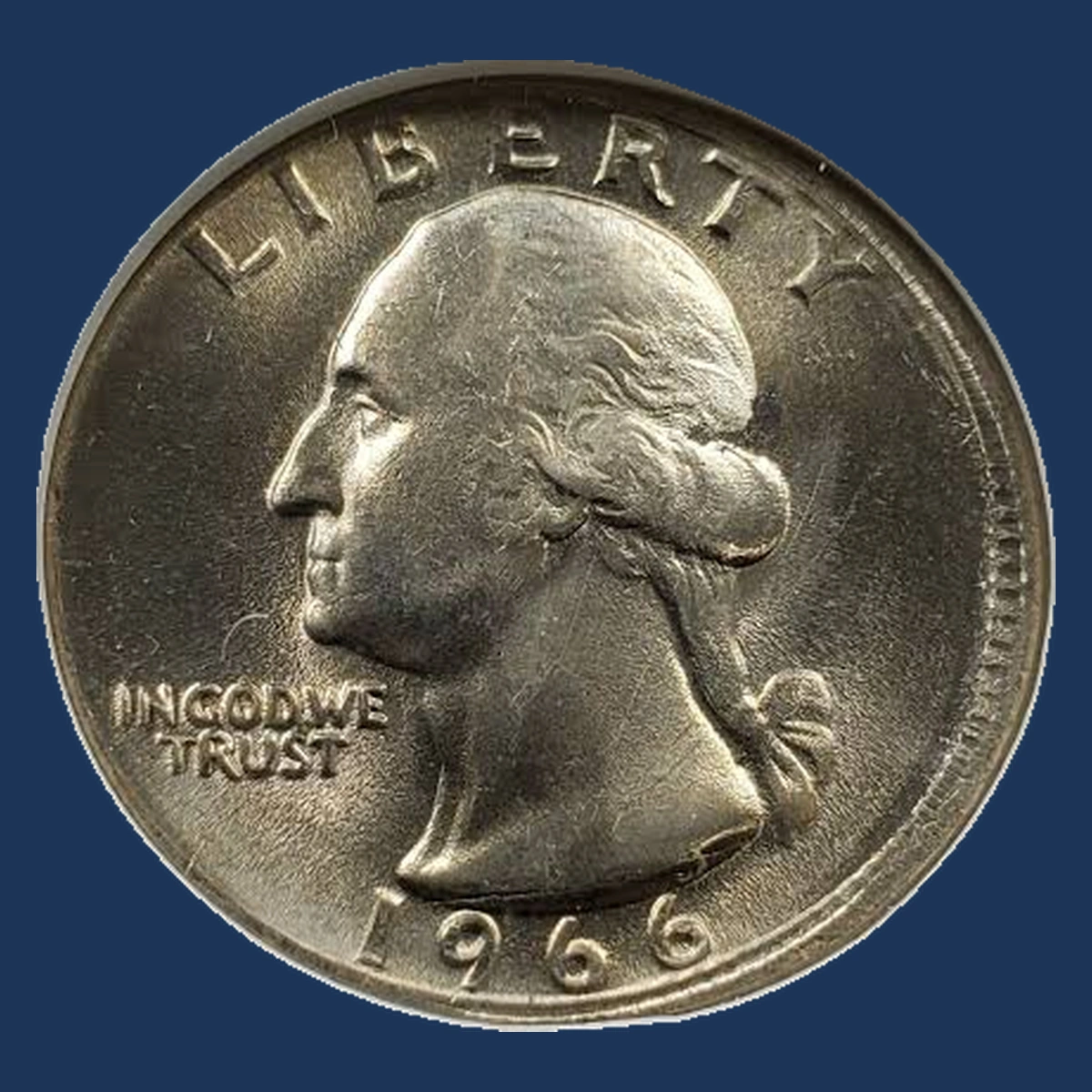
The rim overhangs the date and the upper back lettering on this Special Mint Set quarter. Its blank was only partly surrounded by the collar during striking.
The metal held inside the collar remained narrow, while the unrestrained portion spread farther outward. That difference creates the stepped edge of a partial-collar error.
NGC graded the recorded 1966 example MS67. Special Mint Set coins were collector issues with a special finish, distinct from ordinary circulation coins.
Their lack of a mintmark is normal for the year. It does not explain the abnormal rim on this particular piece.
Estimated Value
The MS67 Special Mint Set example sold for $144 in July 2021. A comparable authenticated partial-collar error has an estimated range of $50 to $600.
MS67 indicates an unworn coin with very few marks. Surface quality matters on a collector issue, but the original edge step must also remain clear.
A stronger, more understandable rim difference can increase appeal. Damage that flattens or folds the edge makes the error harder to display and can lower its value.
How to Identify
Look near the date and the words UNITED STATES OF AMERICA for the uneven overhanging rim described by NGC. Then request side views showing the difference in edge levels.
Trace the boundary between the narrow restrained band and the wider spread metal. Its relationship around the edge provides stronger evidence than a thick-looking rim in one front photograph.
Inspect any abrupt dents for later impacts or squeezing. Damage may fold an edge without producing the original partial-collar pattern.
Keep the Special Mint Set identity with the comparison, using the original holder or reliable attribution. A shiny ordinary quarter is not automatically a collector-set coin, and a normal collector finish does not make its edge an error.
6. 1966 Washington Quarter Struck on a Nickel Blank
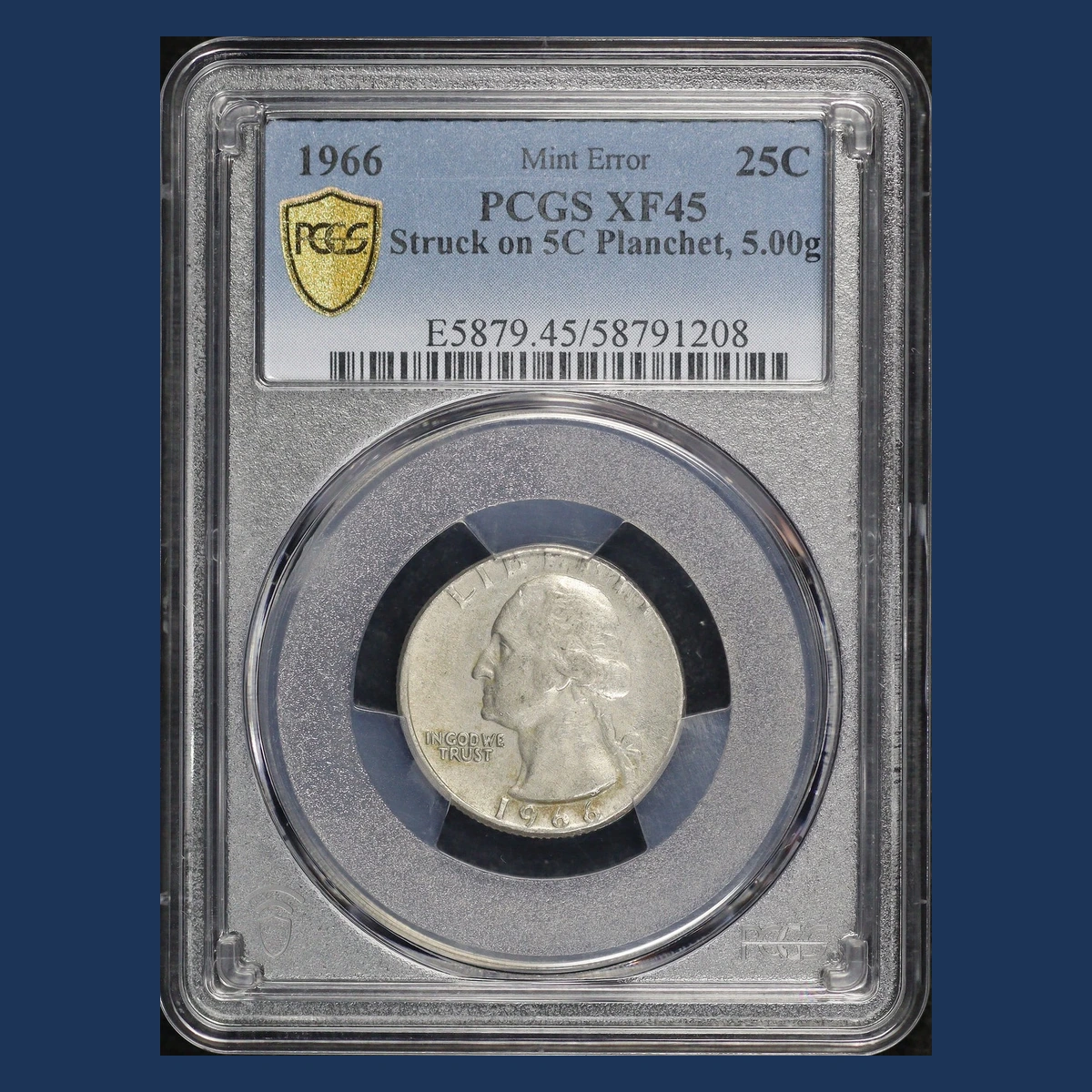
A smaller pale coin carrying Washington’s quarter design may have begun as a nickel blank. The quarter’s outer lettering can run beyond the space available.
A nickel blank normally weighs five grams and contains copper-nickel alloy throughout its thickness. It does not have the copper center and separate outer layers of an ordinary quarter.
The 1966 records include an ANACS AU50 example and a separate PCGS AU55 example. Both grades indicate circulation wear, and neither requires a mintmark: the normal omission of mint letters in 1966 does not identify a particular mint.
Estimated Value
An estimated $150 to $1,500 covers comparable authenticated nickel-blank quarters. A readable date and recognizable outer design help make a smaller coin appealing to collectors.
As a different-year comparison, a 1974-D nickel-blank quarter graded MS62 sold for $240 in June 2019. That unworn example has more surface marks than higher Mint State grades.
The recorded 1966 AU coins have circulation wear, so their condition needs its own comparison. A silver-gray color alone adds no wrong-blank premium.
How to Identify
Compare the quarter design with the coin’s smaller outline, noting which outer letters were cut off during striking. Make sure the surviving date supports 1966 rather than another partial year.
Inspect the edge for metal of one basic alloy through its thickness. A copper-center stripe would instead point toward a clad blank.
For a loose candidate, use a scale and calipers to record weight and diameter. An unused nickel blank starts near five grams and 21.2 millimeters, though the strike can spread it.
Check for trimming or filing that could have reduced an ordinary quarter. Original design meeting a naturally struck edge is more useful than a small diameter produced by later metal removal.
7. 1966 Washington Quarter Reported Strike on a Cent Blank
Washington’s quarter design can look crowded on a brown or reddish cent-sized disk. Reports for 1966 include a strike on a copper-based cent blank.
The smaller blank cannot hold all the outer letters and design intended for a quarter. Its color and the missing outer details should fit the same wrong-blank explanation.
A period cent blank normally weighs 3.11 grams, much less than a regular 5.67-gram quarter. This is not the 2.50-gram copper-plated zinc construction used for most modern cents, and simply coloring a normal quarter does not recreate the error.
Estimated Value
For a confirmed cent-blank quarter, estimate $400 to $2,000. Strong surviving identity and an attractive copper surface can improve collector interest.
For comparison, a 1974 no-mintmark cent-blank quarter graded MS62 sold for $540 in December 2024. A 1974-D MS64 example brought $977.50 in January 2010.
Those are separate-year auction examples, not established sales for the reported 1966 coin. Heavy wear, damage, or an incomplete date can place a candidate lower than an otherwise similar, clearly identified piece.
How to Identify
Use the visible design to establish the denomination before relying on the copper color. Washington, the quarter lettering, or the eagle must belong to a genuine quarter strike.
A loose candidate can be weighed against the 3.11-gram standard for a period cent blank. Its starting diameter would be about 19.05 millimeters, with some spreading possible during striking.
Check the edge structure and inspect the date under magnification. Copper plating on a full-size quarter cannot explain the natural fit of a larger design onto an originally smaller blank.
Look for cut edges, seams, and later added marks. A specialist should confirm the metal and strike together before the reported cent-blank estimate is applied.
8. 1966 Washington Quarter Struck on a Dime Blank, Including an Indented Strike
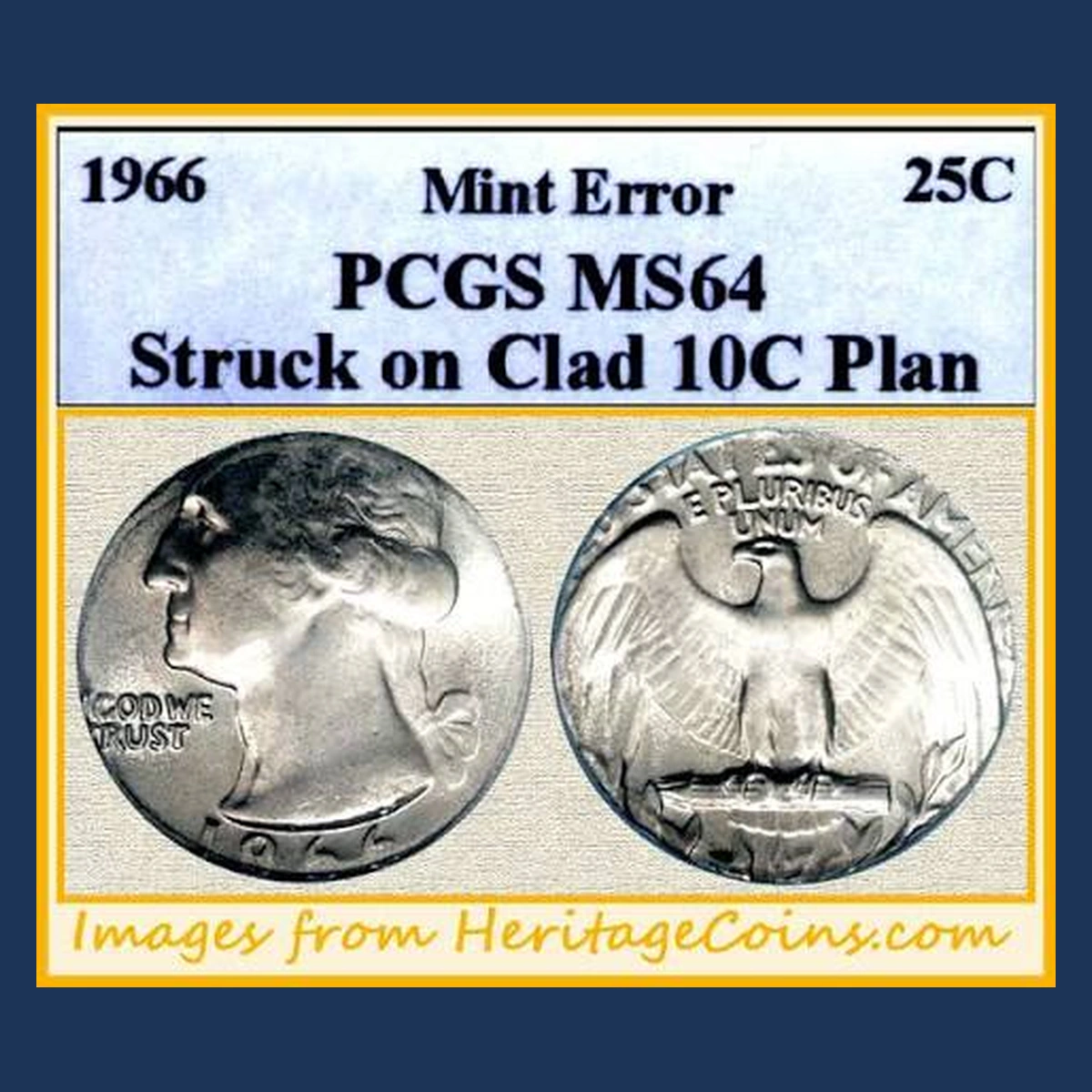
A dime blank leaves little room for the larger quarter design. On one MS63 example, a roughly 10% shift toward the upper left removes still more outer detail.
Parts of all four date digits remain on that coin. They should be read in their actual incomplete form, rather than presented as a fully visible year.
Another MS64 example combines a dime blank, a 30% off-center strike, and a 60% depression from an overlapping blank. Its remaining eagle and weak date belong to one complex object, not three separately priced coins.
Estimated Value
The MS63 dime-blank quarter sold for $460 in January 2005. The MS64 off-center and indented combination brought $862.50 in April 2006.
Estimate $300 to $2,500 across comparable authenticated examples. The upper part favors clearly readable identity, attractive surfaces, and dramatic combinations that remain easy to understand.
A partial date or later damage can reduce appeal. For the indented example, price the whole coin rather than adding separate full values for its blank, displacement, and hollow.
How to Identify
Inspect the surviving year with magnification and compare the visible parts of every digit. The slightly displaced MS63 coin preserves fragments of all four, not an untouched full date.
Check the small blank’s edge for the copper center and pale coverings expected on a clad dime. For a loose coin, the standard dime starting measurements are 2.268 grams and 17.91 millimeters.
On the more complex example, separate its missing outer design from the smooth depression. The first reflects the small, misplaced blank; the second formed where another blank blocked the strike.
Follow the remaining eagle and weak date around that hollow. Their relationship should explain one original strike, rather than a depression hammered into a finished wrong-blank coin.
9. 1966 Washington Quarter Incomplete Blank Punches with Two Curved Clips
An arc across the coin can mark a cutting punch that did not pass completely through the metal strip. The metal remains connected instead of becoming a fully open gap.
The featured 1966 quarter has two such incomplete punches, plus two actual curved clips. PCGS graded the coin AU55, indicating circulation wear.
The fainter front arc runs from beside the Y in LIBERTY toward the final 6. On the back, its counterpart extends from F in OF toward R in QUARTER, giving the two faces connected clues to the same blank-making problem.
Estimated Value
For an authenticated combination of two incomplete punches and two curved clips, estimate $200 to $3,000. Clear surviving arcs on both faces can make the unusual cutting sequence understandable.
The recorded AU55 coin has some wear, so the strength of the remaining marks matters. A clean, well-preserved boundary is more useful than a vague curved scratch.
A simpler 1966 twenty-percent straight clip sold for $124 in June 2024. That single defect does not establish the value of this complex example.
How to Identify
First distinguish the open clips from the incomplete arcs. One removes metal entirely; the other leaves a narrow curved scar across metal that remains attached.
Follow the fainter front arc from the Y toward the last 6, then locate the corresponding back arc from F to R. Matching both faces matters because a scratch added later may occur on only one surface.
Inspect the marks for a narrow, sharply defined path extending toward the edge. Compare the full pattern with the published AU55 example, rather than tracing any convenient curved line.
Leave the connected metal undisturbed. Bending it to see whether the punch nearly cut through could destroy the evidence of the original incomplete cut.
10. 1966 Washington Quarter Triple Strikes and Saddle Strikes
Three strikes can leave a quarter with several displaced parts of its design. One recorded MS65 example has impressions 70%, 75%, and 85% off center.
Another MS64 coin is cataloged as a saddle triple strike, with its second and third impressions 80% and 90% off center. A saddle strike has a bent connecting area between separate striking zones.
These are different coins with different arrangements. The repeated letters, portraits, and changes in outline show how their strikes relate, while the connecting shape adds useful evidence on the saddle example.
Estimated Value
The three-displacement MS65 coin sold for $1,140 in July 2021. The separate saddle triple strike brought $780 in the same auction.
An estimated $300 to $3,500 covers comparable genuine repeated-strike quarters. Clear individual impressions can make the sequence easier to appreciate than a crowded, damaged overlap.
The percentages describe where the strikes fell, not automatic premiums. Remaining identity, original surface condition, and the preservation of any bent connecting metal are important parts of the value.
How to Identify
Choose one surviving portrait or group of letters and follow its position across the coin. Repeat that process for the other impressions before deciding how many blows occurred.
On the saddle example, examine the bridge between the separate striking zones from the side. Its shape must fit the original striking sequence rather than a bend added afterward.
Photograph both faces without trying to flatten the coin. Later dents and scratches can obscure the boundaries where one strike altered an earlier image.
Keep the percentages attached to their correct specimen: 70%, 75%, and 85% belong to the MS65 coin. The saddle example instead has 80% and 90% second and third strikes, so its outline requires a different comparison.
11. 1966 Washington Quarter Matching Pair with a Dime-Blank Quarter and Brockage
These two coins explain each other. A quarter design first struck on a dime blank later rested face down against a normal quarter blank.
Another strike pressed the small coin’s front design into the larger coin’s back. The transferred image is sunken and backward, which collectors call a brockage.
Mint Error News describes the surviving pieces as a matching pair rather than a permanently bonded object. The larger coin records the second strike on the smaller one, even though that extra blow is not obvious from the small piece alone.
Estimated Value
The estimated value is $1,000 to $6,000 for the complete authenticated pair. Its appeal comes from preserving both sides of the same striking event.
For context, the separate 1966 dime-blank quarter with an off-center strike and indent sold for $862.50 in April 2006. That price concerns one coin, not this matching pair.
A clear correspondence between the transferred image and its source is essential. Selling the pieces separately would remove much of the evidence that makes the pair interesting.
How to Identify
Compare the small coin’s front with the backward impression on the large coin’s back. Use a mirrored photograph to see whether several design details line up in position and shape.
Check the transferred image under light from the side to confirm that it sinks into the receiving surface. Matching only the general portrait is not enough; the smaller coin’s surviving details should explain the impression.
Examine both pieces separately for later squeezing or added marks. They are reported to remain separate, so a physical bond is not required.
Keep their photographs and any grading records together. Do not press the coins against each other to test the match, because their original surfaces carry the evidence of the paired strike.
Conclusion
The estimated $5 to $6,000 range includes individual coins and one matching pair valued together. Small interrupted details sit far below the most complex combinations of wrong blanks and repeated strikes.
Keep the physical clues separate: a clipped gap has no metal, a depression retains metal, and a backward image records contact with another coin. None of these errors is established simply by the normal absence of a mintmark.