1959 Quarter Error List with Pictures

Two strikes left a dramatic mark on a 1959 quarter sold for $4,560 in July 2021. The second blow landed 60% off center, placing another design partly beyond the coin.
1959 quarter errors also include wrong metal blanks, a repeated D, and material caught during striking. Estimated values across the examples below run from $20–$6,000.
Some features need magnification; others change the whole outline. Use the following comparisons to see what each one actually looks like.
1. 1959 Washington Quarter Front Lamination Split
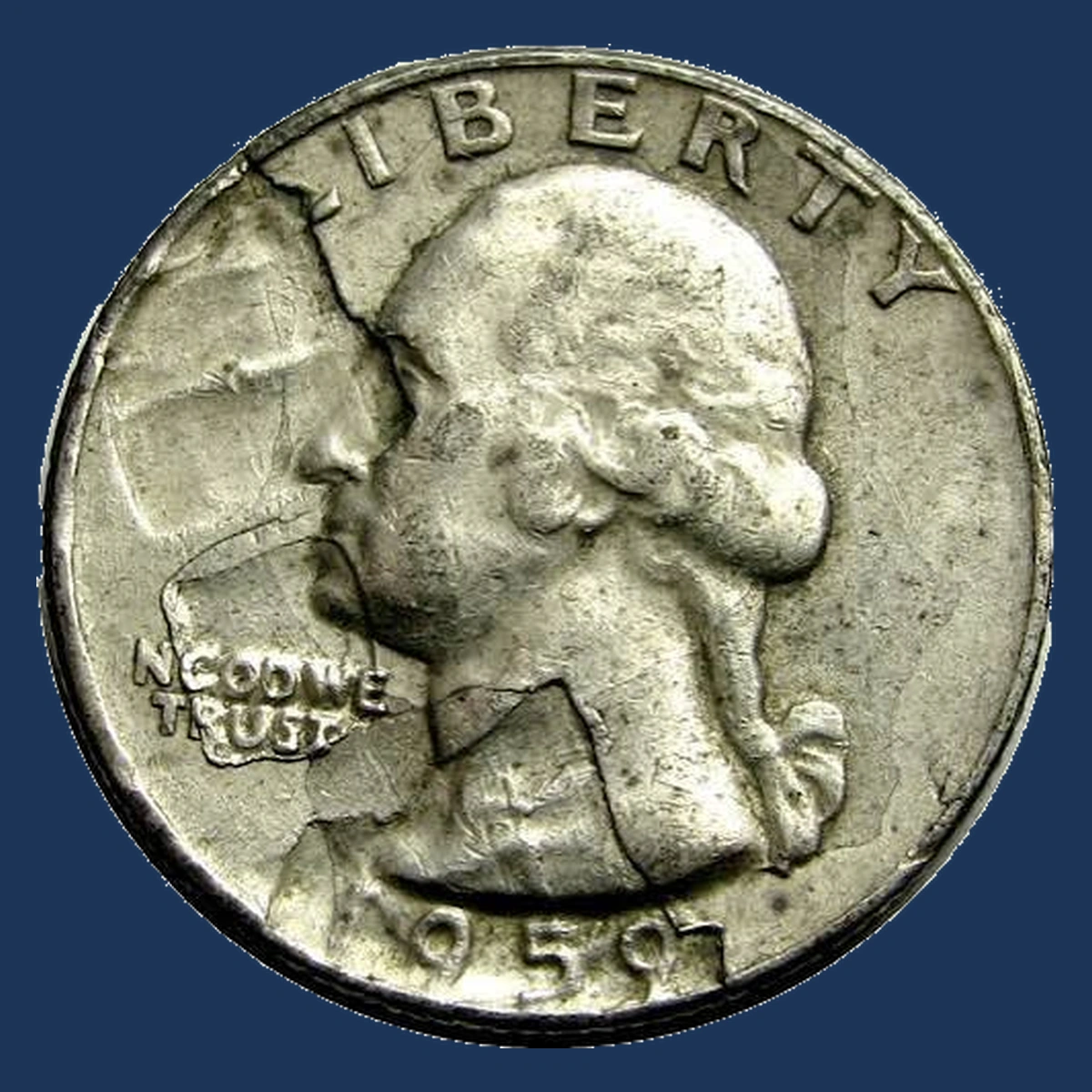
An uneven split on Washington’s side can reveal a flaw within the coin’s metal. Such lamination faults form when part of the alloy separates, sometimes leaving a flap and sometimes losing a small piece.
A Denver front-lamination example appears in a market listing for 1959. Examine the opening and its thin edges to distinguish a natural split from a gouge cut into the finished coin.
The underlying silver alloy is normally solid throughout. This differs from a missing outer sheet on a later clad quarter, which has a copper center between separate pale layers.
Estimated Value
For a genuine 1959-D front lamination, estimate $20–$175. The amount of original metal affected and the clarity of the split help determine collector interest.
A neat attached flap or obvious natural separation can be easier to display than a rough area mixed with scratches. Wear and cleaning still affect the whole coin’s price.
This is an estimated type range; an isolated market description without a completed sale does not establish a realized price.
How to Identify
Examine the border between the rough area and the intact front design with a magnifier. Look for a natural split continuing into the coin rather than metal carved away with a tool.
If a flap remains, leave it attached and change the angle of the light to see beneath its edge. Do not bend it to test the connection.
Confirm the D on the reverse below the wreath and remember that the normal coin is ninety-percent silver.
A copper patch beneath a silvery coating may have another explanation. Follow the split into the surrounding silver metal to see whether a thin layer has separated naturally.
2. 1959 Washington Quarter Clipped Blank
A curved or straight gap can begin before the design reaches the coin. It happens when the blank is cut from a section of metal that cannot provide a complete round disc.
The clipped-blank type appears in 1959 year guides, without a fixed mint or gap size. Each coin can differ in how much of its edge is missing.
Some damaged quarters have a similar silhouette. A genuine clip needs original metal around the gap, showing how the rim and design formed with that section already absent rather than being cut away later.
Estimated Value
An estimated $25–$400 covers identifiable 1959 clips from modest gaps to more striking shapes. Attractive original surfaces and a readable date help make the piece collectible.
As a different-year example, a 1980-P corner clip graded NGC MS65 sold for $204 in June 2023. That later clad coin provides a comparison, while the size and condition of a silver 1959 clip still need individual assessment.
How to Identify
Photograph the missing section together with the whole date before enlarging the edge. Keep both endpoints visible so you can follow the gap into the surrounding design.
Under a magnifier, study both ends of the gap and the way the struck rim approaches them. Look for cut grooves, filed surfaces, or letters sliced after the coin was made.
A weak rim opposite the gap can support an original clip, but it is not a substitute for examining the gap itself.
Handle the coin only by its remaining edge.
The key evidence is original struck metal around a section that was already missing when the quarter received its design.
3. 1959 Washington Quarter Struck Through Retained Grease
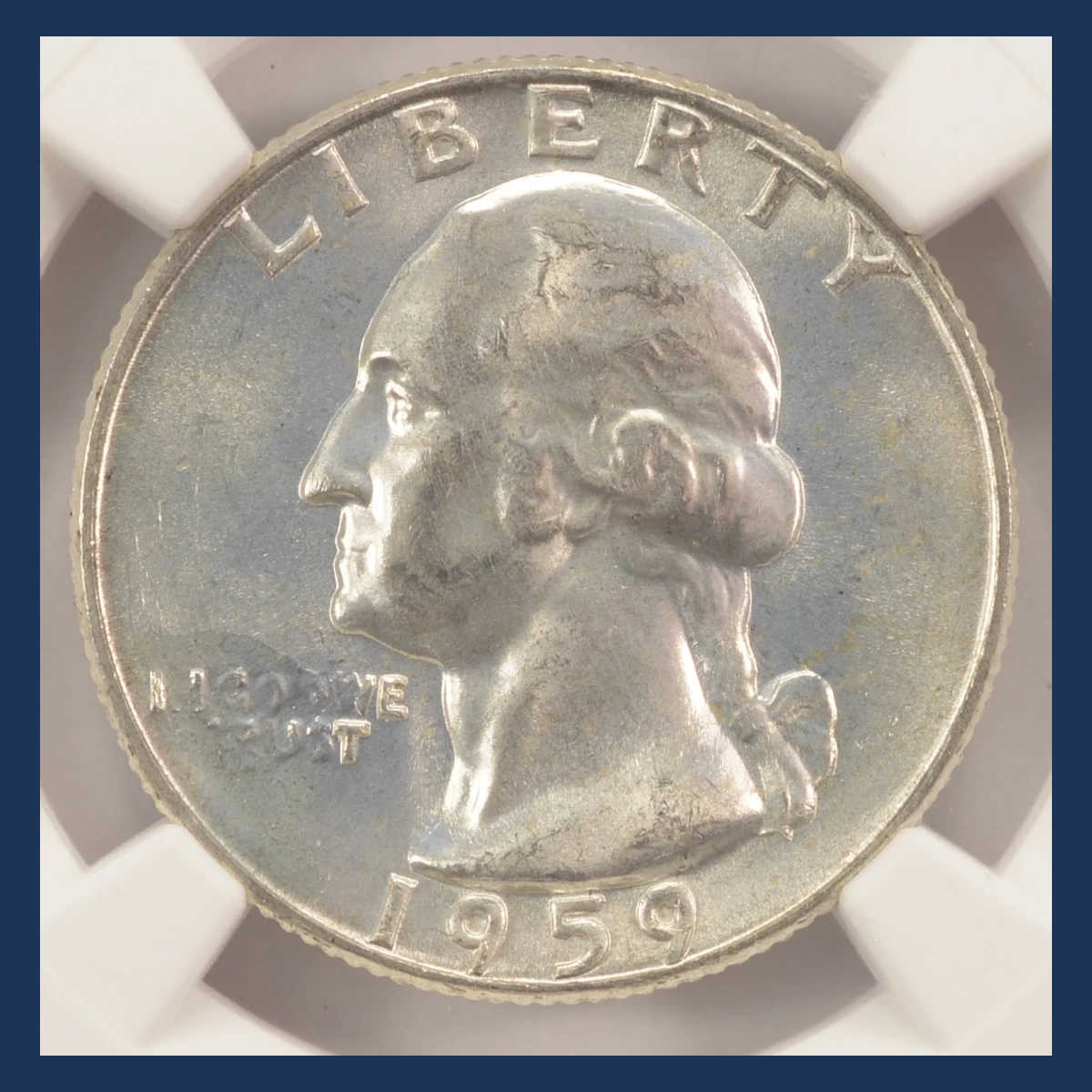
A patch of material trapped in the press can prevent part of the design from forming clearly. On a retained-grease error, some of that material remains attached after striking.
PCGS records a 1959 quarter graded MS64 with this description. Look at the boundary of the retained patch, where the nearby design may stop or become weak.
A dark spot alone is not enough. Grease caught during the blow needs a relationship with the interrupted design, while dirt deposited during years of storage can sit over lettering that was already complete underneath.
Estimated Value
Estimate $75–$600 for a correctly identified 1959 retained-grease strike. A clearly blocked area with original material still present can be more interesting than ordinary weak lettering.
For a different-material comparison, a 1963 quarter struck through a retained copper fragment, graded ANACS MS64, brought $720 in July 2021. Copper is a firmer, more obvious obstruction, so that result supports the broader comparison without becoming a direct price for retained grease.
How to Identify
Do not remove the retained material, even if it looks like something that could be wiped away. Its position is part of the evidence for how the design was blocked.
Use a magnifier and angled light to inspect where the material meets the coin. Determine whether the surrounding design stops, weakens, or changes at that boundary.
A stain changes color without necessarily blocking the original strike. Added dirt may cover intact letters rather than showing the pressure relationship of material caught during manufacture.
For the certified example, compare the photographed surface with its PCGS identification. The visible connection between retained material and interrupted detail matters more than the darkness of the patch.
4. 1959 Washington Quarter Thirty-Percent Off-Center Strike
Washington’s design can partly miss the silver blank when it enters the press away from the center. An untouched crescent then remains beside the struck part of the coin.
A historical Fred Weinberg listing records a 1959 Philadelphia quarter struck 30% off center toward ten o’clock. That is a specific reported example, not the required direction for every off-center quarter dated 1959.
This coin received a misplaced strike rather than necessarily receiving two strikes. A second set of impressions would provide additional evidence of a different press event, as in the separate double-struck example below.
Estimated Value
For an identifiable 1959 off-center quarter, estimate $100–$750. The historical thirty-percent example helps establish the type, while the estimate allows for differences in wear and surviving detail.
A 1988-P thirty-percent off-center quarter graded ANACS MS63 sold for $109 in January 2022. Its later clad metal and different year limit the comparison.
A clear silver-quarter date and an attractive unstruck area can support a stronger price than a damaged or partly unreadable example.
How to Identify
Picture a clock over the upright Washington portrait to understand the reported ten-o’clock direction. Compare the displaced design with the untouched part of the blank, without rotating photographs to force a match.
Both faces should show that the blank sat away from the tool centers. If only the front is shifted, check for a misaligned tool instead.
A magnifier helps find grinding marks or flattened design in a supposed untouched crescent. For a loose normal-size candidate, a scale can compare the weight with the 6.25 g silver-quarter standard.
Trace the edge of the struck area: one displaced impression beside original blank metal supports an off-center strike without proving a second blow.
5. 1959 Washington Quarter Repunched D Mintmark
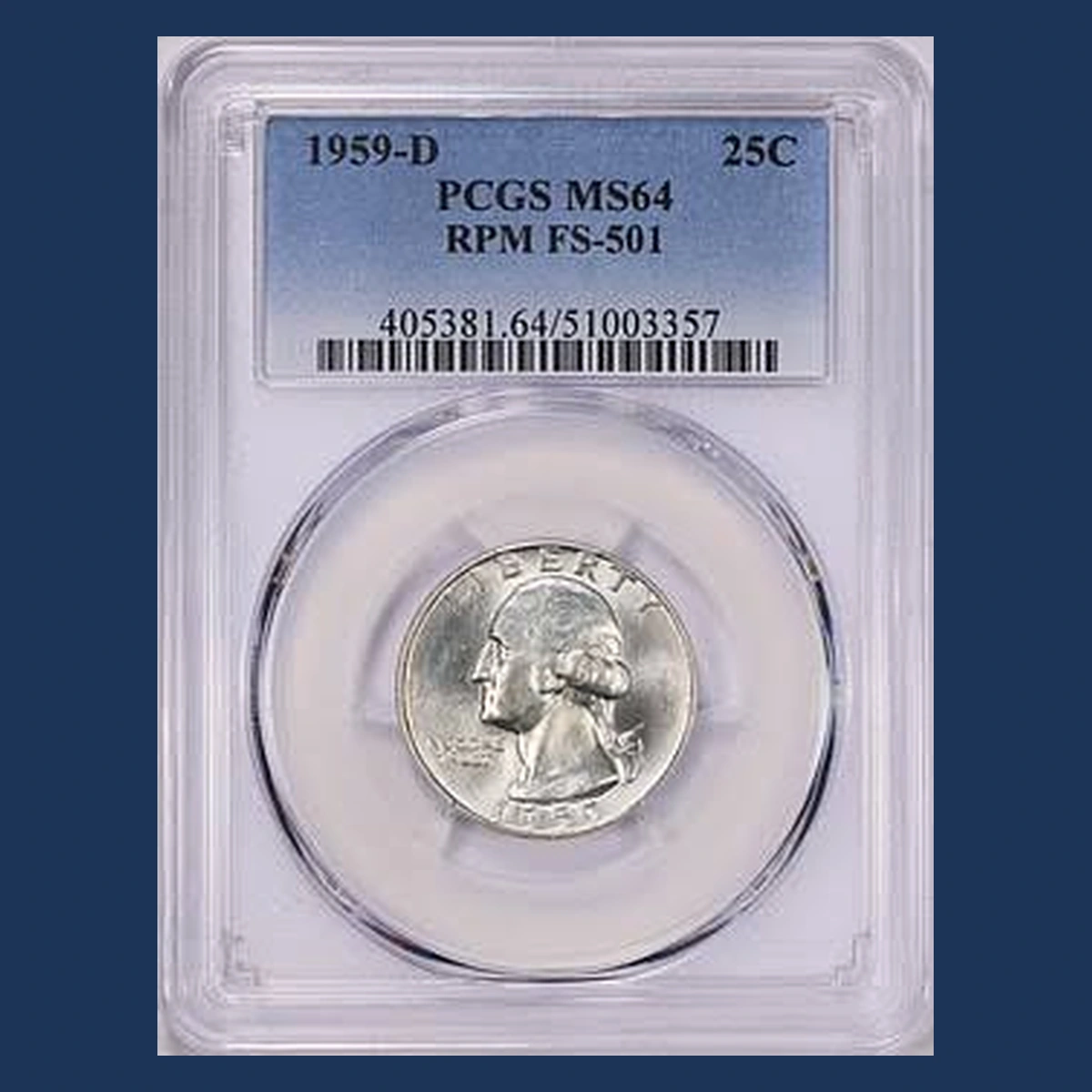
An extra outline beside the small D can record more than one entry of the mintmark punch into a stamping tool. The finished coin then repeats that doubled letter even after a single normal strike.
The 1959-D variety is recognized as FS-501. Its location is below the wreath on the eagle side, rather than beside Washington’s portrait as on later quarters.
A second D should be supported by its actual shape. A swollen letter, an impact on the mintmark, or a thin flat shelf from mechanical doubling can look similar without representing the same repunched pattern.
Estimated Value
PCGS lists an MS65 FS-501 auction result of about $541 in January 2017. MS65 describes an unworn coin with relatively few marks.
Use an estimated $40–$800 for correctly identified 1959-D repunched mintmarks across different conditions. A well-defined extra outline and a clean surrounding reverse help the viewer see the feature.
The recorded result applies to the named variety and grade; a damaged D does not inherit that value merely by looking doubled.
How to Identify
Find the D below the wreath and choose a sharp FS-501 photograph at a similar enlargement. Keep the letter upright so its outer curve and straight stroke can be compared accurately.
A 10× magnifier should reveal the extra outline rather than just a shadow on one side. Change the light direction: a real raised feature stays in the same place as the shadow moves.
Examine nearby metal for a hit that pushed part of the D sideways, then check whether the extra edge is a flat mechanical shelf. The useful match is the specific surviving D shape, not an imagined punch direction inferred from a thick-looking letter.
6. 1959 Washington Quarter Doubled Front and Reverse Lettering
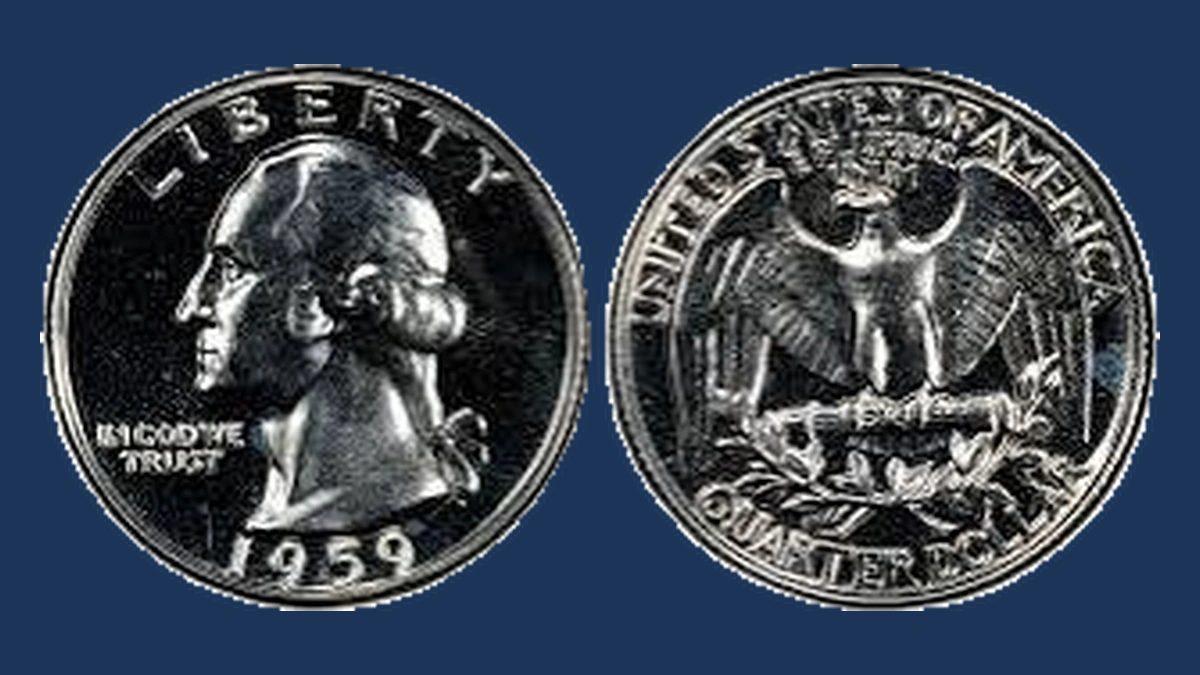
IN GOD WE TRUST is the main place to look for the Proof FS-101 front variety. Proofs are specially made collector coins, and this doubled design belongs to the stamping tool rather than a second blow to the coin.
Other front lettering can show smaller extra outlines. A separate year report describes doubling in UNITED STATES OF AMERICA and QUARTER DOLLAR on the reverse.
That reverse report does not establish the same finish or a matching front variety. The two sets of features should be compared separately, without assuming that both appear on one particular coin.
Estimated Value
PCGS records a Proof FS-101 graded PR67 at $288 in September 2011. That result describes the whole collector coin, including its condition and finish.
Estimate $50–$1,000 for identified Proof FS-101 examples, and $25–$250 for a genuine doubled reverse that can be matched to a clear pattern. The combined group spans $25–$1,000.
Bright surfaces or slightly thick letters alone do not establish either identity or the associated value.
How to Identify
Inspect IN GOD WE TRUST with a 10× magnifier before searching the rest of a possible Proof FS-101. Look for separated, rounded extra outlines that repeat on more than one affected letter.
The coin’s Proof identity needs to agree with the Proof variety example, not just with a reflective patch.
For the separate reverse report, turn directly to UNITED STATES OF AMERICA and QUARTER DOLLAR.
Compare those letters with a normal reverse under the same lighting. Flat ledges, wear, or a pushed edge can mimic a doubled outline.
The front variety is best recognized through its repeated motto details; reverse candidates need their own matching eagle-side pattern.
7. 1959 Washington Quarter Type B Reverse on an Ordinary Strike
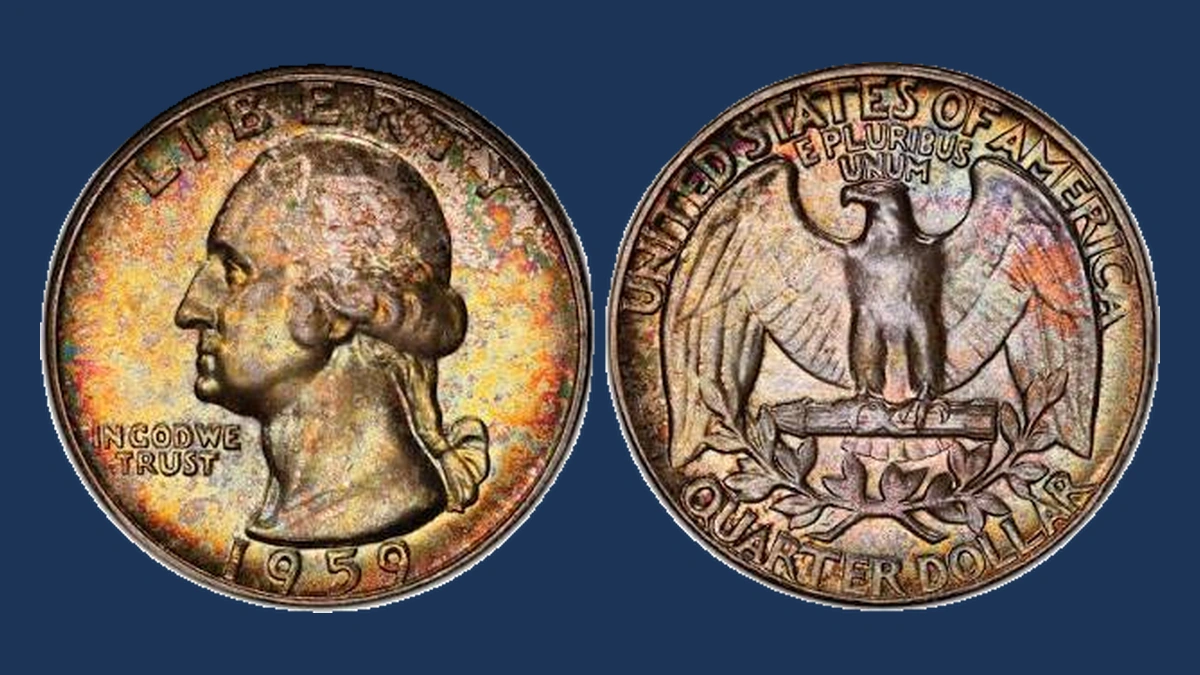
The eagle side can look almost normal until you notice extra space between the E and S in STATES. Type B has this separation and other reverse details associated with the tools used for Proof coins.
Some ordinary Philadelphia quarters received that design too. Collectors identify the resulting variety as FS-901, rather than treating it as doubled lettering or a second strike.
An actual Proof naturally has the Proof-style reverse. Its Type B features therefore do not create the same unusual combination, and a shiny ordinary coin is not automatically a Proof.
Estimated Value
A Type B example graded MS66+ sold for $900 in February 2018, according to the PCGS record. That high-condition result reflects the entire coin, not a fixed premium attached to every Type B reverse.
Estimate $25–$1,200 for ordinary-strike 1959 FS-901 coins. Clear design differences, attractive surfaces, and a correctly established ordinary finish guide the comparison.
Normal Proof quarters should be valued as Proofs rather than assigned this ordinary-strike variety range.
How to Identify
An E–S gap is a useful clue, but check whether the coin is an ordinary strike or a collector Proof. Type B is normal on the Proof.
Use a magnifier to compare STATES with a clear ordinary Type A reverse. Keep both photographs at the same scale so the letter spacing is easy to judge.
Next, compare the eagle and nearby leaves with a Type B photograph. A scratch between two letters cannot reproduce the matching design elsewhere on the reverse.
Inspect the whole coin’s finish or its grading label to confirm ordinary striking. The variety combines that ordinary finish with the separated E and S and the other Type B details.
8. 1959 Washington Quarter Wrong Nickel or Penny Blank
A nickel blank can hold much of a quarter’s design while stretching the outer words toward its edge. A Philadelphia ANACS MS65 example shows this especially in QUARTER DOLLAR.
A separate nickel-blank example graded NGC MS66 weighs 5.1 g. Nickel metal differs from the normal ninety-percent-silver alloy, even when both coins look pale under a lamp.
The Denver penny-blank example has brown copper-alloy surfaces, a complete date and D, but cut-off LIBERTY and denomination. These are separate wrong blanks with different metals and sizes, rather than normal silver quarters that merely acquired unusual colors.
Estimated Value
The ANACS MS65 nickel-blank example sold for $805 in March 2006. The Denver penny-blank NGC MS65 Brown coin brought $1,380 in February 2011.
Estimate $500–$2,500 for comparable identified 1959 wrong-blank quarters. A readable date, recognizable quarter design, and clear metal identity make the comparison stronger.
Within that range, strong original detail is easier to display than heavily worn or damaged lettering. Trimming or plating does not create a genuine wrong-blank strike.
How to Identify
The Denver penny-blank coin provides a useful visual starting point: read its complete 1959 date and reverse D, then note the missing outer words. Its copper color should agree with the smaller original blank.
Use a scale and calipers on a loose candidate. Normal starting blanks were about 3.11 g and 19.05 mm for pennies, or 5 g and 21.21 mm for nickels.
The documented NGC nickel example actually weighs 5.1 g. Spreading during striking can change the width, so size alone is not a complete metal test.
Inspect the edge through a magnifier for filing or added plating. Original small-blank boundaries and the correct alloy must explain the distorted quarter lettering together.
9. 1959 Washington Quarter Double Strike with a Sixty-Percent Off-Center Second Blow
Two groups of quarter details show that this coin returned beneath the tools after its first strike. The second blow landed far to one side, leaving a large displaced portion of another design.
The documented PCGS MS63 example is described as sixty percent off center on its second strike. That percentage measures the displacement of the later blow, not how much metal disappeared from the blank.
This differs from a doubled die, where small extra outlines already exist in the stamping tool. Here, two separate impacts changed the arrangement of designs across the same piece of silver.
Estimated Value
The PCGS MS63 double-struck quarter brought $4,560 on July 15, 2021. For a similarly clear 1959 double strike, estimate $2,000–$6,000.
The widely separated impressions make the second blow easy to recognize. Surviving dates, attractive original surfaces, and the amount of readable design can raise or lower interest.
That price concerns the combined double-strike and off-center features on one coin, rather than two errors valued separately and added together.
How to Identify
Identify one group of Washington-side details, then find the displaced group belonging to the second blow. Follow recognizable portrait edges or letters instead of starting with isolated parallel lines.
Use a magnifier to study the overlap, where the later impression altered part of the earlier one. Compare the reverse to see how the other stamping tool affected the same metal.
Do not expect a sixty-percent missing piece: the figure describes how far the second design missed the blank.
Check for later dents or squeezed-coin marks that could imitate doubled detail.
The direct clue is two recognizable groups of struck quarter design, with one clearly displaced beyond the area of the first impression.
Conclusion
These 1959 quarters offer several different clues, from extra letter outlines to an unmistakable second strike. Estimated whole-coin values range from $20–$6,000, depending on the mechanism, condition, and clarity of the feature.
Give the mintmark, finish, and surviving design equal attention. A correct identification should explain the visible metal, while a familiar variety name or a high-grade comparison alone cannot establish the same value.