1923 Quarter Error List with Pictures

Liberty’s shield survives on one 1923-S quarter, but her head missed the metal entirely. That dramatic off-center strike belongs in an estimated $5,000–$20,000 range for comparable lightly worn examples.
Other 1923 quarter errors require a closer look, including an extra E near the knee and a raised teardrop. Estimated whole-coin values below run from $25–$20,000.
Read on to separate those shapes and learn what each one means.
1. 1923 Standing Liberty Quarter Peeling Metal
A lifted flake or a shallow opening can reveal metal separating within the coin. Collectors call this a lamination error.
The separation begins at a weak area in the metal, rather than from a second design being stamped nearby. Part of the flake may remain attached.
Peeling is reported for 1923 quarters, without a fixed location that every example must share. These silver coins were made from a single alloy, not the bonded outer sheets of modern quarters, so a peeling patch does not mean an entire manufactured layer is missing.
Estimated Value
For a genuine Philadelphia example with modest peeling, estimate $25–$300. Comparable worn San Francisco examples can fall around $200–$1,000, including the value of that scarcer issue.
A different silver quarter, a 1932-S graded NGC AU58 with front peeling, sold for $228 in September 2023. That comparison illustrates a whole-coin price, not a fixed peeling premium.
Large intact flakes may draw more interest, while scratches and corrosion can reduce appeal.
How to Identify
Protect any loose flap before trying to identify the error. Do not lift it with a needle or rub the exposed surface clean.
With light directed across the coin, trace where the metal separates from the surrounding surface. A partly attached flake may carry a piece of the original design, while the opening beneath it looks uneven.
Check whether a nearby scrape has instead pushed metal into a ridge. Corrosion usually leaves pits rather than a continuous thin sheet.
The 1923 quarter’s silver alloy has no copper center to expose. A copper-colored patch therefore needs a different explanation, and color alone cannot establish peeling or identify the mint.
2. 1923 Standing Liberty Quarter Extra E near Liberty’s Knee
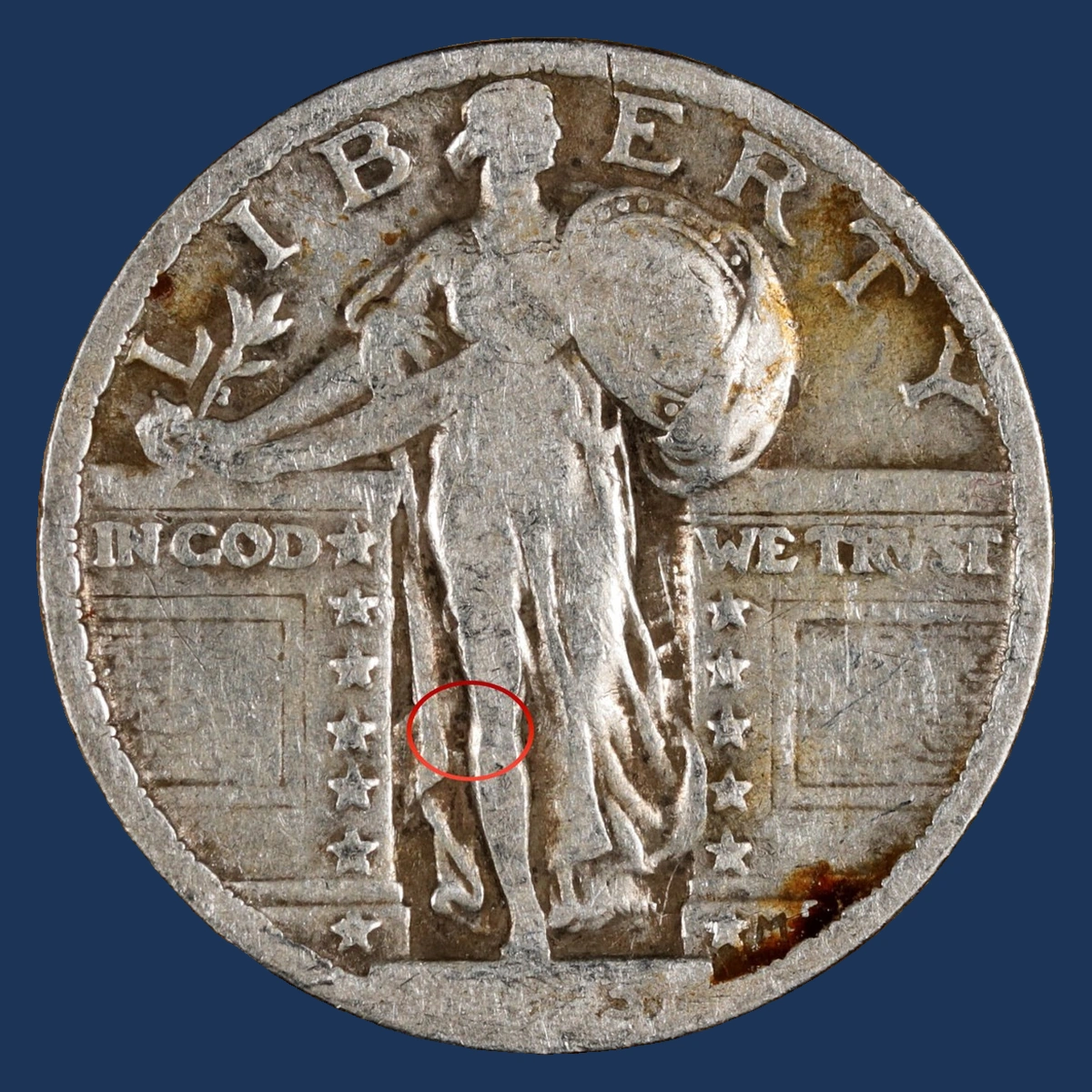
A faint letter near the knee can look out of place among Liberty’s clothing folds. On the reported Philadelphia clash, it resembles an E from the back motto E PLURIBUS UNUM.
The two steel stamping tools, called dies, can meet when no blank metal disk lies between them. Contact marks on a tool can then appear on later coins.
This extra shape comes from the opposite design, not from a second complete strike. A plain raised blob in the same general area instead points toward the separate broken-tool feature discussed below.
Estimated Value
Estimate $40–$500 for a confirmed Philadelphia knee clash, depending on wear and how clearly the letter can be seen. A strong shape on an attractive coin is easier to display than a faint trace.
The range applies to the whole quarter. It assumes the extra mark matches the opposite design rather than a scratch or clothing fold.
Cleaning can make a small mark seem brighter while reducing the coin’s appeal, so leave the surrounding surface untouched.
How to Identify
Find the E in E PLURIBUS UNUM on the back before studying the extra shape near the knee. This gives you a real letter to compare rather than an imagined outline.
Photograph both faces straight on, then compare how the opposing designs would meet inside the press. A possible clash must fit that relationship in both position and shape, even if only part of the letter survives.
Use a magnifier to separate the extra line from nearby clothing folds and scratches. A scratch can cross the area at any angle; a transferred letter should follow the shape of the opposing design.
3. 1923 Standing Liberty Quarter Raised Cracks and the Teardrop Break
A thin raised line and a rounded raised blob can both come from a damaged stamping tool. Coin metal fills a crack or a space where part of the tool has broken away.
The Philadelphia feature nicknamed Big Brother Teardrop sits beside Liberty’s right knee, on the viewer’s left. It occupies an inner part of the design rather than joining the outer rim.
Other 1923 reports describe smaller cracks or chips near the shield or date. Those reports do not establish that every raised line belongs to the teardrop example.
Estimated Value
For modest confirmed cracks on Philadelphia coins, estimate $25–$200. A clear teardrop break can support an estimated $75–$750, depending on the coin’s wear and appearance.
Comparable worn San Francisco quarters with small original cracks may fall around $200–$1,000, including their scarce-date value. A tiny line does not explain that entire price.
The teardrop range assumes the raised feature matches the known position and shape, rather than an unrelated lump or added material.
How to Identify
Begin beside Liberty’s right knee, which lies on the viewer’s left. The teardrop should appear as extra raised metal in the recessed area, not as a carved hole.
View it from two lighting directions to judge its height.
Compare the outline with an identified teardrop example, keeping nearby clothing folds visible in both photographs. An E-shaped trace belongs to the clash comparison instead of this plain broken-tool shape.
For a smaller crack elsewhere, follow the line across the surface and check that it stands above the metal. Scratches cut downward and may push a small ridge along one side.
Do not scrape a lump to test it; attached dirt or solder needs professional examination.
4. 1923 Standing Liberty Quarter Doubled Front Design
Look for two raised edges within a letter, number, or star rather than a broad shift of the whole design. Such doubling can originate when the stamping tool itself is made with an imperfectly aligned image.
Each coin struck from that tool can repeat the same pattern. The term doubled die describes the tool, not two separate blows delivered to the coin.
Front doubling is reported for 1923 quarters, but the date, LIBERTY, and stars are inspection areas rather than a proven checklist shared by every mint or example.
Estimated Value
A confirmed Philadelphia doubled front has an estimated range of $50–$750. Comparable worn San Francisco examples can be estimated at $250–$1,500, including the value of the scarcer coin itself.
For a different-date silver-quarter comparison, a 1945 Philadelphia FS-101 graded PCGS MS65 sold for $552 in March 2018. It does not establish a sale for a 1923 variety.
Strength, matching features, and preservation determine where an identified example belongs within these estimates.
How to Identify
Choose a normal quarter with similar wear before comparing the lettering. Worn stars and a flattened date can look much thicker than sharp details on an unworn coin.
Under a 10× magnifier, examine letter corners and the tips of stars for rounded separation or small notches. Work outward from one clear feature and look for related doubling elsewhere.
A low, flat shelf beside a letter can come from movement during striking. That shelf differs from the fuller extra image expected from a doubled tool.
Take close photographs at the same angle, with the mint-letter area included in a wider view. Match the pattern on the same mint’s coin before assigning a variety name.
5. 1923 Standing Liberty Quarter Front Design Blocked by Foreign Material
A sunken patch may interrupt the design where something stood between the blank and a stamping tool. The object prevents that portion of the image from reaching the coin normally.
This is called a struck-through error. GreatCollections cataloged a 1923-S example with the effect on its front and an NGC AU Details description.
AU indicates light wear, while Details flags a condition problem. The description does not identify the blocking material, so a particular cloth, wire, or grease pattern should not be assumed from the error name alone.
Estimated Value
Estimate $250–$2,000 for a comparable genuine 1923-S struck-through quarter. The range includes the San Francisco coin’s underlying collectible value, as well as the visible minting fault.
A large, easily understood interruption can attract stronger interest than a faint shallow patch. Surface damage and the reason for a Details description can lower the price.
The estimate is for the complete coin. Do not add a second full scarce-date price on top of it.
How to Identify
Inspect the surface problem separately from the blocked-design area. A genuine minting error does not make later scratches or cleaning disappear from the condition assessment.
Next follow the boundary where normal design enters the depression. Lettering may fade or stop at that boundary, while an ordinary gouge cuts through an already finished image.
Use low light from several directions to see whether the hollow contains an actual texture. Do not name the object from a smooth patch alone.
Photograph the complete front so the location and scale remain clear.
Include the S near Liberty’s feet on the viewer’s left. That mint letter affects the coin’s identity and value independently of the depression.
6. 1923 Standing Liberty Quarter Design Struck 25% Off Center
Liberty’s head is absent on the reported 1923-S example, yet her shield remains sharply defined. The image shifted toward roughly ten o’clock because the blank sat away from its proper position during striking.
PCGS graded the coin AU58, indicating very slight wear, and described it as twenty-five percent off center. Its stretched date still allows the year and mint to be recognized.
A blank area remains opposite the displaced design. That combination distinguishes the error from an ordinary quarter whose exposed date and highest details have simply worn away in circulation.
Estimated Value
A comparable lightly worn 1923-S quarter with a dramatic twenty-five-percent shift has an estimated value of $5,000–$20,000. Its scarce issue and readable identity both contribute to that whole-coin estimate.
For scale, a much later 1965 quarter graded NGC MS65 with a twenty-five-percent shift sold for $180 in December 2025. The common later issue is not a direct price substitute.
Preserved surfaces and the striking visual contrast support stronger interest in the earlier coin.
How to Identify
Confirm the date and mint before estimating how far the design moved. The known example has a stretched but readable 1923 date and an S near the base of the standing figure.
Find the blank crescent, then follow the design toward the opposite edge. The shift should explain both the missing head and the surviving shield, rather than just a worn patch at the top.
Turn the coin over and compare where its design lies on the same piece of metal. A centered back behind an uneven front calls for a different explanation from both images missing the properly centered blank.
Keep full photographs of both faces, including the entire blank area.
Conclusion
Estimated values for these 1923 quarter errors range from $25–$20,000. A small peeling area and a dramatic off-center strike represent very different kinds of minting trouble.
Look especially carefully around Liberty’s knee: an extra letter and a raised blob have different causes. Keep the scarce San Francisco issue’s underlying value in mind, and preserve the date, mint letter, and original surfaces when examining any candidate.