1848 Quarter Error List with Pictures

Finding a repeated date on an 1848 quarter does not automatically mean finding an unusual exception. Both known circulation-coin tool pairings carry doubled or tripled date impressions.
A superb ordinary-strike example sold for $21,150 in November 2013. That whole-coin price reflects a scarce issue in exceptional condition, rather than a price for an extra date stroke alone.
For 1848 quarter errors, the estimated range below is $100 to $25,000. Learn how the date and the eagle’s shield work together to distinguish the two varieties.
1848 Liberty Seated Quarter Doubled and Tripled Repunched Dates
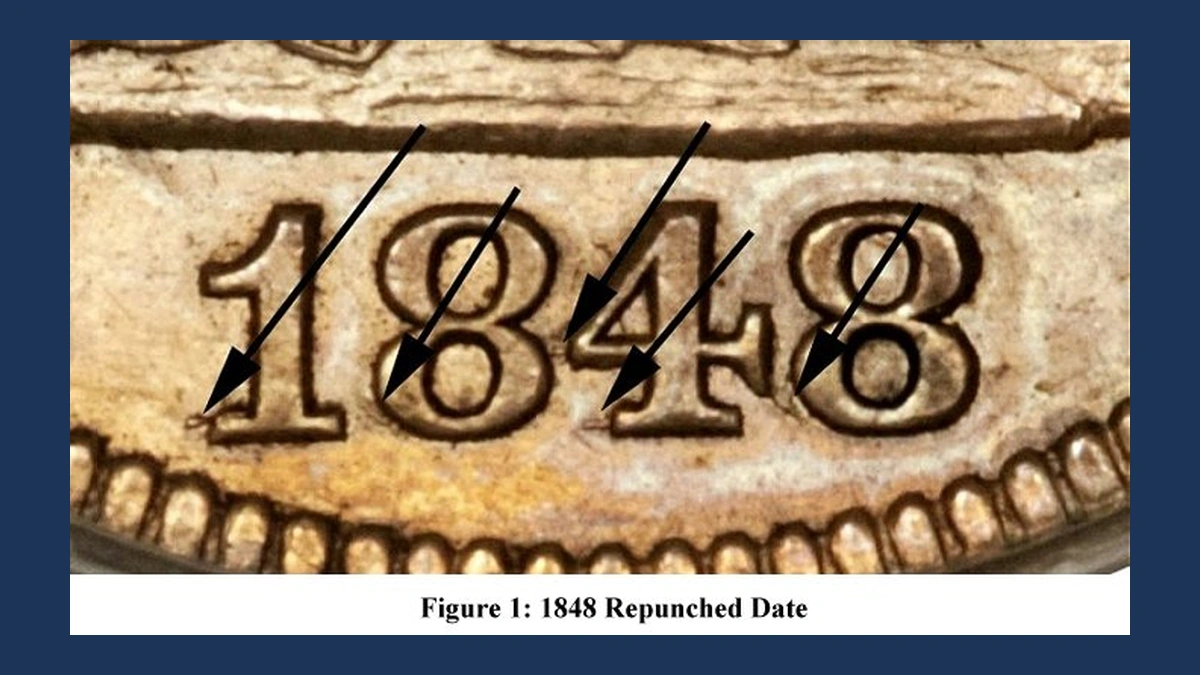
The numerals of 1848 can retain overlapping strokes from two or three applications of the date punch. This happened while a die, the steel tool used to stamp coins, was being prepared.
The finished tool passed those shapes to the coins it struck. It did not require each coin to be struck two or three times.
The doubled-date front pairs with a back showing a small central shield defect, often called a compass point. The tripled-date front pairs with a back lacking that feature.
These are two forms of the same date-punch mechanism.
Estimated Value
Estimated whole-coin values span $100 to $25,000, from worn examples to exceptional unworn pieces. Since both known circulation varieties have repeated dates, repetition alone does not guarantee a large premium.
A PCGS AU50 example sold for $1,050 in January 2023. AU50 means light wear, with much detail remaining.
Compare coins with similar surfaces and wear before comparing the number of date impressions. A sharp tripled date on a cleaned coin need not outrank an attractive doubled-date example.
How to Identify
Check the eagle’s shield as well as the date. The central defect helps separate the doubled-date pairing from the tripled-date pairing described in the 1848 variety study.
Now enlarge the entire date under a 10× magnifier. Trace the extra numeral outlines and compare them with the matching front photograph, keeping their relationship to the rim visible.
Do not count every glint of light as another punch impression. Changing the light direction helps distinguish a raised shape from a scratch, stain, or reflection.
On a worn coin, some strokes can merge or disappear. Use the surviving date detail and the correct back together, rather than rejecting it because all the original outlines are no longer equally sharp.
Conclusion
The interesting question for an 1848 quarter is which repeated-date pairing it shows. The eagle’s shield provides a useful second check after you examine the numerals.
Estimated whole-coin values of $100 to $25,000 depend heavily on preservation. The doubled or tripled appearance is part of the known circulation varieties, so count visible strokes for identification rather than multiplying the price.
Keep the front and back of the same coin together in every comparison.