1837 Quarter Error List with Pictures

A fine trace below Liberty’s ear and a line cutting across the portrait tell different stories about the tools that struck an 1837 quarter. Both can survive ordinary circulation wear.
One lightly worn example combining a back crack and an ear-area clash sold for $1,380 in January 2006. That is one whole-coin price, not two error prices added together.
The 1837 quarter errors below have estimated values of $75 to $3,000. Compare the small transferred design first, then follow the much longer crack paths.
1837 Capped Bust Quarter Clash Traces Below Liberty’s Ear
Small unintended traces beneath Liberty’s ear were described on an 1837 Capped Bust quarter. They differ from the normal hair detail around the ear.
The marks come from clashing dies, the steel tools that stamp the two faces. If they meet without a blank between them, one tool can mark the other.
The next coins can receive faint parts of the opposite design. They are not caused by another finished coin rubbing against the portrait.
The cataloged NGC AU58 example also has a back crack. AU58 means only slight wear, leaving much original detail available for comparison.
Estimated Value
The NGC AU58 quarter brought $1,380 in January 2006. That result includes its condition, variety, clash, and back crack as one coin.
For worn through lightly worn examples with clear genuine clash traces, estimate $75 to $2,500. Smooth surfaces make small transferred details easier to appreciate.
A trace lost among scratches offers less appeal than one visible against an undisturbed background. The faint mark alone should not be assigned the entire auction price as an added premium.
How to Identify
Find Liberty’s ear in a complete portrait image, then examine the area immediately beneath it. Avoid starting with a tightly cropped line whose position cannot be established.
Compare the suspicious traces with normal hair detail on the same design. A genuine clash should add an unintended shape rather than merely strengthen an existing curl.
Use side lighting to check whether the trace was struck into the surface or cut across it later. An isolated scratch with displaced edges cannot establish clashing.
The catalog gives the location without identifying a specific transferred eagle feature. Match the actual example or seek a specialist comparison before naming that shape.
Keep the ear visible beside the mark in the photograph.
1837 Capped Bust Quarter Cracks Across Liberty and the Back Lettering
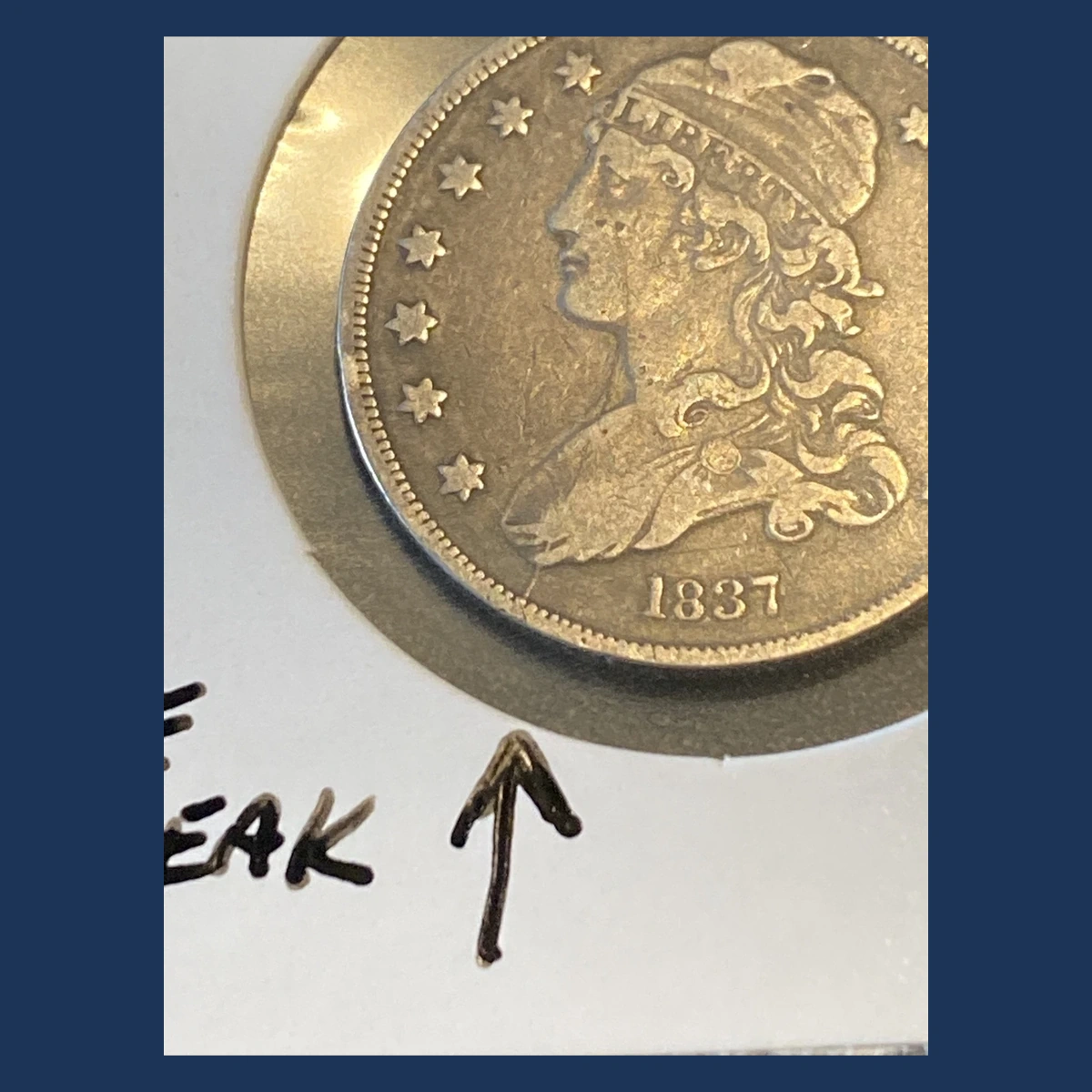
One 1837 tool left a raised line crossing much of Liberty’s portrait. It begins near the rim at 7 o’clock and continues upward toward the rim above the cap.
Along the way, the reported path crosses the bust and throat, then reaches E above the portrait. Back cracks also affect the lettering and nearby border.
These ridges form when metal enters splits in the dies during striking. They are not open breaks through the coin itself.
Different coins show different stages of this damage. A shorter or weaker line must be compared with the corresponding stage, rather than assumed identical.
Estimated Value
A PCGS AU58 example sold in September 2017 for $950 plus a $166.25 buyer’s fee, totaling $1,116.25. Its long front crack was specifically described.
Estimate $100 to $3,000 for circulated through lightly worn examples with clear crack patterns. The upper end favors sharp, attractive coins rather than simply the longest line.
Scratches, cleaning, and rough surfaces can reduce value. When a crack accompanies a clash, the final comparison remains the price of the complete coin.
How to Identify
Follow the front ridge from the lower-left rim near 7 o’clock toward the portrait. Compare each crossing of the bust, throat, and E instead of judging only the line’s total length.
At the top, check its continuation toward the border above the cap. The reported route gives several fixed points that a random scratch is unlikely to reproduce.
Turn the light and inspect for a raised ridge rather than an incised cut with pushed-up edges. Do not run a fingernail across it.
The back deserves its own photograph of the affected lettering and border. A back crack does not automatically prove that the front reached the same late stage as the photographed long-crack example.
Conclusion
Under-ear clash traces and long raised cracks reveal different kinds of contact or damage involving the stamping tools. A complete front-and-back comparison helps keep them separate from scratches.
Estimated whole-coin values run from $75 to $3,000, depending on preservation and the strength of the features. The actual examples show that an attractive early quarter can carry more than one feature.
Judge that combined coin once, with all its surfaces and details in view.