1827 Quarter Error List with Pictures

The final 7 hides part of an older date, but it cannot tell you when every 1827 quarter was made. Original coins and later restrikes share that altered front design.
An exceptional original sold for $705,000 in May 2015. This was the price of the entire rarity, not a separate payment for its overdate.
The 1827 quarter errors below carry estimated whole-coin ranges of $50,000 to $750,000. Compare the date, the shape of 2 in 25 C, and the back before judging a candidate.
1. 1827 Capped Bust Quarter 1827/3/2 Overdate
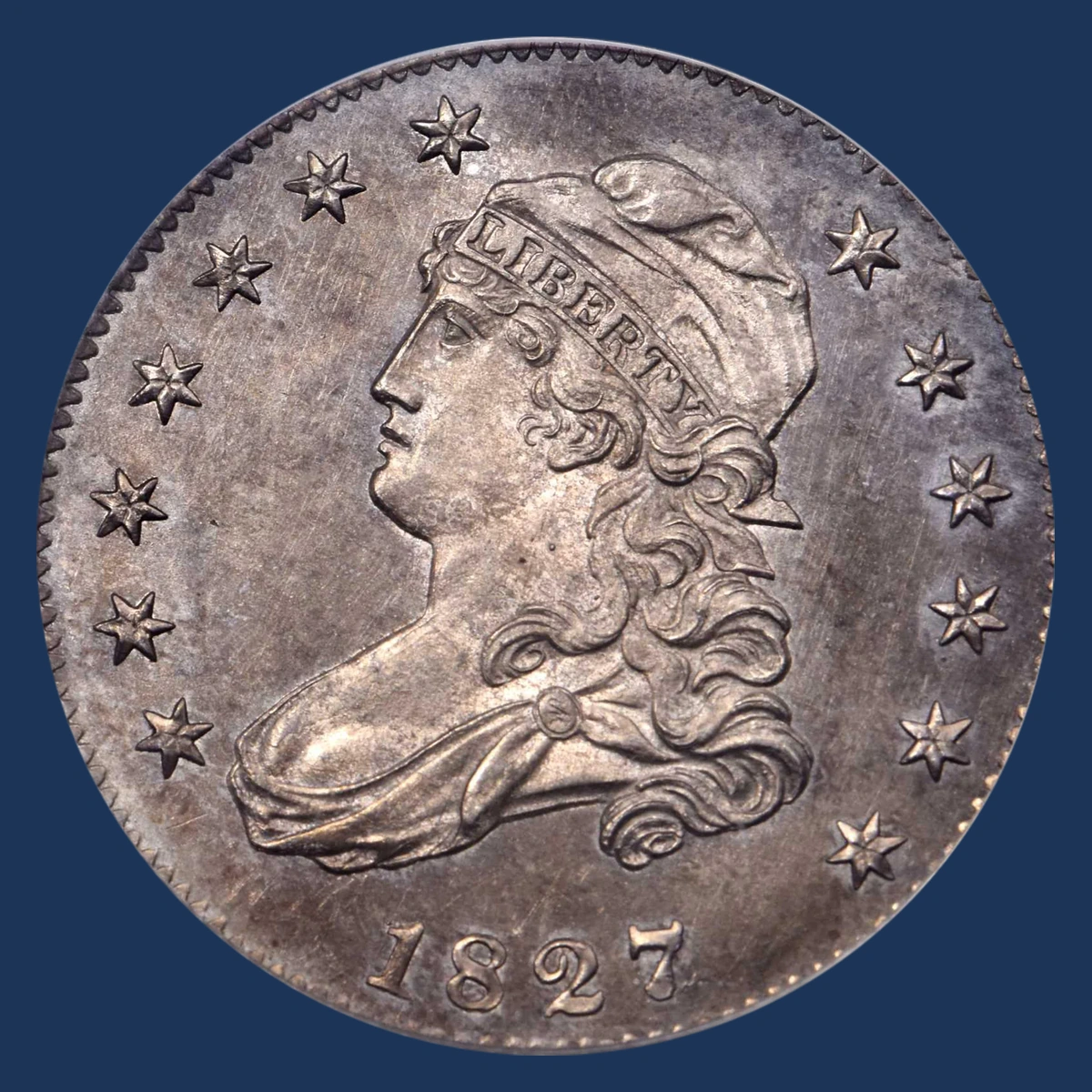
Curves beneath the final 7 reveal that the date was changed on the stamping tool. Collectors call this an overdate.
The die, a steel tool used to stamp coins, began with an 1822 date. A 3 replaced the final 2, and a 7 later replaced that 3.
The other digits were punched again too. This sequence does not mean that each finished quarter was struck three times.
Both originals and later restrikes carry the altered date. Restrikes are coins made later using an earlier date, so the year alone cannot establish their version.
Estimated Value
Allow an estimated $50,000 to $750,000 across the silver versions. Within that span, later restrikes generally fit a $50,000–$250,000 estimate, while originals warrant $100,000–$750,000.
The Pogue original brought $705,000 in May 2015. Another original sold for $588,000 in August 2021.
Those prices reflect exceptional rarities, their preservation, and ownership histories. A worn or impaired example should be compared with its own version, rather than priced solely from the visible older digit.
How to Identify
Turn to 25 C on the back before studying the date. Originals have a curled base on the 2, while the other main back design has a square base.
That square-base group includes both unusual early experimental pieces and later restrikes. It should not be treated as one uniform production batch.
Now enlarge the final 7 and compare the underlying curves with an authenticated 1827/3/2 quarter. Include the entire date in the photograph, because the neighboring digits also show work on the tool.
A specialist should compare the letter positions, surfaces, and edge with known examples. Do not accept a newly cut or added date merely because one small curve resembles a 3.
2. 1827 Capped Bust Quarter Off-Center Strike Candidate
A true off-center strike would leave part of the design beyond the silver disc. An unstruck area would remain beside the incomplete portrait and eagle.
This happens when a blank lies partly outside the stamping tools. It differs from a front tool shifted over an otherwise centered coin.
For 1827, the off-center claim needs an authenticated example before it becomes an established variety. The known experimental coins struck over older quarters are a separate matter.
An uneven rim or traces of an older design therefore cannot, by themselves, establish an off-center 1827 quarter.
Estimated Value
A provisional whole-coin estimate of $100,000 to $750,000 applies only if a genuine 1827-dated off-center piece is established. It reflects this rare date’s market, not a recorded off-center sale.
The $588,000 original sold in August 2021 provides a comparison for the underlying rarity. It was not cataloged as off center.
The version, readable date, preservation, and size of the displacement would all affect value. A damaged or altered date does not qualify for this estimate.
How to Identify
Keep a suspected rarity in its holder and photograph both faces. A slab should not be opened simply to test a mint-error claim.
Find where the portrait ends at the metal’s boundary, then compare the eagle side against that same area. Genuine displacement should explain the incomplete designs and the unstruck space together.
Check for grinding, erased details, or an edge cut into a finished coin. An uneven border alone is insufficient.
For a loose coin, record weight and diameter without cleaning it; the usual silver standard is 6.74 grams and about 27.5 millimeters. Known experimental pieces made from reduced older coins require their own specialist comparison.
Keep the visible 1827 date included in every full-front photograph.
3. 1827 Capped Bust Quarter Raised Crack across the Back Lettering
A raised line runs across the upper back of original 1827 quarters. It links several letters instead of appearing as an isolated mark in the open surface.
The route passes through ED in UNITED, across the area above the scroll, and beneath F in OF. It continues through the base of A and across ME in AMERICA.
Silver entered a split in the stamping tool, copying that split as a ridge on the coin. This feature belongs to the original, curled-base-2 back.
Later damage on coins dated 1828 should not be assigned to this earlier appearance.
Estimated Value
Original quarters displaying this crack have an estimated whole-coin range of $100,000 to $750,000. The crack helps identify the version; it is not an extra premium added to the overdate price.
A PCGS Proof 65 Cameo original sold for $588,000 in August 2021. Proof indicates special production, while Cameo describes contrast between the design and background.
Its clear crack, attractive surfaces, and important ownership history belonged to one complete coin. Cleaning or substantial wear changes that comparison.
How to Identify
Find UNITED and trace the line through its final two letters, ED. Follow it rightward above the scroll, the ribbon carrying the motto.
Below F in OF, check that the same route continues toward AMERICA. At A it crosses the base, then passes across ME.
These fixed points matter more than the total length visible in one photograph. Lighting can hide a fine section while making another appear unusually heavy.
Compare the raised route with an authenticated original and check the curled base of 2 in 25 C. A scratch cut into the finished silver will not reproduce the same connected ridge through those letter positions.
Do not require the additional broken-tool patch that developed when this back design was used for 1828 coins.
Conclusion
An altered date and a raised back crack can belong to the same rare 1827 quarter. Their values should never be added together.
Estimated whole-coin ranges extend from $50,000 to $750,000, with the version and condition carrying much of that value. A claimed off-center example needs separate authentication before those estimates apply.
Begin with the final date digit and the 2 in 25 C, then compare the complete coin.