1823 Quarter Error List with Pictures

Missing arrow details can be part of an 1823 quarter’s original design. A specially made collector coin, called a Proof, showed those omissions and sold for $396,562.50 in June 2014.
The 1823 quarter error list begins with a rare date: every genuine example has 3 punched over 2. Whole-coin estimates below range from $10,000–$400,000, with condition and Proof status making enormous differences.
Follow the checks below to distinguish original tool features from damage and the separately reported striking errors.
1. 1823 Capped Bust Quarter Reported Die Crack
A raised line can form when silver enters a crack in the stamping tool. The coin copies the narrow opening as a ridge, rather than receiving a scratch afterward.
The Most Valuable Quarters year list includes die cracks for 1823, but gives no particular route or illustrated specimen. A claimed example therefore needs its own close inspection.
The date alone does not identify this feature. A line through the portrait, letters, or smooth background must stand above the surrounding silver and behave like one continuous tool mark.
Estimated Value
For a genuine circulated 1823/2 quarter with a confirmed crack, use $10,000–$100,000 as a broad whole-coin estimate. The rare date and remaining detail drive most of that range.
A small ridge cannot be priced as though it were a common, inexpensive quarter with a modest error added. Severe cleaning or damage may outweigh the attraction of the crack.
This range is conditional on a real coin and Mint-made ridge, not a recorded crack sale.
How to Identify
First make sure the line is raised. Move a small lamp from one side to the other while examining the area through a magnifier.
A scratch normally leaves a channel, sometimes with a raised lip along its edge. Follow both sides of the mark to avoid mistaking that lip for a tool crack.
Photograph where the line meets letters or portrait details, since a genuine ridge should fit the stamped surface. Do not clean the area to expose it.
The year list provides no fixed route to match. A continuous raised line across the original surface is the useful starting evidence, followed by expert examination of the coin and its date.
2. 1823 Capped Bust Quarter Reported Off-Center Strike
An off-center quarter would have part of its design cut off while another part of the blank remained unstruck. This happens when the blank sits outside its intended position between the stamping tools.
The same year guide reports off-center strikes, without a photographed 1823 example or a stated percentage. That report does not establish a particular direction or amount of missing design.
A slightly uneven border is not enough. Early quarters can look imperfectly centered while still retaining the whole design, and later trimming can also remove portions of the rim.
Estimated Value
If a circulated 1823/2 quarter is confirmed with a genuine off-center strike, estimate $15,000–$150,000 for the whole coin. A readable date, clear missing design, and an undamaged blank area would be central to its appeal.
This is a conditional estimate for a reported type, not an auction result for an identified specimen. A small shift with substantial wear would be judged differently from a dramatic error that retains a clear overdate.
How to Identify
Lay photographs of the two faces side by side before concentrating on the rim. Mark the portion where the design ends and the portion where plain, unstruck metal remains.
If only one face is shifted, consider a misaligned tool rather than an off-center blank.
Look around the edge with a magnifier for filing or cutting that could have removed a normal border. A scale and calipers help compare the intact coin with the normal 6.74 grams and roughly 27.5 millimeters.
Wear and missing metal can change those measurements, so numbers alone cannot establish the error.
The decisive visible combination is clipped-off design beside genuine unstruck metal, with enough date remaining to identify 1823/2.
3. 1823 Capped Bust Quarter 1823 over 1822 Date
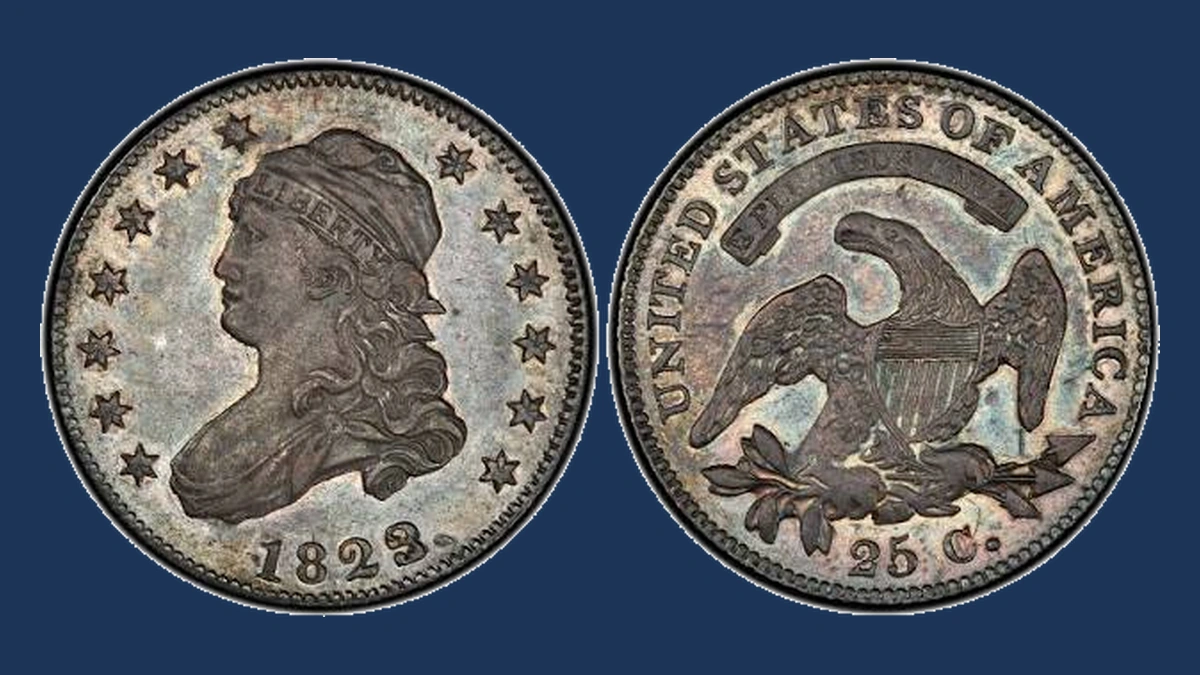
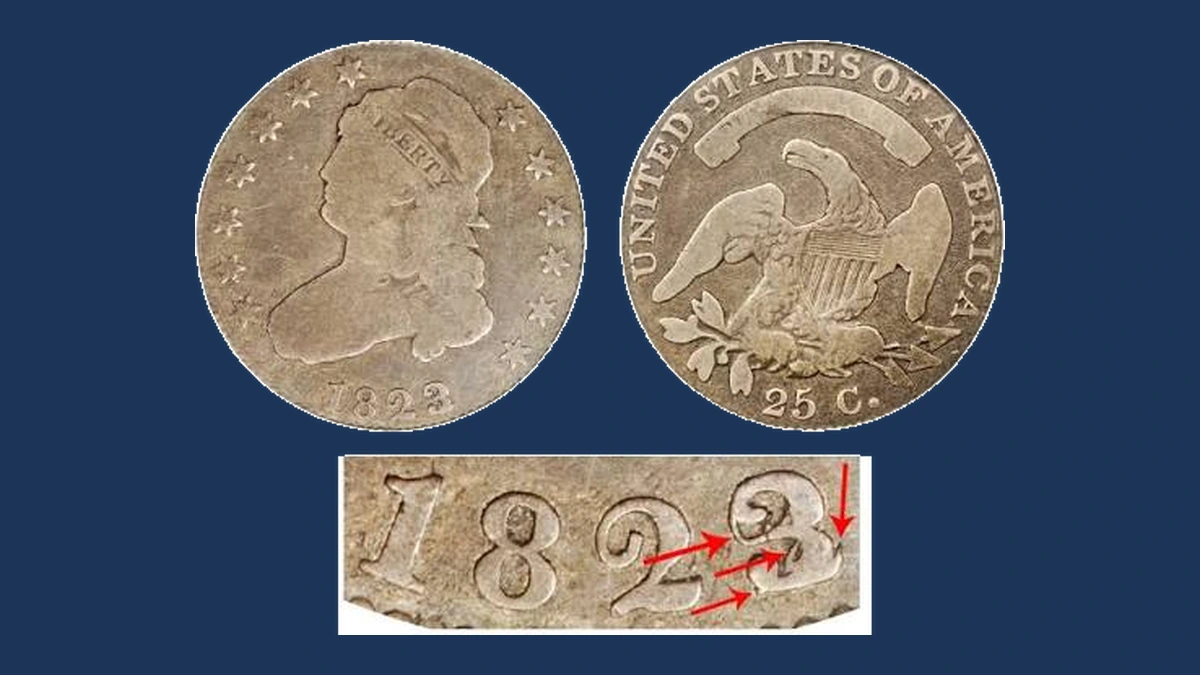
Every known genuine 1823 quarter has an older 2 beneath the last 3 in its date. The worker changed a tool dated 1822 before it was used to stamp these quarters.
This creates an overdate: parts of two numerals share the same position. It does not mean that an 1822 finished coin was struck again in 1823.
Both ordinary coins and the celebrated Proof show the feature. A Proof is specially made for collectors, but the overdate alone cannot distinguish that finish from a coin intended for circulation.
Estimated Value
Heritage sold the PCGS PR64 Proof for $396,562.50 in June 2014. The catalog described it as the only known Proof at that time.
Whole-coin estimates run from $10,000–$400,000, spanning heavily worn examples through that exceptional collector coin. An ordinary lightly worn AU58 example brought $246,750 in May 2015, according to PCGS.
The older 2 identifies the issue; condition and finish explain much of the price difference.
How to Identify
Enlarge the final 3 without covering the other date digits. Compare the surviving 2 underneath with the illustrated PCGS overdate example.
Check that the extra strokes fit that older numeral, not random scratches or cuts around the date. An altered date can look convincing in a small, low-resolution image.
Then compare the portrait, stars, and eagle with a genuine 1823/2 quarter. The date should belong naturally to the same worn surface as the rest of the coin.
Bright surfaces do not establish Proof status.
For the overdate itself, a clear match of the 2 beneath 3 is the essential first check before professional authentication.
4. 1823 Capped Bust Quarter Incomplete Arrow and Claw Design
Parts of the arrows and a toe are missing even on a sharply struck 1823/2 quarter. Heritage identifies incomplete arrowheads and shafts, along with the central toe of the claw on the viewer’s right.
The missing detail came from the master design tool used to make working dies. Damage to that original tool left the new stamping tool incomplete.
Harder striking could not restore a shape that was absent from the tool. The reverse was repaired before later use, so later quarters made with it can show details missing in 1823.
Estimated Value
This feature belongs to the same rare issue as the overdate, giving a whole-coin estimate of $10,000–$400,000 across worn examples through the exceptional Proof. It is not a second price to add to the date variety.
The $396,562.50 Proof discussed above also shows the incomplete reverse design. Its value reflects the entire coin and special finish.
On worn examples, visible arrow remnants and sound surfaces make the original omissions easier to separate from later wear.
How to Identify
Compare the eagle’s arrows with the surrounding feathers and lettering. If those nearby details are sharp but the same arrow portions are absent, simple circulation wear is a poor explanation.
Use magnification to inspect the arrowheads and shafts separately. Then look for the missing central toe on the claw at the viewer’s right, keeping the eagle upright.
The pattern matters more than general weakness. Photograph these areas under angled light and compare them with the sharply struck 1823/2 Proof, rather than a later repaired reverse.
Matching gaps in the arrows and right-hand claw, surrounded by surviving detail, provide the clearest check for this incomplete design.
Conclusion
The $10,000–$400,000 estimates reflect the rarity of the 1823 quarter itself, as well as its condition and finish. The altered date and incomplete arrows belong to the same basic tool pair.
Treat a claimed crack or off-center strike as a separate question requiring visible evidence. For any candidate, a readable overdate and matching eagle details are more useful than an impressive label alone.