1818 Quarter Error List with Pictures

Extra lines on an 1818 quarter may come from a cracked tool, contact between tools, or an entire second strike. Their shapes tell different stories.
The 1818 quarter errors below range from small surface flaws to a flipped, double-struck coin. Estimated whole-coin values run from $80 to $185,000.
At the high end, an exceptionally preserved 1818/5 overdate sold for $182,125 in August 2014. Work through the visible marks below before comparing a worn pocket piece with that exceptional coin.
1. 1818 Capped Bust Quarter Raised Lines across Stars and Arrows
A raised line can join stars above Liberty’s cap and continue toward the right edge. On later examples, another line runs inward from the lower-right back edge through the arrows.
These are die cracks: splits in the steel tools that stamp coins. Silver enters each split during the strike and leaves a raised ridge.
The lines grow as the tools deteriorate. Different coins therefore show different lengths and strengths.
A shorter crack does not mean that part of the coin has been erased. It may show the tool before the split became longer or deeper.
Estimated Value
For circulated through modest unworn examples with these cracks, estimate $80 to $5,000. A strong line crossing several recognizable features usually draws more attention than a barely visible thread.
The grade and general attractiveness still account for much of the whole-coin value. Heavy cleaning can reduce appeal even when the crack is bold.
If the same coin also shows a clash or repeated strike, compare that combined example. The longest crack alone does not justify adding the upper estimate again.
How to Identify
Count the front stars from the lower left around Liberty to locate stars 8, 9, and 10 above the right side. Compare the ridge through these stars and the space above the cap.
Check whether a branch reaches the right rim. Different stages may show that connection weakly or strongly.
On the back, follow the lower-right line through the lowest arrowhead and across the upper shafts toward the eagle. Do not mistake an ordinary arrow shaft for an added ridge.
Side lighting should reveal a raised line rather than a cut through finished detail. Photograph the route across several fixed points; that pattern is more persuasive than one enlarged, isolated segment.
2. 1818 Capped Bust Quarter Repeated Outlines beneath the Motto Ribbon
Faint outlines can repeat below the ribbon above the eagle. The ribbon carries E PLURIBUS UNUM, and the unwanted marks sit beneath it.
The tools sometimes met without a blank between them, transferring parts of one design to the opposite tool. Later coins copied those traces together with their intended designs.
Repeated contact could leave two or three sets of marks. That does not mean the coin itself received two or three strikes.
The 1818 records describe this repeated clashing on particular tool combinations. Normal feather lines and scratches need to be separated from those transferred shapes.
Estimated Value
Estimate $100 to $5,000 for worn through modest unworn examples with recognizable clash marks. Multiple clear impressions may be more interesting than a single faint trace.
Their appeal depends on visibility against the surrounding surface. Deep scratches or distracting corrosion can overwhelm a small transferred outline.
This is a whole-coin estimate for the described condition range. A coin with a crack and a clash should receive one overall assessment, rather than separate prices multiplied by the number of visible traces.
How to Identify
Cover the surrounding lettering in a photograph and concentrate on the space just beneath the motto ribbon. Compare it with the same area on a normal 1818 back.
Identify the ordinary feather and ribbon lines before marking any extra shapes on the photograph. Then compare those shapes with parts of Liberty’s portrait at the same image size.
Two or three traces should make sense as repeated contact between the tools, not simply as unrelated scratches. If substantial portions of the border or entire design have moved, examine the coin for another strike instead.
You can annotate the photograph, but do not trace or rub the lines on the coin itself.
3. 1818 Capped Bust Quarter Small Missing Section near the Bottom Edge
A small piece can be missing near the bottom edge of an 1818 quarter. The early-quarter reference records a mint clip close to 6 o’clock on one example.
A clip begins with an incomplete blank, the metal disc used to make a coin. The tools then strike the design onto the remaining silver.
That differs from someone cutting a piece out of a finished quarter. The nearby design and the missing section’s surface help distinguish the two.
The old description gives a location, but it does not establish the same notch shape for every 1818 candidate.
Estimated Value
A genuine small clip on an 1818 quarter has an estimated whole-coin range of $150 to $7,500. The lower end fits heavily worn examples, while attractive, sharper coins can command much more.
A notch must be convincing as an original blank defect. Its size alone is not enough, since later cutting also removes silver.
Readable date detail and intact surfaces make comparison easier. A clip beside heavy damage is less desirable than a cleanly preserved original missing section.
How to Identify
For a loose coin, use a scale to record its weight before inspecting the notch. The original standard was 6.74 grams, although wear also removes silver.
Now examine the bottom edge around 6 o’clock. Look closely at how the rim and nearby design approach the missing section.
Weakly formed detail beside an original gap differs from complete letters or border teeth cut away afterward. Check the notch for file marks, fresh cuts, or squeezed metal.
The rim opposite the gap may also be weak, but that clue is not equally visible on every genuine clip. Combine it with the notch surface and adjacent design rather than accepting a low weight as proof.
4. 1818 Capped Bust Quarter Narrow Metal Separation above the Branch
A narrow separation appears above the branch on one documented 1818/5 quarter. A weakness within the silver alloy allowed part of the metal to separate.
This is called lamination. It can leave an attached sliver or an irregular shallow opening, depending on how the metal separates.
The example with the branch-area flaw was graded PCGS MS64, meaning unworn with some marks. A separate worn 1818 coin was also listed with a lamination by ANACS.
The location on one coin should not be copied onto the other. Each separation has its own shape and position.
Estimated Value
The PCGS MS64 overdate with the narrow lamination sold for $9,000 in February 2022. Its price included the overdate, attractive color, and unworn preservation.
Allow an estimated $100 to $12,000 for worn through comparable unworn coins with small genuine separations. A large loose flap would need a different comparison.
The flaw does not automatically improve every coin’s value. Buyers may prefer a subtle original separation to a larger damaged or unstable area.
How to Identify
An attached sliver should be left exactly where it sits. Do not lift it to see underneath.
The unworn 1818/5 auction example has a narrow separation just above the branch on the back. Locate the branch in a full-face image before enlarging that small line.
Gentle side lighting can reveal an opening or the edge of a lifted piece. A solid raised ridge without separating metal points toward a different feature, such as a die crack.
Check how struck details meet the opening and whether a tool cut or corrosion has disturbed its edges.
The separately listed worn ANACS coin needs its own comparison. Its lamination cannot be placed above the branch merely because the unworn example has one there.
5. 1818 Capped Bust Quarter Off-Center Flip-over Double Strike
A row of old border teeth across the eagle can reveal that the coin was struck again. The little teeth normally form part of the design around the outside.
An 1818 collector example was described as an off-center flip-over double strike. The coin turned over between blows, bringing the opposite design onto each face.
The owner noted a strike remnant near the front date and a possible date digit near the back rim. The piece also showed separate crack and clash features.
Those faint tool marks should not be confused with the shifted second strike.
Estimated Value
Estimate $1,000 to $20,000 for an authenticated 1818 flip-over double strike. Readable overlapping design and original surfaces determine how persuasive the display is.
The reported collector coin is heavily worn, so a sharper example would need comparison on its own merits. No sale price is attached to that account.
A few indistinct lines cannot support the upper end. Buyers should be able to follow evidence of both strikes, including the reversed placement of front and back designs.
How to Identify
Trace the old border impressions across the eagle in a large back photograph. Their spacing and curve should fit a displaced coin border rather than a row of unrelated dents.
Now bring in the front photograph and locate the reported remnant near the date. To support a flip-over strike, the combined evidence must explain how front and back design elements changed sides.
A possible date digit near the back rim can support that sequence, but it cannot supply a complete invented date. Have a specialist assess the overlapping impressions together, separating them from the coin’s additional clash traces and checking for later squeezing or added marks.
6. 1818 Capped Bust Quarter Five Percent Off-Center Strike
One 1818/5 quarter was certified with a five-percent off-center strike. Its disc sat slightly out of position when the tools struck it.
The misplaced metal changed how the design fitted within the outline. It is a positioning error separate from the older 5 beneath the date’s final 8.
Mint Error News pictured the NGC MS65 example. That grade indicates an unworn coin with strong preservation.
An older catalog also described an 1818 off-center quarter with clash marks and a crack through the eagle’s beak. These accounts should not be assumed to show the same coin.
Estimated Value
For genuine 1818 off-center quarters, estimate $500 to $40,000 across worn through attractive unworn examples. The certified five-percent overdate belongs to the better-preserved end of that comparison.
A 1978 dealer catalog asked $3,200 for an unworn off-center example with clash marks and a beak-area crack. That historical asking price is not an auction result.
Displacement, readable date, preservation, and any overdate all affect the whole-coin price. The percentage alone cannot determine its value.
How to Identify
Compare how the design meets the edge on both faces. A genuine off-center blank should account for missing outer detail and unused metal in corresponding areas.
If only the front appears shifted while the eagle remains normally placed, investigate a misplaced tool instead. Uneven photography can also exaggerate a narrow rim difference.
Use the certified five-percent example for the scale of the shift, without assigning it a direction absent from the written description. Examine the actual photographs for that detail.
The final date digit deserves a separate close-up to establish 1818/5. Keep the date test separate from the edge test: seeing an older 5 does not, by itself, prove an off-center strike.
7. 1818 Capped Bust Quarter 1818 over 5 Date
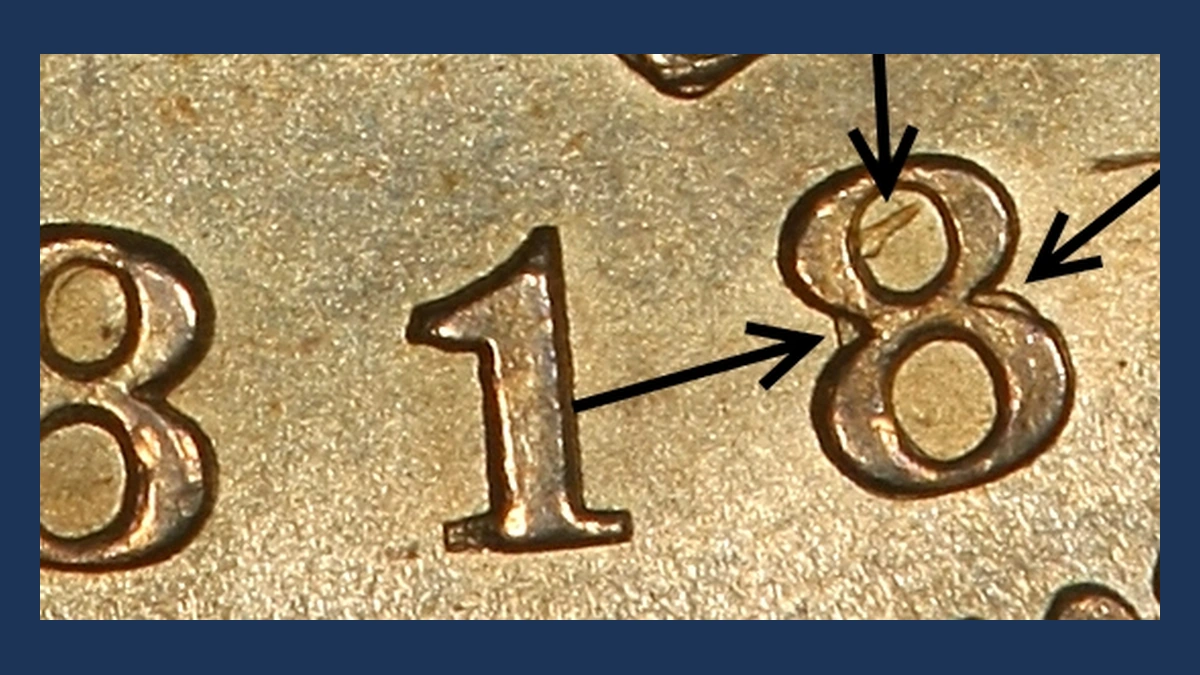
An older 5 can remain visible inside and beside the final 8. The mint changed an unused 1815-dated stamping tool so it could produce coins dated 1818.
Collectors call the result 1818/5. The extra lines were already in the tool before the silver coin was struck.
The older digit appears strongly on some examples and much less clearly on others. Later work on the tool could reduce its traces.
A weak older digit therefore needs comparison with the correct example. It is not evidence that the finished coin received a separate strike dated 1815.
Estimated Value
The recorded overdate sale reached $182,125 in August 2014 for an exceptionally preserved NGC MS67-star coin. MS67 indicates a very high unworn grade.
An estimated $100 to $185,000 spans heavily worn examples through that exceptional quality. Much more ordinary pieces sit far below the record.
For perspective, an NGC VF20 example, showing moderate circulation wear, sold for $1,265 in January 2009. The clear older digit and the coin’s surfaces both matter.
How to Identify
Read the whole date before isolating its final 8. This quarter’s overdate is 1818/5, which should not be confused with the 1818/7 half-dollar variety.
Inspect the space inside the upper part of the final 8 and the extra outline beside it. Compare the visible remnants with an authenticated example at a similar level of wear.
The strength of the older 5 varies with the tool’s condition. A clearer photograph cannot recover a feature that tool maintenance removed before striking.
Check for cuts or added lines that imitate a numeral, especially where the surface differs from the surrounding silver. Keep both loops of the 8 visible together when making the comparison.
Conclusion
Raised cracks, missing metal, and repeated designs require different comparisons. The date can add another feature: an older 5 beneath the final 8.
Estimated whole-coin values span $80 to $185,000, with preservation especially important at the upper end. The same quarter may have an overdate, a peel, or an off-center strike together.
Identify all visible features, then compare that complete coin once instead of adding separate error estimates.