1806 Quarter Error List with Pictures

An old 5 can survive inside the final 6 of an 1806 quarter. One exceptionally preserved overdate brought $188,000 in May 2015.
This 1806 quarter error list also explores backward impressions, shifted designs, and damaged stamping tools. Whole-coin estimates range from $200–$200,000, with the upper end reserved for exceptional coins.
Some striking and blank errors remain possible candidates rather than known examples. Use the feature-by-feature checks below to see what each claim requires.
1. 1806 Draped Bust Quarter Rotated Dies
The eagle may sit at an angle after you turn the portrait upright and flip the coin top to bottom. That difference can come from the two stamping tools being set at the wrong angle.
Heritage described an ANACS Good 4 Browning-4 quarter with about thirty degrees of counterclockwise rotation. Good 4 means heavy wear, but the relationship between its faces can still be checked.
A separate Browning-5 example was described as slightly rotated. That wording does not give it the same thirty-degree angle as the Browning-4 coin.
Estimated Value
Estimate $200–$3,000 for circulated examples with a clear, genuine rotation. Larger angles can add interest, but the amount of wear and the scarcity of the particular tool pairing also matter.
The heavily worn Browning-4 example should be compared with similarly worn quarters, not exceptional unworn overdates. Its catalog description establishes an angle rather than a selling price used here.
A small tilt shown only in separately rotated photographs offers little basis for an added premium.
How to Identify
Use a clear holder to keep the coin’s twelve-to-six line steady. Set Liberty upright, then turn the whole holder from top to bottom without twisting it sideways.
The eagle should finish upright on a normally aligned United States coin. Note whether it leans left or right after the same movement.
A protractor placed beside a straight photograph helps measure the angle. Leave a certified coin sealed and record a continuous flip of its holder instead of opening it.
Repeat the test, starting with Liberty upright each time. A consistent thirty-degree counterclockwise result matches the reported Browning-4 alignment; a different coin needs its own measurement.
2. 1806 Draped Bust Quarter Misaligned Front Die
The portrait side can be noticeably displaced even when the eagle side is centered. Heritage documented exactly that relationship on a PCGS VG8 Browning-5 quarter, with the front shifted about two to three percent.
One stamping tool sat out of position relative to the other. This differs from a blank lying off-center between both tools.
The auction coin also has a reverse crack reaching the second feather of the left wing. That line helps identify the example, but it is not what caused the front design to move.
Estimated Value
The PCGS VG8 example sold for $1,610 at Heritage in January 2005. VG8 indicates substantial wear with major details still visible.
Use $500–$5,000 as a whole-coin estimate for circulated examples with a demonstrable misalignment. This includes the quarter’s condition and variety, not just the percentage of movement.
The sale coin’s crack belongs to the same object, so its value should not be added again under die damage.
How to Identify
Photograph both faces straight on, keeping the entire rim in each image. Compare the distances between the design and the edge on opposite sides of the portrait.
Then repeat that comparison around the eagle. A shifted front with a centered back is the important relationship.
For the documented Browning-5 example, inspect LIBERTY with a magnifier: E sits unusually high above B. The back also has the crack toward the second left-wing feather.
Those details help distinguish the known variety from a loosely cropped photograph of another coin.
Check the actual rim rather than the image border; the uneven spacing must belong to the front design while the reverse remains centered.
3. 1806 Draped Bust Quarter Die Clash Marks
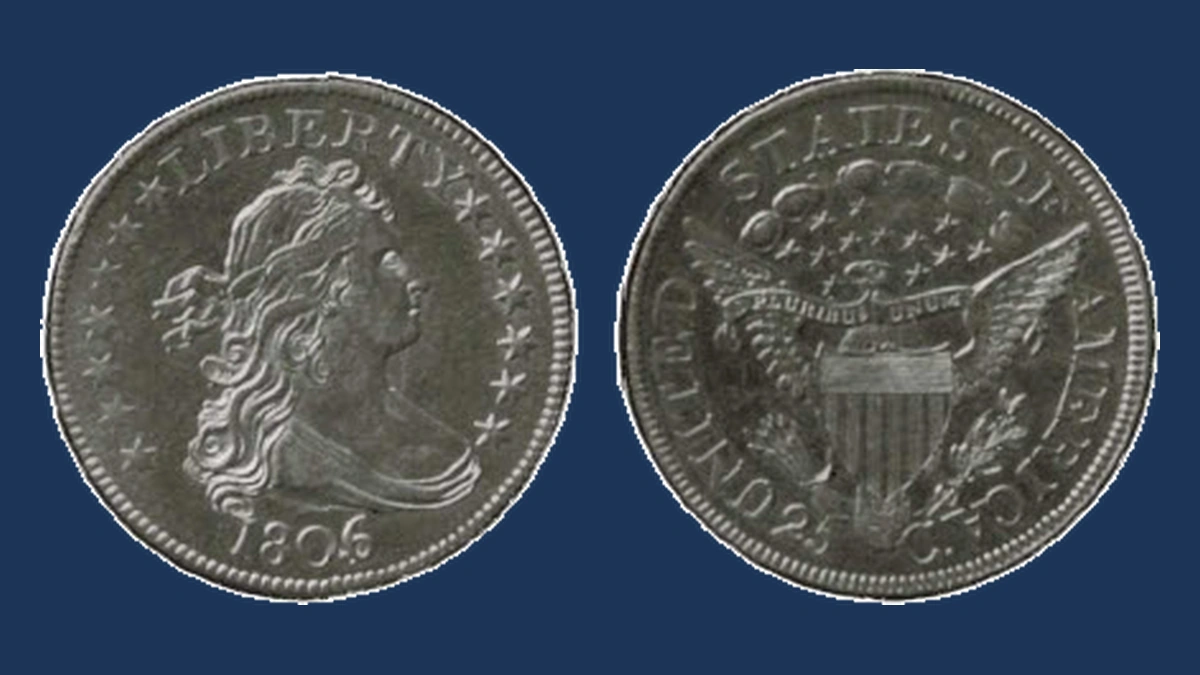
Faint extra shapes around the olive branch can come from the portrait-side tool, rather than the eagle design. Browning describes strong clash marks near the branch, berry, and upper leaves on later 1806/5 Browning-1 quarters.
A clash happens when the stamping tools strike each other without a blank between them. The contact transfers part of one design to the opposing tool, which repeats it on later coins.
The branch and berries themselves are normal. Only additional traces that fit the opposite design support the clash description.
Estimated Value
For worn through attractive lightly worn 1806/5 quarters with recognizable clash marks, estimate $250–$6,000. This is a whole-coin range that includes the overdate and preservation.
Bold, easily explained transferred shapes are more appealing than indistinct marks hidden by heavy wear. Scratches across the same area can make comparison difficult.
The exceptional overdate auction near the end of this article is a condition comparison for that variety, not a confirmed sale of this specific clashed stage.
How to Identify
Find a normal branch outline in a clear 1806/5 reverse photograph before examining the candidate. Ordinary stems and leaf edges are easy to mistake for added lines.
Use soft angled light around the berry and upper leaves, then magnify the spaces beside them.
A faint extra shape should be compared with the portrait-side design that contacted the reverse tool. Try to match the shape itself rather than merely its general direction.
Long cracks and cut scratches need a separate explanation even when they cross the same area.
Keep the normal branch visible in your close-up; recognizable portrait-side traces beyond the expected leaves and berries support the clash identification.
4. 1806 Draped Bust Quarter Possible Broadstrike
An unusually wide quarter may invite a broadstrike claim, but this early issue needs special care. Its original striking method did not control the edge exactly like a modern tightly collared press.
A genuine broadstrike would involve abnormal spreading while the complete design remained on the blank. A merely wide or uneven border is not enough.
The year guide treats this type as hypothetical for 1806 rather than identifying a documented coin. Any candidate must be compared with normal Draped Bust quarters before its size is called an error.
Estimated Value
For a circulated 1806 quarter confirmed as abnormally spread during striking, a working estimate is $1,000–$8,000. That range assumes a readable date, complete design, and an edge free from later rolling or hammering.
A normal wide-border coin belongs in an ordinary date-and-condition comparison. It does not earn the same estimate simply because its diameter looks larger in a photograph.
The proposed range describes a confirmed candidate, rather than a known 1806 broadstrike transaction.
How to Identify
The first comparison should be with authenticated Draped Bust quarters, whose borders can vary. A modern quarter’s tightly controlled outline is a misleading standard for this issue.
Check that the entire design remains on the candidate despite the expanded outline.
For a loose coin, measure several diameters with calipers and weigh it on a scale. About 27.5 millimeters and 6.74 grams are the normal starting figures, with wear and early production variation to consider.
Magnify the edge for flattening or tool marks caused by later rolling and hammering. Use recorded measurements for a sealed coin.
Complete design combined with spreading beyond the normal early-quarter variation needs to be established before calling the wide border a broadstrike.
5. 1806 Draped Bust Quarter Possible Clipped Planchet
A clipped planchet is a blank that lacked part of its outline before the coin was struck. The missing metal should therefore affect how the nearby rim and design formed.
No definite 1806 quarter example is established by the year guide’s discussion. A published examination also rejected a supposed 1806/5 clip as an artificial cut.
That makes the edge especially important. A notch in an old coin may result from sawing, cutting, or another later accident, even when the rest of the quarter and its overdate are genuine.
Estimated Value
An authenticated circulated 1806 quarter on a genuinely clipped blank can be estimated at $1,000–$10,000, depending on the missing section and remaining condition. This is a conditional whole-coin range.
A later cut receives no Mint-error premium from that estimate. Damage may instead reduce the value of the underlying quarter.
Clear metal flow beside the gap and an undamaged surrounding surface would support a stronger comparison than a small, rough notch with an unclear origin.
How to Identify
Look into the gap from the side before deciding whether its outline resembles a familiar clip shape. Parallel saw grooves or pushed-up metal suggest a later cut.
With a magnifier, examine the rim as it approaches the missing section. A gap present during striking can affect the nearby design and may weaken the opposite rim.
Opposite-rim weakness alone is not proof, especially on an unevenly struck early quarter.
A scale can show a shortfall from the normal 6.74 grams, but wear and deliberate cutting also remove weight. Photograph the intact edge as well as the gap for comparison.
Give priority to how the rim formed beside the missing section, rather than the notch’s shape or a low weight alone.
6. 1806 Draped Bust Quarter Possible Off-Center Strike
For a true off-center strike, the blank would sit partly outside the space between the stamping tools. Part of the design would miss the blank, leaving plain metal on the opposite side.
The 1806 year guide does not identify a confirmed example. Its discussion describes a possible error rather than a cataloged coin.
The known Browning-5 quarter with a shifted front is a different case because its reverse is centered. That coin cannot demonstrate a two-sided off-center strike, even though older wording uses off-center to describe its front.
Estimated Value
A confirmed, clearly off-center circulated example with a readable 1806 date could fall around $3,000–$15,000. This estimate assumes an actual misplaced blank, not the smaller single-face misalignment described earlier.
The amount of missing design, the size of the unstruck area, and surface condition would shape the comparison. A date lost at the edge would complicate identification.
No particular percentage or photographed 1806 specimen is assigned this conditional range.
How to Identify
Find the unstruck metal first. It should sit beside a clear boundary where the design stops, rather than simply form a slightly wider border.
Turn the coin over and compare the corresponding displacement on the other face. A centered eagle behind a shifted portrait suggests a misaligned front tool instead.
Inspect the outer edge for clipping or trimming that could imitate missing design. Keep both sides at the same image scale so a cropped photograph cannot exaggerate the shift.
Finally, enlarge the date and compare the surviving digits with a genuine 1806 quarter. A real blank area paired with missing design on both faces is more persuasive than uneven rim spacing.
7. 1806 Draped Bust Quarter Die Cracks and Rim-Connected Breaks
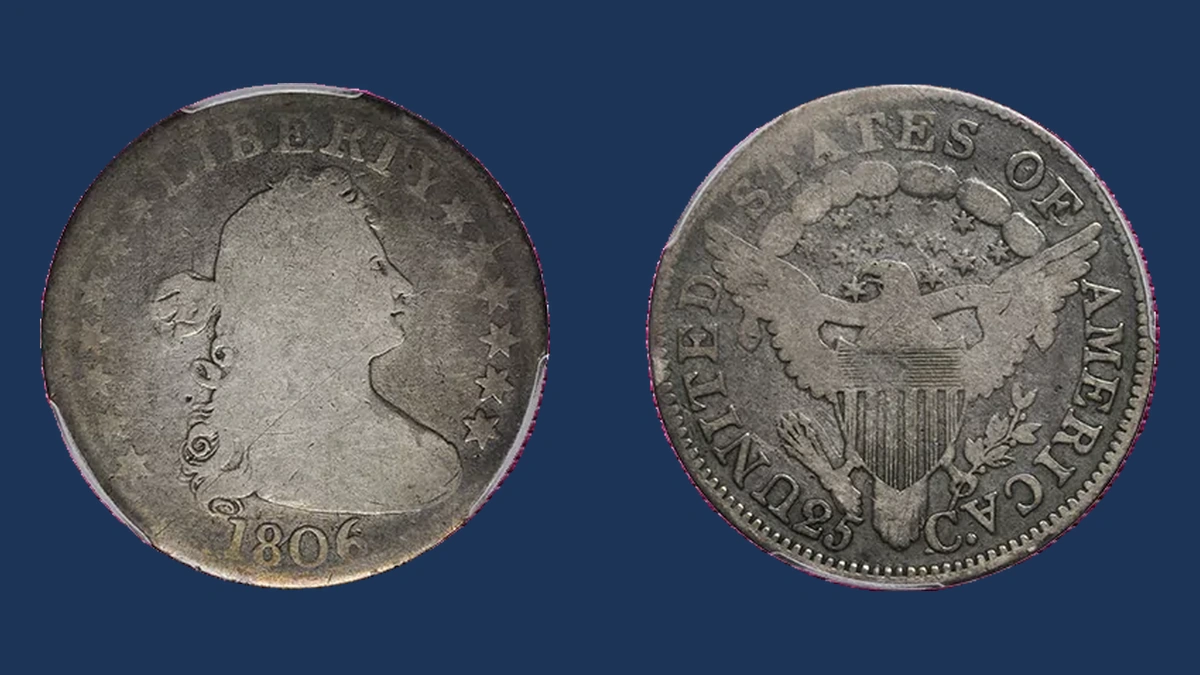
Thin raised ridges and larger rim-connected areas record different degrees of damage to a stamping tool. A full missing piece can leave a smooth lump called a cud; a retained broken piece may preserve some design.
Browning-5 has a reverse crack from ten o’clock toward the second left-wing feather. The John Reich Collectors Society shows Browning-2 breaks above T and ATES, Browning-5 above Y, and Browning-6 above ST.
A year-guide claim also places Browning-8 breaks near 25 and UN. That last report lacks the same illustrated confirmation as the Society’s examples.
Estimated Value
Whole-coin estimates range from $250–$20,000 for circulated examples, from modest cracks to scarce, well-defined larger breaks. The particular tool variety can be an important part of the value.
The $1,610 Browning-5 misaligned coin also has the left-wing crack. That price cannot be counted twice.
A dramatic raised area with recognizable surrounding letters is easier to compare than a battered rim. The upper estimate requires a desirable confirmed break, not merely a faint line.
How to Identify
Use the nearby letters to choose the right comparison. Examine T and ATES on a Browning-2 reverse, Y on a Browning-5 front, or ST on a Browning-6 reverse.
The Society’s illustrated examples show these separate locations. They should not all be expected on one coin.
A magnifier and angled light will reveal whether the affected area is raised and connected to the rim. A retained break can keep letters or other details at a changed level.
For the narrow Browning-5 crack, follow the ridge from ten o’clock to the second left-wing feather. A rim dent pushes metal aside; the illustrated breaks reproduce a damaged tool’s boundary in the struck design.
8. 1806 Draped Bust Quarter Double Strike
Repeated letters and stars can show that a quarter received two separate blows. Browning records an 1806/5 example whose double strike was easiest to see at LIBERTY and some stars.
The coin was described historically as almost unworn. Its description does not establish how far it moved between blows or whether it turned over.
This matters because a second strike can leave overlapping raised designs without creating a backward, sunken impression. A small repeated date digit from a reworked tool has a different origin and should not establish a double strike by itself.
Estimated Value
Estimate $3,000–$30,000 for genuine double-struck examples from circulated through lightly worn condition with a readable overdate. The strength and separation of the repeated design are major considerations.
The historical record confirms the type but does not supply a current sale for that particular coin. A broader second impression would need a different comparison from faint doubling confined to a few letters.
Surface damage and a poorly preserved date can offset the appeal of an unusual strike.
How to Identify
Place an enlarged view of LIBERTY beside a view of the nearby stars. Mark the repeated letters and star points to see whether they describe one consistent second design position.
Examine how the two impressions overlap under a magnifier, since the second blow may flatten parts of the first. Check the back for supporting repeated artwork, but do not infer a flipped-over strike without opposite-side designs.
The historical description does not state that the coin turned over, and its 1806/5 date has a separate cause. Repeated LIBERTY letters and stars moving together offer better evidence of two blows than the old 5 beneath 6 alone.
9. 1806 Draped Bust Quarter Possible Wrong Planchet
A wrong-planchet error would place the quarter design on a blank intended for another coin. The result might have an unexpected size, weight, metal, or incomplete design.
The existing 1806 quarter discussion does not identify a confirmed specimen of this type. An unusual color or low weight alone does not establish one.
A different case sometimes causes confusion: an 1827 quarter struck over an older 1806/5 quarter. That is an 1827 overstrike using an older coin, not evidence that the Mint used the wrong blank to make an 1806 quarter.
Estimated Value
For an authenticated 1806 quarter on a wrong blank, a provisional whole-coin estimate is $10,000–$75,000. The intended blank, readable design, and degree of preservation would be essential to any closer valuation.
This range does not apply to plated, filed, or heavily corroded quarters. Those changes can alter color and weight without creating a Mint error.
An expert-confirmed metal and blank identity would carry far more weight than an unsupported seller’s description.
How to Identify
Record weight and diameter before guessing which denomination supplied the blank. A normal 1806 quarter is about 6.74 grams and 27.5 millimeters, made from roughly 89.24 percent silver.
Use a scale and calipers gently on a loose coin, or obtain recorded measurements for a sealed example. Photograph the edge for plating, filing, and exposed layers.
If the measurements are unusual, a professional nondestructive metal test can help explain why. Do not scratch the surface or apply acid.
Next compare the surviving quarter design with the available space. Consistent metal, size, and design evidence for a different blank is needed; an odd color or a low reading by itself is not enough.
10. 1806 Draped Bust Quarter Mirror Brockage
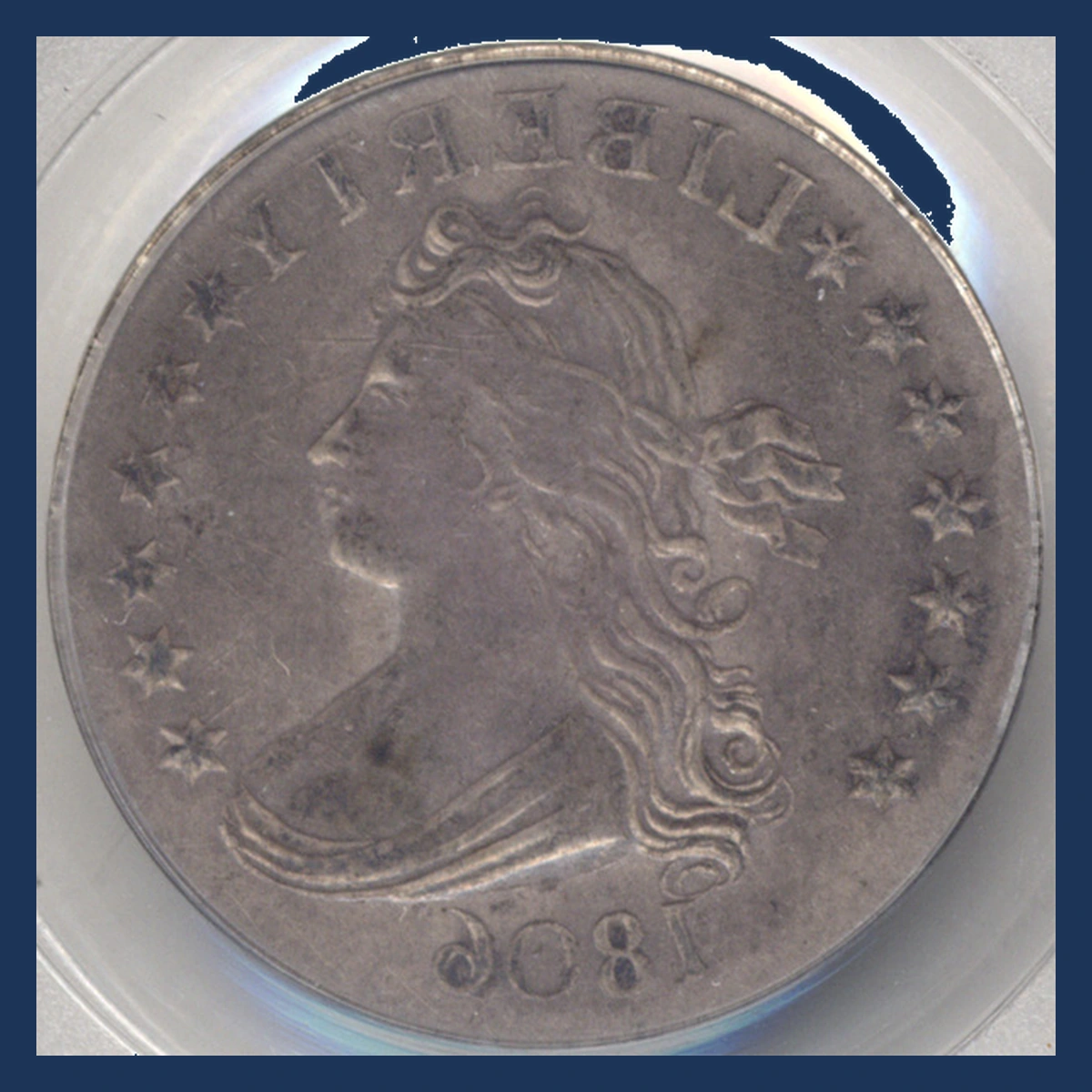
One face of a brockage carries a sunken, backward copy of the other face’s design. A previously struck coin became trapped in the press and impressed its raised design into the next blank.
Dealer Mike Byers handled two PCGS VF30 examples, meaning moderately worn coins. One front brockage was identified from the 1806 Browning-2 reverse tool; the other has the 1806/5 Browning-1 front.
They represent opposite brockage faces, not evidence that the two coins struck each other. The coin lacking a normal dated portrait was identified through its matching reverse tool.
Estimated Value
Estimate $25,000–$100,000 per coin for comparable authenticated early-quarter brockages. This is an editorial range, not the undisclosed amount paid for the dealer’s two examples.
Byers marks the quarters sold and cites a $20,700 Capped Bust dime brockage as a historical comparison. That dime is a different denomination and its price is not a sale of either quarter.
The depth, completeness, and clarity of the backward image all affect appeal.
How to Identify
A backward word is only the beginning of the check: determine whether its letters are sunken. Hold the coin under angled light and use a magnifier to follow the depth of the impression.
Compare the sunken design with the normally raised design on the other face. In the Browning-2 example, the missing normal portrait date makes the reverse tool match essential for assigning the year.
The other example retains the 1806/5 front, giving a different route to identification. A matching mirror image must also fit the coin’s overall strike and edge, which an early-error specialist can examine for signs of a later squeeze.
11. 1806 Draped Bust Quarter 1806 over 1805 Date
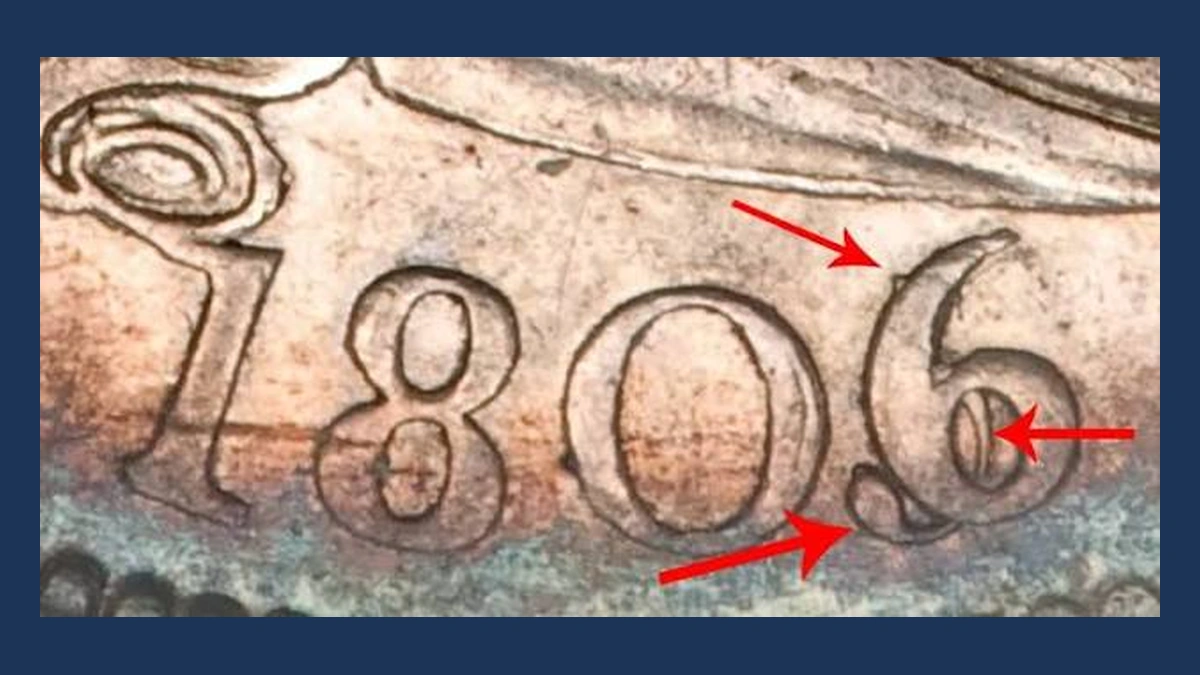
The last digit can contain more than the expected curve of 6. On the 1806/5 Browning-1 variety, remnants of an earlier 5 survive beneath it, including a visible lower loop.
The Mint changed a tool previously used for an 1805 quarter so it could carry the next year’s date. Coins struck from it copied both the new digit and the surviving older strokes.
This is an overdate, not a finished 1805 coin stamped again. Even a worn example can retain the older number clearly enough to identify the variety.
Estimated Value
PCGS records $188,000 in May 2015 for the exceptional MS66 Pogue 1806/5 quarter. MS66 describes a highly preserved coin without circulation wear.
Estimate $250–$200,000 across heavily worn identifiable examples through an outstanding unworn specimen. That span reflects a large condition difference, not the same premium on every coin with a visible 5.
Cleaning, major marks, and weak detail move an example away from the record comparison.
How to Identify
Begin inside and below the final 6, using a magnifier to separate its main curve from the remains of 5. Check the old lower loop against a clear photograph of a genuine overdate.
Keep the entire 1806 date in view while comparing the digits. A close crop of one unusual curve can hide an altered date or the wrong denomination.
Look for natural wear that continues across both old and new strokes. Scratched channels or disturbed metal around the digit deserve closer examination.
The same overdate also appears on other denominations, so confirm 25 C on the eagle side. The matching 5 beneath the quarter’s final 6 is the direct identifying feature.
Conclusion
From a small rotated reverse to a mirror-image impression, the features here call for different checks. The estimated $200–$200,000 range covers ordinary collectible conditions through exceptional pieces, including the rarest high-grade overdates.
Keep the 1806 date, the coin’s two faces, and its actual edge together in your examination. A genuine old quarter can still carry later damage, and an appealing error name cannot replace matching physical evidence.