1805 Quarter Error List with Pictures

A line through the date and a second set of letters beneath the eagle require different explanations. On an 1805 quarter, one can come from a broken tool and the other from another strike.
An example combining cracks and clash traces sold for $1,560 in May 2024. These 1805 quarter errors have estimated whole-coin values of $300 to $25,000 in the condition ranges described below.
Look beyond a single bright line: follow the crack, match the transferred shape, or trace the displaced lettering.
1. 1805 Draped Bust Quarter Extra Traces from Contact between the Dies
Extra design traces can appear on the back of an 1805 quarter, where they interrupt the expected eagle-side detail. Strong examples are recorded in the early-quarter reference.
These marks begin when the dies, the steel tools that stamp coins, meet without a blank between them. Contact can leave one tool carrying part of the other’s design.
Later coins receive that extra shape during an otherwise ordinary strike. The coin does not have to be struck twice.
A May 2024 auction example had clash traces on both faces as well as a crack through the date.
Estimated Value
Estimate $300 to $8,000 for circulated through lightly worn 1805 quarters with recognizable clashes. The upper end favors attractive examples retaining strong original details.
A coin graded NGC VF30 brought $1,560 in May 2024. VF30 indicates moderate wear with substantial detail still visible.
That sale included both clash traces and cracks on one coin. Cleaning, scratches, and the strength of the transferred shapes should all be considered before applying the comparison to another example.
How to Identify
Put photographs of the front and back next to each other at the same size. Identify any extra back-side shape that could correspond to Liberty’s portrait rather than the normal eagle design.
The written account emphasizes the back without naming every transferred feature. Use an authenticated example to establish the exact shape instead of inventing a feather or curl from a stray line.
Inspect the suspicious area under changing light for a scratch cutting across the finished surface. A faint original outline should be assessed together with the surrounding design and other matching traces.
If entire words or border sections have shifted substantially, investigate another strike instead of treating all repeated marks as clashing.
2. 1805 Draped Bust Quarter Raised Cracks through the Portrait, Date, and Back Letters
A raised line can run inward from the left edge toward Liberty’s hair below the lower ribbon. It passes through points of the fourth star on the left.
Other examples show a line leading left from the foot of the date’s 1. Another rises from the bottom edge through 5 toward the bust.
Later back cracks affect the tops of STA and the first T in STATES. These paths record growing splits in the stamping tools.
The coin copied the openings as raised ridges. Different stages of tool damage need not show every line equally clearly.
Estimated Value
The $1,560 May 2024 example has a crack rising through 5 toward Liberty’s clothing, together with clash marks. It is a price for the complete moderately worn coin.
Allow an estimated $300 to $10,000 for circulated through attractive lightly worn examples with these cracks. A clear long route can help display the feature.
The coin’s overall condition remains essential. Marks beside the ridge, harsh cleaning, or corrosion may reduce appeal even when the tool crack is easy to follow.
How to Identify
Test whether the suspected line is raised before following its route. Side lighting can distinguish a ridge from a cut with metal pushed up along the sides.
For the ribbon-area example, count upward from the lowest left star to the fourth. Compare the line through that star toward the hair and left border.
The date provides two other checkpoints: the foot of 1 and the line rising through 5. Match each route separately because the tools developed these cracks at different stages.
Turn to STATES for the back comparison, especially the tops of STA and the first T. Keep scratches next to a real crack separate; the auctioned example had both kinds of marks.
3. 1805 Draped Bust Quarter Repeated Strikes Leaving Displaced Lettering
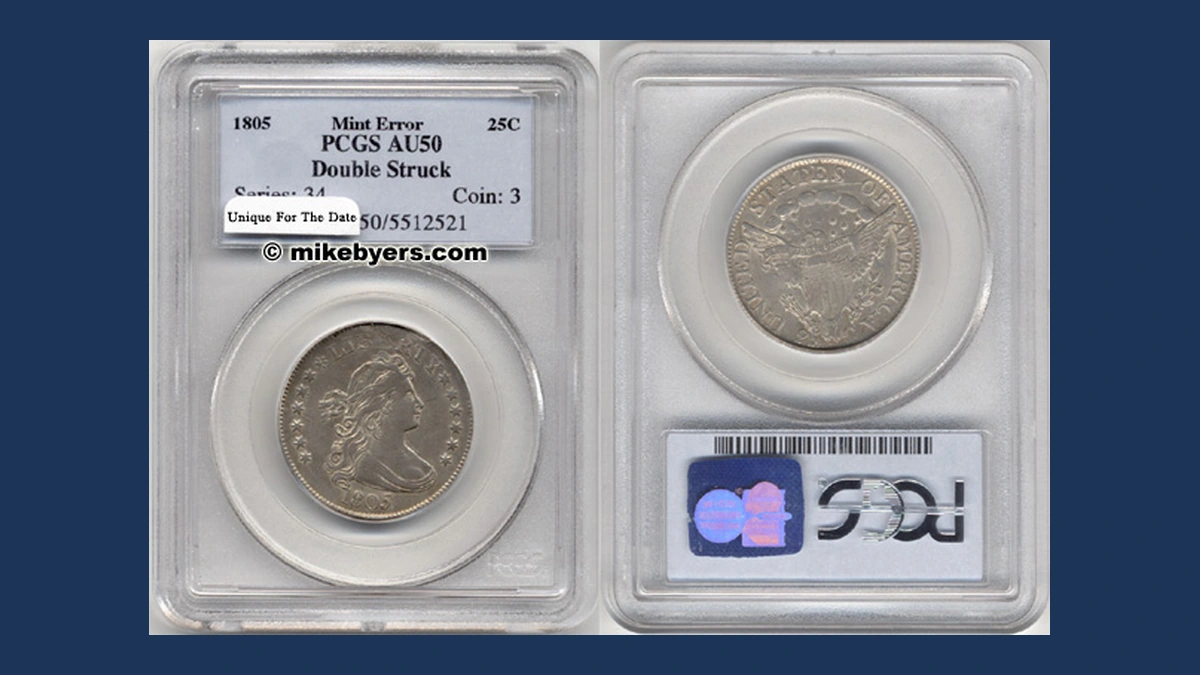
Parts of RICA and the denomination’s C appear below the eagle’s tail on one recorded double-struck quarter. Those remnants belong in different positions on the ordinary design.
The coin received another blow after moving within the press. Enough of an earlier impression survived to show the displacement.
A separate PCGS AU50 double-struck example has also been published. AU50 means light circulation wear, but its label does not establish that it is the same coin described in the older reference.
Fine repeated edges on a letter are a different clue from large remnants of an earlier strike.
Estimated Value
A double-struck example described as VF30 sold for $1,265 in November 1998. That older auction entry does not identify a grading service.
For genuine worn through attractive lightly worn examples, estimate $1,000 to $25,000. Strong displaced letters and a clear explanation of the two impressions can increase interest.
The separately published AU50 specimen should be judged from its own design remnants. Its grade alone does not supply a sale price or prove an exact match.
How to Identify
Find the out-of-place letters beneath the eagle’s tail in a complete back photograph. Compare their forms with RICA in AMERICA and C in the denomination.
Trace how those remnants could fit an earlier displaced impression. Nearby original detail should support the same movement rather than requiring several unrelated explanations.
Be careful with a normal C close to the tail: some 1805 varieties place that letter against the feathers. Close placement alone is not a second strike.
Examine both faces for further overlapping design and for later added impressions. A specialist comparison should connect the surviving letter fragments to the striking sequence without borrowing the exact pattern of the separate AU50 coin.
Conclusion
The reported 1805 features fall into three useful checks: transferred design traces, raised crack routes, and remnants of another strike. A worn coin can still retain enough detail for those comparisons.
Estimated whole-coin values run from $300 to $25,000 for the examples and conditions discussed. Cracks and clash marks can coexist, as the recent auction example shows.
Use one complete-coin comparison rather than adding a separate maximum price for each mark.