1850 Cent Error List with Pictures

The rim is a useful starting point for 1850 Braided Hair cent errors. It may carry a peeling layer, a raised break, a missing section, or metal spread beyond the normal border.
An unworn 1850 cent with a rim lamination sold for $603.75 in September 1997. A different, dramatically off-center coin was later offered at $3,800; that was an asking price.
Estimated whole-coin values below run from $20–$5,000. Read on to compare the edge with both faces and separate these very different features.
1. 1850 Braided Hair Cent Reported Die Clash — Estimated Up to $400
A faint outline that resembles part of the opposite face can suggest a die clash. The steel stamping tools, called dies, hit each other without a metal disc between them.
Later coins may copy the resulting tool marks along with the normal design. The extra shape must be recognizable, rather than simply an unexplained line.
For an 1850 claim, a specific coin needs that comparison. A wreath-like mark on the portrait or a star-like shape on the back is not, by itself, an established pattern for this date.
Estimated Value
For a confirmed clash on an ordinary 1850 large cent, use an estimated $20–$400. Most of the value can still come from the coin’s condition and collectible variety.
A different 1850 striking error, a broadstrike graded VF25, sold for $241.50 in June 2008. That same-year comparison sets a general price scale, but a faint clash does not automatically receive the premium of a coin with a visibly altered outline.
How to Identify
Compare the suspicious curve with the design on the other face before naming the error. A recognizable section of portrait or wreath is more useful than a short isolated line.
Under a 10× magnifier, check whether scratches, corrosion, or pushed-up metal explain the mark. Moving the light can show that a supposed extra outline is only a shadow.
A scale and calipers compare the copper cent with 10.89 grams and 27.5 mm, while the plain edge should be checked for alteration. Photograph the full coin with the close-up, then trace the alleged transferred shape against the opposite design on that same coin.
2. 1850 Braided Hair Cent Rim Clip — Estimated Up to $700
A small part of the outer edge can be missing because the metal disc was incomplete before striking. Collectors call this a clip.
An 1850 N-22 example is recorded with a rim clip. A separate seller has described multiple clips on another coin, which requires each gap to be examined individually.
The shape of the gap and nearby design can show how the metal formed during striking. A cut made afterward removes already finished detail, so a missing section alone does not prove an error from the Mint.
Estimated Value
An estimated $30–$700 covers identifiable clips on worn through attractive 1850 cents. Larger missing sections may draw more interest, provided the remaining surfaces and edge show an original error.
For a later small-cent comparison, a clipped 1939 cent graded MS64 Brown sold for $180 in January 2023. The 1850 large cent has a different ordinary collector value, and a seller’s multiple-clip description should not multiply that comparison price.
How to Identify
Check the whole outline first. If several gaps are present, each needs its own examination rather than one apparently good clip proving them all.
Use a 10× magnifier to inspect the plain edge inside the missing section. Saw marks, repeated tool cuts, or a sharp raised lip can indicate later alteration.
A genuine clip removes some of the normal 10.89 grams. Weigh the coin and use calipers across intact portions to compare its original 27.5 mm diameter.
Look at the struck rim near both ends of the gap and across from it. Softened formation there can support an original clip, especially when the missing section lacks later cutting marks.
3. 1850 Braided Hair Cent Rim Breaks and Raised Cracks — Estimated Up to $1,200
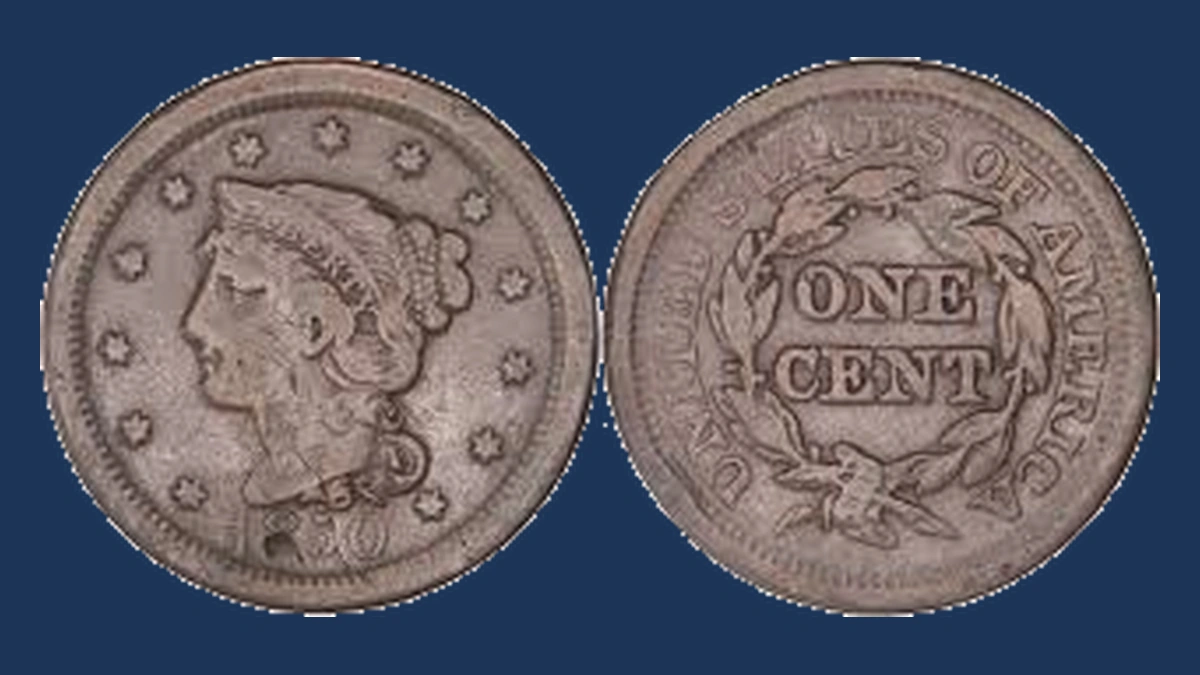
Raised patches can connect the back rim to the letters around it. Recorded 1850 examples include breaks near the E in STATES and between F and A.
A rim-connected patch is called a cud. It forms when a piece of the stamping tool breaks away and coin metal fills the opening.
Another recorded coin has four back-rim breaks. A thin raised crack needs its own shape comparison; it should not be assigned an invented route between those larger patches or treated as a confirmed 1850 pattern without a matching example.
Estimated Value
Estimate $20–$1,200 for collectible coins with these tool failures. Fine cracks usually add little, while clearly matched rim breaks and desirable varieties can attract more.
A later copper-nickel 1864 cent with a retained rim break and broadstrike sold for $646.25 in 2016. That combined-error comparison differs from an 1850 large cent, and four small cuds do not automatically make a coin worth four times a single-cud example.
How to Identify
Begin at the back lettering and locate where a raised patch meets the rim. Compare the E in STATES or the space between F and A with the appropriate recorded coin.
Inspect the boundary under a 10× magnifier. A patch from a broken tool should merge into the original surface, while attached metal may show a separate seam.
For a thin line, tilt the coin to see whether the line rises or cuts downward.
Use a scale and calipers to check roughly 10.89 grams and 27.5 mm, then inspect the plain edge for a folded border.
Follow the original raised metal from the lettering into the rim, without assuming that nearby scratches belong to the same tool break.
4. 1850 Braided Hair Cent Lamination — Estimated Up to $1,500
A layer of copper separates along the rim above the first star on a documented 1850 N-9 cent. This local weakness is called lamination.
The defect began in the metal used for the coin. It does not mean that the entire disc split into two halves.
The auction example retained sharply formed stars and other details despite its small rim flaw. It had previously been graded MS64 Brown by PCGS, while the auction’s copper specialists assessed it as MS61 Brown; both descriptions concerned the same unworn coin.
Estimated Value
$603.75 was paid for the N-9 cent on September 11, 1997. Its sharp unworn detail contributed to that whole-coin price, so the result should not be read as the lamination’s separate value.
Use an estimated $25–$1,500 across circulated through well-preserved examples. The Heritage description provides a specific rim location; larger missing layers can be more visible yet also reduce a coin’s appeal if they obscure important design.
How to Identify
Find the first star at the lower left of the portrait, then examine the rim immediately above it at 10×. Look for an actual separating layer rather than a dark patch or a cut across the surface.
Keep calipers away from any loose copper; measure an intact span against the normal 27.5 mm. If weighing is safe, compare the remaining metal with 10.89 grams, remembering that an attached layer may leave nearly full weight.
View the plain edge and the layer boundary under low side lighting. Follow the separation into the rim above that first star without lifting or scraping the copper to test it.
5. 1850 Braided Hair Cent Broadstrike — Estimated Up to $2,000
Extra metal spreads above the portrait and below the back design on the recorded broadstrike. The surrounding ring, called the collar, did not fully limit the coin’s sideways flow.
The auction described a PCGS VF25 example with that uneven expansion. Its proposed explanation was partial restraint at the bottom of the front but not at the top.
The widened outline is the visible feature to check. A broadstrike retains the intended design, unlike an off-center strike that places part of that design beyond the metal disc.
Estimated Value
An 1850 broadstrike graded PCGS VF25 sold for $241.50 on June 29, 2008. It provides a same-year price comparison for a circulated coin with outward-spread metal.
The estimated range is $150–$2,000, allowing for stronger condition, clearer expansion, and overall collector appeal. Natural surfaces and complete lettering help explain the error, while corrosion, rim damage, or artificial flattening can make an apparently similar coin a poor comparison.
How to Identify
Place the front upright and look above the portrait, then turn to the expanded area below the back design. Those two positions should describe the same part of the metal disc.
Use calipers to compare several widths with the normal 27.5 mm diameter. A scale checks whether the coin remains near its standard 10.89 grams.
Inspect the plain edge and broad border at 10× for original spreading rather than hammered flattening or filing.
The catalog’s collar explanation describes how the shape may have formed; the coin itself must provide the evidence. Follow the complete outer design into the expanded border to distinguish this broadstrike from an off-center strike.
6. 1850 Braided Hair Cent Off-Center Strike — Estimated Up to $5,000
The portrait and lettering move toward the upper right on a recorded 1850 off-center cent. A large crescent of unused metal remains on the opposite side.
Fred Weinberg listed the example as 40% off center toward one o’clock, graded PCGS XF45. The grade indicates circulation wear with much of the detail still present.
The disc was partly outside the proper striking position. Both faces must fit that displacement; a centered back paired with only a shifted front would instead suggest a problem with one stamping tool.
Estimated Value
The dealer’s price list, updated in January 2007, offered the PCGS XF45 coin at $3,800. That was an asking price, not a recorded sale.
Estimate $400–$5,000 for identifiable 1850 off-center cents.
An 1854 large cent struck about 50% off center sold for $1,527.50 in September 2016 at VF20. Its greater wear and different date distinguish it from the 1850 dealer example.
How to Identify
The surviving 1850 date is essential to the comparison. Do not substitute an undated Braided Hair cent simply because its displacement looks similar.
With the date upright, check the one-o’clock shift under a 10× magnifier. Follow the point where the design ends because the disc was no longer beneath the tool.
Weigh the coin against the normal 10.89 grams, since the displaced strike does not itself remove metal. Calipers can record any distortion relative to 27.5 mm.
Inspect the plain edge and unused crescent for grinding.
Compare the cut-off design on both faces with the opposite unstruck metal; that relationship shows the misplaced disc more clearly than a wide rim alone.
Conclusion
A missing piece, a raised patch, and an expanded border point to different stages of coin making. Check where the feature meets the original surface before choosing a name.
These 1850 large cents have estimated whole-coin values of $20–$5,000. Preservation and a readable date matter alongside the error, and a dealer’s asking price should be kept separate from an actual auction result when judging a purchase.