1796 Draped Bust Cent Error List with Pictures

Liberty’s doubled profile helped make one 1796 Draped Bust cent especially interesting. Graded PCGS AU55, it sold for $20,700 in February 2008, with light wear and several striking features.
This 1796 Draped Bust penny error list ranges from small missing pieces of copper to a complete backward wreath design. Estimated whole-coin values for these examples run about $250–$25,000.
The separate Liberty Cap design is not covered here. Use the visible differences below to work out what happened to each Draped Bust cent.
1. 1796 Draped Bust Cent Curved and Straight Pieces Missing from the Blank
A small curved opening lies right of Liberty’s bust on a cataloged 1796 cent. Another example has a straight missing section near the front’s L and the back’s UNI.
Both concern an incomplete blank, the copper disc used to make a coin. A misplaced cut can produce a curved gap or a straight edge before striking.
The two examples have different openings and different surface histories. The straight-clip coin also has later surface damage that does not explain how its blank was made.
A naturally shaped gap must still be distinguished from metal cut away after minting.
Estimated Value
Worn 1796 Draped Bust cents with modest clips fit an estimated $300–$1,500 range. Their date and condition remain important parts of the price.
The curved-clip example, graded VG7 with heavy wear, sold for $408 including fees in January 2023. It also had a shallow copper flake and a small later dig.
That is one combined coin price. The straight clip should be assessed separately, especially because its surface damage affects how buyers view it.
How to Identify
Compare the opening’s position on both faces before evaluating its shape. The curved example is right of the bust, while the straight example meets different lettering on its two faces.
A 10× magnifier should reveal the wall of the opening and the design at both ends. Saw teeth or regular filing lines suggest that someone cut the finished coin.
Weigh a loose cent on a scale against the original 10.89 grams. Calipers can compare intact spans with about 28–29 millimeters, allowing for missing copper.
Inspect the plain edge and the border opposite the opening. Any softened design supporting an original clip must be distinguished from the separate straight-clip coin’s known later damage.
2. 1796 Draped Bust Cent Shallow Copper Flakes and Peeling Layers
A shallow missing flake near Liberty’s chin appears on the same worn cent with the small curved clip. Another auctioned 1796 has a thin original separation at OF on the back.
These are local flaws in the copper blank. A weak layer can separate before or during striking, leaving a shallow opening or a loose sheet.
The chin-flake example also has a small dig beneath the O in ONE. The catalog treats that dig as a different mark, not another original peeling area.
Neither coin is described as having split completely into two thinner discs.
Estimated Value
Allow an estimated $250–$2,000 for worn 1796 cents with modest original flakes. A scarce variety in better condition may fit roughly $2,000–$10,000, with most of that difference unrelated to the flaw’s size.
The chin-flake and curved-clip coin sold for $408 including fees in January 2023. Both features are included in that single result.
The separate OF-lamination example was PCGS VF30, with moderate wear. Its scarce variety and raised back break also affect the complete coin’s value.
How to Identify
On the heavily worn example, distinguish the shallow opening near the chin from the small dig below O in ONE. A 10× magnifier and sideways light help show their different boundaries.
Leave any attached sheet of copper in place. Moving it can erase the evidence that links the layer to the original blank.
Use a scale and calipers only where handling is safe, comparing a loose coin with 10.89 grams and about 28–29 millimeters. Inspect its plain edge if the flaw reaches the side.
For the separate VF30 coin, enlarge OF rather than borrowing the first example’s chin location. Follow the thin separation into the surrounding metal instead of treating every pit as a flake.
3. 1796 Draped Bust Cent Raised Cracks and Larger Tool Breaks
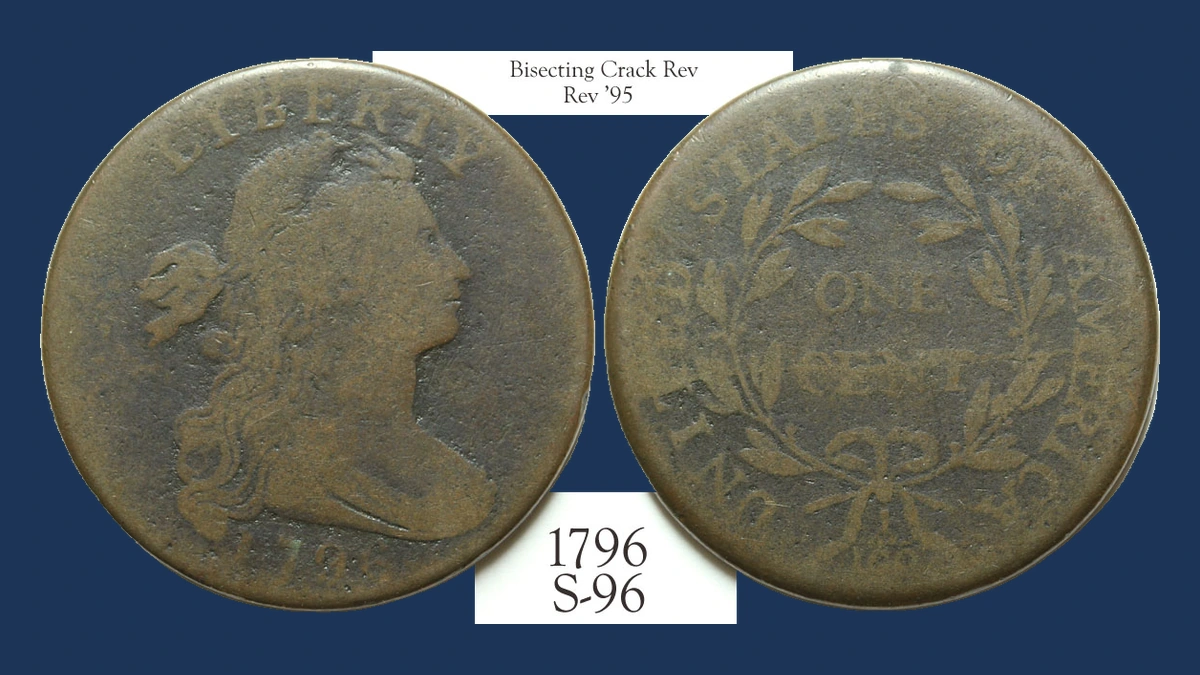
A narrow raised line can cross LIBERTY, while a larger raised patch may reach the rim above TY. Both can come from damage to a die, the steel tool that stamped the coin.
Cracks in that tool fill with copper during striking. If an edge section breaks away, the resulting raised patch is called a cud.
Another 1796 example has a crack through TES on the back and a retained break above it. The broken steel remained partly in place.
That retained section can still carry design details. It should not be rejected simply because its surface is not blank.
Estimated Value
Worn 1796 Draped Bust cents with tool cracks or breaks fit an estimated $300–$3,000 range. Scarcer varieties or attractive, better-preserved pieces can fit about $3,000–$15,000.
The broad front break above TY is documented on a PCGS VF30 example, with moderate wear. The retained back break occurs on a different VF30 coin.
These are not two prices to add to one cent. Buyers also consider the surviving design, surface problems, and how difficult that particular variety is to obtain.
How to Identify
To check a thin crack, move light across the line and use a 10× magnifier to see whether it rises above the copper. On the S-92 example, compare the bases of RTY and tops of BER.
A broad patch needs an edge view as well. Inspect the plain edge beside TY for a dent that could have pushed copper upward after minting.
The back-break example requires a different photograph, centered on TES. Follow its boundary and any surviving design within the shifted area.
A loose copper cent normally began near 10.89 grams and 28–29 millimeters. A scale and calipers can record those measurements without pressing a fragile edge.
Compare each raised feature with its own example rather than combining their different crack paths into one coin.
4. 1796 Draped Bust Cent Backward Wreath Impression on a Dateless Coin
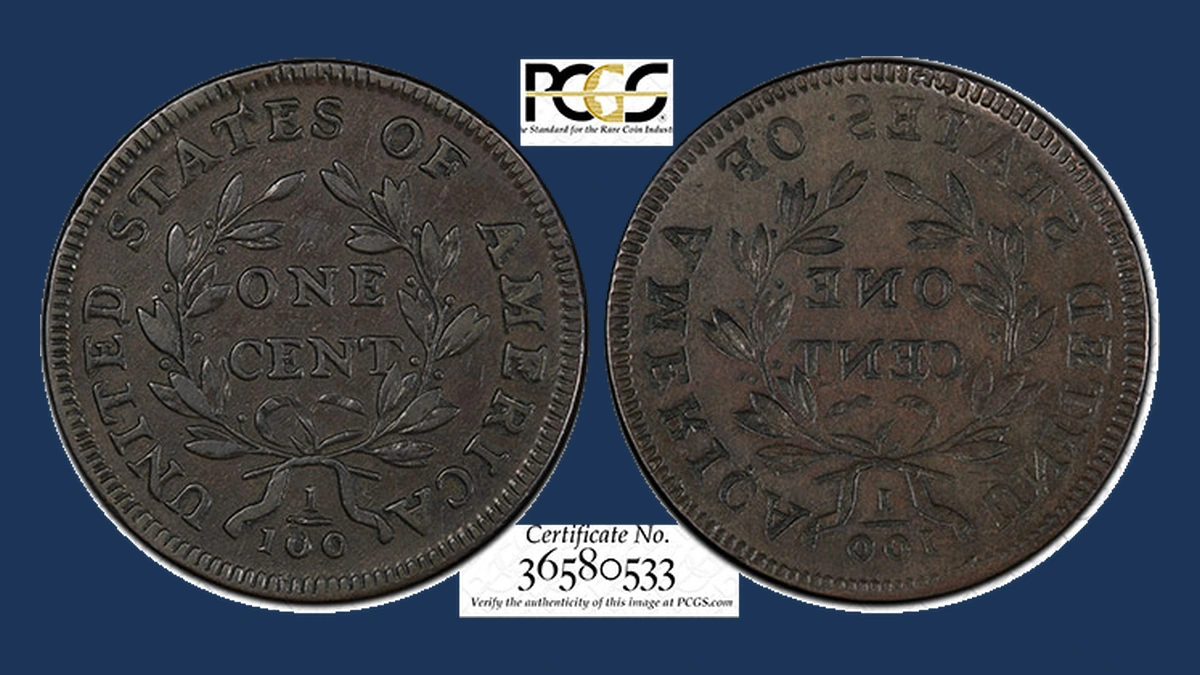
Neither face shows Liberty’s portrait or a date on this unusual cent. One has the normal wreath design, and the other carries a backward impression sunk into the copper.
The error is a brockage. A struck coin contacted another blank in the press and impressed its raised design into that blank.
The back’s design and a break at the second T in STATES connect this specimen to 1796 Draped Bust tooling. The year is identified from those features, not from visible date digits.
Two raised wreath designs would be a different situation. Here one design is distinctly sunken.
Estimated Value
For a convincing, identifiable reverse brockage of this type, estimate $4,000–$15,000. The complete impression and the ability to connect the dateless coin to known tooling matter to collectors.
PCGS describes this specimen in a VF35 holder, with light to moderate wear. It brought $5,280 at Heritage in December 2018.
That is an actual whole-coin sale, rather than a value assigned to an ordinary cent with a few extra lines. Other dateless brockages require their own identification.
How to Identify
Check the depth of ONE CENT before trying to assign a year. Under a 10× magnifier, one face should carry raised letters and the other backward letters pressed below the surface.
Compare the normal back with the Reverse of 1797 design used on some 1796 Draped Bust cents. Its second T in STATES needs the matching break; the general wreath alone is insufficient.
A safely handled loose example can be weighed on a scale against the usual 10.89 grams and measured with calipers against roughly 28–29 millimeters. Photograph the plain edge and both complete faces for a specialist, since no visible front date is available to settle the year.
5. 1796 Draped Bust Cent Forty-Percent Off-Center Strike
The date survives on a dramatic 1796 error even though most of LIBERTY missed the blank. Only its L remains, and Liberty’s facial features lie outside the struck copper.
The catalog describes a forty-percent shift toward the upper right. The coin was graded PCGS F12, with substantial wear but readable major details.
Its blank was out of position when the tools delivered the design. This left part of the intended image beyond the edge and an area of unstruck copper elsewhere.
The surviving date makes the coin easier to identify than an otherwise similar error without any numerals.
Estimated Value
Estimate $2,000–$8,000 for worn, clearly identifiable 1796 off-center cents, with stronger or better-preserved examples around $8,000–$20,000. No sale amount is assigned to the recorded forty-percent F12 specimen here.
For a different-year comparison, a thirty-percent off-center 1808 Classic Head cent described as AU55 brought $6,462.50 in February 2018. It had very light wear but no visible date.
The two coins differ in design, condition, and identification. A larger missing portion does not by itself guarantee a higher price.
How to Identify
Follow the complete 1796 date across the lower design, then inspect the surviving L above the portrait. These details help place the recorded forty-percent example correctly in a full photograph.
Use a 10× magnifier along the boundary where the struck design meets blank copper. Scraped-off letters or grinding lines can betray an altered normal coin.
Photograph the back without changing which physical edge is at the top. Its missing design should fit the same misplaced blank.
A loose blank originally weighed about 10.89 grams and measured roughly 28–29 millimeters. A scale and calipers record its current weight and outline.
Include the plain edge around the unstruck area to check for later cutting rather than assuming all missing design came from the press.
6. 1796 Draped Bust Cent The LIHERTY Letter-Punch Error
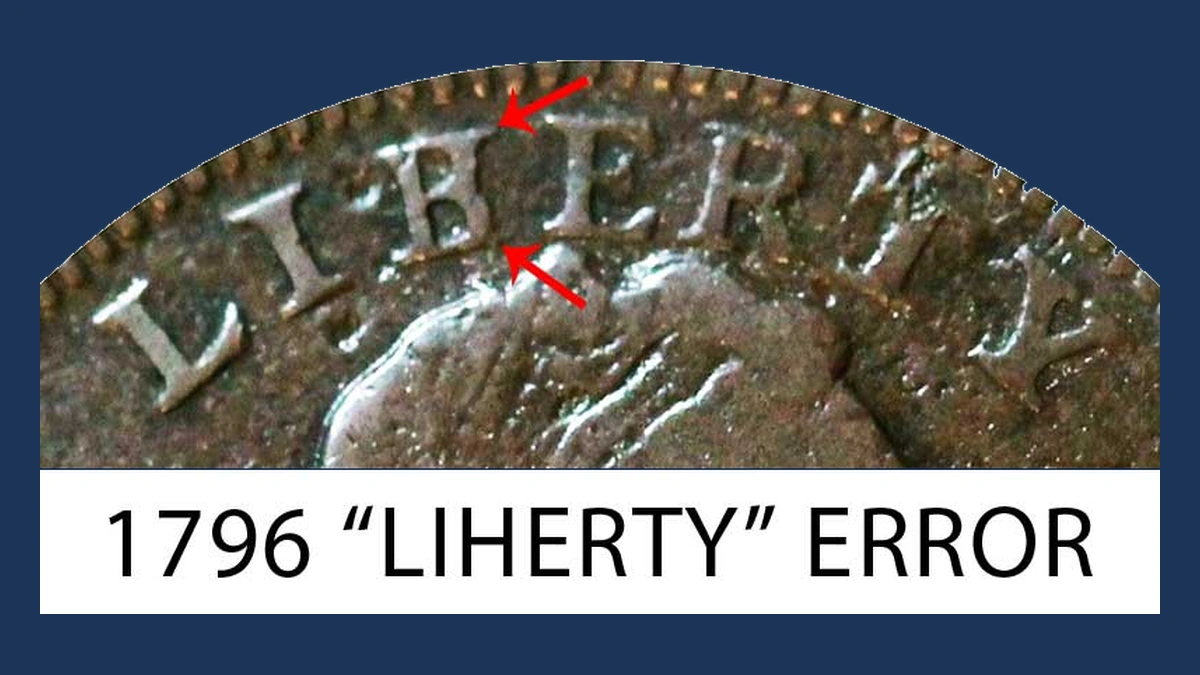
The word above Liberty can appear to read LIHERTY because its B looks unusual. The extra strokes came from an inverted B punched into the stamping tool and then corrected with an upright B.
It was not simply an H used in place of a B. The two B impressions overlap and can leave an H-like appearance on the coin.
Two cataloged varieties share this affected front tool while using different back designs. The letter error itself is the same feature.
Wear changes how clearly the overlapping strokes survive. A damaged B on another cent is not automatically this variety.
Estimated Value
Worn examples with a clear LIHERTY letter pattern fit an estimated $800–$6,000 range. Attractive pieces with more surviving detail can fit roughly $6,000–$20,000.
These are whole-coin estimates for the two back pairings, not a sale price for one specimen. The less available pairing and stronger condition can change the comparison substantially.
An H-like outline alone does not justify the premium. Buyers need the original overlapping-B pattern, the correct Draped Bust design, and copper surfaces that have not been reshaped.
How to Identify
Begin with the whole word LIBERTY under a 10× magnifier. Compare the unusual B with a known LIHERTY example rather than trying to match it to a normal printed H.
The two cataloged back pairings need separate wreath comparisons. A matching front letter does not mean every leaf and berry must match one photograph.
For a loose cent, a scale and calipers can check about 10.89 grams and 28–29 millimeters. Photograph the plain edge and full Draped Bust portrait along with the letter.
Finally, move a lamp across the B and its surrounding copper. Look for the overlapping curved strokes of two B punches, while checking for later cuts or smoothing that could reshape the letter.
7. 1796 Draped Bust Cent Repeated Clash Traces on the Two Faces
More than one faint outline can appear among the normal details when stamping tools clash repeatedly. Each contact can transfer parts of one design onto the other tool.
A later coin copies those extra marks. The process can repeat without the coin itself receiving several blows.
Heritage describes multiple sets of clash marks on both faces of the S-92 example with the doubled profile. Other 1796 Draped Bust varieties are also reported with clashes.
The number of faint lines does not establish the number of times a coin was struck. Tool contacts and repeated coin strikes are different events.
Estimated Value
Clashed 1796 cents in worn condition fit an estimated $300–$4,000 range, with attractive, lightly worn examples around $4,000–$25,000. Those amounts include the date, variety, and preservation of the whole coin.
The S-92 example discussed below has both clash marks and a doubled profile. Its auction result covers those features together, rather than assigning a separate amount to each.
Faint traces on rough copper can be difficult to appreciate. Clear transferred shapes and natural surfaces are more useful than counting lines.
How to Identify
Lay full front and back photographs beside each other and identify an extra outline that might belong to the opposite design. A 10× magnifier and low-angle light can reveal marks hidden by ordinary straight-on lighting.
Check the coin’s overall condition before interpreting those faint lines. On a loose example, a scale and calipers compare 10.89 grams and about 28–29 millimeters, while an edge photograph records the normal plain surface.
Now test the suspected outline against a turned or mirrored image of the opposite face. A scratch has no reason to reproduce a wreath leaf or portrait detail, and several transferred outlines do not prove several blows on this coin.
8. 1796 Draped Bust Cent Doubled Portrait Outline and Possible Second Strike
A broad second contour follows Liberty’s profile from the forehead almost to the chin on a recorded S-92 cent. Extra outlines also appear at RTY in LIBERTY.
Heritage argued that these separated features could reflect another strike on the front. The catalog presented that explanation as an interpretation, not a settled doubled-die classification.
A doubled die would be a stamping tool already carrying duplicated details. Repeated striking instead adds another impression while the coin is in the press.
The distinction matters even when both effects look doubled. The full set of surviving features must support the proposed cause.
Estimated Value
A worn 1796 cent with convincing repeated profile detail fits an estimated $500–$5,000 range. Strong, lightly worn examples can fit roughly $5,000–$25,000.
The PCGS AU55 specimen sold for $20,700 in February 2008. It combines the broad profile, doubled lettering, tool cracks, and clash marks on an attractive early cent.
That result is not a price for an isolated extra chin line. Neither does the sale settle which striking process produced the doubling.
How to Identify
Trace the second profile under a 10× magnifier from the forehead downward. Compare its spacing with the repeated strokes on RTY instead of judging the chin alone.
Tilt the coin to distinguish a rounded contour from a flat shelf beside the normal design. A shelf can result from movement during one blow and needs a different explanation.
Photograph the back as well, even though the published argument concentrates on the front. A specialist should consider what both faces preserve before deciding whether another strike occurred.
Use a scale and calipers on a loose example against 10.89 grams and about 28–29 millimeters, with a plain edge. Keep the profile, letters, and unedited full-coin views together so the diagnosis does not depend on one flattering crop.
Conclusion
Estimated whole-coin values for these 1796 Draped Bust examples range from $250–$25,000. Clear features, surface quality, and the particular coin variety all affect where a piece belongs.
Keep a raised crack separate from peeling copper, and check whether a repeated design is raised or sunk into the surface. A missing date may require matching the back’s tool marks.
When one cent carries several features, compare its complete sale price rather than adding a price for each mark.